
Geometric Coherence via Weighted Matching for 3D Heterogeneous Multi-Agent Reach-Avoid Games
Prajwal Vijay · N/A · 2026
Framework
N/A
License
N/A
Stars
N/A
Summary
We study assignment quality in 3D heterogeneous multi-agent reach-avoid games and identify a recurring failure mode of cardinality-only matching in geometrically structured scenarios, which we term \emph{Geometric Sprawl}.
Abstract Summary
Key Points
- We study assignment quality in 3D heterogeneous multi-agent reach-avoid games and identify a recurring failure mode of cardinality-only matching in geometrically structured scenarios, which we term \emph{Geometric Sprawl}.
- In these cases, multiple maximum-cardinality assignments are available, but some induce spatially incoherent pairings and inefficient pursuit trajectories.
- Building on the evasion-space framework of Yan et al.~\cite{yan2022}, we introduce a cardinality-first weighted sequential matching method in which the Hamilton--Jacobi--Isaacs interception value $z_I(s,j)$ is used as a secondary assignment weight.
- Each sequential stage is solved with a min-cost max-flow backend, while the unweighted baseline uses the same solver with the weight term removed.
- We evaluate both methods on a deterministic 35-scenario benchmark (7 families & 5 initialization variants) under two regimes: a diagnostic stationary-unmatched setting and a hybrid saddle-point setting with goal-directed unmatched evaders.
Problem Formulation
Consider a reach-avoid game with $N_{p}$ pursuers $\mathcal{P}=\{P_{1},\ldots,P_{N_{p}}\}$ and $N_{e}$ evaders $\mathbb{E}=\{E_{1},\ldots,E_{N_{e}}\}$ in $\mathbb{R}^{3}$. The goal region is $\Omega_{\text{goal}}=\{x\in\mathbb{R}^{3}\mid z\leq 0\}$ and the play region is $\Omega_{\text{play}}=\{x\in\mathbb{R}^{3}\mid z>0\}$.
All players are holonomic mass points with first-order kinematics [ 1 ] : where $u_{P_{i}}(t),u_{E_{j}}(t)\in\mathbb{S}^{2}$ are heading unit vectors and $v_{P_{i}},v_{E_{j}}\in\mathbb{R}^{+}$ are speeds.
Weighted Matching: Resolving Geometric Sprawl
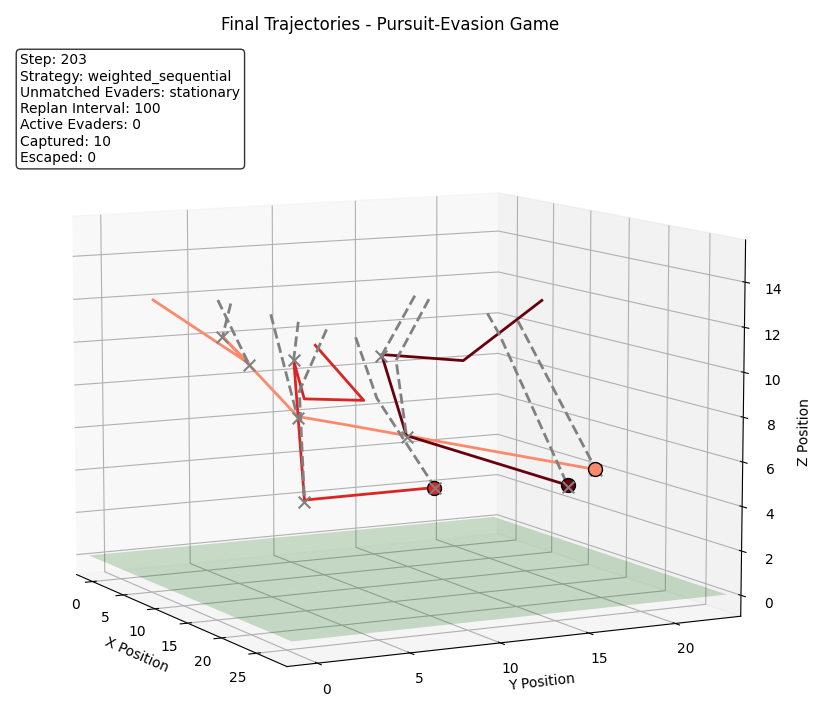
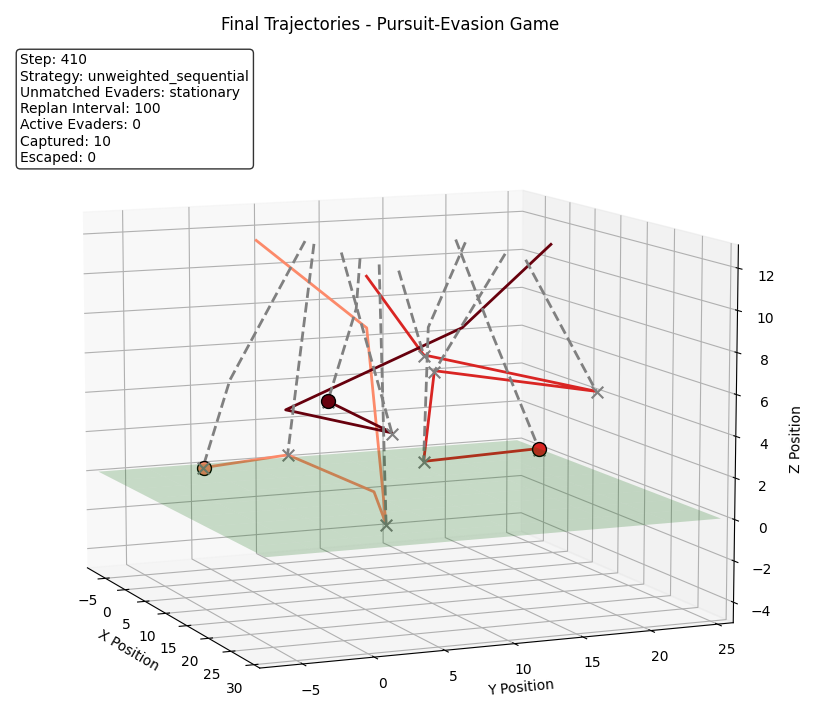
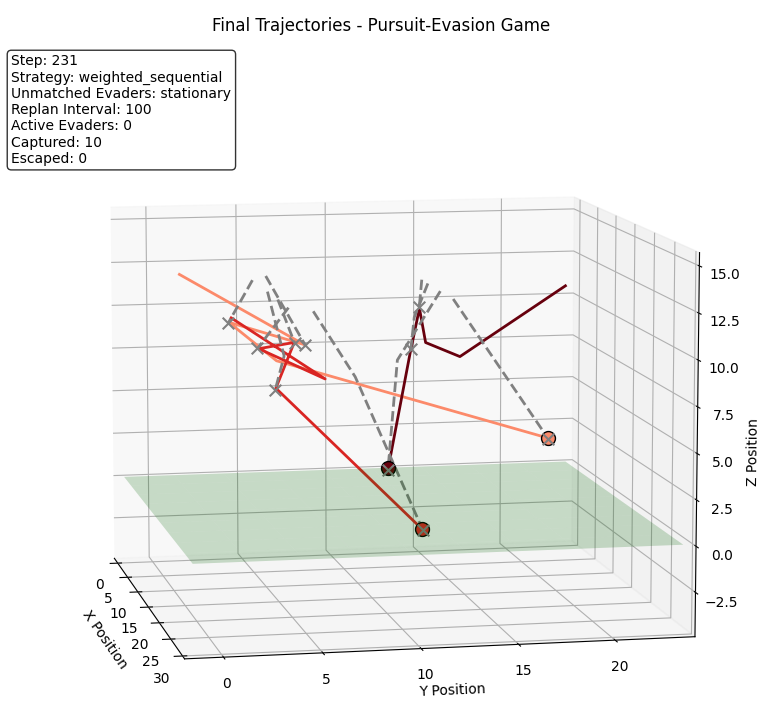
The SOTA formulation [ 1 ] maximizes only the number of captured evaders. A coalition intercepting an evader at $z=0.01$ above the goal plane is treated identically to one catching an evader at $z=7.0$—both count as one capture. This indifference to capture quality is acceptable when the assignment has a unique maximum-cardinality matching. It is catastrophic when many such matchings exist.
Simulation Framework and Benchmark Suite
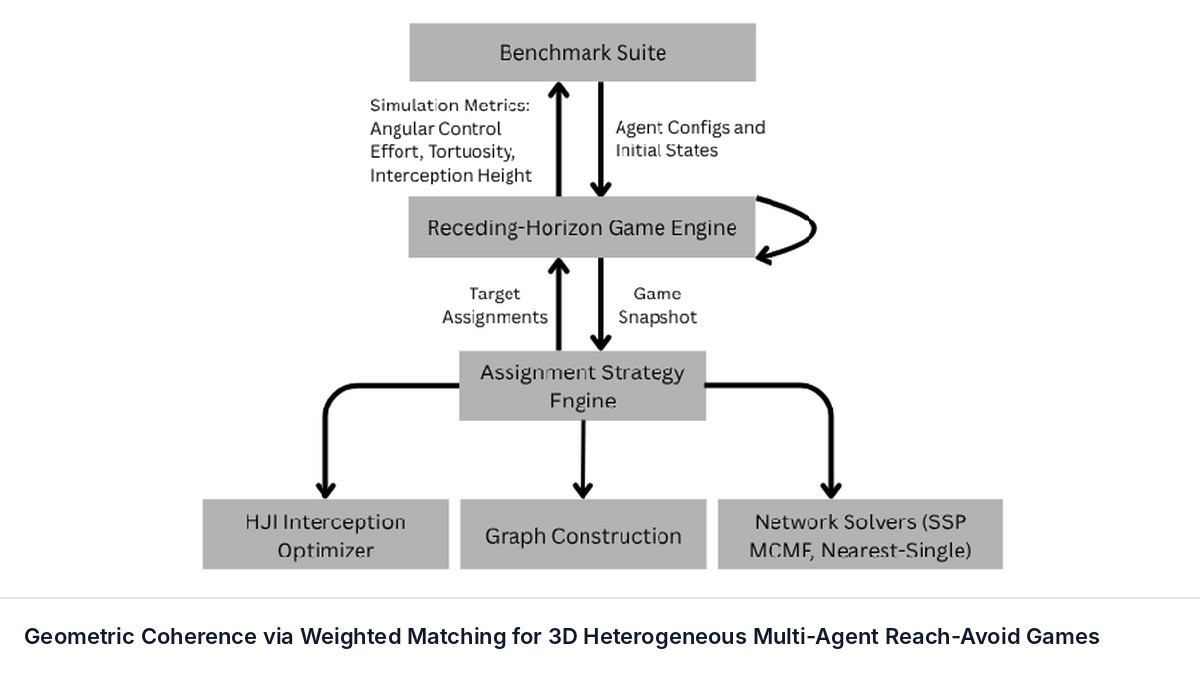
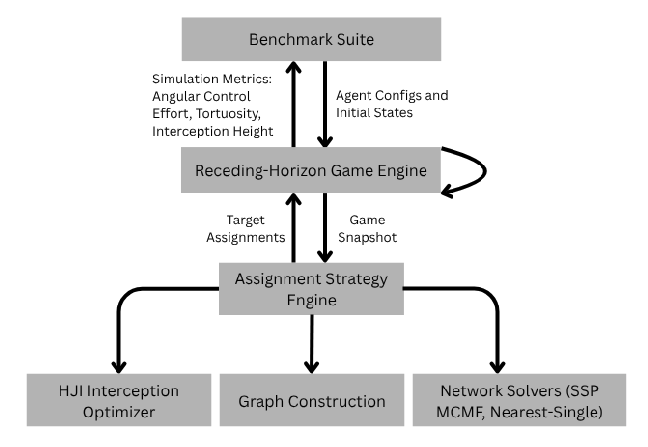
The simulation is implemented in Python, utilizing SciPy for sequential least squares programming (SLSQP) and Matplotlib for 3D visualization. To support reproducible ablation studies, the architecture is structured into three interacting tiers as depicted in figure 1 : Scenario & Evaluation Tier : Generates the 35-scenario deterministic benchmark suite.
It initializes heterogeneous agent configurations (speeds, capture radii) and logs fleet-wide telemetry, including path tortuosity and angular control effort ($J_{\theta}$).
Results
Performance metrics . We report steps to resolution and termination reason ( all_resolved vs. max_steps ), captured/escaped evader counts, mean interception height and two trajectory-quality metrics: path tortuosity $\tau=L_{\mathrm{path}}/L_{\mathrm{chord}}$ and angular-effort proxy In our first-order holonomic simulator, lower $\tau$ and $J_{\theta}$ indicate smoother and less aggressively turning trajectories.
Sources and Demonstrations
Figures are reproduced from Vijay See the full paper for experimental details and the project page, when the paper links one, for demonstrations and videos.
Related Papers
4D Radar Perception Algorithms for Autonomous Driving: A Review
Xumin Wu, Jun Zhou, Jilin Mei et al.
Research on 4D millimeter-wave radar perception algorithms has flourished in recent years, extending from signal processing and object detection to semantic segmentation, motion estimation, occupancy prediction, and dynamic scene reconstruction.
A Browser-Native Digital Test Range for Benchmarking 4D Ocean-Glider Planning Algorithms
Edward Holmberg, Elias Ioup, Mahdi Abdelguerfi
Repeated in-situ evaluation of ocean-glider planners requires scarce vehicles, operators, deployment and recovery resources, and ocean conditions that cannot be reset for competing algorithms.
A Mode-Unified, Continuous, and Biomimetic Control Strategy of a Robotic Lower Limb Prosthesis
Hanjun Kim, Sixu Zhou, John Shim et al.
Existing biomimetic lower-limb prosthesis controllers are commonly designed for discrete locomotion modes, requiring separate parameterizations for level walking, ramps, and stairs.
A Review Of Robotic World Models For Dynamic Environments Based On Factor And Scene Graphs
Marco Giberna, Miguel Fernandez-Cortizas, Jose Luis Sanchez Lopez et al.
Models based on graphs have emerged in robotics as a powerful foundation for internal world representations, where factor and scene graphs are among the most prominent model types found in the related literature and in successful robotic solutions.