
REACT: A Fully Spiking State-Space Model for Real-Time Event-Driven Temporal Perception
Geoffroy Keime, Nicolas Cuperlier, Benoit R. Cottereau · N/A · 2026
Framework
N/A
License
N/A
Stars
N/A
Summary
Robotic systems operating in dynamic environments require visual perception that evolves continuously with the incoming sensory stream.
Abstract Summary
Key Points
- Robotic systems operating in dynamic environments require visual perception that evolves continuously with the incoming sensory stream.
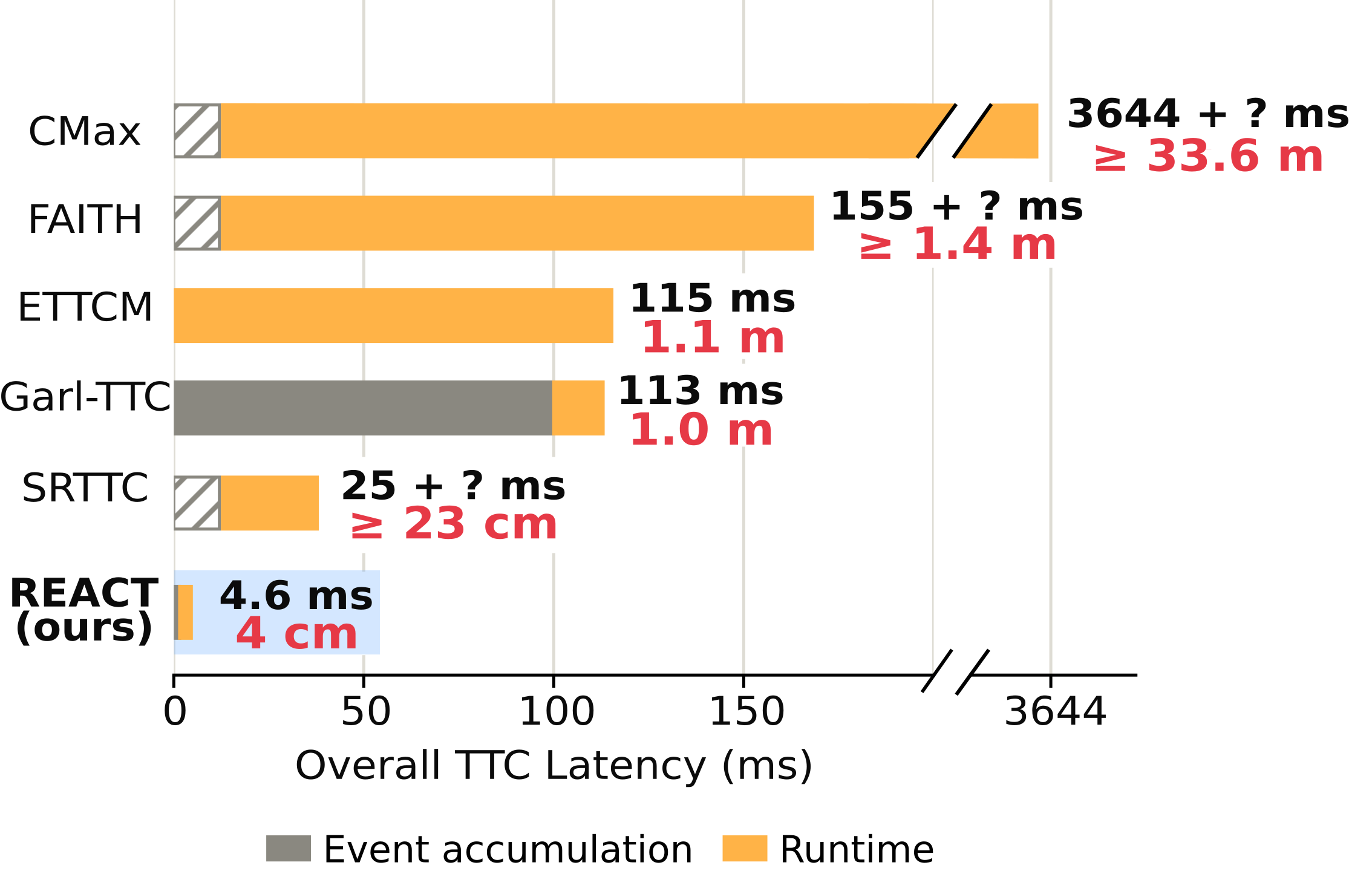
- Event cameras provide microsecond temporal resolution and asynchronous sensing, but most learning-based methods accumulate events into frames or temporal bins, introducing an integration delay that can limit fast reaction.
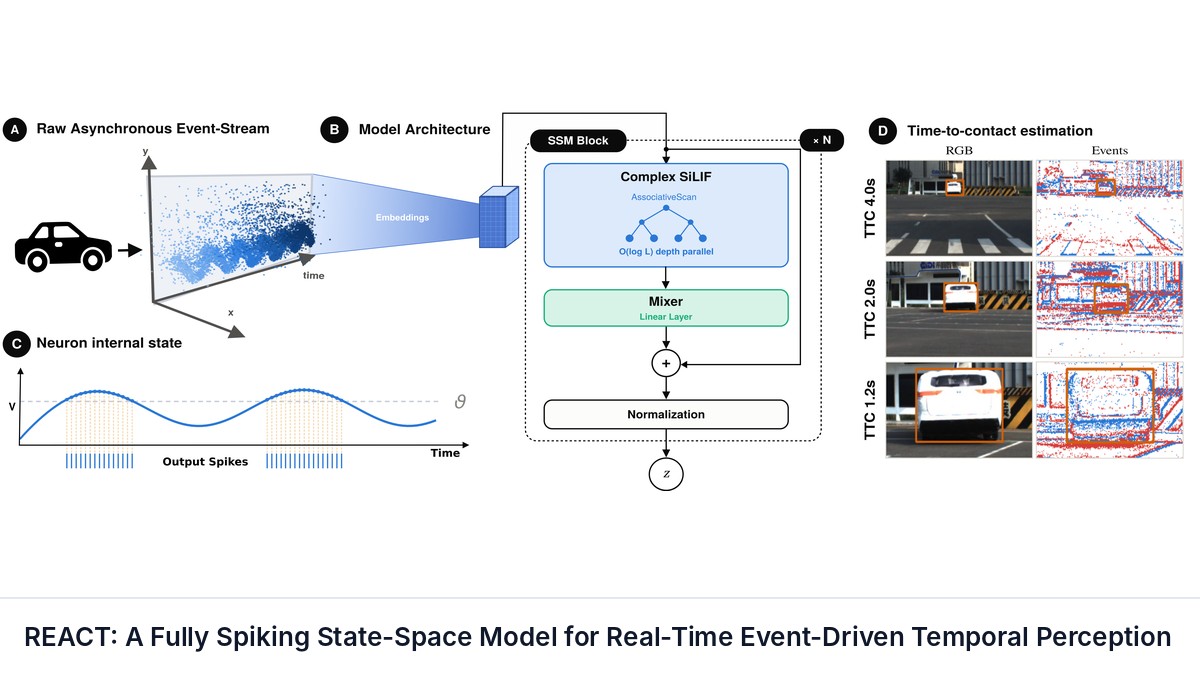
- Here we propose REACT, a fully spiking state-space model for event-driven temporal perception that processes raw events one by one, without temporal accumulation.
- REACT uses a complex-valued spiking neuron, C-SiLIF, whose continuous-time dynamics are driven by the physical inter-event interval, allowing its internal state to evolve at the temporal resolution of individual events.
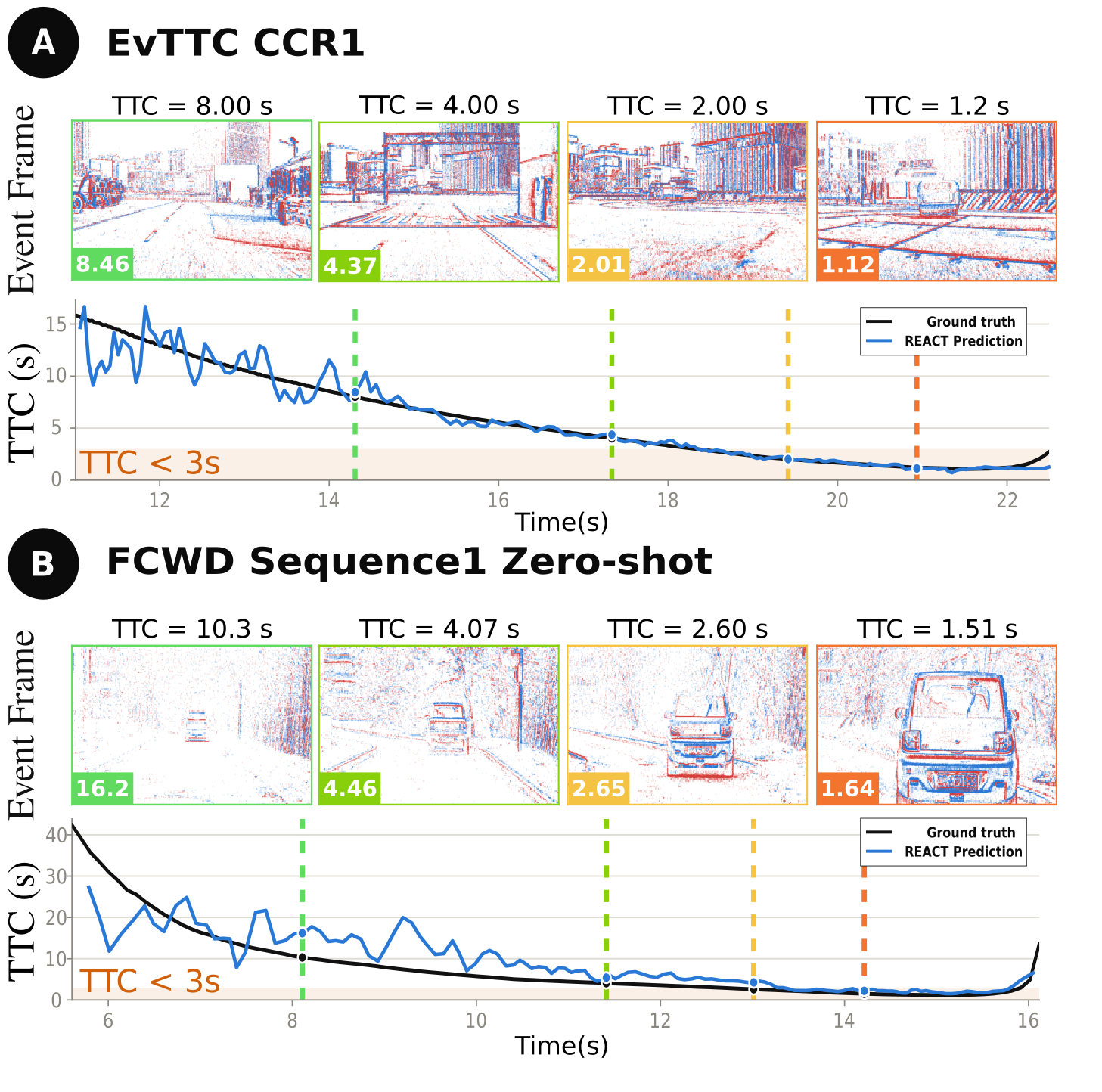
- We evaluate REACT on gesture recognition and time-to-collision (TTC) estimation from full-field event streams, without a target bounding box or localization input.
Methods
An event camera outputs an asynchronous stream of $L$ tuples $\mathcal{E}=\{(t_{k},x_{k},y_{k},p_{k})\}_{k=1}^{L}$, where $t_{k}$ is the timestamp, $(x_{k},y_{k})$ the pixel coordinate on an $H\times W$ sensor, and $p_{k}\in\{0,1\}$ the polarity of the brightness change. Most learning-based pipelines first accumulate this stream into frames, voxel grids, or fixed time bins.
REACT consumes it directly: no event representation is constructed at any stage, and the model state is updated once per event.
Experiments
We first evaluate the architecture on a standard neuromorphic classification benchmark, before turning to the continuous temporal prediction task of Sec. IV-B . DVS128-Gesture is the benchmark on which Event-SSM and its compute-in-memory counterpart both report results, so it measures whether a fully spiking SSM reaches the accuracy of comparable event-by-event models at a much smaller cost.
Sources and Demonstrations
Figures are reproduced from Keime et al. See the full paper for experimental details and the project page, when the paper links one, for demonstrations and videos.
Related Papers
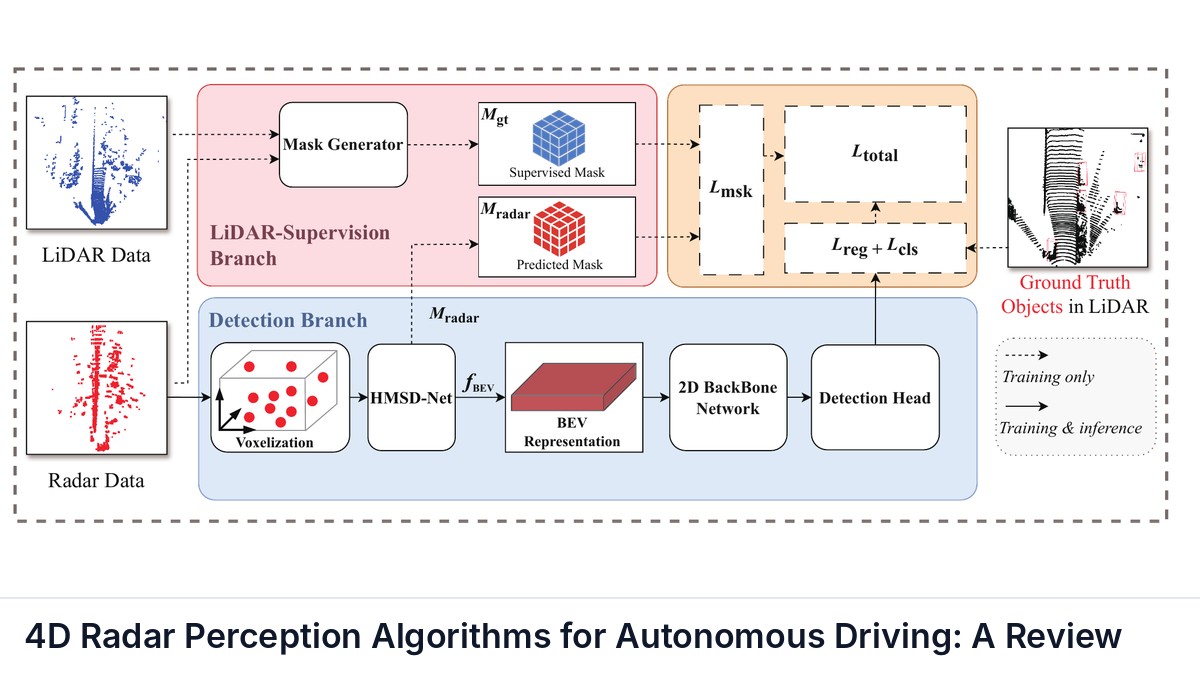
4D Radar Perception Algorithms for Autonomous Driving: A Review
Xumin Wu, Jun Zhou, Jilin Mei et al.
Research on 4D millimeter-wave radar perception algorithms has flourished in recent years, extending from signal processing and object detection to semantic segmentation, motion estimation, occupancy prediction, and dynamic scene reconstruction.
A Review Of Robotic World Models For Dynamic Environments Based On Factor And Scene Graphs
Marco Giberna, Miguel Fernandez-Cortizas, Jose Luis Sanchez Lopez et al.
Models based on graphs have emerged in robotics as a powerful foundation for internal world representations, where factor and scene graphs are among the most prominent model types found in the related literature and in successful robotic solutions.

A Sim-to-Real Integration Pipeline for Training and Deployment of Chunk-Based VLA Manipulation Policies
Mathilde Kappel, Clémence Grislain, Mohamed Chetouani et al.
Vision-Language-Action (VLA) models have become a prominent paradigm for mapping multimodal inputs, including semantic instructions, visual observations of the scene, and proprioceptive observations, to robot actions.
Aim Short to Reach Far: Your Frozen World Model Can Plan Better Than You Think
Xvyuan Liu, Jianjie Fang, Chen Gao et al.
Planners built on visual world models commonly score each predicted outcome by its distance to the encoded goal image. We show that this target can limit control even with exact dynamics and globally optimal short-horizon search: reaching a goal may require actions that initially move away from it.