
DITTO: Dexterous Interface for Transparent TeleOperation
Joaquin Palacios, Katelyn Lee, Cheng Zhang, Zhanpeng He, Matei Ciocarlie · N/A · 2026
Framework
N/A
License
N/A
Stars
N/A
Summary
Collecting data for manipulation with high-DOF hands is challenging, as interfaces must capture rich hand motion while rendering the contact interactions essential for precise manipulation.
Abstract Summary
Key Points
- Collecting data for manipulation with high-DOF hands is challenging, as interfaces must capture rich hand motion while rendering the contact interactions essential for precise manipulation.
- Existing data collection approaches face a trade-off: teleoperation ensures deployment consistency but lacks force feedback, while handheld (in-the-wild) systems provide natural force transparency but introduce a visual embodiment gap at deployment.
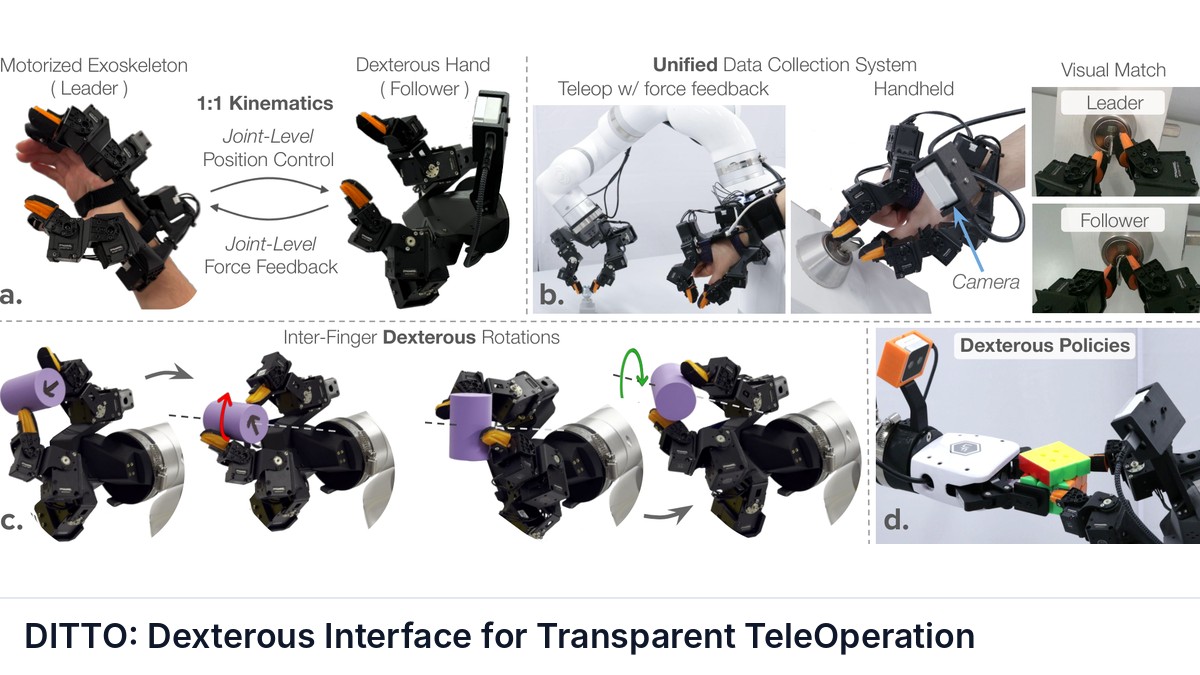
- We present DITTO, a Dexterous Interface for Transparent TeleOperation, which resolves this through the anatomically informed co-design of a dexterous 7-DOF robotic hand and a kinematically equivalent motorized exoskeleton.
- A 1-to-1 actuator mapping between the exoskeleton and robotic hand enables handheld (in-the-wild) data collection and bilateral teleoperation with joint-level force feedback unified in a single platform.
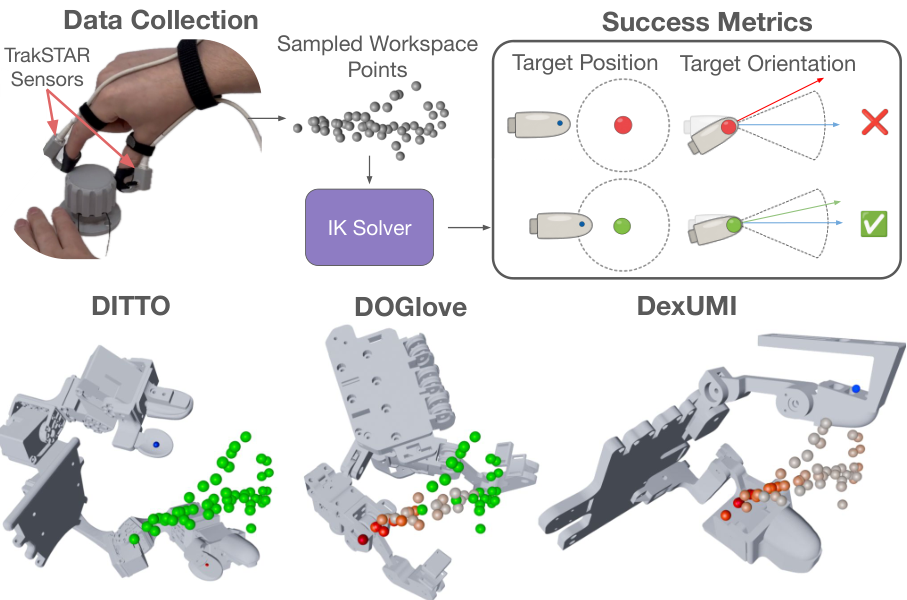
- We demonstrate that the DITTO exoskeleton spans the operator's natural index-to-thumb workspace, and showcase DITTO's dexterous capabilities via learned policies on contact-rich tasks.
DITTO Hardware Design
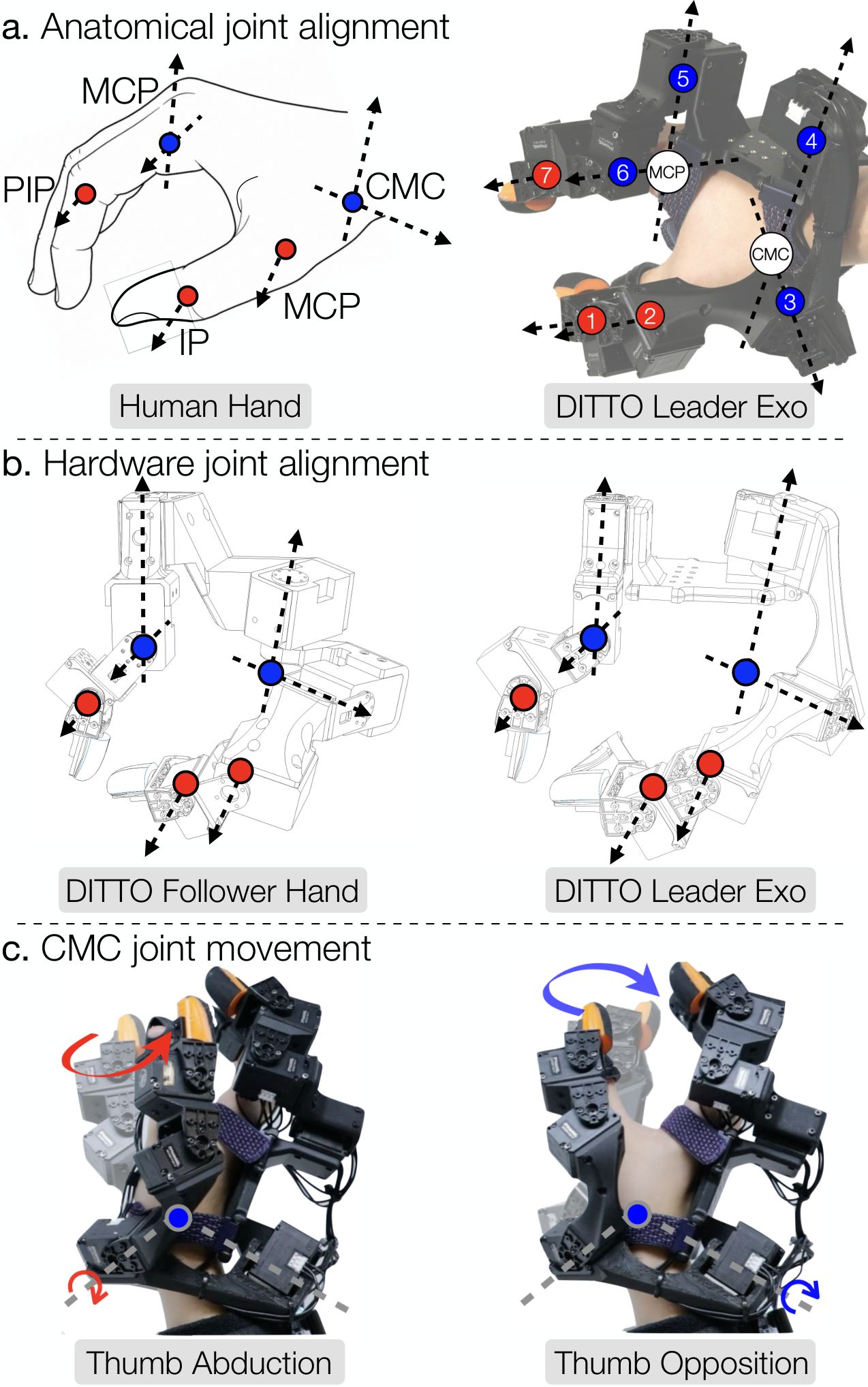
DITTO aims to bridge the fundamental trade-off between kinematic and force transparency in teleoperation by co-designing a dexterous 7-DOF hand and a kinematically equivalent motorized wearable exoskeleton. This leader-follower system has a 1:1 actuator mapping, where every motor on the follower hand corresponds to a motor on the leader exoskeleton.
This concept has been demonstrated for arm teleoperation [ 13 , 14 ] but not for high-DOF hands in a wearable form factor.
User Study: Dexterous Data Collection
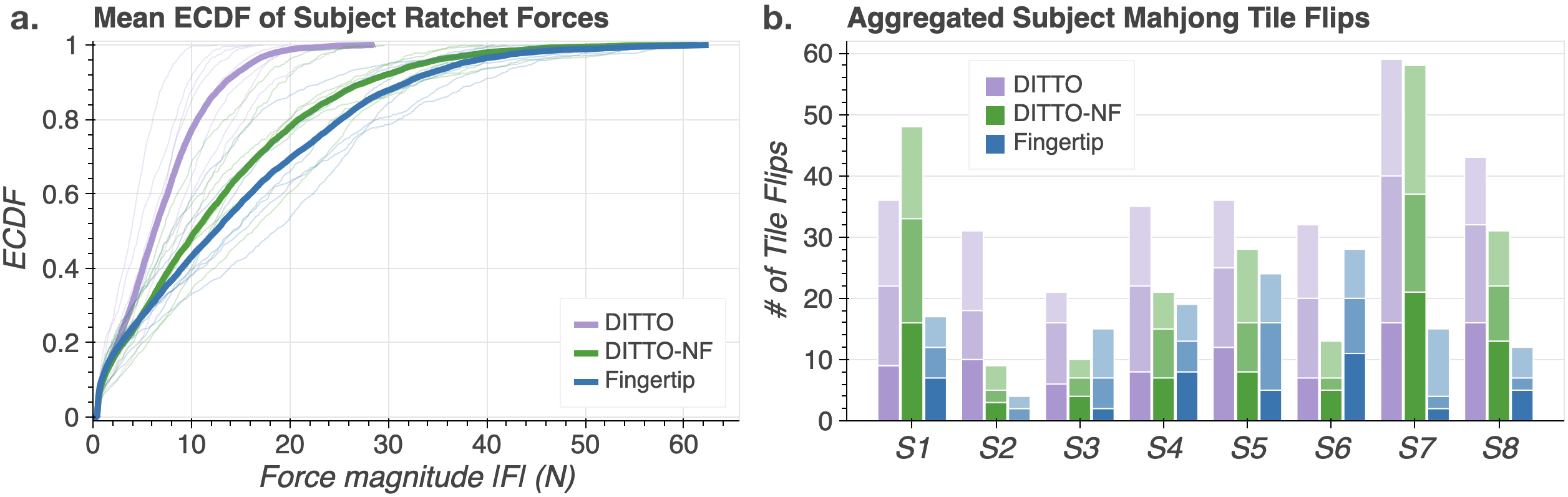
When used in leader-follower teleoperation mode, DITTO aims to provide active force feedback while still allowing rich tip-to-tip movement for dexterous tasks. To assess the importance of these features, we conducted a user study ($n=8$) comparing DITTO teleoperation against two ablations and across two tasks that require coordinated fingertip dexterity and force regulation.
We compare three teleoperation conditions : DITTO exoskeleton: leader-follower teleoperation using DITTO exoskeleton with force feedback enabled.
Kinematic Workspace Analysis
Matching human index-to-thumb dexterity is a key design goal for DITTO providing two important benefits. First, from the perspective of the DITTO leader (a wearable exoskeleton), a human-like workspace removes constraints on the teleoperator’s hand to allow natural and intuitive movement without pressure points.
Second, from a follower perspective, human-like tip-to-tip movement implies high dexterity, since the human hand can perform complex manipulation with just index-to-thumb grasps exclusively.
Policy Learning Results
Finally, we evaluate weather DITTO data-collection enables autonomous policies for tasks requiring use of the intrinsic hand DOFs, as well as regulation of contact forces with the environment. We test these abilities for both data collection modes offered by DITTO, teleoperation and handheld, as well as combined datasets from both paradigms.
For the autonomous policies, we use standard Diffusion Policies with a Transformer Architecture [ 17 ] using the relative pose representation from [ 18 ] .
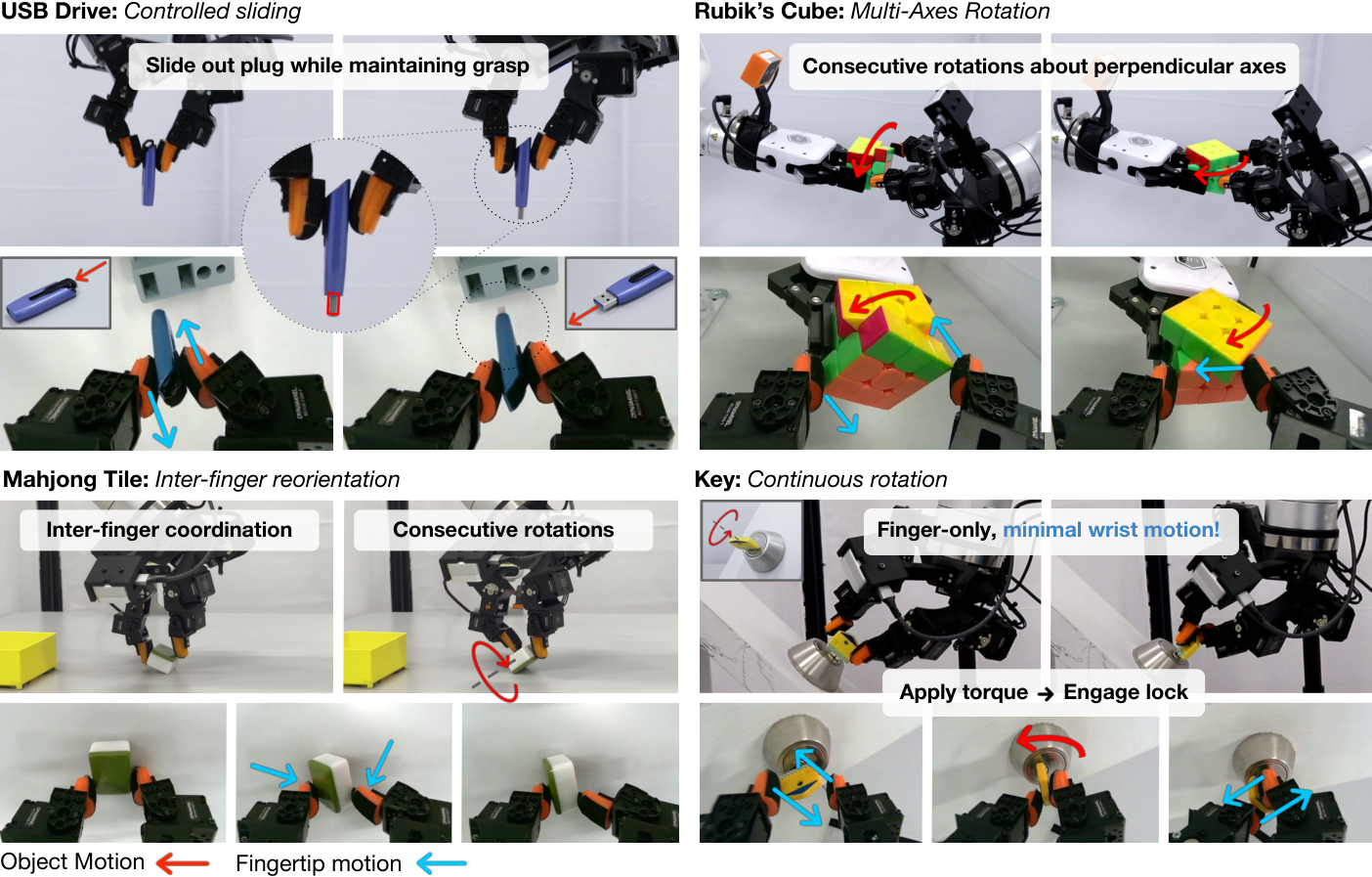
Sources and Demonstrations
Figures are reproduced from Palacios et al. See the full paper for experimental details and the project page, when the paper links one, for demonstrations and videos.
Related Papers

A Sim-to-Real Integration Pipeline for Training and Deployment of Chunk-Based VLA Manipulation Policies
Mathilde Kappel, Clémence Grislain, Mohamed Chetouani et al.
Vision-Language-Action (VLA) models have become a prominent paradigm for mapping multimodal inputs, including semantic instructions, visual observations of the scene, and proprioceptive observations, to robot actions.

AXIS: A Growable Community-Driven Data Engine for Scalable Robot Manipulation
Mengfei Zhao, Dihong Huang, Yikai Tang et al.
Learning effective robot manipulation policies requires diverse, high-quality demonstrations, yet existing data pipelines are often difficult to scale because they rely on specialized hardware, centralized operators, or fixed task suites.

Capability-Aware Arbitration for Semantic Intent-Based Shared Control
Zhaoda Du, Michael Bowman, Xiaoli Zhang
Shared control often allocates robot authority based on confidence in inferred human intent, assuming reliable autonomous execution. When this assumption fails, high intent confidence can cause over-helping.
Design and Evaluation of a Touchscreen-Based Teleoperation Interface for Robotic Manipulators
Juan José García Cárdenas, Alperen Kenan, Hamidreza Raei et al.
Intuitive teleoperation interfaces are crucial for the safe and effective operation of robotic manipulators in challenging environments.