
Residual Fault Adaptation for Dexterous In-Hand Manipulation Under Runtime Joint Faults
Linan Deng, Xing Liu, Lin Hong, Feng Hua, Guijun Ma, Zuogong Yue, Fumin Zhang · N/A · 2026
Framework
N/A
License
N/A
Stars
N/A
Summary
Dexterous in-hand manipulation requires coordinated control of multiple actuated joints, and a runtime joint fault can abruptly disrupt the contact configuration required for successful manipulation.
Abstract Summary
Key Points
- Dexterous in-hand manipulation requires coordinated control of multiple actuated joints, and a runtime joint fault can abruptly disrupt the contact configuration required for successful manipulation.
- In this work, we propose residual fault adaptation (RFA), a teacher-anchored framework for compensating for hidden command-channel faults.
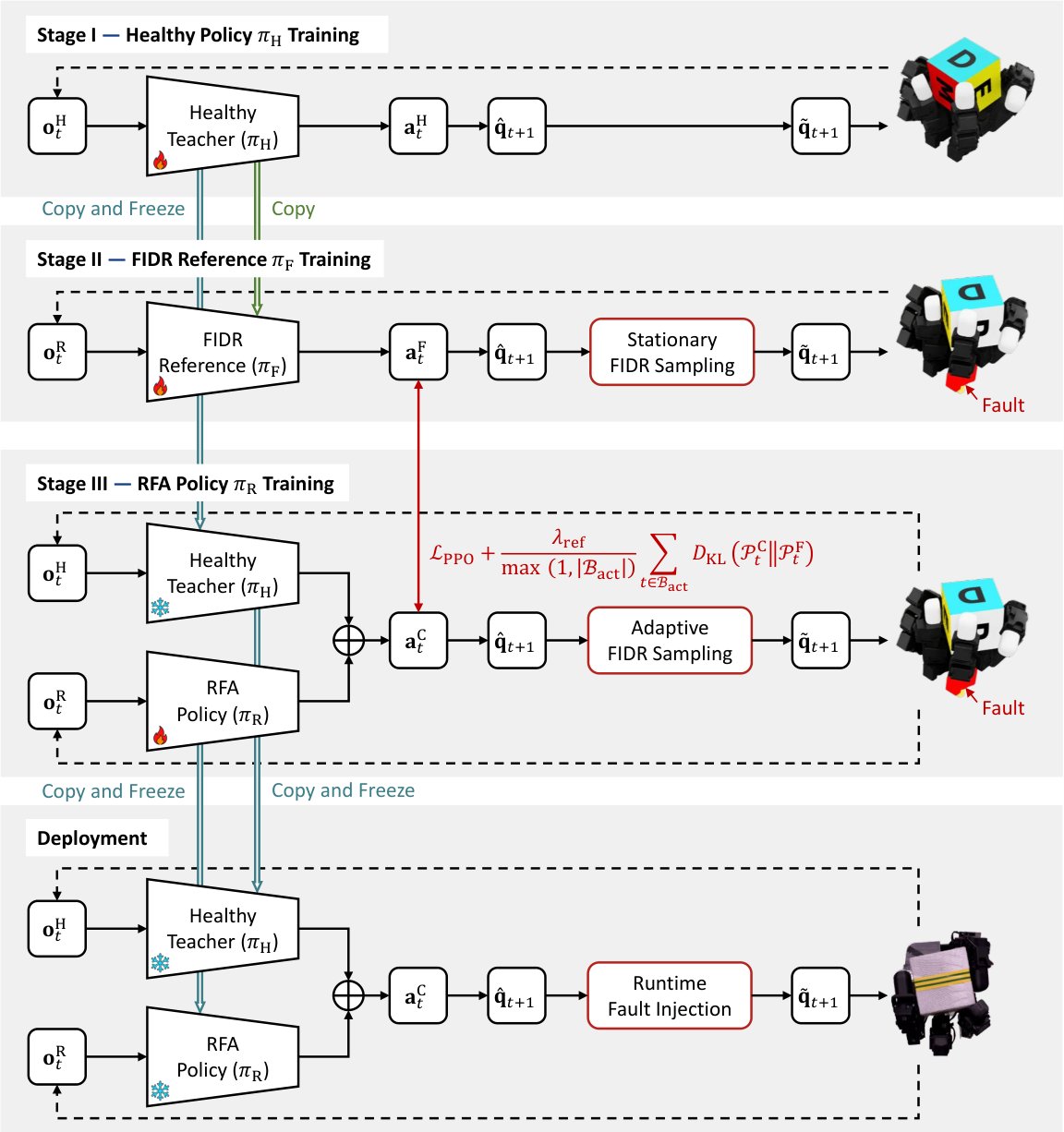
- RFA retains a frozen healthy teacher to provide nominal behavior and trains a recurrent residual policy to infer corrective actions from proprioceptive and command-response history.
- During training, fault-injection domain randomization (FIDR) varies the fault mode, affected joint, severity, and onset time, while adaptive sampling increases the frequency of fault modes associated with lower recent performance.
- A frozen Direct FIDR policy provides a distributional reference only on fault-active training samples and is absent from deployment.
Residual Fault Adaptation
Overview of RFA during training and deployment is shown in Fig. 1 , which summarizes the separation between training-only fault variables and deployed information. Training proceeds in three stages: healthy-policy pretraining, Direct FIDR reference training, and residual-policy training, with the corresponding components detailed in the following subsections.
Fault injection and adaptive sampling operate outside the controller, which receives only proprioceptive and command-response history.
Experiments
RFA is evaluated under matched simulation protocols and in a targeted physical study using a LEAP Hand. The simulation experiments quantify healthy and post-onset task-level outcomes under the fixed mixed-fault protocol and include fault-mode, mechanism, and severity analyses. The physical study characterizes command realization, joint responses, and object rotation.
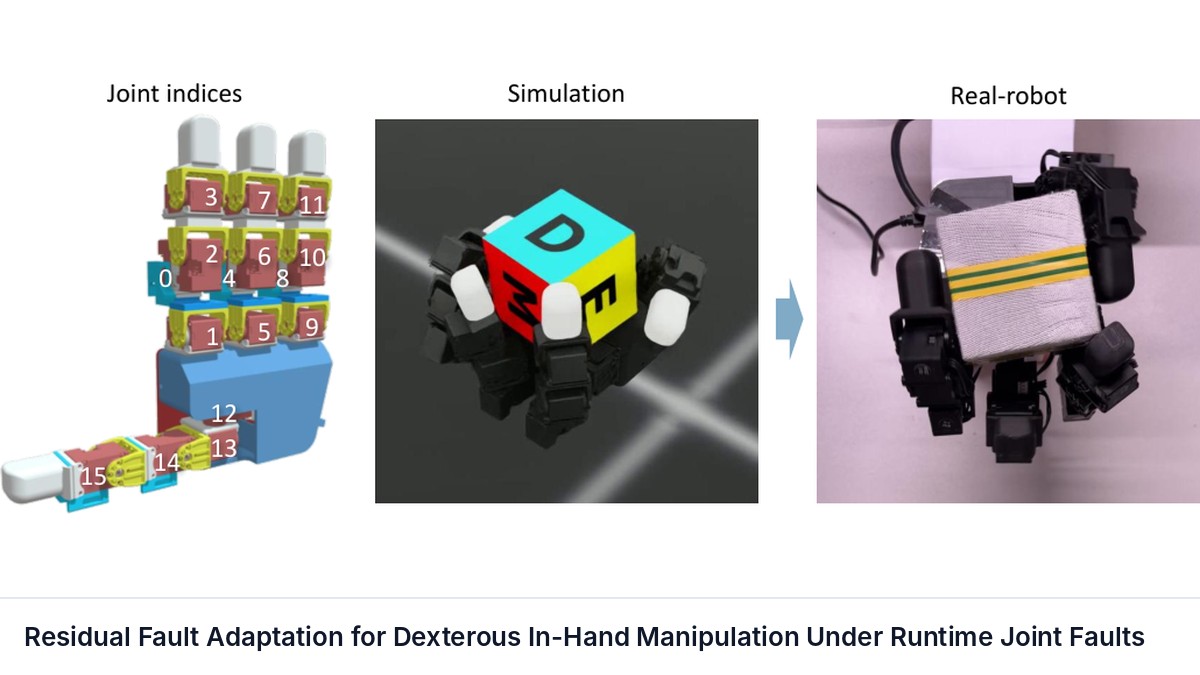
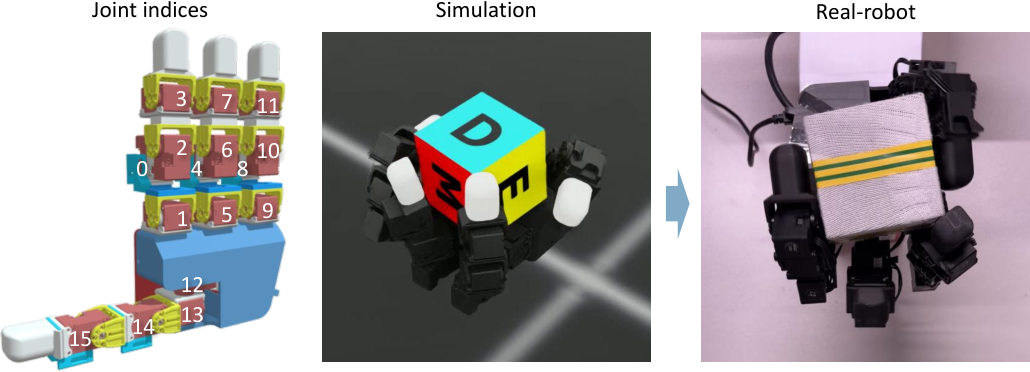
The simulation experiments use a 16-DoF LEAP Hand in Isaac Lab to rotate the DexCube about the world $z$-axis. Fig.
Sources and Demonstrations
Figures are reproduced from Deng et al. See the full paper for experimental details and the project page, when the paper links one, for demonstrations and videos.
Related Papers
A Balanced Data Diet: Addressing the Exploration Bottleneck in Mega-Scale RL for Robot Control
Octi Zhang, Mateo Guaman Castro, Patrick Yin et al.
General-purpose robots must perform a wide range of tasks from agile locomotion to dexterous manipulation.

A Sim-to-Real Integration Pipeline for Training and Deployment of Chunk-Based VLA Manipulation Policies
Mathilde Kappel, Clémence Grislain, Mohamed Chetouani et al.
Vision-Language-Action (VLA) models have become a prominent paradigm for mapping multimodal inputs, including semantic instructions, visual observations of the scene, and proprioceptive observations, to robot actions.
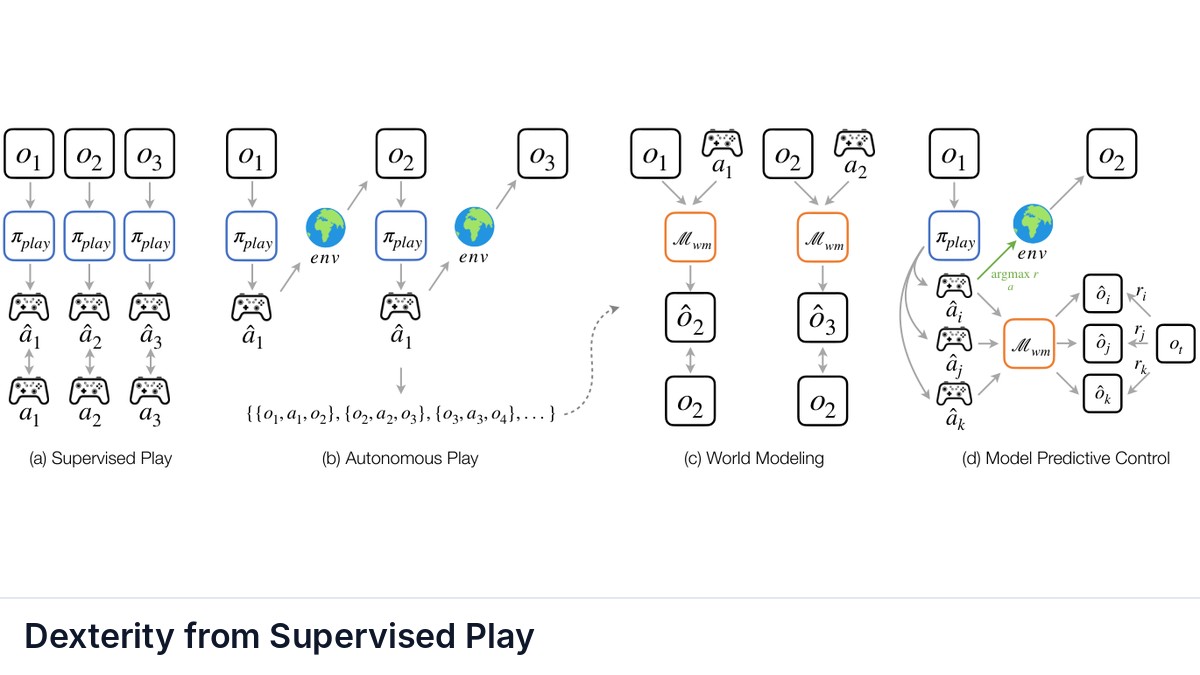
Dexterity from Supervised Play
Botao He, Yiming Dou, Yiannis Aloimonos et al.
How can robots autonomously collect the contact-rich experience needed to learn dexterous manipulation?
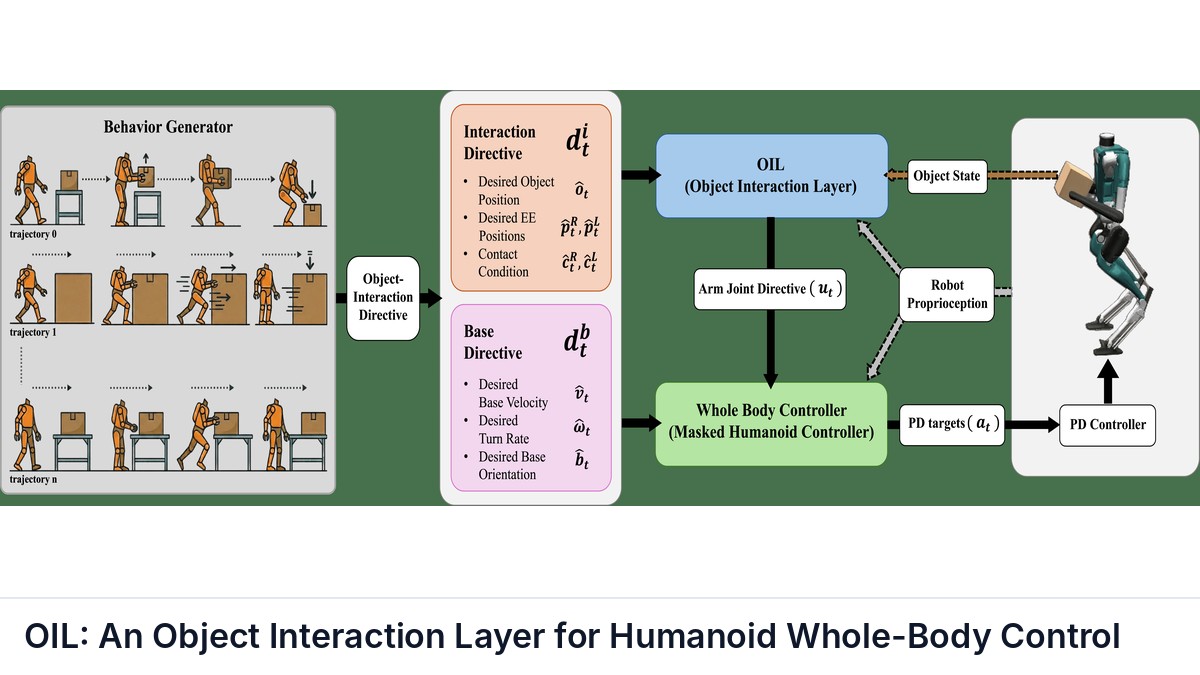
OIL: An Object Interaction Layer for Humanoid Whole-Body Control
Pranay Dugar, Mohitvishnu S. Gadde, Rajesh Mangannavar et al.
Recent progress in learned whole-body controllers for humanoid robots has enabled robust free-space motion by tracking kinematic targets such as joint or end-effector trajectories.