
PHIRL: Aligning Learned Rewards with Task Progress for Inverse Reinforcement Learning
Hang Yu, James Staley, Cheng Xi Tsou, Xiujin Liu, Wenchang Gao, Jindan Huang, Shijie Fang, Zhegong Shangguan, Angelo Cangelosi, Reuben Aronson, Elaine Short · N/A · 2026
Framework
N/A
License
N/A
Stars
N/A
Summary
Human demonstrations provide dense policy-level information but sometimes lack local precision. Human feedback presents accurate local critiques, but offers sparse evaluations rather than direct policy guidance.
Abstract Summary
Key Points
- Human demonstrations provide dense policy-level information but sometimes lack local precision
- Human feedback presents accurate local critiques, but offers sparse evaluations rather than direct policy guidance.
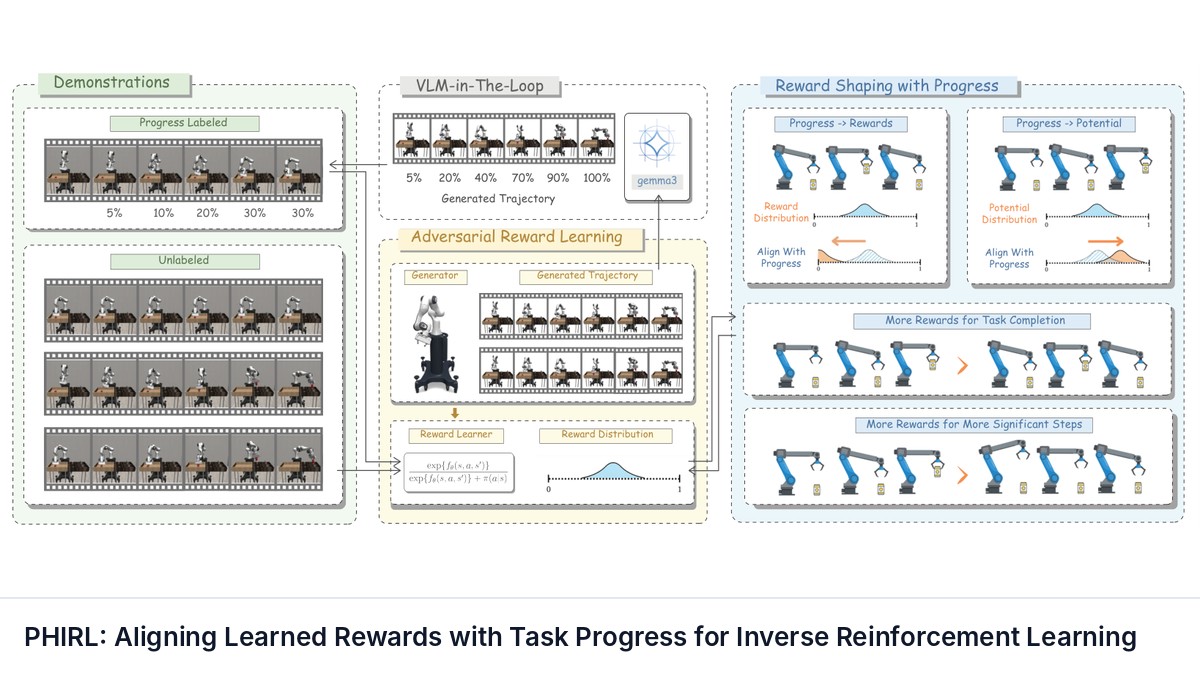
- We propose Progress-Heuristicized Inverse Reinforcement Learning (PHIRL), a data-efficient framework that learns robust reward functions by jointly leveraging demonstrations and feedback.
- Specifically, we use progress, a feedback modality that describes cumulative task completion
- PHIRL iteratively infers a reward function from demonstrations via inverse reinforcement learning, calculates the learned rewards over the progress-annotated demonstrations, and aligns the rewards with progress annotations over four dimensions.
Methodology
Our goal is to effectively learn robust reward functions. As previously mentioned, human demonstrations can be combined with human feedback to improve learning efficiency. Our work is built on the key insight that rewards inferred from a set of demonstrations should be consistent with the feedback on the same set of demonstrations. We use a numerical human feedback form, progress [ 20 ] for reward function alignment.
Progress is a signal that describes the cumulative degree of task completion, ranging from fully incomplete to fully complete.
Experiments and Results
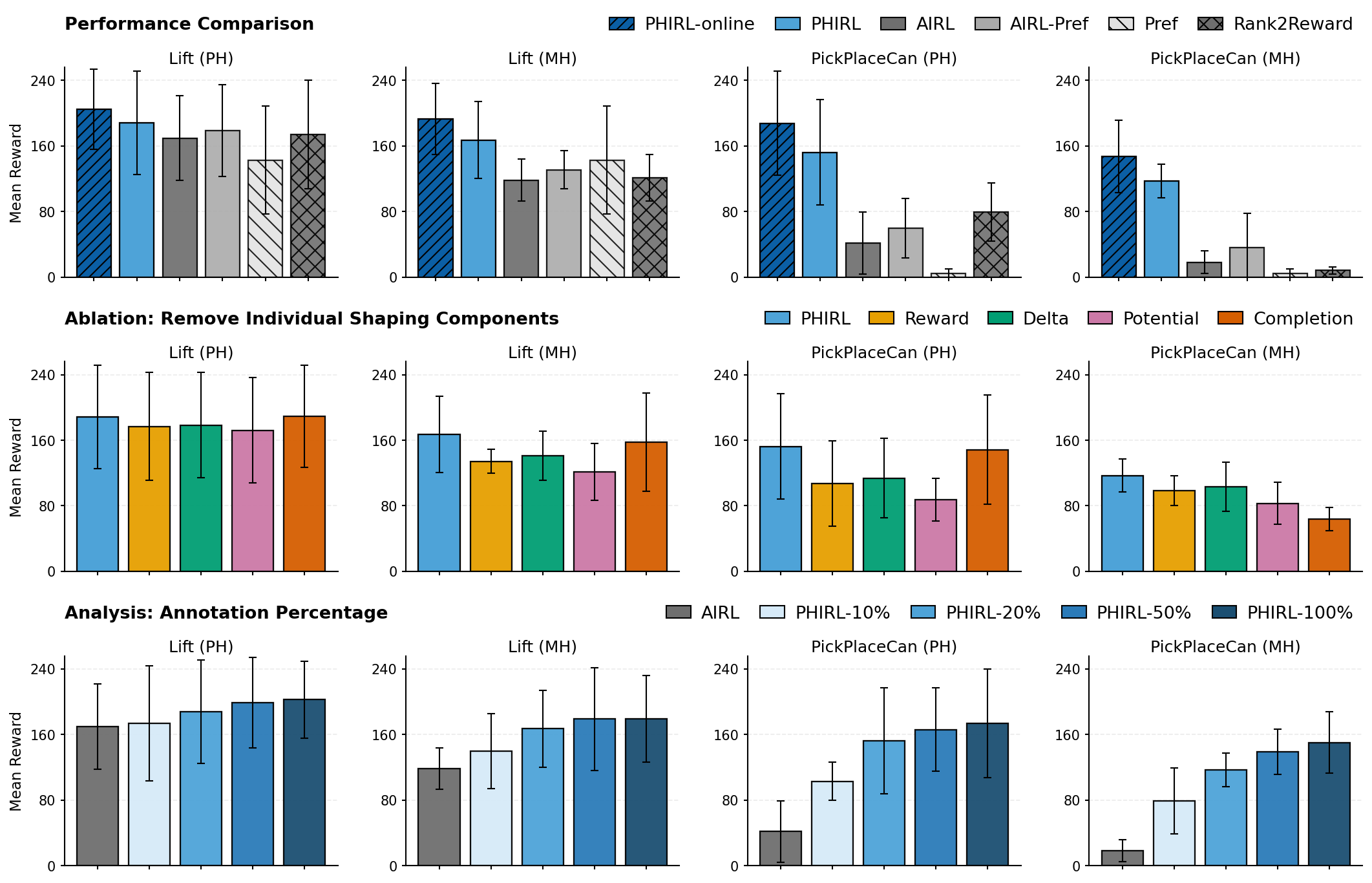
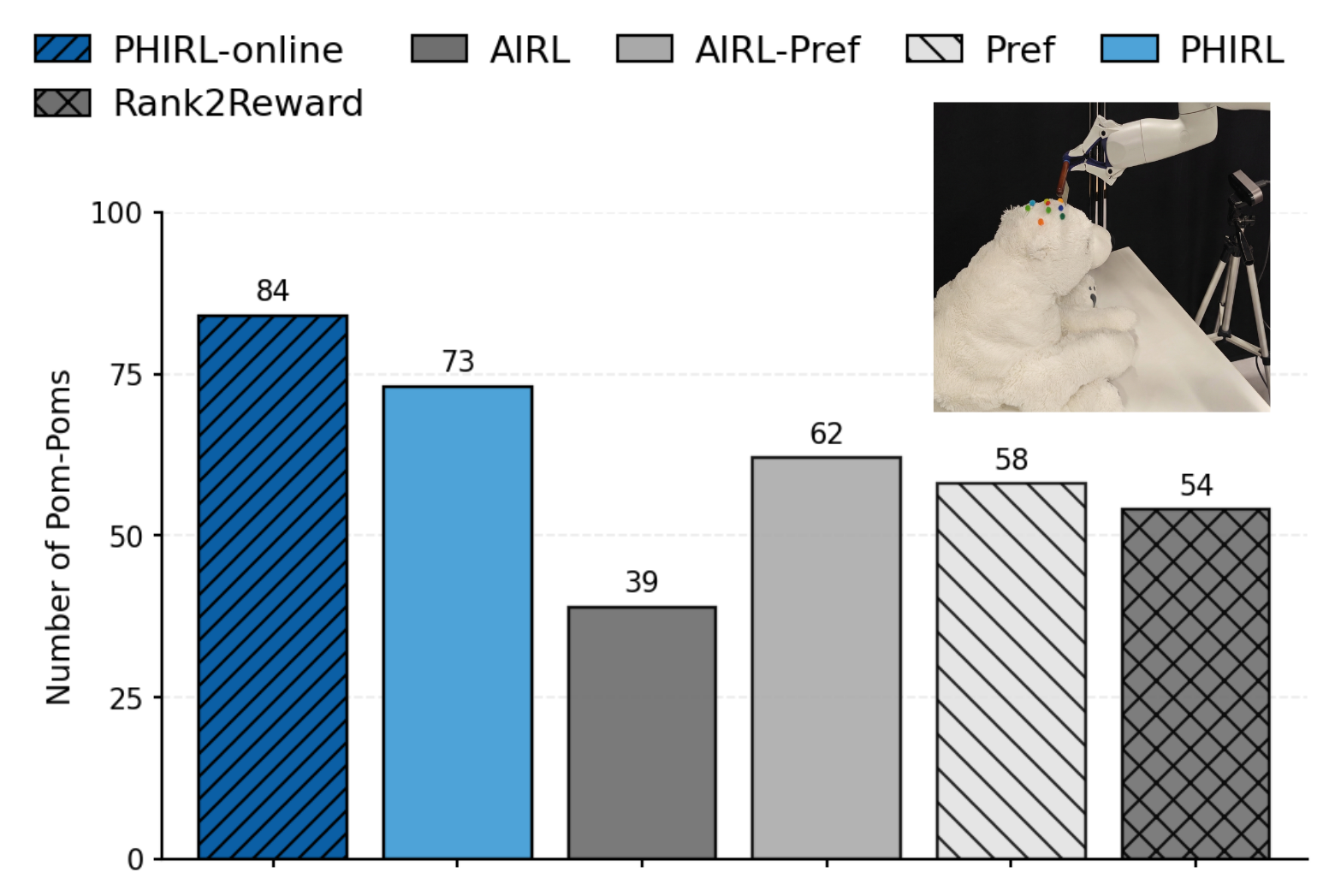
In this section, we run PHIRL with four baselines using one task with a real robot and two tasks from Robosuite [ 21 ] to validate PHIRL’s performance and our claimed contributions. In addition, we demonstrated that the reward functions learned by PHIRL are robust to reward hacking in two representative scenarios.
Domains We selected two domains from Robosuite, Lift and PickPlaceCan, and one real robot task, animal-brushing. For the Lift domain, the goal is to reach the block and lift it to a certain height.
Sources and Demonstrations
Figures are reproduced from Yu et al. See the full paper for experimental details and the project page, when the paper links one, for demonstrations and videos.
Related Papers

A Sim-to-Real Integration Pipeline for Training and Deployment of Chunk-Based VLA Manipulation Policies
Mathilde Kappel, Clémence Grislain, Mohamed Chetouani et al.
Vision-Language-Action (VLA) models have become a prominent paradigm for mapping multimodal inputs, including semantic instructions, visual observations of the scene, and proprioceptive observations, to robot actions.
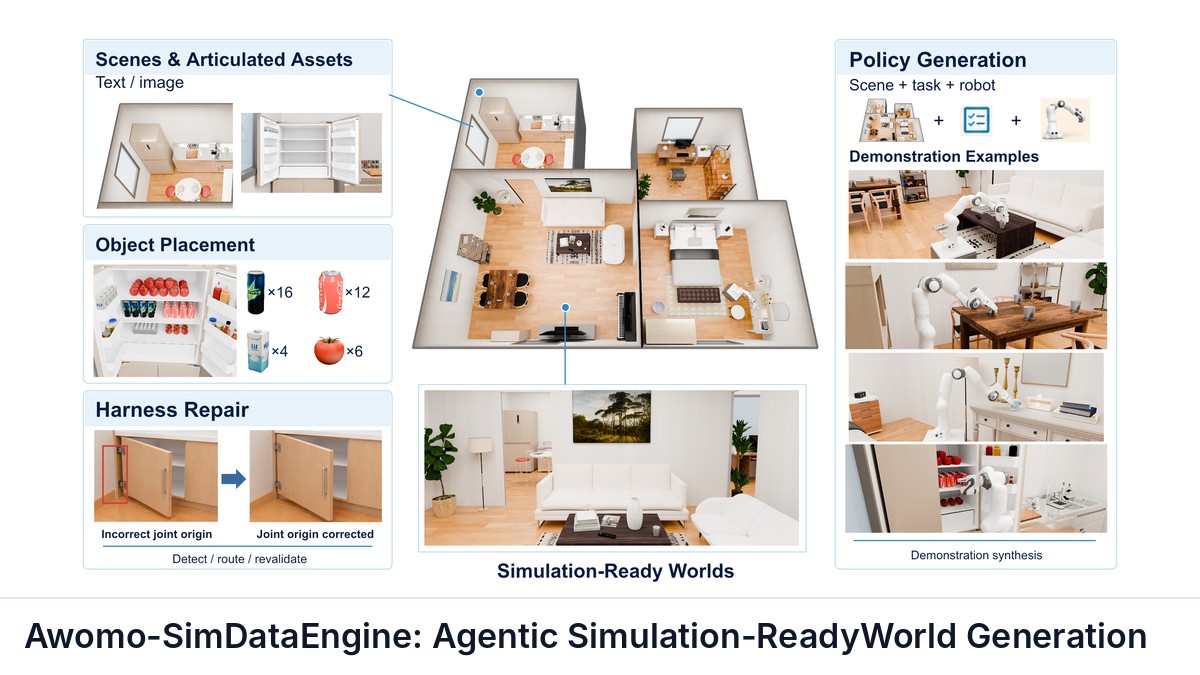
Awomo-SimDataEngine: Agentic Simulation-ReadyWorld Generation
PhysicalRSI Team, Danjiao Ma, Enhui Ma et al.
Generating useful robot-training data requires more than visually plausiblescenes: objects must support interaction, placements must remain physicallyvalid, and tasks must admit repeatable execution.

Capability-Aware Arbitration for Semantic Intent-Based Shared Control
Zhaoda Du, Michael Bowman, Xiaoli Zhang
Shared control often allocates robot authority based on confidence in inferred human intent, assuming reliable autonomous execution. When this assumption fails, high intent confidence can cause over-helping.
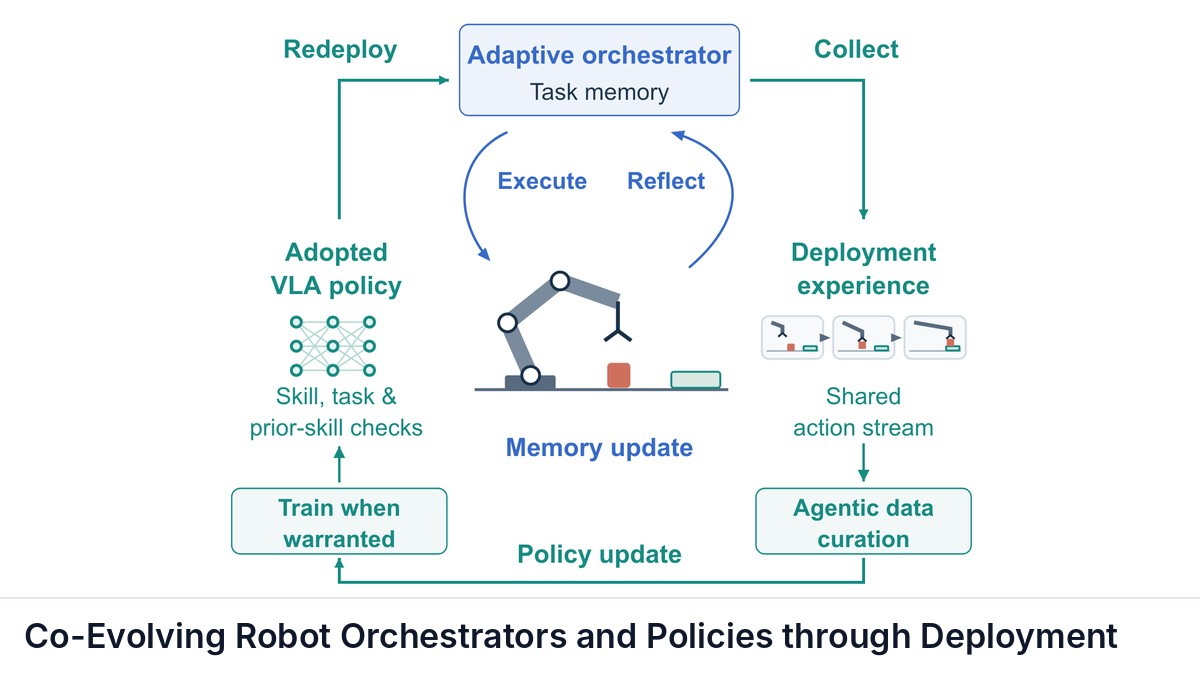
Co-Evolving Robot Orchestrators and Policies through Deployment
Xilun Zhang, Maggie Wang, Erik Bauer et al.
Vision-language-action (VLA) policies trained on large datasets are capable within their training domains, yet they still fail to generalize to the variety of situations a robot meets in real-world deployment.