
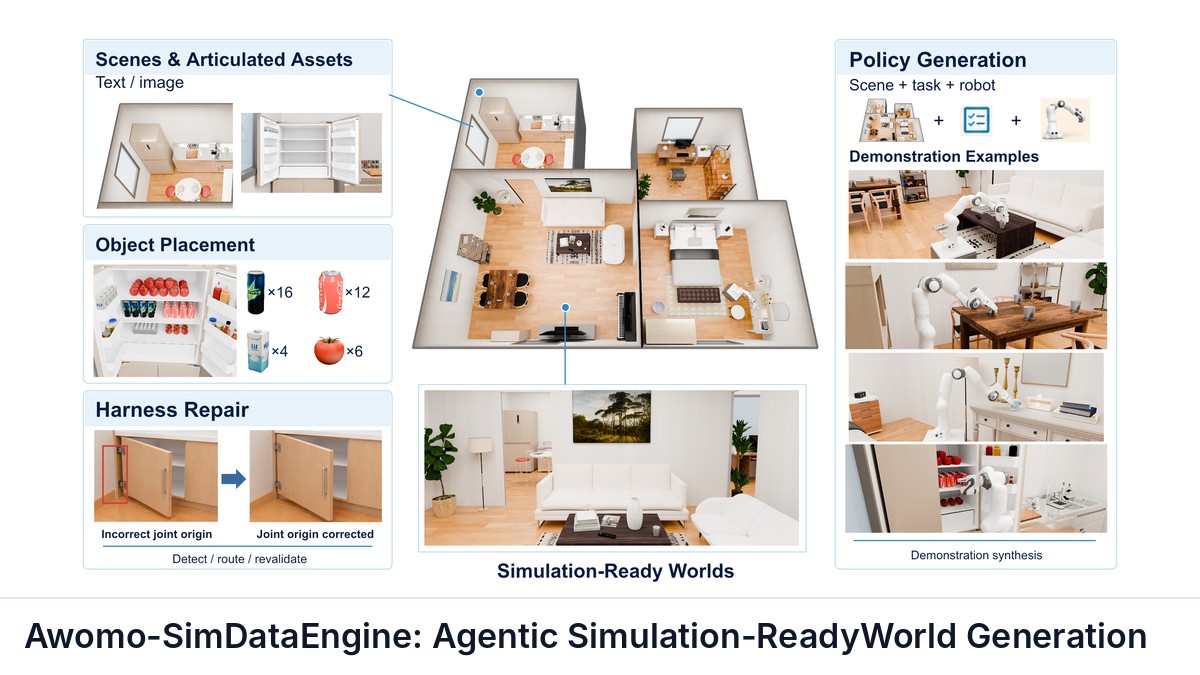
Awomo-SimDataEngine: Agentic Simulation-ReadyWorld Generation
PhysicalRSI Team, Danjiao Ma, Enhui Ma, Haohan Liu, Heng Jia, Hui Shan, Jianhua Xu, Jiahuan Zhang, Jiangdi Xu, Kaiwen Guo, Kaicheng Yu, Linwei Zhang, Liyang Jin, Maochun Luo, Pengyao Niu, Shiwen Li, Shuangyu Feng, Tong Zhang, Tianheng Wang, Xin Wang, Xiangru Huang, Yongqiang Huang, Zhaozhi Wang, Zijian Ma · N/A · 2026
Framework
N/A
License
N/A
Stars
N/A
Summary
Generating useful robot-training data requires more than visually plausiblescenes: objects must support interaction, placements must remain physicallyvalid, and tasks must admit repeatable execution.
Abstract Summary
Key Points
- Generating useful robot-training data requires more than visually plausiblescenes: objects must support interaction, placements must remain physicallyvalid, and tasks must admit repeatable execution.
- We present\textbf{Awomo-SimDataEngine}, an agentic system that connects asset and scenegeneration to robot demonstration synthesis.
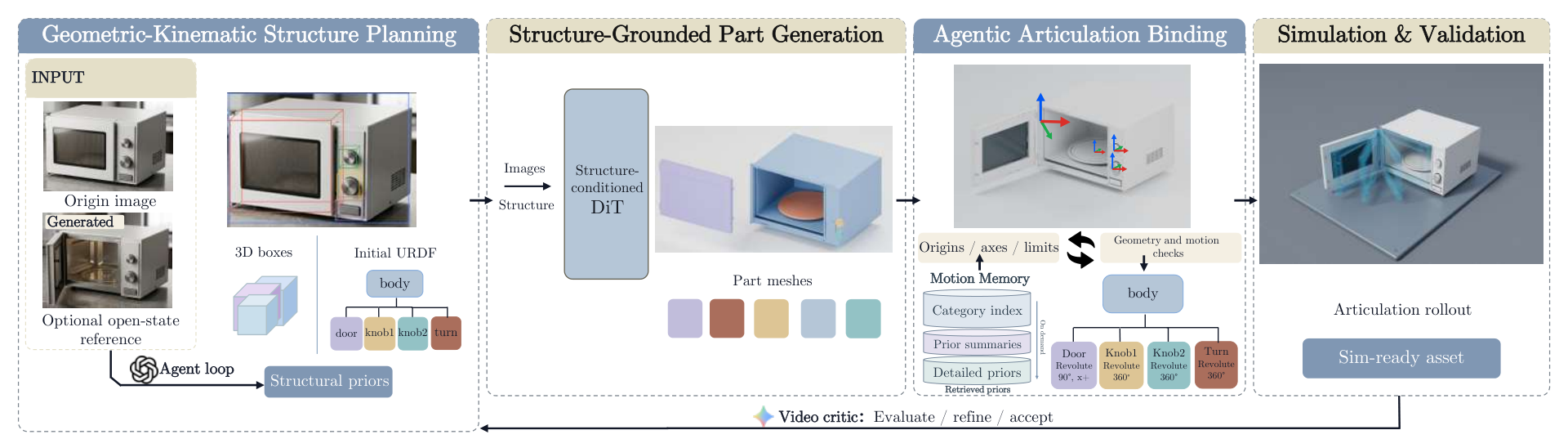
- Shared asset services providerigid and articulated objects, including structure-grounded part and jointgeneration with ISArt.
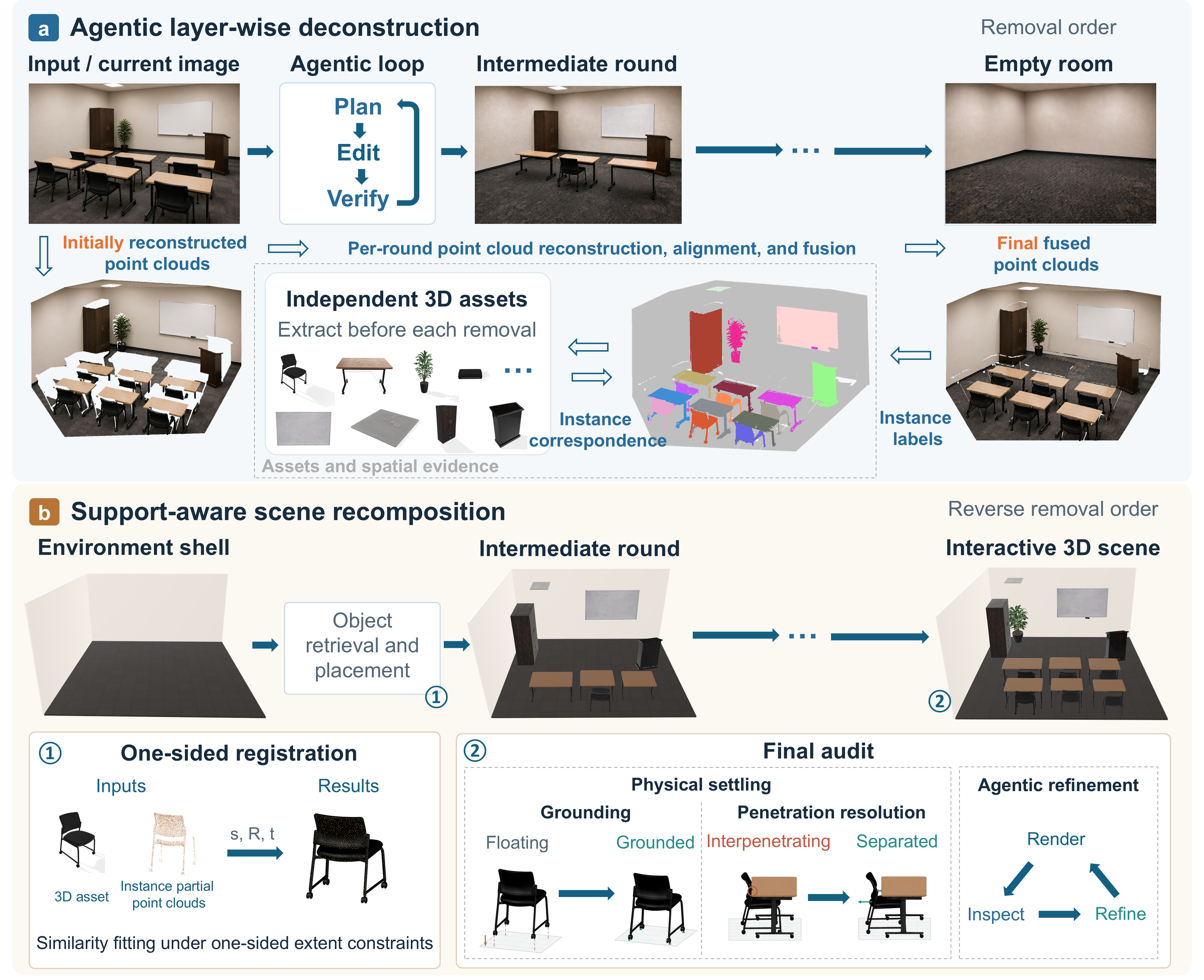
- Scene generation supports two complementary routes:Unravel reconstructs editable scenes from images, while SimForge buildssingle-room and multi-room environments from text.
- A graph-native harnesscoordinates construction, validation, andbounded repair, routing failures to the responsible module while retainingunaffected scene state.
Overview
Awomo-SimDataEngine connects simulation-ready asset generation, text- and image-driven scene generation, and automated demonstration synthesis through a Graph-Native Harness. Sections 4 – 5 describe ISArt, Unravel, and SimForge; Sections 6 – 7 describe their orchestration and the PolicyForge interface. Module-level asset and scene evaluations are reported separately from downstream policy co-training results.
The input is $C=\{T_{\textup{text}},I,Q\}$: a scene description, one image, and an optional task request.
Asset Generation
Asset generation converts an object request into a validated simulator asset. Given text, an image, or both, the module obtains candidates through retrieval, image-to-3D generation, specialized generation, or procedural modeling. Object-centric references remove distracting scene content and provide appearance and structural cues.
Each branch returns geometry and available semantics, orientation, scale, articulation, and physical information to the shared validation process in Section 6 .
Scene Generation
Awomo-SimDataEngine supports two parallel scene-generation routes. Unravel reconstructs an editable scene from a single image, optionally accompanied by a description; SimForge constructs single-room scenes and multi-room houses from text. Neither route requires the other as a preprocessing stage.
Both use the asset services in Section 4 , retain object and articulation identities, and produce worlds for validation and downstream demonstration synthesis.
Graph-Native Harness for Execution and Repair
The Graph-Native Harness coordinates asset generation, Unravel reconstruction, SimForge scene construction, simulator packaging, and PolicyForge demonstration synthesis. Each execution edge specifies its inputs, responsible module, validation requirements, and records needed to resume or repair the result. Figure 1 shows these system connections.
The execution graph organizes module calls and recovery for both SimForge’s text-driven construction and Unravel’s image-grounded recomposition.
Policy Generation via Automated Demonstration Synthesis
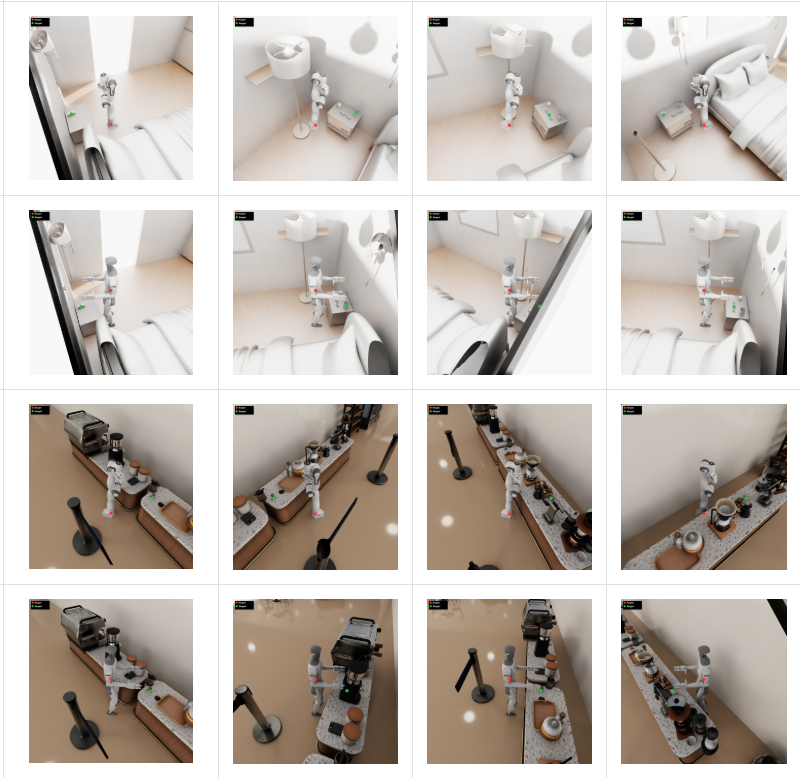
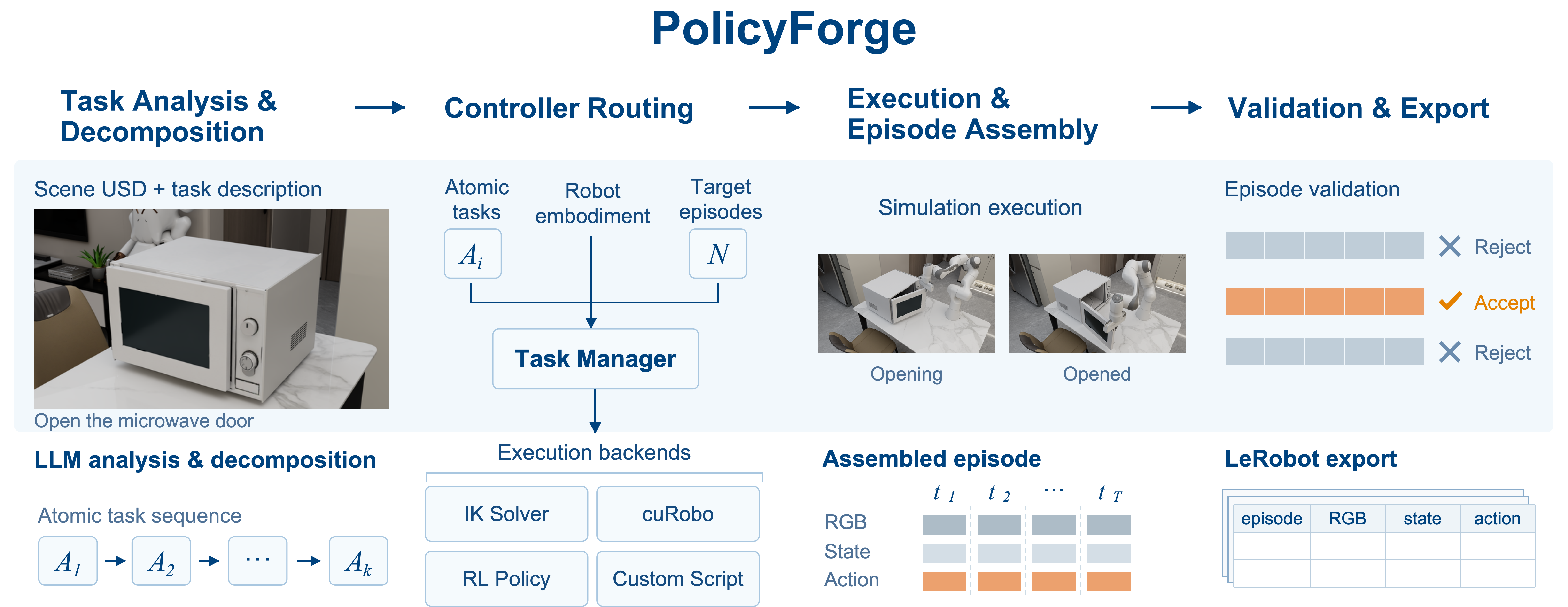
Given a validated Awomo-SimDataEngine world and a task contract, we propose PolicyForge , which provides a fully automated pipeline that converts a user-level task specification into large-scale, multi-embodiment demonstration data ready for policy learning.
The pipeline operates within NVIDIA Isaac Sim and is designed to be embodiment-agnostic: it supports a growing roster of robotic platforms including Franka, Piper dual-arm, Agibot G1, and Agibot G2, each interacting with diverse objects across procedurally generated scenes.
Experiments and Results
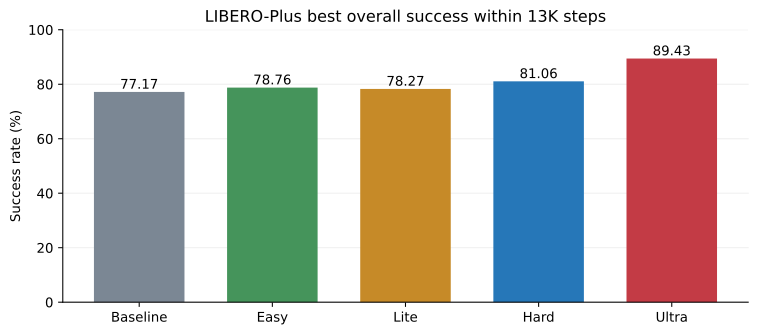
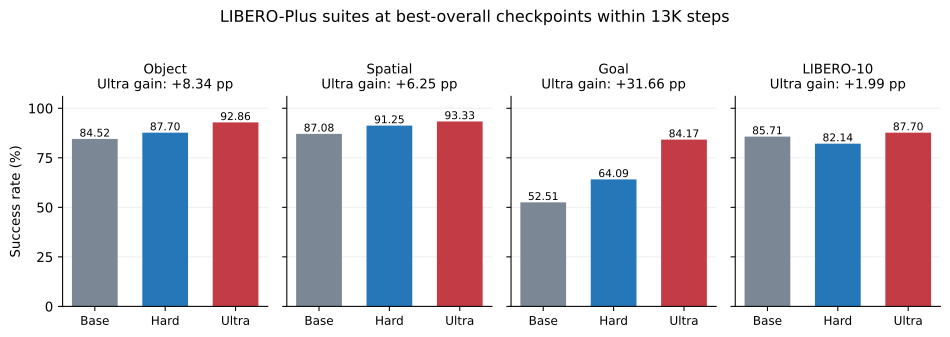
We evaluate whether PolicyForge demonstrations generated in Isaac Sim improve a World-Action Model (WAM) on the MuJoCo-based LIBERO-Plus benchmark [ Fei et al., 2025 ] . The main comparison selects each configuration’s best evaluated checkpoint up to and including 13K steps by overall success, using the same evaluation set of 1,003 episodes across object, spatial, goal, and long-horizon suites.
This measures the downstream utility of the co-training data across simulator boundaries.
Sources and Demonstrations
Figures are reproduced from Team et al. See the full paper for experimental details and the project page, when the paper links one, for demonstrations and videos.
Related Papers

A Sim-to-Real Integration Pipeline for Training and Deployment of Chunk-Based VLA Manipulation Policies
Mathilde Kappel, Clémence Grislain, Mohamed Chetouani et al.
Vision-Language-Action (VLA) models have become a prominent paradigm for mapping multimodal inputs, including semantic instructions, visual observations of the scene, and proprioceptive observations, to robot actions.

Capability-Aware Arbitration for Semantic Intent-Based Shared Control
Zhaoda Du, Michael Bowman, Xiaoli Zhang
Shared control often allocates robot authority based on confidence in inferred human intent, assuming reliable autonomous execution. When this assumption fails, high intent confidence can cause over-helping.
Co-Evolving Robot Orchestrators and Policies through Deployment
Xilun Zhang, Maggie Wang, Erik Bauer et al.
Vision-language-action (VLA) policies trained on large datasets are capable within their training domains, yet they still fail to generalize to the variety of situations a robot meets in real-world deployment.
Design and Evaluation of a Collaborative Teleoperation Interface for Multi-Operator Multi-Robot Systems in Challenging Environments
Alperen Kenan, Juan José García Cárdenas, Adriana Tapus et al.
Multi-robot systems that combine the complementary capabilities of specialised platforms are critical for complex missions in challenging, inaccessible environments.