
MonoDuo: Using One Robot Arm to Learn Bimanual Policies
FeaturedSandeep Bajamahal, Lawrence Yunliang Chen, Toru Lin, Zehan Ma, Jitendra Malik, Ken Goldberg · · 2026
Framework
N/A
License
N/A
Stars
0
Summary
Bimanual coordination is essential for many real-world manipulation tasks, yet learning bimanual robot policies is limited by the scarcity of bimanual robots and datasets. Single-arm robots, however,
Abstract Summary
Key Points
- Framework for learning bimanual policies from single-arm robot + human collaboration.
- Collects single-arm demonstrations while human performs the other side, then swaps roles.
- Uses hand pose estimation, segmentation, and inpainting to create synthetic bimanual demos.
- Zero-shot deployment on unseen bimanual configurations; up to 70% success.
- Few-shot fine-tuning with 25 target demos boosts performance by 65-70% over scratch.
Problem Statement
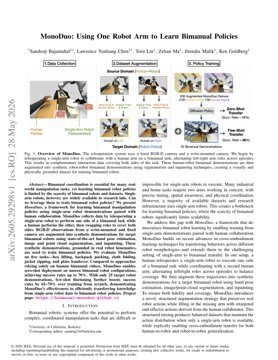
As described in Figure 1 , MonoDuo collects a demonstration dataset $\mathcal{D}^{\mathcal{S}}=\{\tau_{1}^{\mathcal{S}},\tau_{2}^{\mathcal{S}},...,\tau_{n}^{\mathcal{S}}\}$ consisting of $2N$ successful trajectories of a source robot-human pair $\mathcal{S}=(\mathcal{S}_{r},\mathcal{S}_{h})$ performing some task.
MonoDuo
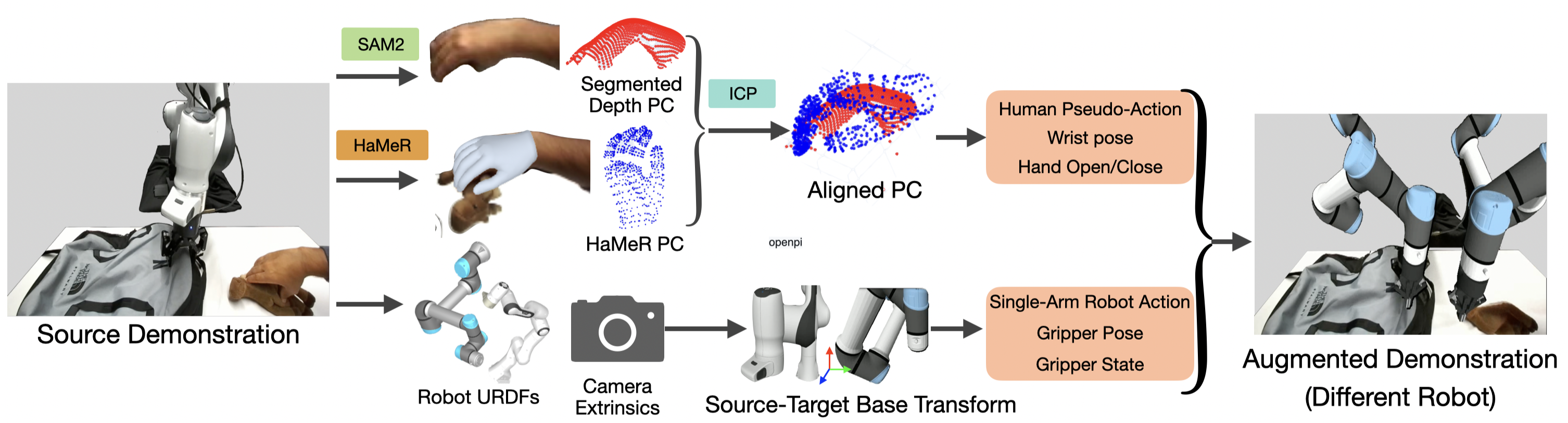
In this section, we describe more details of how MonoDuo enables the learning of bimanual robot policies when only a single-arm robot is available. An overview is shown in Figure 1 . For each bimanual task, we collect a source dataset $\mathcal{D}^{\mathcal{S}}$ using a human to teleoperate a single-arm robot to collaborate with a human partner on the task.
To ensure a balanced data distribution, the roles of left-arm and right-arm are alternated across episodes.
Experiments
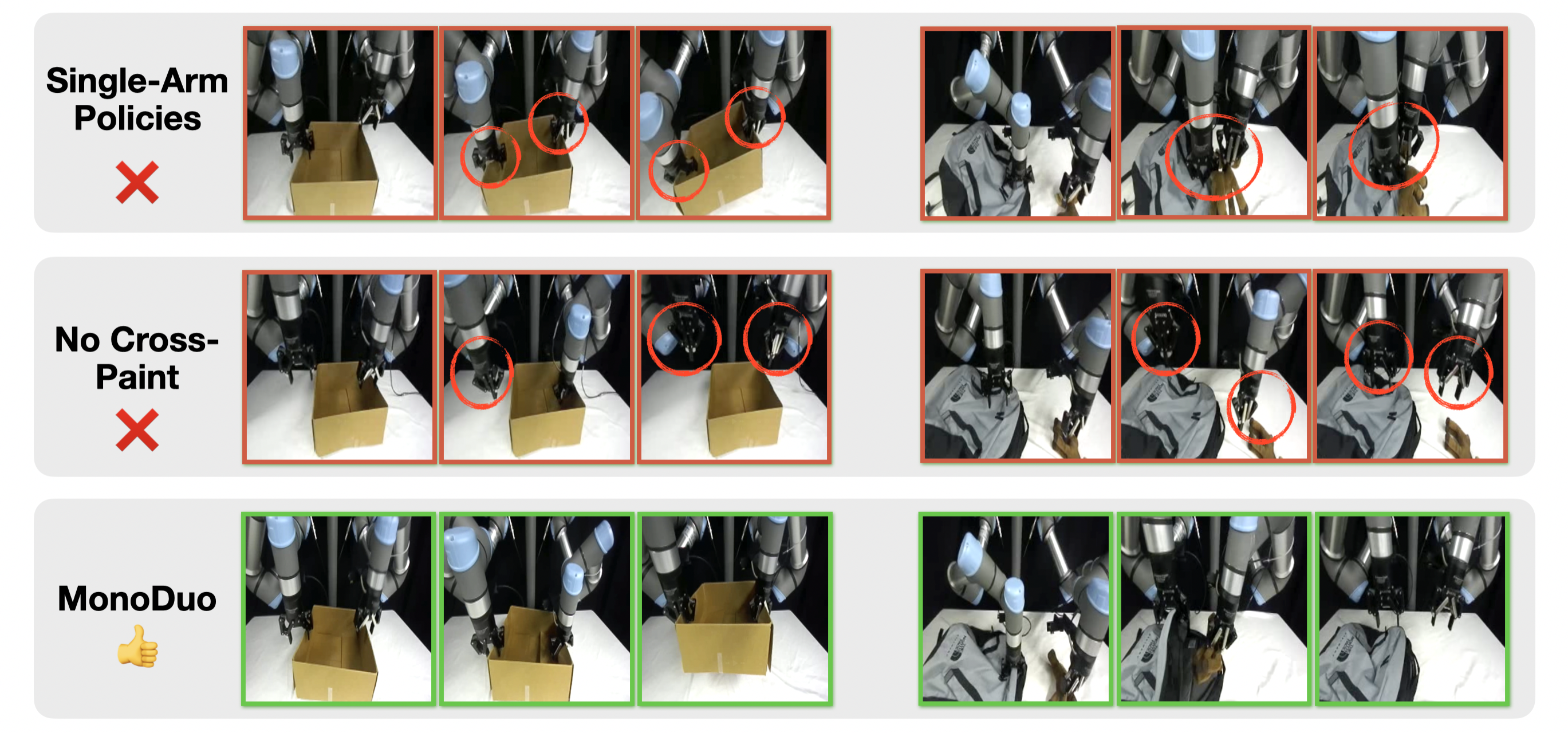
We use a Franka arm as the single-arm source robot, and a pair of UR5e arms setup as the bimanual target robot. For RGB-D data collection, we use a ZED2 stationary fixed camera and a ZED-mini wrist-mounted camera.
Sources and Demonstrations
Figures are reproduced from Bajamahal et al. See the full paper for experimental details and the project page, when the paper links one, for demonstrations and videos.
Related Papers
Open X-Embodiment: Robotic Learning Datasets and RT-X Models
Open X-Embodiment Collaboration
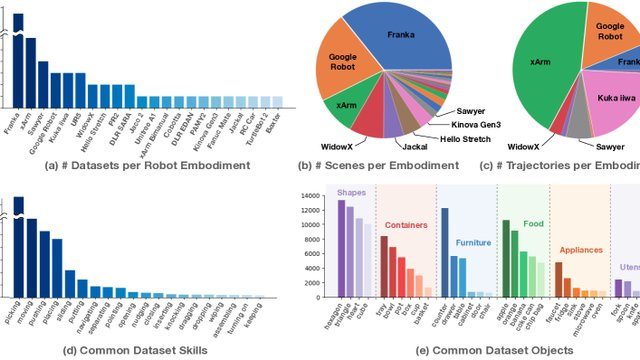
The largest collaborative robot learning dataset ever assembled, spanning 22 robots from 21 institutions, enabling training of generalist RT-X policies that exhibit positive cross-embodiment transfer.
EgoForce: Forearm-Guided Camera-Space 3D Hand Pose from a Monocular Egocentric Camera
Christen Millerdurai, Shaoxiang Wang, Yaxu Xie et al.
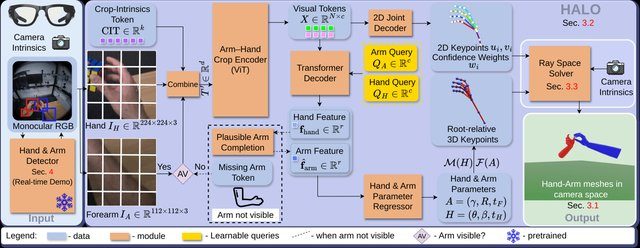
Reconstructing the absolute 3D pose and shape of the hands from the user's viewpoint using a single head-mounted camera is crucial for practical egocentric interaction in AR/VR, telepresence, and hand-centric manipulation tasks, where sensing must remain compact and unobtrusive.
SI-Diff: A Framework for Learning Search and High-Precision Insertion with a Force-Domain Diffusion Policy
Yibo Liu, Stanko Oparnica, Simon Shewchun-Jakaitis et al.
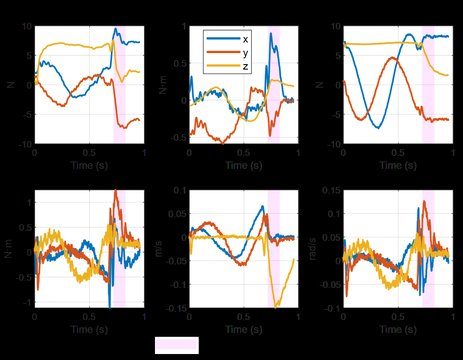
Contact-rich manipulation is fundamental in robotics but poses significant challenges due to uncertainties in relative poses, such as misalignments and small clearances in peg-in-hole tasks.
TMRL: Diffusion Timestep-Modulated Pretraining Enables Exploration for Efficient Policy Finetuning
Matthew M. Hong, Jesse Zhang, Anusha Nagabandi et al.
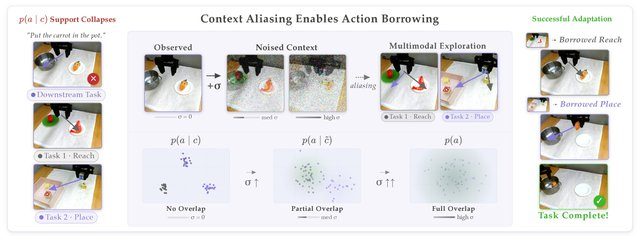
Fine-tuning pre-trained robot policies with reinforcement learning (RL) often inherits the bottlenecks introduced by pre-training with behavioral cloning (BC), which produces narrow action distributions that lack the coverage necessary for downstream exploration.