
GeoLAM: Learning Geometry-Grounded Latent Actions from Unlabeled Human Videos
Yifan Xie, Hekun Tian, Jinkun Liu, YuAn Wang, Qiao Sun, Wenbo Ding · N/A · 2026
Framework
N/A
License
N/A
Stars
N/A
Summary
Human videos provide rich manipulation experience, but extracting action representations that preserve useful motion remains challenging. Visual reconstruction alone can entangle manipulation-related motion with appearance changes and camera movement.
Abstract Summary
Key Points
- Human videos provide rich manipulation experience, but extracting action representations that preserve useful motion remains challenging.
- Visual reconstruction alone can entangle manipulation-related motion with appearance changes and camera movement.
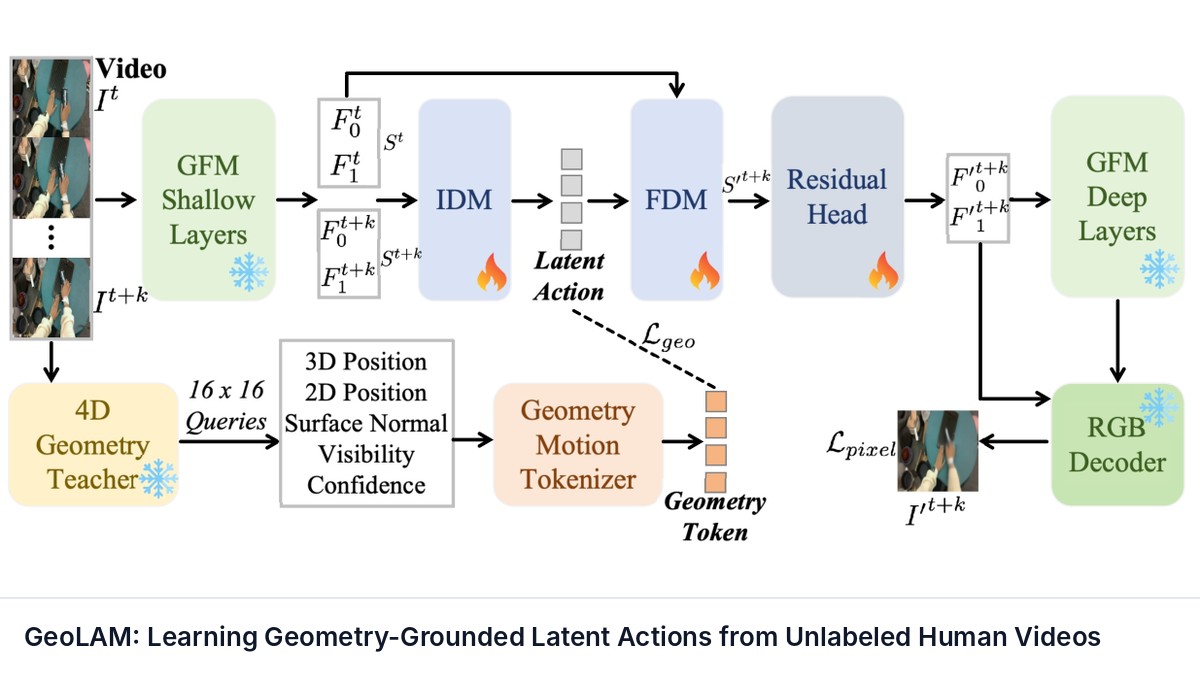
- We present GeoLAM, a framework for learning geometry-grounded latent actions from action-free human videos.
- GeoLAM combines future-frame reconstruction through a frozen geometric feature hierarchy with motion supervision from a training-only 4D geometry teacher.
- The geometric representation provides a structural prior, while the teacher's predictions yield spatially pooled targets capturing 3D displacement, residual image-plane motion, and surface-orientation changes.
Method
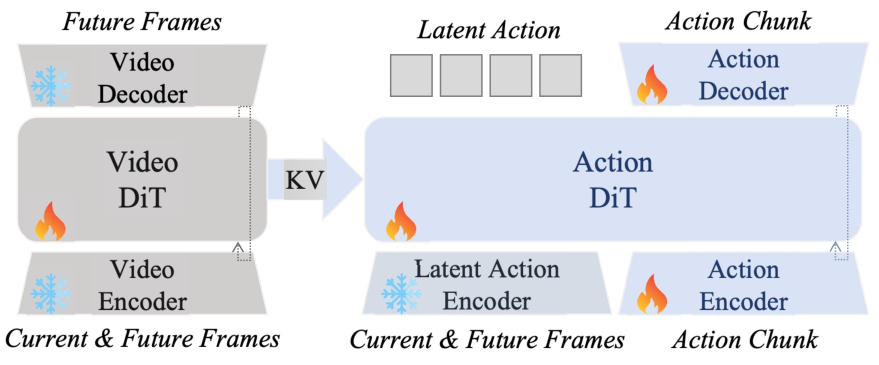
Latent-action models recover transition variables from action-free videos by coupling an inverse dynamics model (IDM) with a forward dynamics model (FDM) [ 4 ] . However, image prediction alone may entangle controllable motion with appearance changes and camera motion [ 5 , 6 ] . As illustrated in Fig.
1 , we reduce this ambiguity with two complementary constraints: geometry-aware future-frame reconstruction and training-only supervision from a 4D geometry teacher. We denote the two clip endpoints by $\mathbf{I}^{t}$ and $\mathbf{I}^{t+k}$.
Experiments
Training. All models are trained with distributed data parallelism on 64 NVIDIA A800 GPUs using bfloat16 mixed precision. We optimize the latent-action model for 200,000 steps with AdamW, a learning rate of $10^{-4}$, and a per-GPU batch size of 32 (2,048 globally). RGB inputs are resized to $224\!\times\!224$, while the frozen D4RT teacher processes four uniformly sampled context frames at $256\!\times\!256$.
Sources and Demonstrations
Figures are reproduced from Xie et al. See the full paper for experimental details and the project page, when the paper links one, for demonstrations and videos.
Related Papers

A Sim-to-Real Integration Pipeline for Training and Deployment of Chunk-Based VLA Manipulation Policies
Mathilde Kappel, Clémence Grislain, Mohamed Chetouani et al.
Vision-Language-Action (VLA) models have become a prominent paradigm for mapping multimodal inputs, including semantic instructions, visual observations of the scene, and proprioceptive observations, to robot actions.
Capability-Aware Arbitration for Semantic Intent-Based Shared Control
Zhaoda Du, Michael Bowman, Xiaoli Zhang
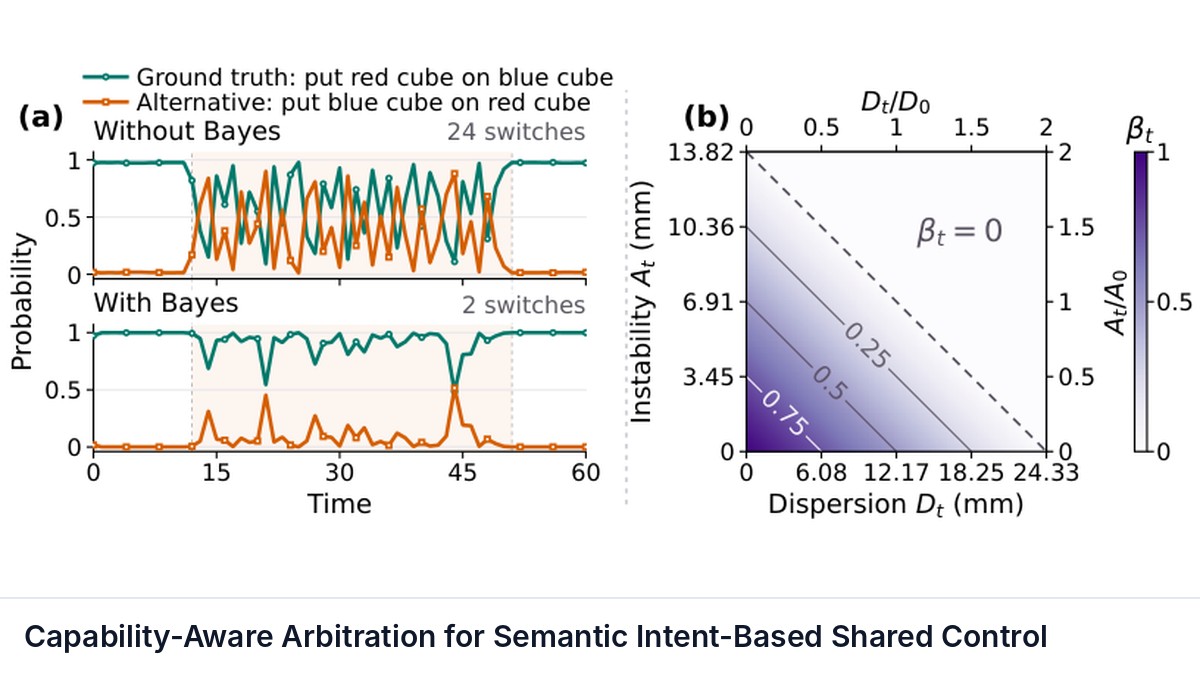
Shared control often allocates robot authority based on confidence in inferred human intent, assuming reliable autonomous execution. When this assumption fails, high intent confidence can cause over-helping.
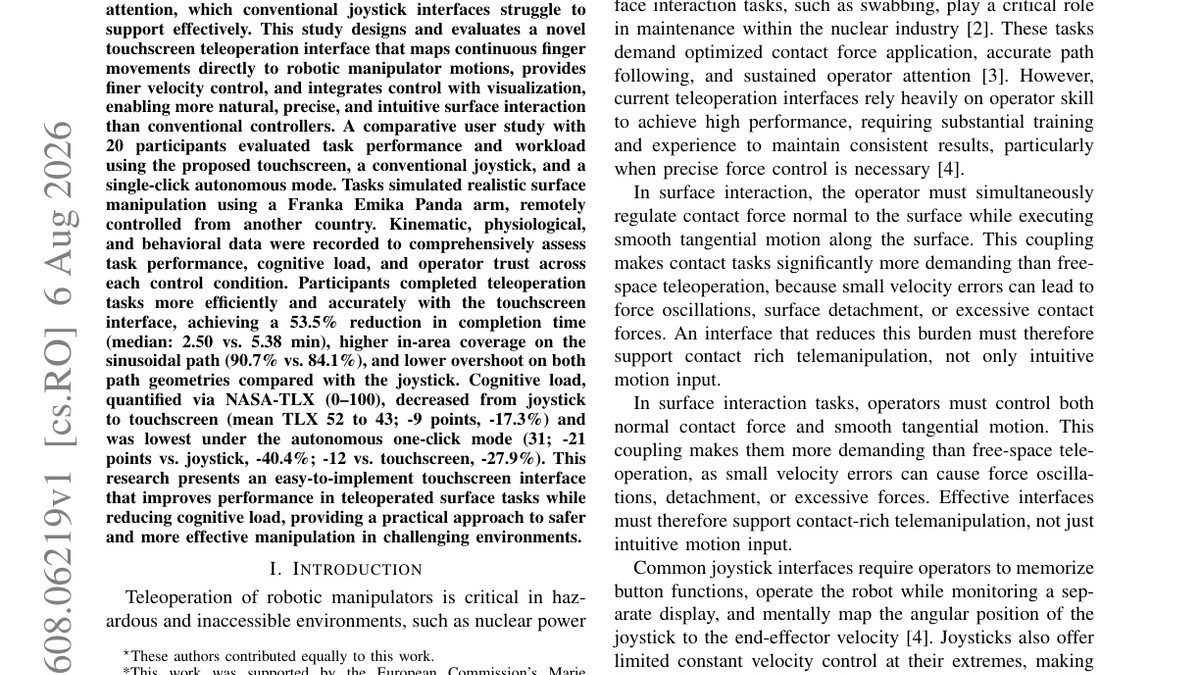
Design and Evaluation of a Touchscreen-Based Teleoperation Interface for Robotic Manipulators
Juan José García Cárdenas, Alperen Kenan, Hamidreza Raei et al.
Intuitive teleoperation interfaces are crucial for the safe and effective operation of robotic manipulators in challenging environments.
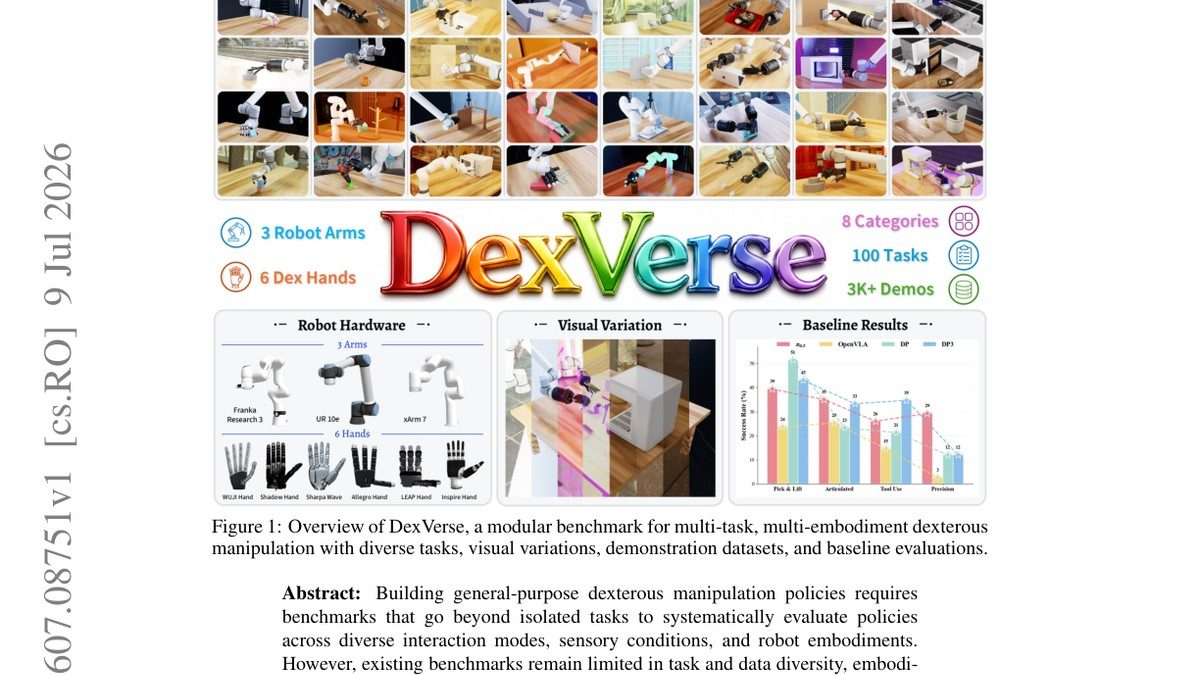
DexVerse: A Modular Benchmark for Multi-Task, Multi-Embodiment Dexterous Manipulation
Yunchao Yao, Zhuxiu Xu, Tianqi Zhang et al.
Building general-purpose dexterous manipulation policies requires benchmarks that go beyond isolated tasks to systematically evaluate policies across diverse interaction modes, sensory conditions, and robot embodiments.