
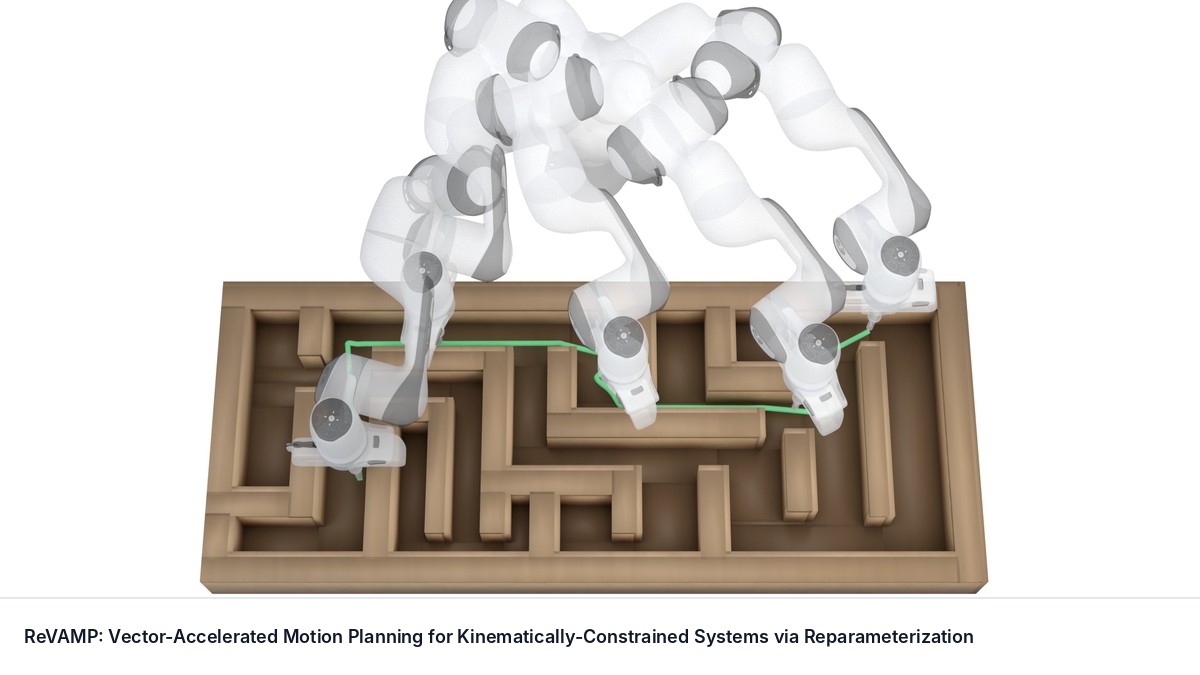
ReVAMP: Vector-Accelerated Motion Planning for Kinematically-Constrained Systems via Reparameterization
Shrutheesh R. Iyer, Thomas Cohn, Zachary Kingston · N/A · 2026
Framework
N/A
License
N/A
Stars
N/A
Summary
Robots often must satisfy one or more constraints during motion planning for real-world tasks. When such constraints reduce the valid configuration space to a measure-zero subset, sampling based planning algorithms require modifications to draw feasible samples.
Abstract Summary
Key Points
- Robots often must satisfy one or more constraints during motion planning for real-world tasks
- When such constraints reduce the valid configuration space to a measure-zero subset, sampling based planning algorithms require modifications to draw feasible samples.
- For many common end-effector constraints, parameterizations built on inverse kinematics (IK) provide an alternate formulation where the constraints are satisfied by construction, allowing directly sampling the feasible set.
- Despite their elegant approach, parameterized planners have remained slower than vector-accelerated implementations of projection-based approaches, leaving their performance ceiling an open question.
- We explore a new axis of vectorization built upon reparameterizing the planning space through analytic IK.
Preliminaries
Let $C\subset\mathbb{R}^{d}$ be the configuration space of a robot with $d$ degrees of freedom, where a configuration $q\in C$ is typically the vector of actuated joint angles. In the presence of environment obstacles, $C_{\text{free}}\subset C$ denotes the subset of configurations that are not in collision. A robot typically interacts with the environment through its end-effector(s), EE(s).
Methodology
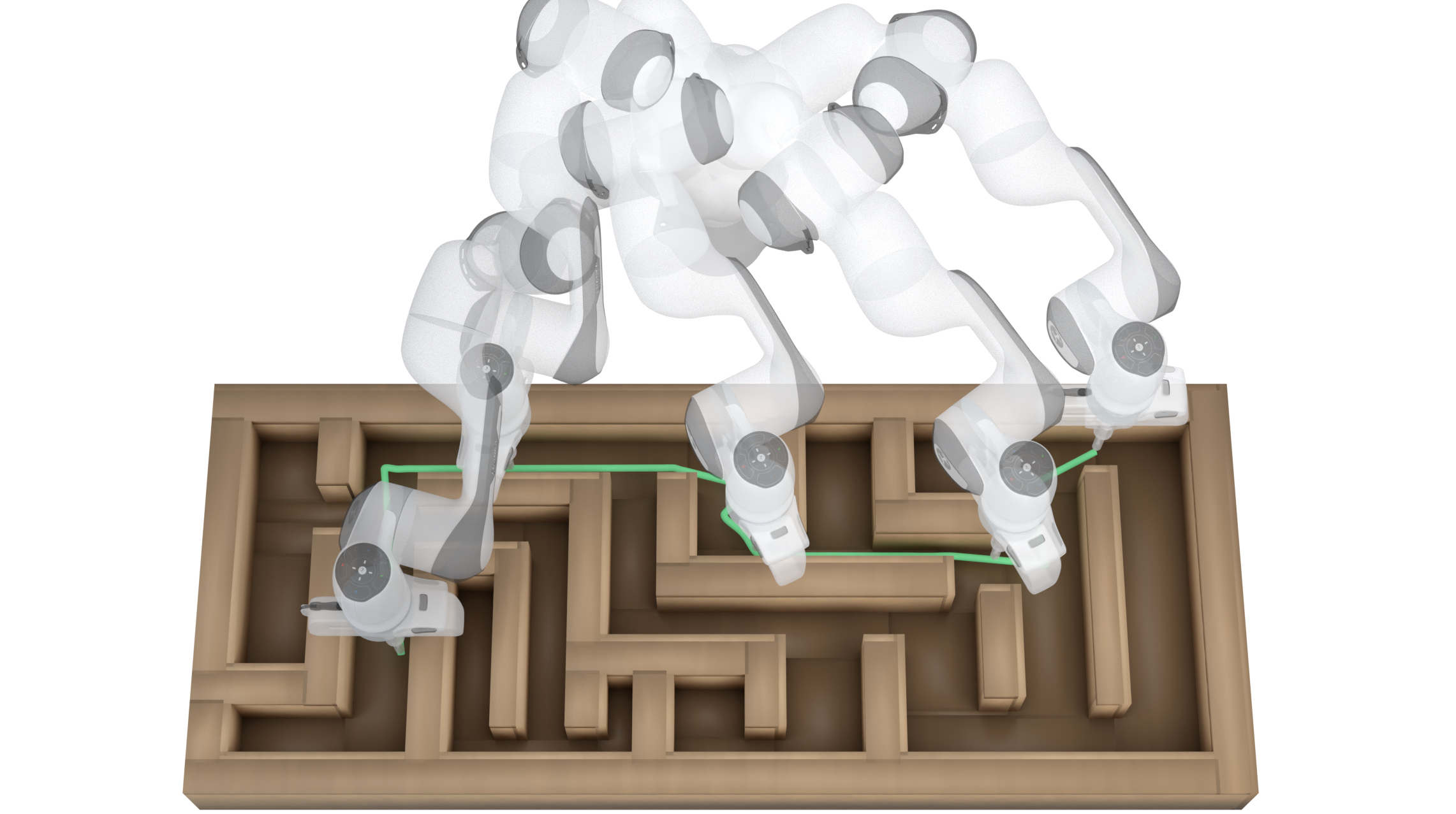
In this work, we propose a new compilation axis for a robot: the analytic inverse kinematics routine, and the subsequent reparameterization that is constructed from it. Starting from the analytic solver, we transform the generated routines into branchless and vectorizable units that map parameterized configurations into joint configurations in parallel.
This allows multiple configurations in the reparameterized space to be resolved simultaneously using SIMD parallelism.
Experimental Evaluation
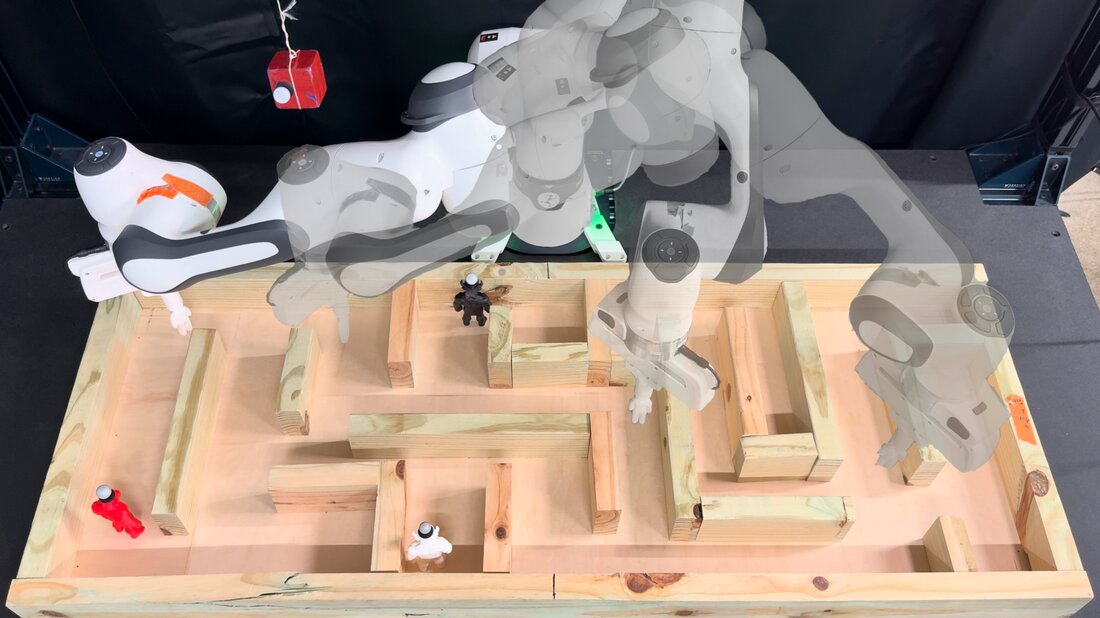
We evaluate our planner across different robots, with increasing DoF, and constraint complexity. All methods were evaluated on the same set of problems on a 5.4GHz Intel i7-13700K CPU with 64GB of RAM, unless specified otherwise. Each experiment highlights a distinct benefit of the planner and its potential implications.
For the FR3 with a plane constraint, we show that planning on $SE(2)$ provides better scaling and strict constraint satisfaction.
Sources and Demonstrations
Figures are reproduced from Iyer et al. See the full paper for experimental details and the project page, when the paper links one, for demonstrations and videos.
Related Papers
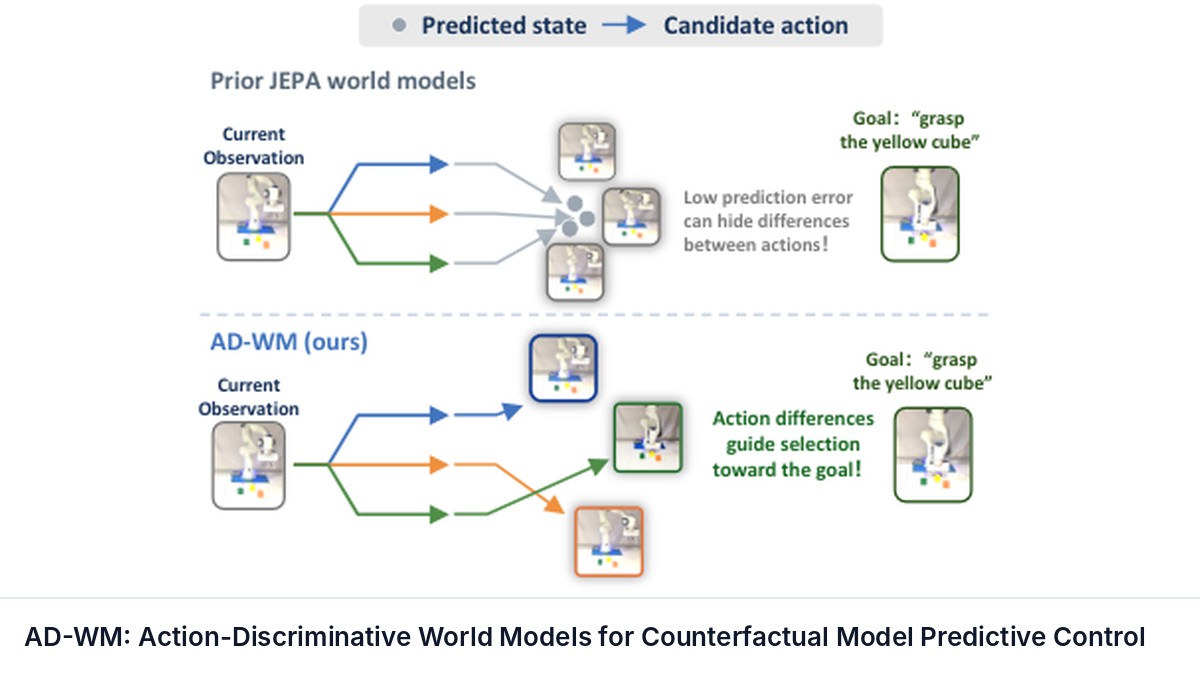
AD-WM: Action-Discriminative World Models for Counterfactual Model Predictive Control
Jiabin Qiu, Zixuan Chen, Hongye Cao et al.
Latent world models are typically trained to predict factual transitions, whereas model predictive control (MPC) must compare alternative actions from the same state. A model can therefore achieve low factual prediction error yet poorly distinguish candidate actions.
AHEAD: Anticipatory Hand-Driven Teleoperation via Human Intent Prediction
Seok Joon Kim, Junho Lee, Federica Spinola et al.
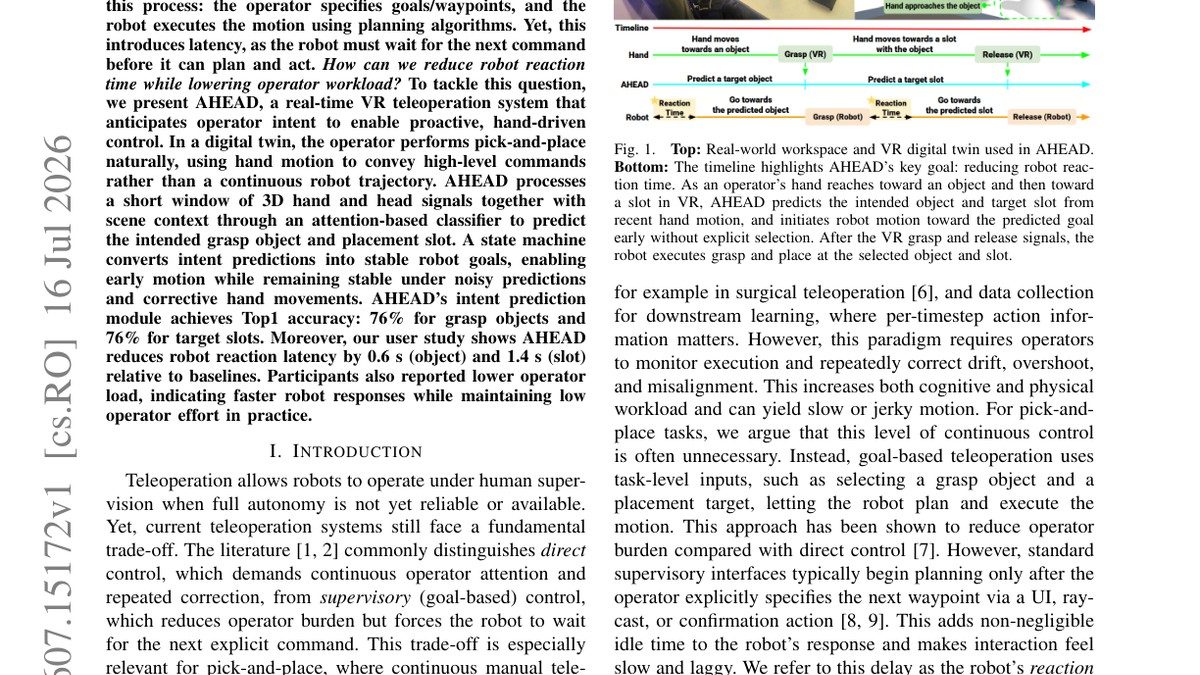
Direct hand-driven teleoperation maps an operator's hand motion to robot end-effector commands at every frame, enabling precise control, but it requires constant monitoring and correction during approach, grasp, and placement, which can be slow and fatiguing.
Autonomous Droplet Navigation via Model-Based Reinforcement Learning: Zero-Shot Transfer and Emergent Dynamics
Rajneesh Anand, Mayuresh V. Kothare
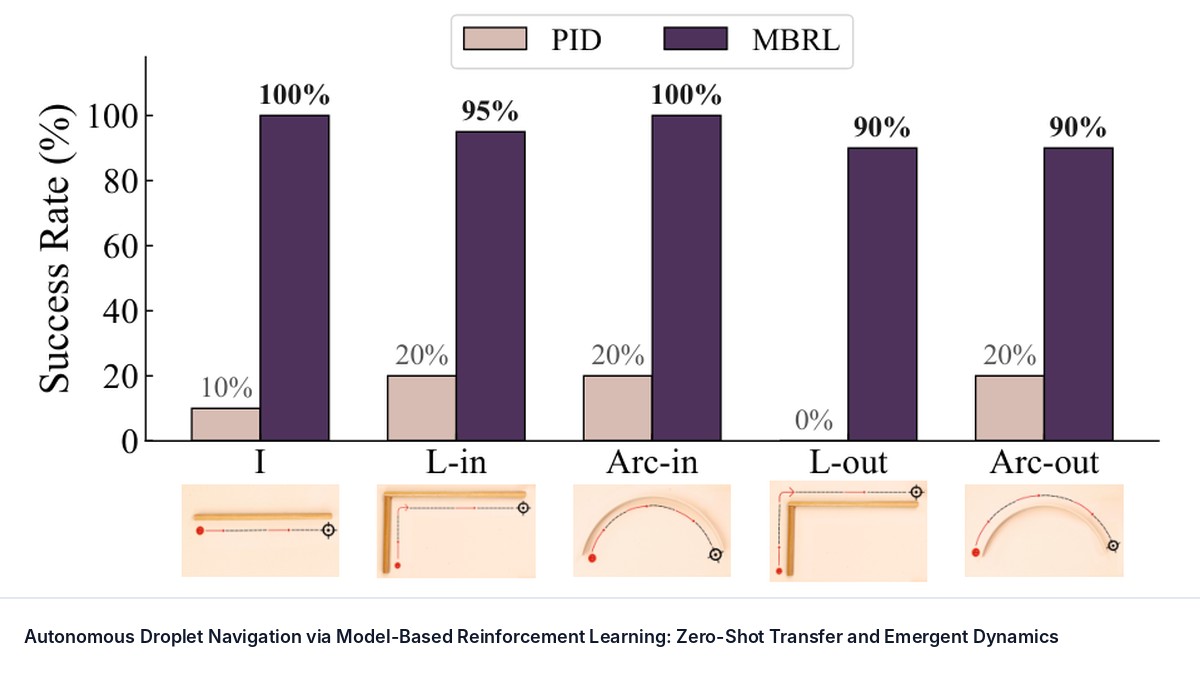
Self-driving laboratories (SDLs) are transforming chemical and materials discovery through closed-loop automation, yet automated infrastructure for physical manipulation of soft, deformable matter remains beyond current robotic platforms.
Body-Grounded Replanning for Physically Adaptive Manipulation
Namiko Saito, Hiroshi Kera
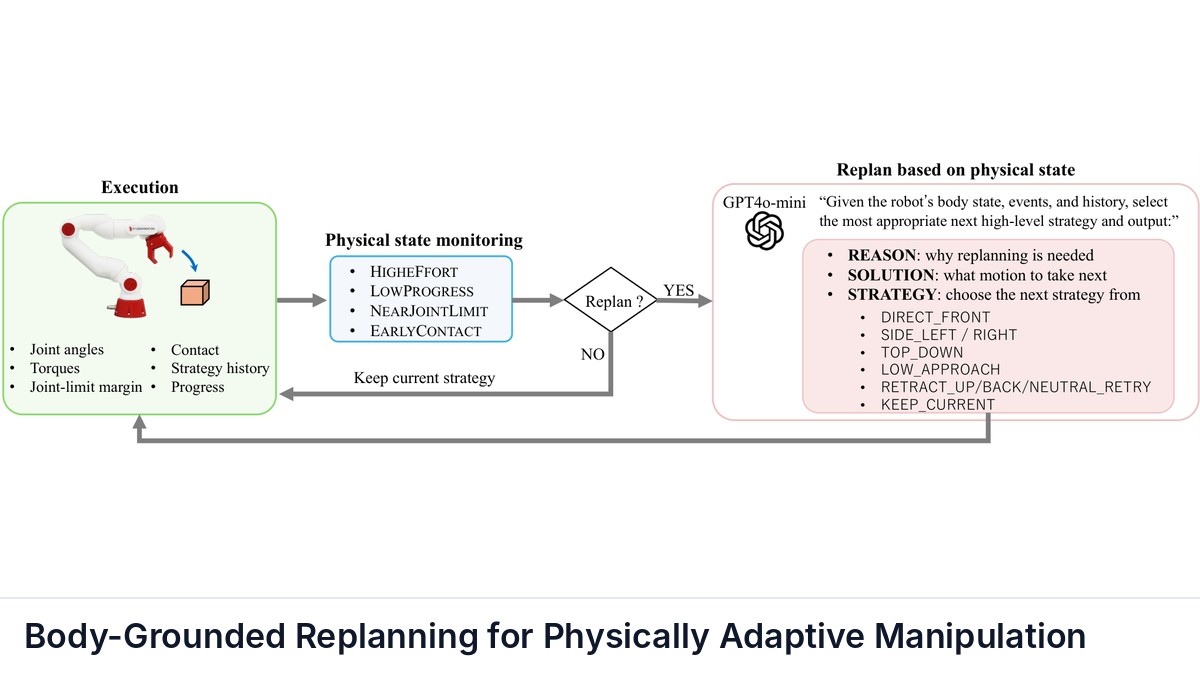
Manipulation requires not only reasoning about the external environment, but also about the robot's physical condition.