
Project SCOUT: Interceptor Drone for Perimeter Defense
Azmain Yousuf, Siwei Cai, Knut Peterson, Lifeng Zhou, David Han · N/A · 2026
Framework
N/A
License
N/A
Stars
N/A
Summary
The rapid proliferation of unauthorized unmanned aerial vehicles (UAVs) has created a growing need for robust, jamming-resistant counter-UAV systems for perimeter defense.
Abstract Summary
Key Points
- The rapid proliferation of unauthorized unmanned aerial vehicles (UAVs) has created a growing need for robust, jamming-resistant counter-UAV systems for perimeter defense.
- This paper presents \textbf{SCOUT} (Spatial Computation for Optimized UAV Tracking), a ROS-integrated onboard perception and control framework for real-time aerial defense against incoming UAVs.
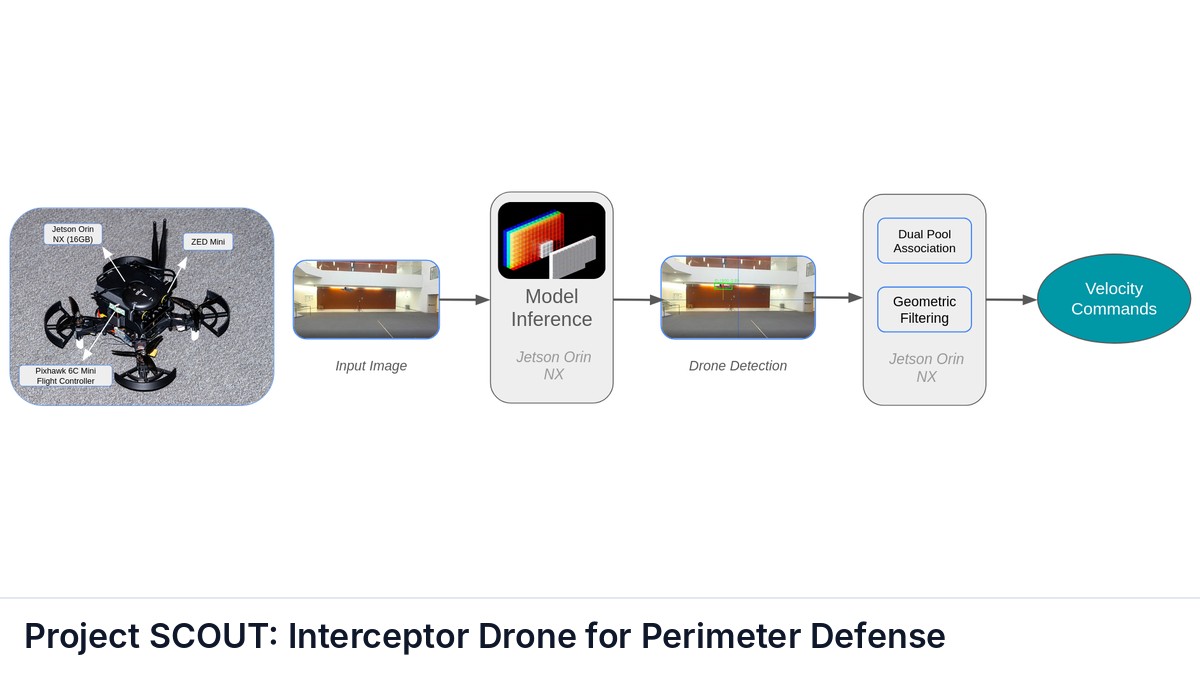
- SCOUT performs visual detection, target association, track filtering, and control command generation directly onboard the defender UAV, without relying on external sensing infrastructure or ground-station computation.
- To provide stable control inputs, the perception pipeline combines TensorRT-accelerated drone detection with ByteTrack-based association and a lightweight track-retention state machine.
- The state machine rejects abrupt target jumps and maintains short-term target continuity during temporary detection degradation, reducing unstable control responses caused by false detections or target switching.
Method
SCOUT is designed to convert onboard visual observations of an incoming UAV into stable control commands for real-time perimeter defense. The system follows a sequential perception-to-control approach, where a drone detector is first trained and fine-tuned for the target UAV, then deployed through a low-latency onboard inference pipeline, as shown in Fig. 1 .
The resulting detections are temporally associated and filtered to produce stable target-center errors, which are finally used by the interceptor controller to generate flight commands.
Experimental Results
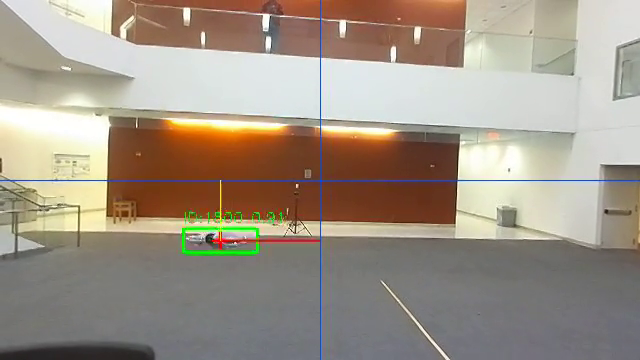
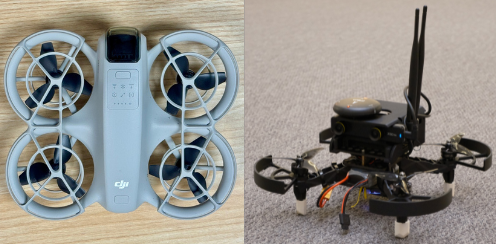
Real-world hardware experiments were designed to verify whether the SCOUT platform can provide real-time target-center estimates and support closed-loop perimeter-defense maneuvers without ground-station computation. We first describe the experimental UAV platforms and test environment, then report detection-stream performance from a representative flight sequence and discuss the observed system behavior.
For this experiment, we use the DJI Neo as the target/adversarial drone.
Sources and Demonstrations
Figures are reproduced from Yousuf et al. See the full paper for experimental details and the project page, when the paper links one, for demonstrations and videos.
Related Papers
A Low-Cost, Open Platform for End-to-End Autonomous Driving on a Miniature Ackermann Vehicle
Gustavo Claudio Karl Couto, Eric Aislan Antonelo, Gabriel George Zipperer
This paper presents a low-cost, open experimental platform for research in end-to-end autonomous driving with miniature Ackermann vehicles.

A Sim-to-Real Integration Pipeline for Training and Deployment of Chunk-Based VLA Manipulation Policies
Mathilde Kappel, Clémence Grislain, Mohamed Chetouani et al.
Vision-Language-Action (VLA) models have become a prominent paradigm for mapping multimodal inputs, including semantic instructions, visual observations of the scene, and proprioceptive observations, to robot actions.
Can People Distinguish Human and AI Agency in Humanoid Teleoperation? A Preliminary Study of Agency Perception
Xiang Li, Koya Dendo, Keigo Minamida et al.
Can people distinguish between human and AI agency in humanoid teleoperation?

Capability-Aware Arbitration for Semantic Intent-Based Shared Control
Zhaoda Du, Michael Bowman, Xiaoli Zhang
Shared control often allocates robot authority based on confidence in inferred human intent, assuming reliable autonomous execution. When this assumption fails, high intent confidence can cause over-helping.