
LeWAM: A JEPA World Action Model with Diffusion-Steering-Based MPC
Shashank Hegde, Alexander Popov, Elie Aljalbout, Nikolai Smolyanskiy · N/A · 2026
Framework
N/A
License
N/A
Stars
N/A
Summary
World action models (WAMs) predict actions and future observations, typically from a reconstruction-based representation that carries noisy, redundant information which can complicate downstream predictions.
Abstract Summary
Key Points
- World action models (WAMs) predict actions and future observations, typically from a reconstruction-based representation that carries noisy, redundant information which can complicate downstream predictions.
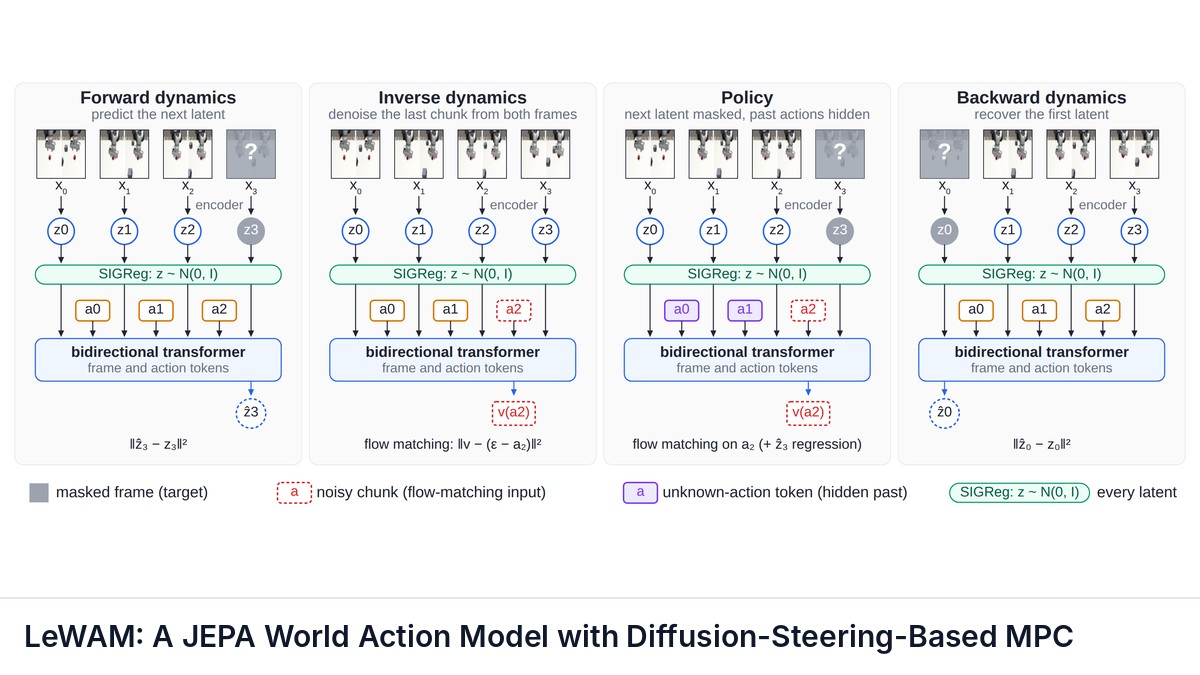
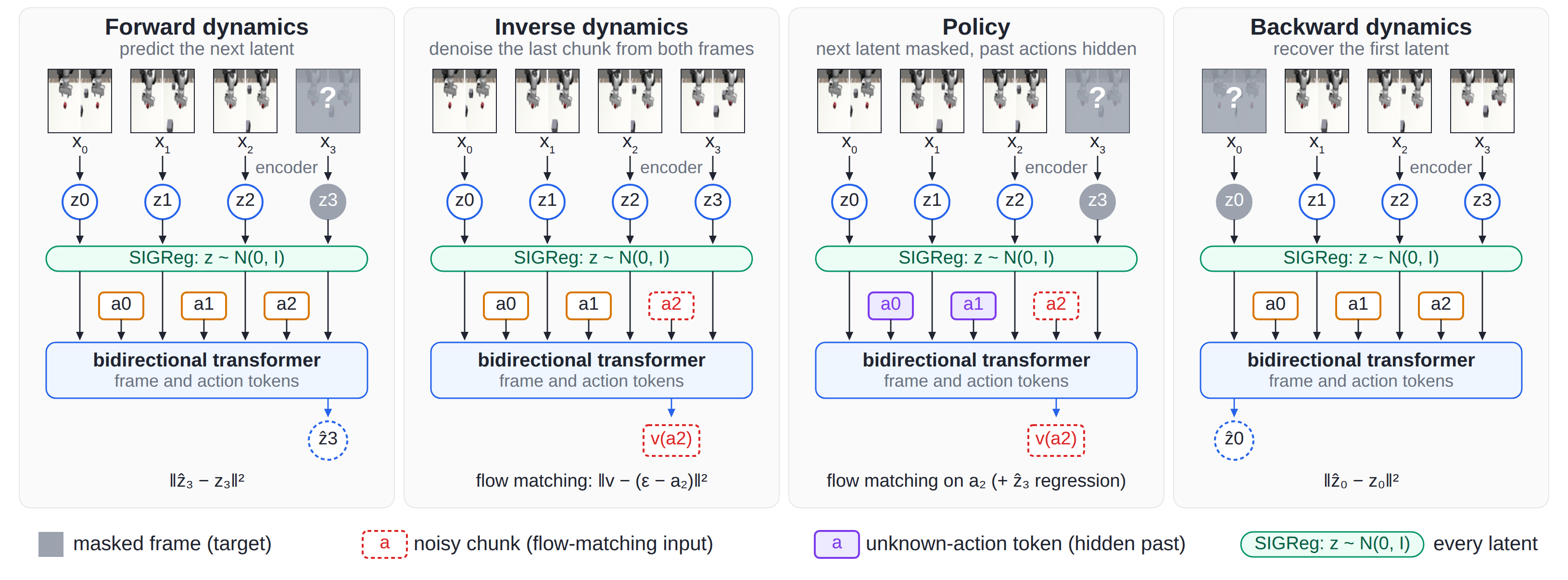
- We introduce LeWAM, a bidirectional transformer for forward, backward, inverse dynamics and policy prediction, on a decoder-free JEPA latent trained end-to-end through all four modes.
- We see the following benefits: 1) Alignment: linear probes read robot and object state from LeWAM's latent better than from a regular Le World Model (a forward-only JEPA world model), while the latent ignores visual distractors as well as LeWM does and far better than a reconstruction-based WAM.
- 2) Acting: Closed-loop evaluations of LeWAM match a regular flow-matching policy trained on the same encoder at matched size, while also providing a world model.
- 3) Planning: Sampling raw actions when planning with WAMs lets MPC exploit dynamics-model inaccuracies; planning in the noise space of the policy head instead improves the closed-loop performance of these WAMs.
LeWAM
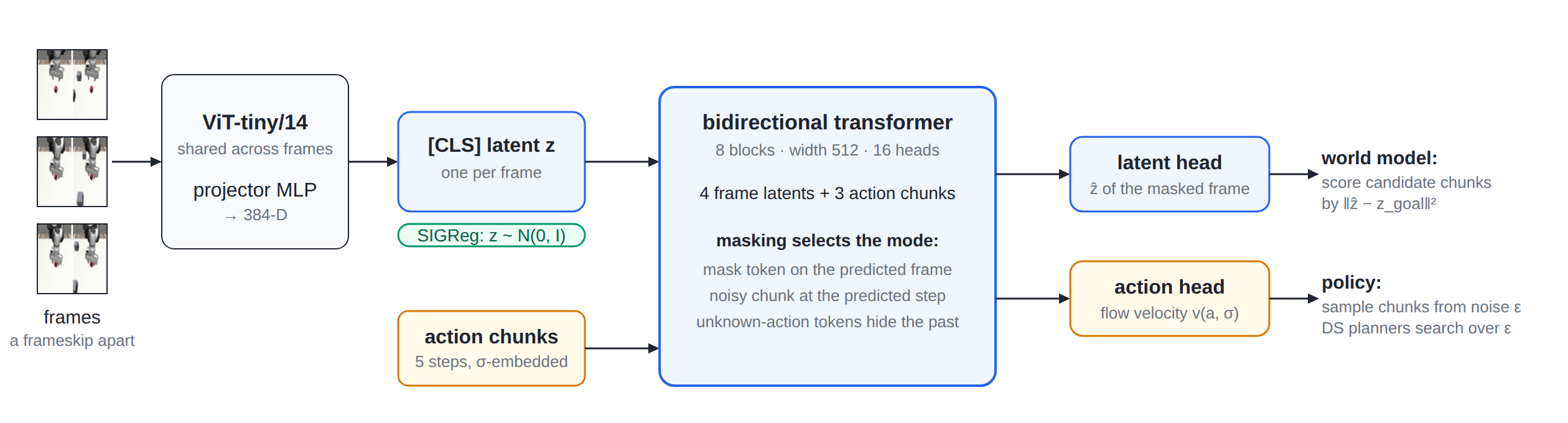
We use a multi-mode skeleton following UWM and Cosmos Policy. This model operates like the predictor in LeWM ( Figure 1 ). A training window contains four frames, $o_{t-2:t+1}$, at a frameskip of five, and the three 5-step action chunks between them, $a_{t-2:t}\in\mathbb{R}^{A}$.
The chunk dimension $A$ is five steps times the per-step action dimension ($A=10$ on PushT, $35$ on robomimic, $70$ on Transport), z-scored per dimension.
Diffusion steering: planning in the policy’s noise space
Given context $\mathbf{z}_{t}$ and a goal latent $z_{g}$ retrieved from a demonstration, following [ 40 , 24 ] , we score a chunk $a$ by with $\hat{f}$ the forward mode, and minimize it over $H$ chunks by a sampling-based planner.
The latter proposes $S$ plans, scores each on its rolled-out final latent, updates the distribution, repeats this process $I$ times, and executes the chosen plan’s first chunk before replanning. The update rule defines the planner. Sampling-based MPCs originally search over raw actions $a_{1:H}\in\mathbb{R}^{AH}$.
Experiments and Results
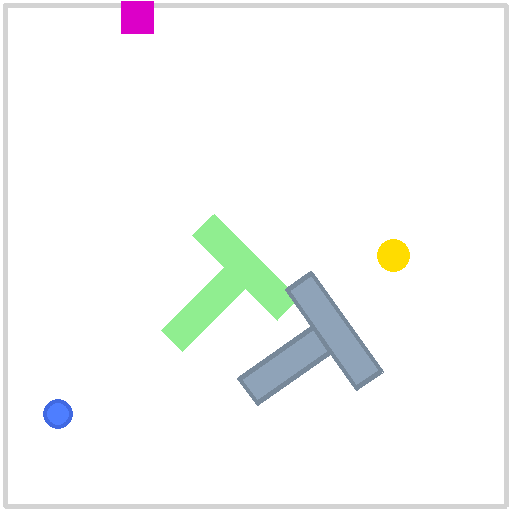
PushT [ 10 , 7 ] : a circular agent pushes a T-shaped block to a fixed target pose; actions are absolute target positions at 10 Hz in chunks of five. We use the 206 human demonstrations of Chi et al. [7] and paint two distractors that are independent of the actions: a dot on a Lissajous curve and a bar sliding along the top edge.
robomimic [ 25 ] : Lift, Can, Square, ToolHang and Transport, using the benchmark’s 200 proficient-human demonstrations replayed in robosuite.
Sources and Demonstrations
Figures are reproduced from Hegde et al. See the full paper for experimental details and the project page, when the paper links one, for demonstrations and videos.
Related Papers

Aim Short to Reach Far: Your Frozen World Model Can Plan Better Than You Think
Xvyuan Liu, Jianjie Fang, Chen Gao et al.
Planners built on visual world models commonly score each predicted outcome by its distance to the encoded goal image. We show that this target can limit control even with exact dynamics and globally optimal short-horizon search: reaching a goal may require actions that initially move away from it.
End-to-End Vision-Language-Action Policies for Autonomous Lunar Rover Docking
Sitan Huang, Grace Gao
Surface navigation on the Moon is subject to extreme illumination contrast and deployment-time perceptual disturbances.
Generalizable Robustness Testing of DNN-Based Robotic Navigation Systems via XAI-Guided Search
Khizra Sohail, Miren Illarramendi, Aitor Arrieta
**Context:** Deep Neural Networks (DNNs) increasingly control Cyber-Physical Systems (CPSs), yet small input perturbations can cause unsafe system-level behavior.
Has GPT-6-Astra Achieved Embodied Intelligence?
SenseNova, Joint Research Team, : et al.
GPT-6-Astra demonstrates a level of competence in robotic manipulation and navigation that challenges the conventional paradigm of building specialized models for individual tasks and embodiments.