
Contact as a Decision Variable: Capability-Tradeoff Contact Selection for Legged Loco-Manipulation
Al Jaber Mahmud, Shuai Li, Xuan Wang · N/A · 2026
Framework
N/A
License
N/A
Stars
N/A
Summary
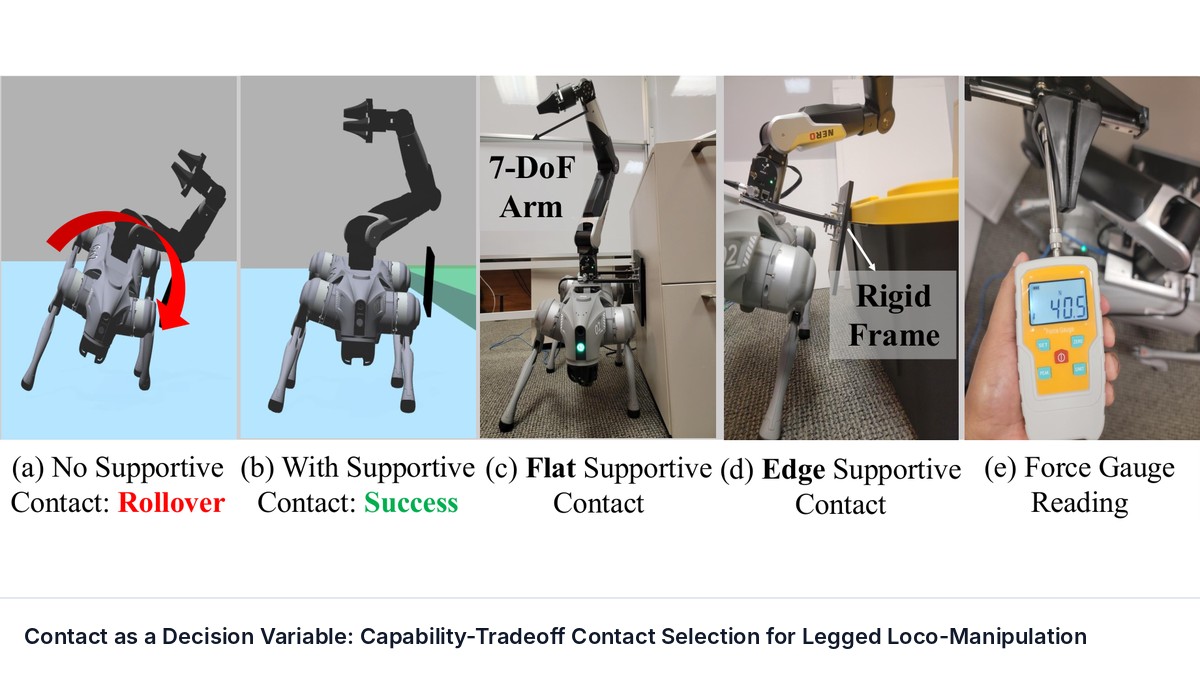
In this paper, we study the joint selection of an environmental support contact and a whole-body configuration for a prescribed loco-manipulation task. A contact may provide greater physical support while restricting the motion required for the task.
Abstract Summary
Key Points
- In this paper, we study the joint selection of an environmental support contact and a whole-body configuration for a prescribed loco-manipulation task.
- A contact may provide greater physical support while restricting the motion required for the task
- We formulate this problem through three capability measures: residual wrench, end-effector reach, and base mobility available after satisfying the task requirements, and we balance them against contact acquisition cost.
- Evaluating these capabilities for every candidate requires repeated whole-body optimizations
- To reduce this computational cost, we propose Capability-Tradeoff Contact Selection (CTCS)
Literature Review
Legged mobile manipulators typically rely on stance-foot contacts for whole-body support [ 6 , 7 , 8 , 9 ] . Additional contacts with environmental structures have also been investigated for humanoid and legged robots [ 10 , 11 ] , as hand and body contacts with environments can help humanoid robots maintain or recover balance under disturbances [ 12 , 13 , 14 ] .
Preliminaries and Problem Formulation
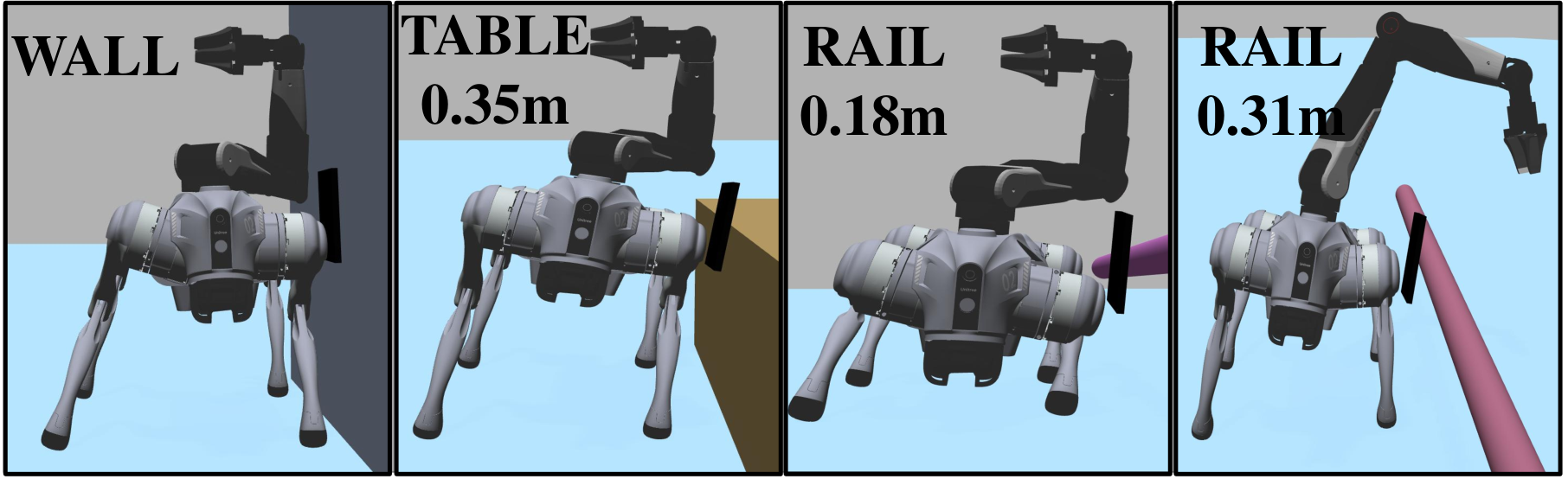
We consider a quadruped mobile manipulator that can use environmental surfaces as additional physical support during a loco-manipulation task. Our objective is to select an environmental contact and whole-body configuration that satisfy the task’s load and motion requirements while providing a favorable trade-off among the capabilities available under the task load.
We first introduce the robot and contact models, then define the task requirements and capability measures, and finally formulate the joint selection problem.
Methodology
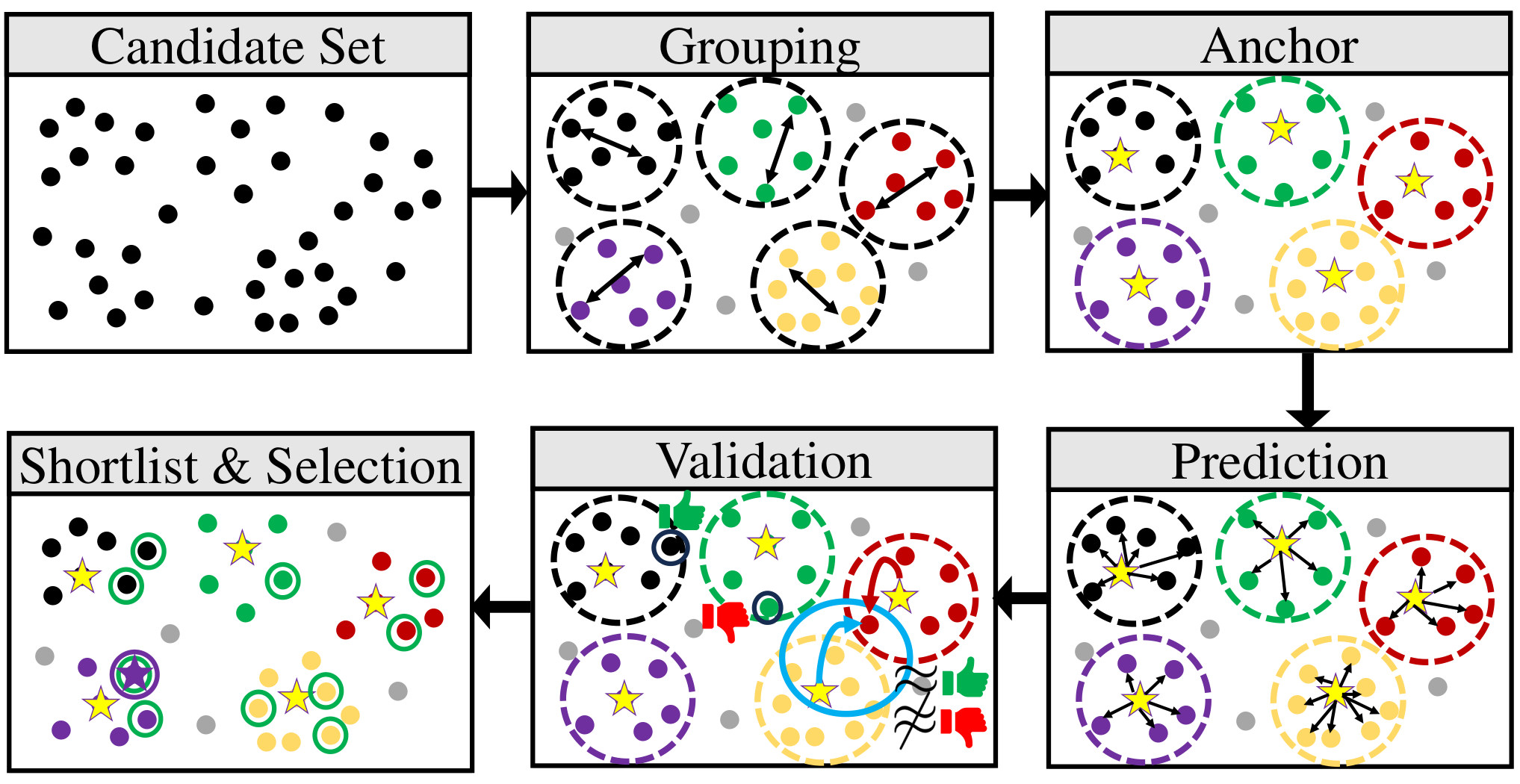
Evaluating the capability vector $\xi(\chi)$ exactly for every candidate requires solving many whole-body optimization problems across the task-applicable capabilities and stance phases. To address this, we propose Capability-Tradeoff Contact Selection (CTCS), which combines exact feasibility screening, local sensitivity-based capability prediction, and selective exact evaluation. As visualized in Fig.
Experiments and Results
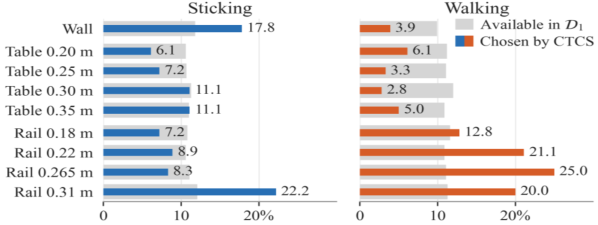
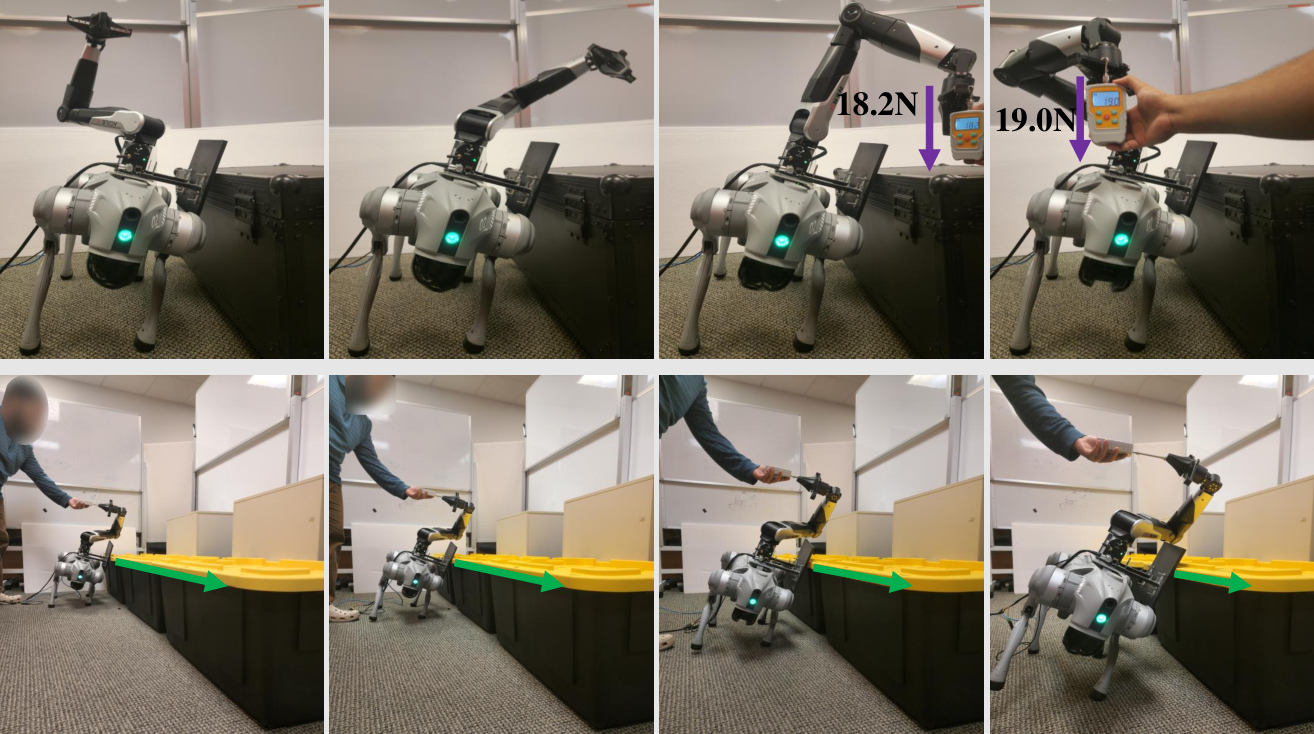
We evaluate CTCS on a quadruped mobile manipulator in environments where multiple support surfaces are available. We assess the contact selection quality, computational cost, and task performance, and compare them with baselines. The validation is performed on both Gazebo simulations and hardware experiments. Hardware and Environment Setup.
We use a Unitree Go2 quadruped equipped with an AgileX NERO 7-DoF manipulator and a rigid planar support frame mounted on the side of its body for establishing environmental contact (Fig. 1 ).
Sources and Demonstrations
Figures are reproduced from Mahmud et al. See the full paper for experimental details and the project page, when the paper links one, for demonstrations and videos.
Related Papers
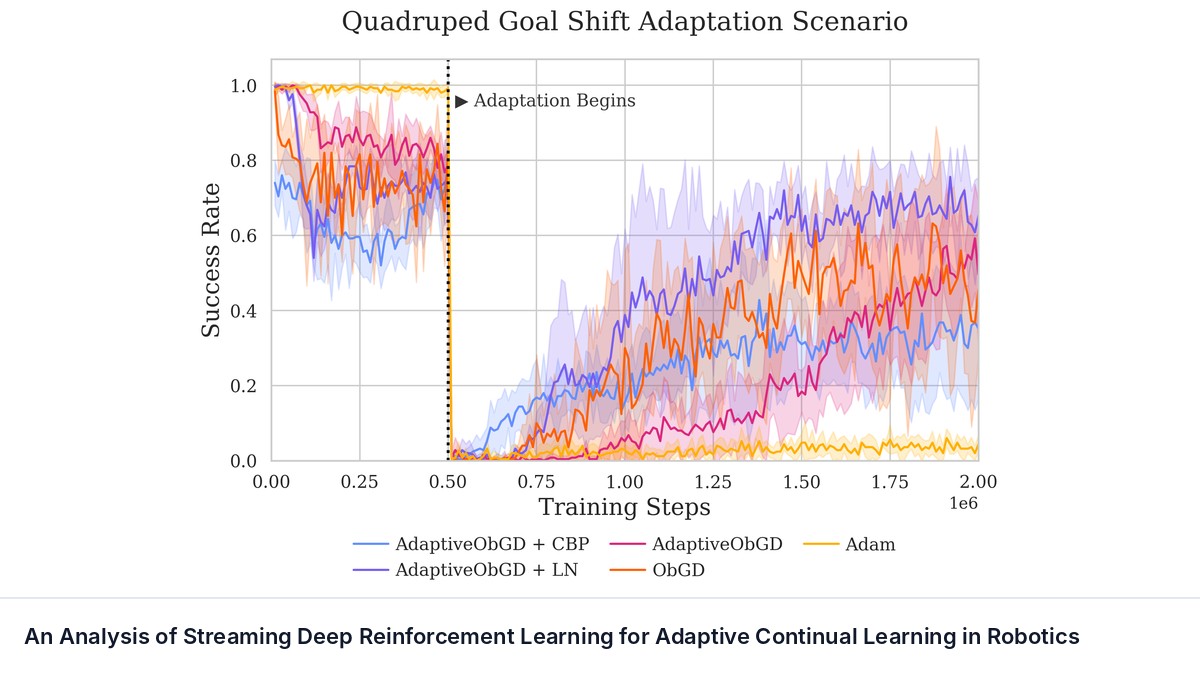
An Analysis of Streaming Deep Reinforcement Learning for Adaptive Continual Learning in Robotics
Teeratham Vitchutripop, Alyssa Quarles, Wenhe Zhang et al.
Over the course of a lifetime, robots may encounter novel scenarios unaccounted for in its original training that result in performance degradation. One common approach to mitigating this issue is to further grow the offline training dataset in hopes of producing a policy robust to these changes.
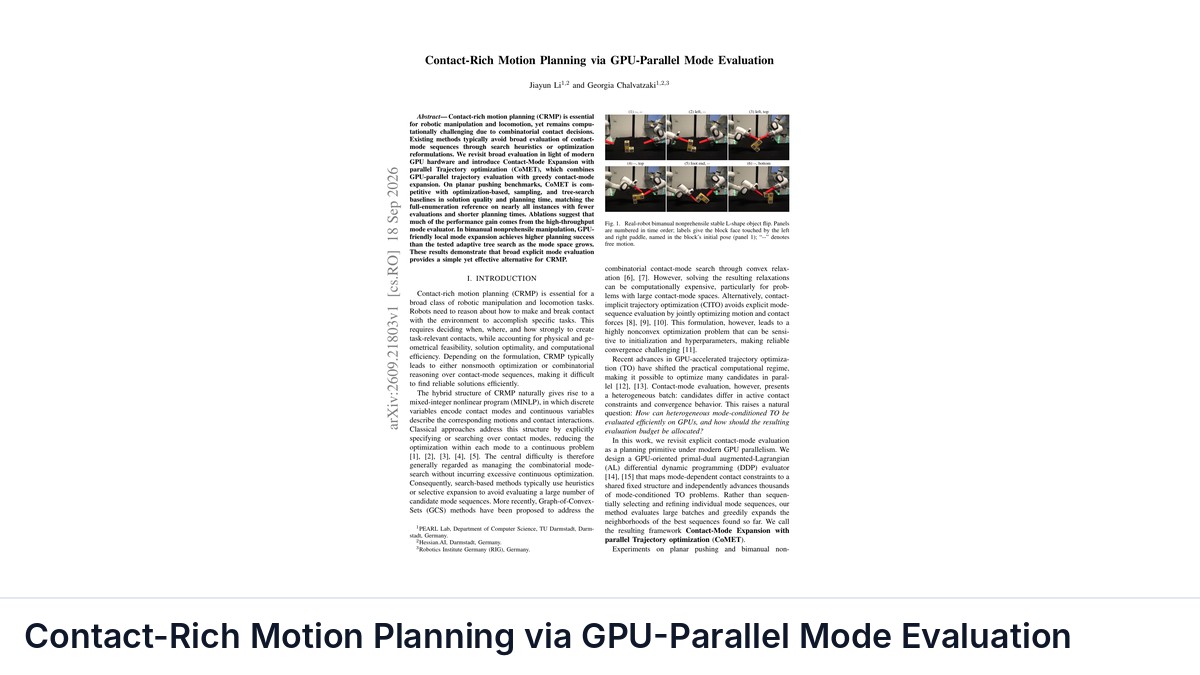
Contact-Rich Motion Planning via GPU-Parallel Mode Evaluation
Jiayun Li, Georgia Chalvatzaki
Contact-rich motion planning (CRMP) is essential for robotic manipulation and locomotion, yet remains computationally challenging due to combinatorial contact decisions.
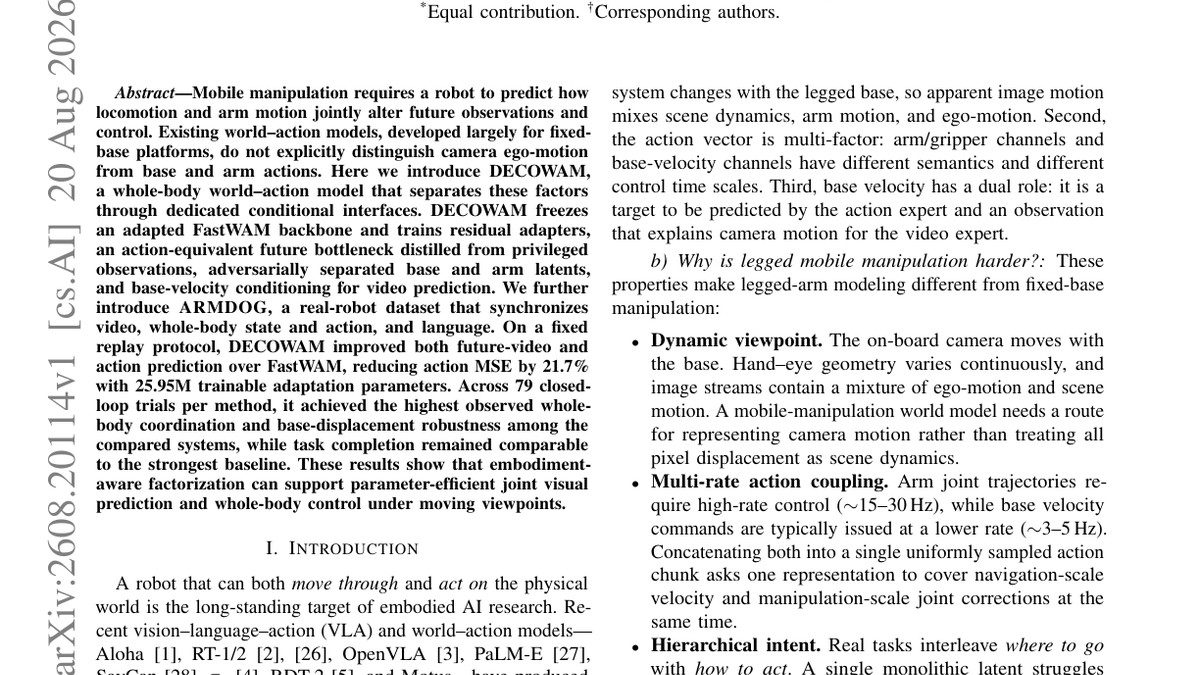
DECOWAM: Decoupled Whole-Body World-Action Model for Legged Mobile Manipulation
Siyuan Ma, Boshi Zhang, Yutian Zhang et al.
Mobile manipulation requires a robot to predict how locomotion and arm motion jointly alter future observations and control. Existing world-action models, developed largely for fixed-base platforms, do not explicitly distinguish camera ego-motion from base and arm actions.
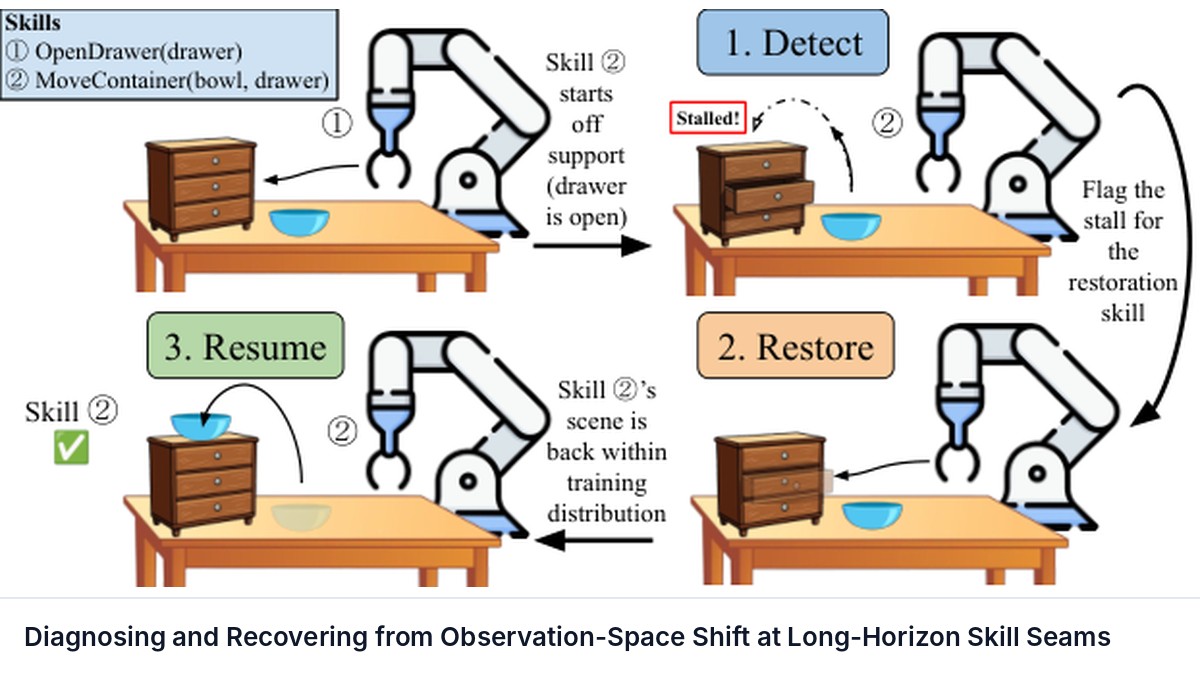
Diagnosing and Recovering from Observation-Space Shift at Long-Horizon Skill Seams
Pranav Wagh, Yu Fang, Yue Yang et al.
Long-horizon robotic manipulation is often built by chaining independently trained skills.