
Diagnosing and Recovering from Observation-Space Shift at Long-Horizon Skill Seams
Pranav Wagh, Yu Fang, Yue Yang, Mingyu Ding · N/A · 2026
Framework
N/A
License
N/A
Stars
N/A
Summary
Long-horizon robotic manipulation is often built by chaining independently trained skills.
Abstract Summary
Key Points
- Long-horizon robotic manipulation is often built by chaining independently trained skills
- Although each skill can be reliable in isolation, performance degrades sharply when skills are chained: each downstream skill must start from the state its predecessor leaves behind rather than from its training distribution.
- We study this failure mode, Observation-Space Shift (OSS), and ask what causes these skill-seam failures.
- Using privileged simulator resets, we find that the dominant shift comes from displaced scene state (e.g., an open drawer or secondary objects left behind by earlier skills), not from the robot's joint configuration or the object the downstream skill manipulates.
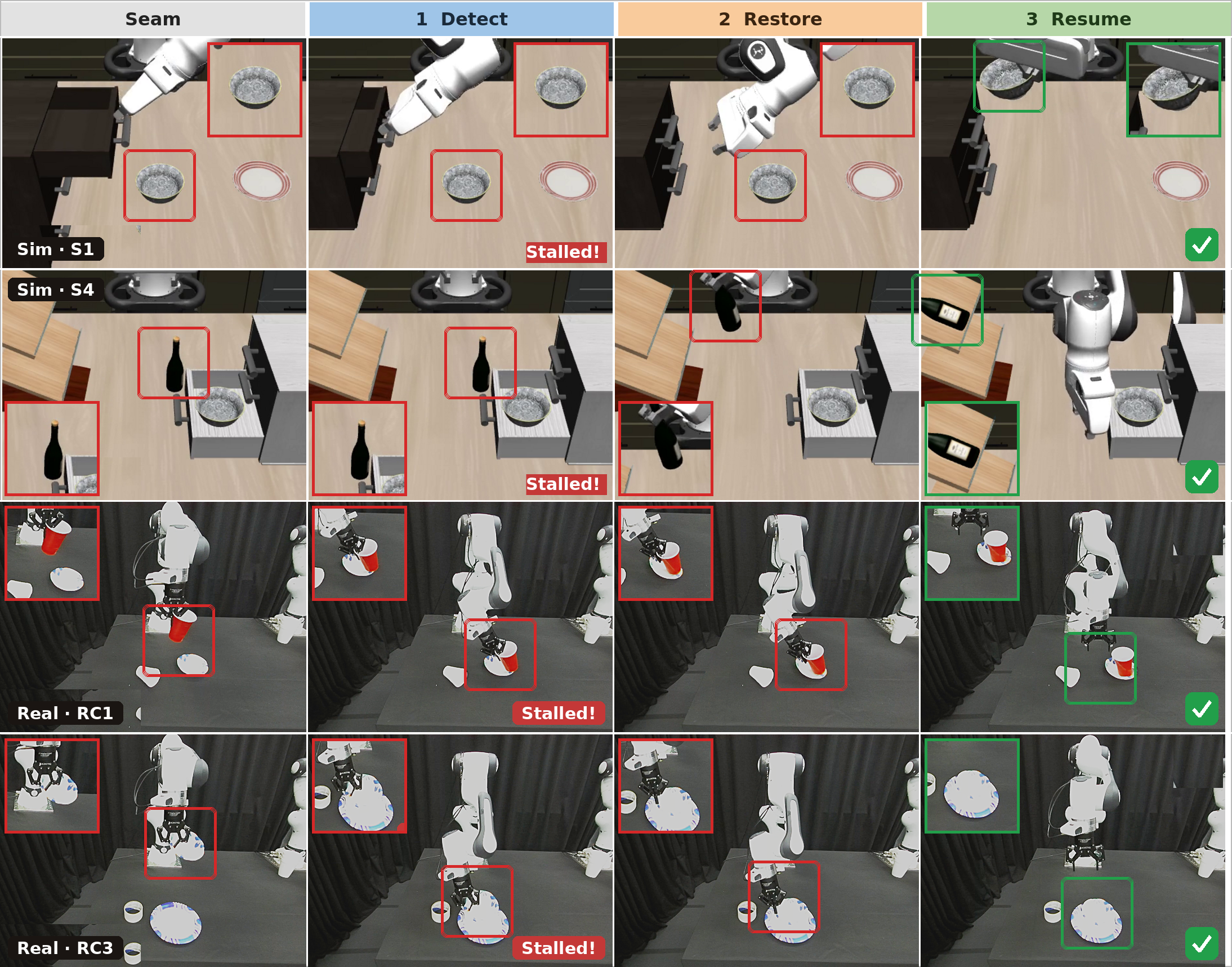
- To test this diagnosis, we build a fully learned detect-restore-resume system: a task-progress monitor detects the stall, a learned policy restores the displaced scene components, and seam-robust fine-tuning lets the skill resume.
Problem Formulation
Setting. We study three-skill chains on BOSS-44, a benchmark of $44$ kitchen and living-room manipulation tasks drawn from LIBERO-90 [ 1 ] . Tasks are simulated in robosuite [ 39 ] on the MuJoCo physics engine [ 40 ] , with a $7$-DOF Panda under $20$ Hz OSC delta control. A chain $\mathrm{ch3}\_N$ is an ordered triple of BOSS-44 tasks run in one continuous episode.
For example, $\mathrm{ch3}\_2$ is open the drawer $\to$ place the bowl on the plate $\to$ place the bowl in the cabinet .
Method: Detect, Restore, Resume
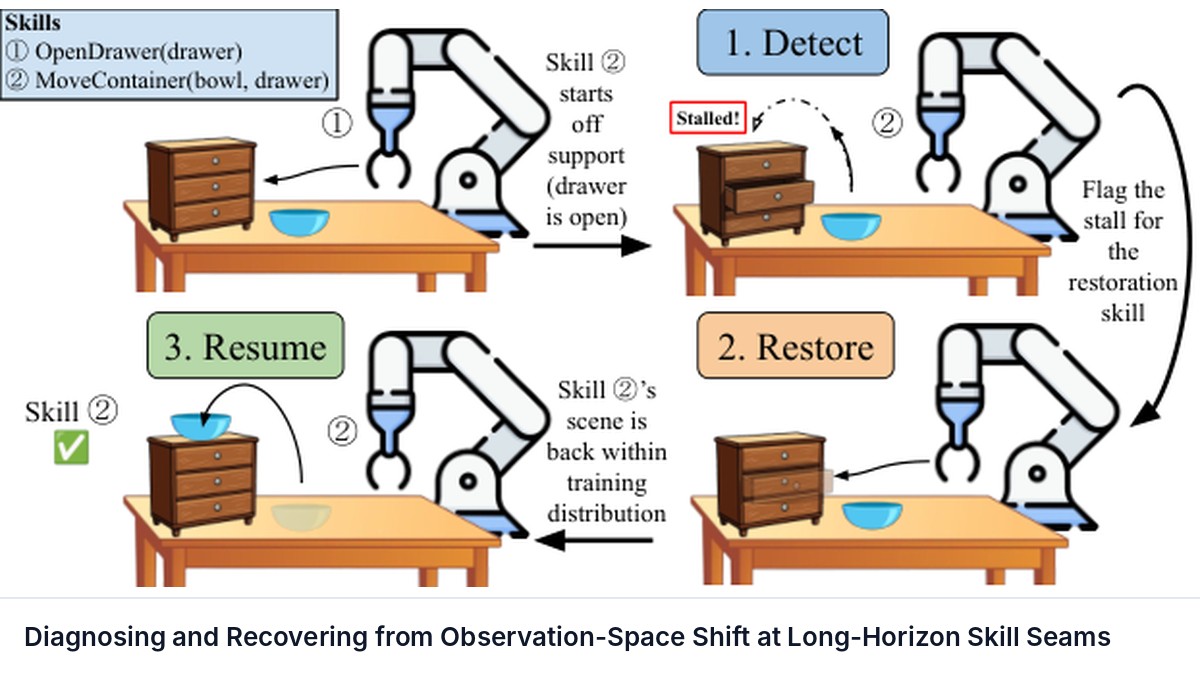
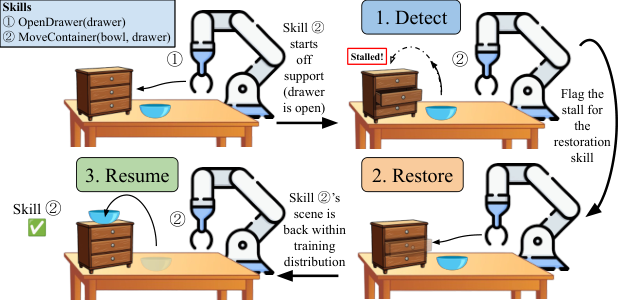
Recovering a chained skill requires noticing it was stalled, putting the scene back on-support, and letting the skill tolerate an imperfect hand-back. We add one learned component for each, detect , restore , and resume , leaving the base skills frozen. All three read only deployable inputs (RGB cameras and proprioception; Fig. 1 ). Detect answers one question: has the current skill stopped making progress?
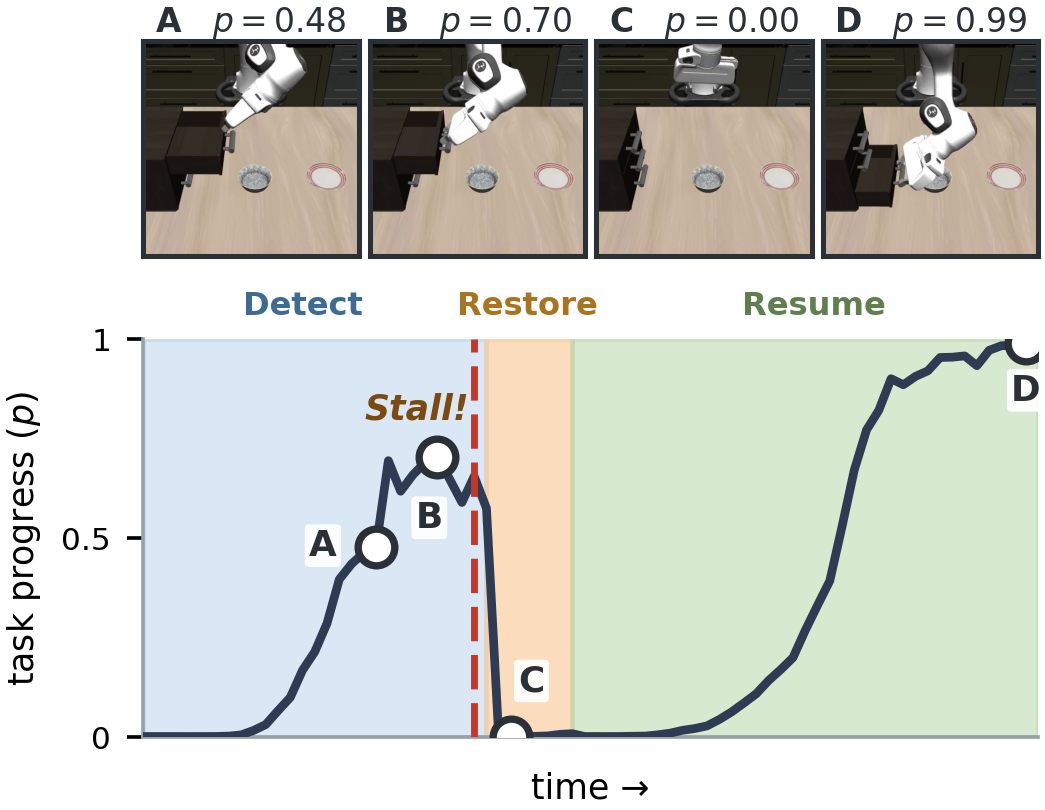
A task-progress head scores each frame’s position within a skill, and the trigger fires when that score stops rising (Fig. 3 ).
Experiments
Metrics. Detection is scored by the AUROC of the alarm statistic over per-seam windows. Overview. We structure the evaluation by first localizing what causes seam collapse and must be restored (Sec. V-A ). We then show that no simpler alternative, like test-time compute, a stronger base policy, or a world model, recovers it (Sec. V-B ). We then present the deployed detect–restore–resume system and its recovery (Sec.
V-C ). Finally, we analyze when restoration is the right action, and why (Sec. V-D ).
Sources and Demonstrations
Figures are reproduced from Wagh et al. See the full paper for experimental details and the project page, when the paper links one, for demonstrations and videos.
Related Papers
DECOWAM: Decoupled Whole-Body World-Action Model for Legged Mobile Manipulation
Siyuan Ma, Boshi Zhang, Yutian Zhang et al.
Mobile manipulation requires a robot to predict how locomotion and arm motion jointly alter future observations and control. Existing world-action models, developed largely for fixed-base platforms, do not explicitly distinguish camera ego-motion from base and arm actions.
DUET: Decoupled Upper- and Lower-Body Execution for Task-Agnostic Humanoid Loco-Manipulation
Kapalik Khanal, Biswash Khatiwada, Stephen Afrifa et al.
Changing a humanoid robot's manipulation policy should not require retraining the controller that maintains the robot's balance.
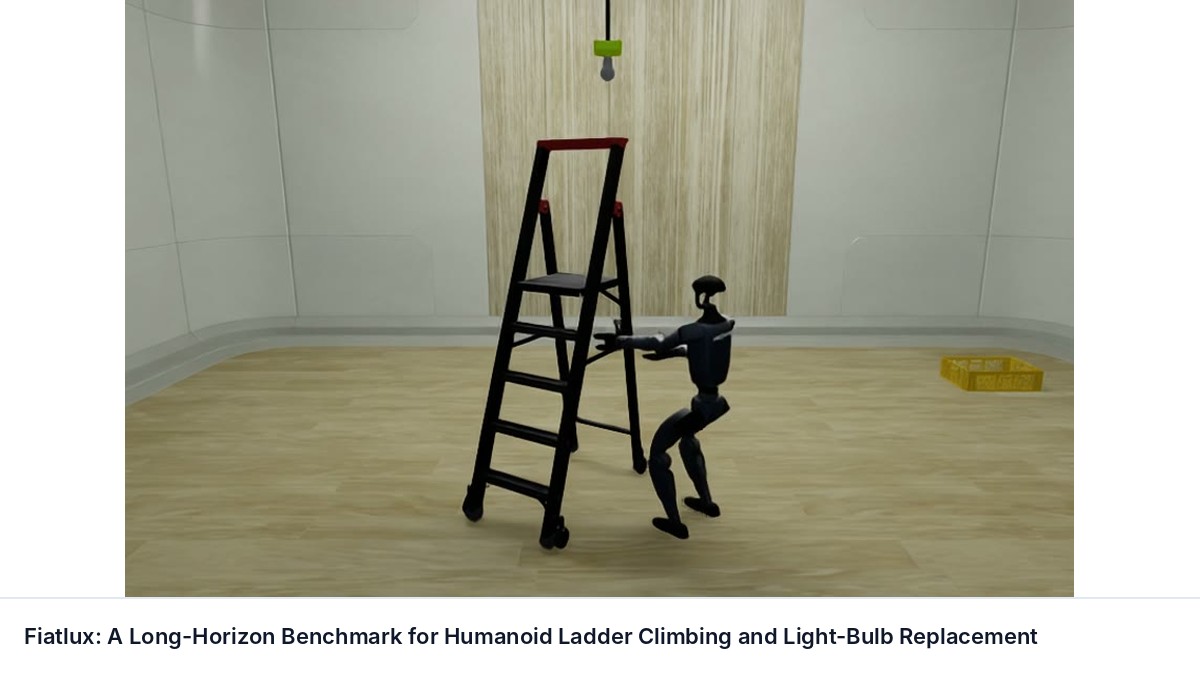
Fiatlux: A Long-Horizon Benchmark for Humanoid Ladder Climbing and Light-Bulb Replacement
Pavel Bushuyeu, Yujin Chen, Anton Nikolaev et al.
Existing benchmarks evaluate tabletop manipulation, flat-floor household activity, or humanoid locomotion and manipulation as separate task groups; none scores vertical mobility and dexterous work on a fragile payload in one long-horizon episode.
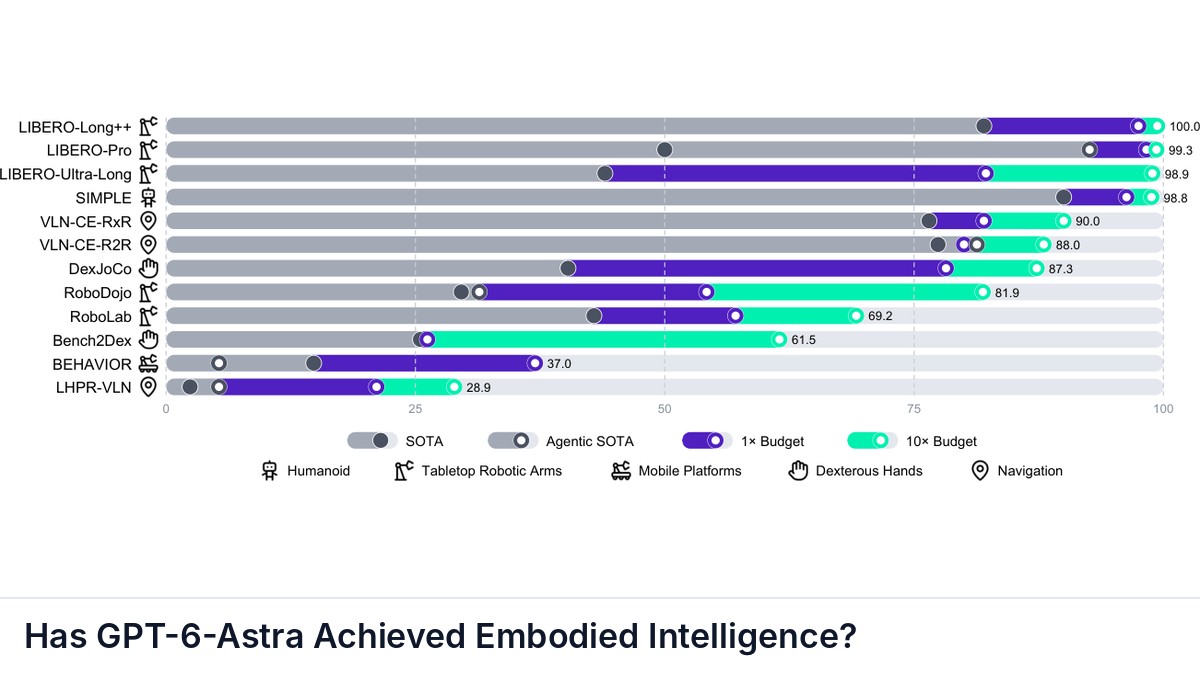
Has GPT-6-Astra Achieved Embodied Intelligence?
SenseNova, Joint Research Team, : et al.
GPT-6-Astra demonstrates a level of competence in robotic manipulation and navigation that challenges the conventional paradigm of building specialized models for individual tasks and embodiments.