
An Analysis of Streaming Deep Reinforcement Learning for Adaptive Continual Learning in Robotics
Teeratham Vitchutripop, Alyssa Quarles, Wenhe Zhang, Richard Xue, Daniel Rakita · N/A · 2026
Framework
N/A
License
N/A
Stars
N/A
Summary
Over the course of a lifetime, robots may encounter novel scenarios unaccounted for in its original training that result in performance degradation. One common approach to mitigating this issue is to further grow the offline training dataset in hopes of producing a policy robust to these changes.
Abstract Summary
Key Points
- Over the course of a lifetime, robots may encounter novel scenarios unaccounted for in its original training that result in performance degradation.
- One common approach to mitigating this issue is to further grow the offline training dataset in hopes of producing a policy robust to these changes.
- In contrast, biological learning occurs moment-to-moment via a stream of experience, unlike the predominantly batch-based and offline nature of deep learning.
- Although recent works show the feasibility of stream-based deep reinforcement learning, where updates use only the latest experience, none have shown it to be a viable continual learning framework for adapting robotic policies to unseen changes.
- In this paper, we present the first analysis of streaming deep reinforcement learning for adaptive continual learning in robotics.
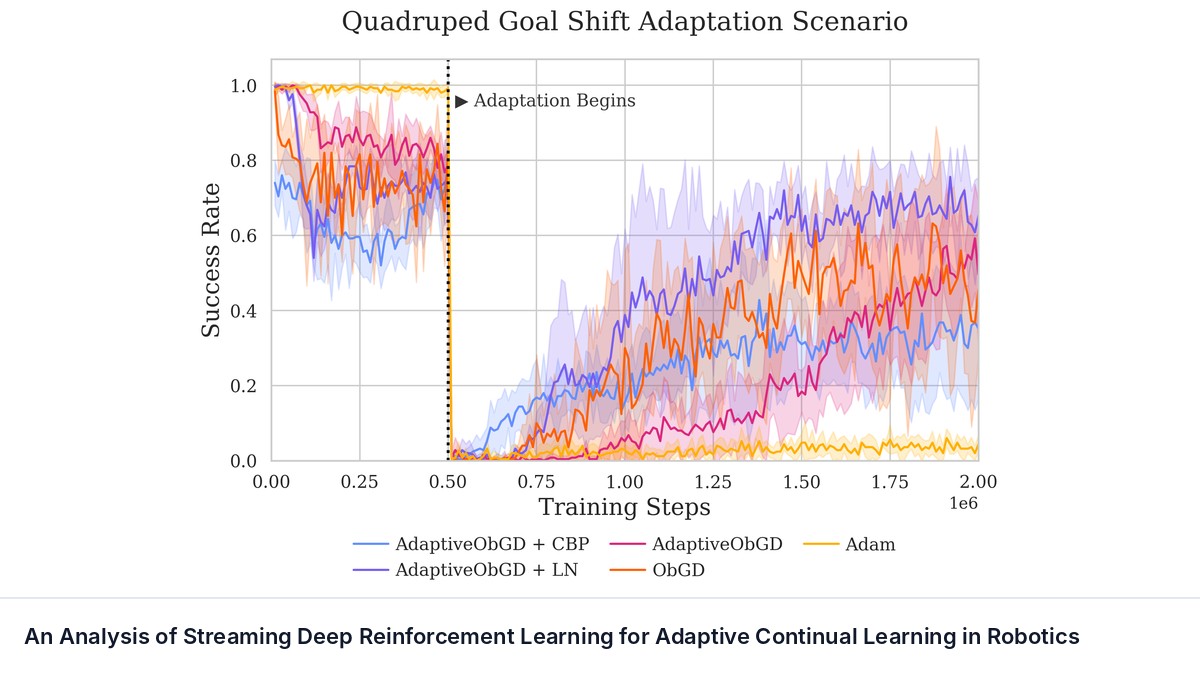
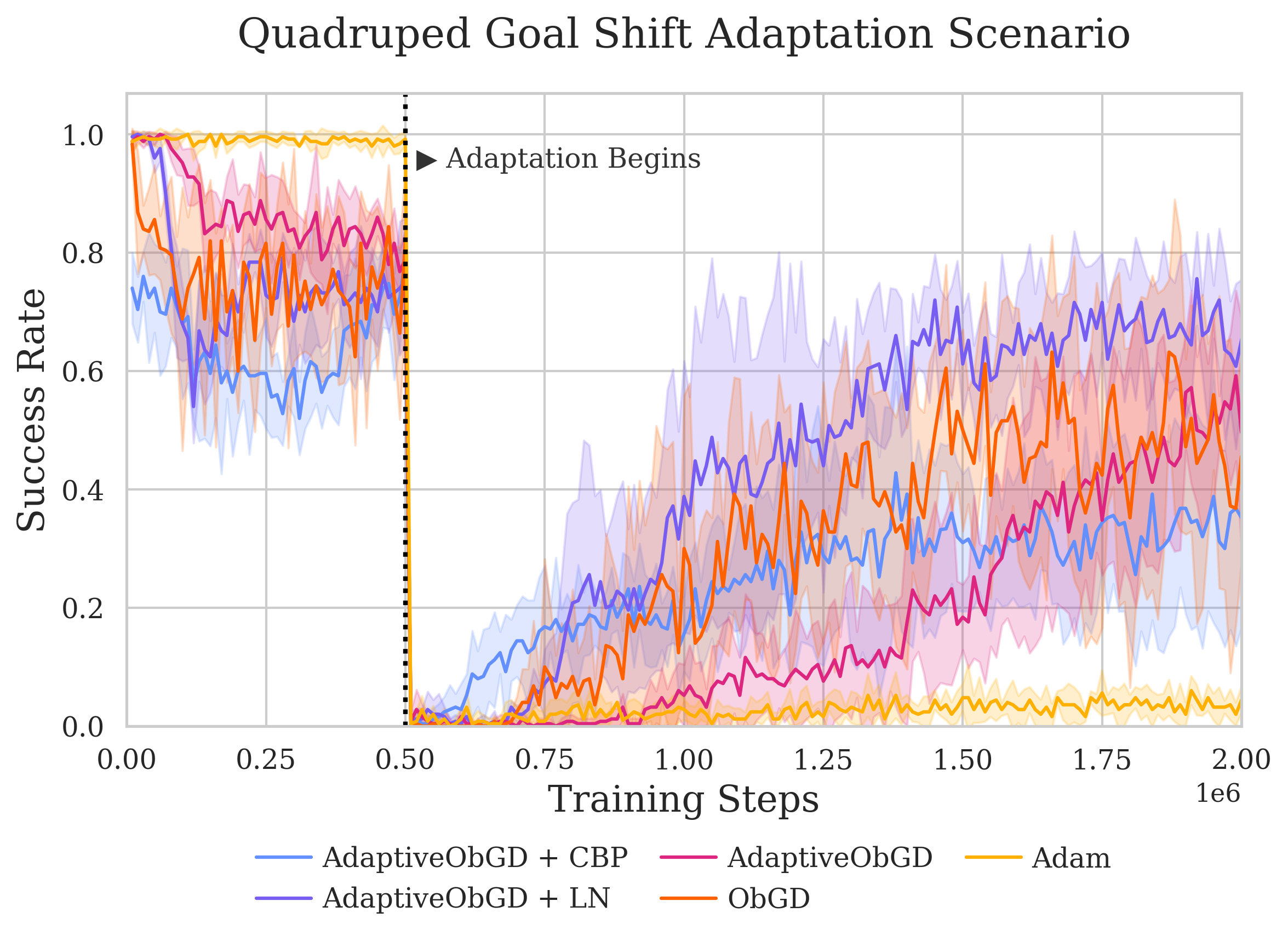
Analysis on Quadruped Locomotion
Our primary analysis is a series of experiments conducted within quadruped locomotion that 1) demonstrate the potential capabilities of streaming deep RL for enabling continual robotic adaptation and 2) analyze how the choice of certain optimizers or plasticity loss mitigation techniques can affect adaptation performance. For all policy training, PyTorch was used as the machine learning framework.
Analysis on Other Robotic Environments
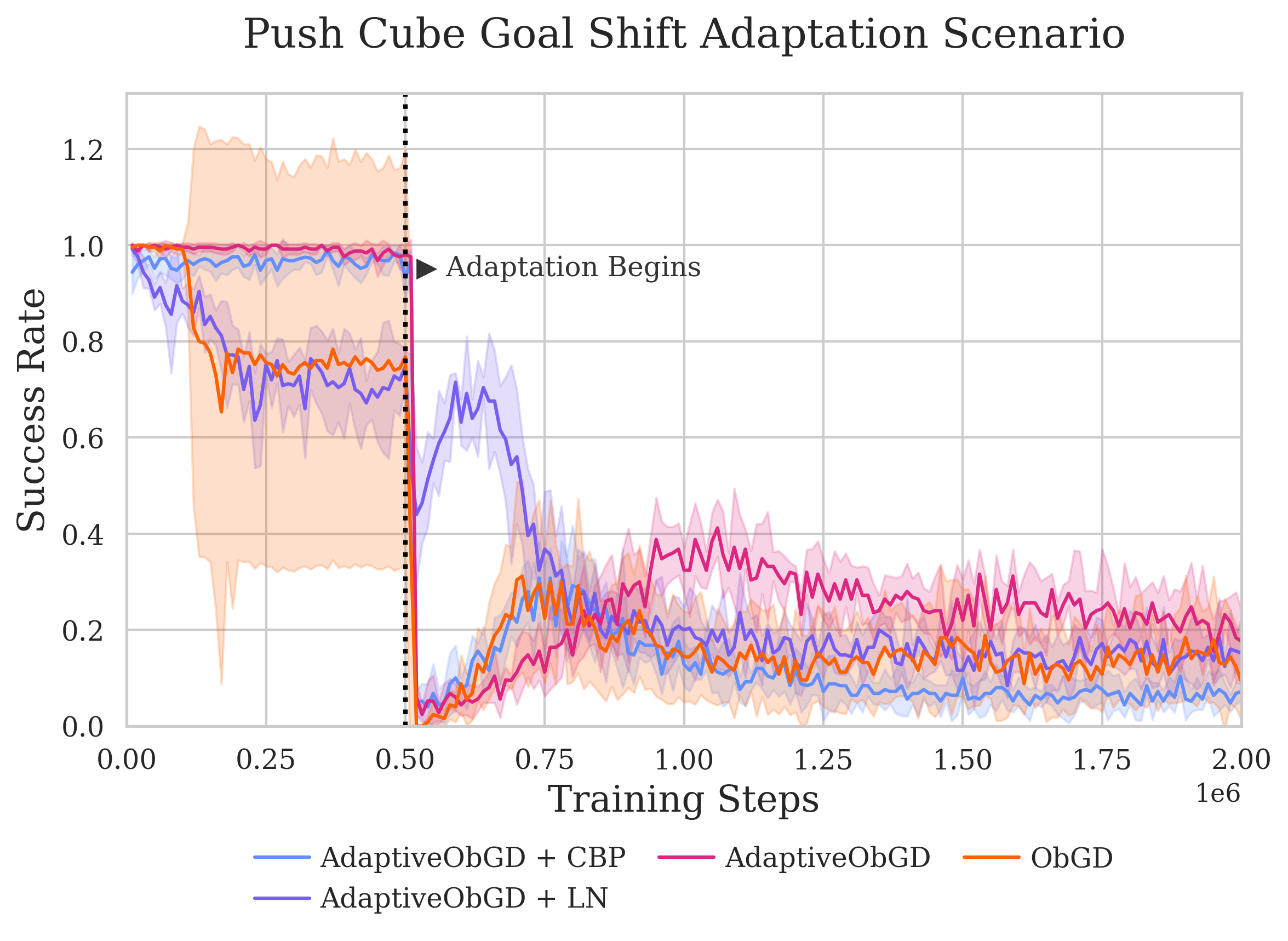
We conduct a series of experiments in robotic manipulation environments to see whether our previous observations about the performance of streaming deep RL for adaptation in quadruped locomotion hold with a different task space and robotic morphology. Note that we follow the same experimental setup as defined previously in § IV-A .
Our subsequent analyses are performed on two object manipulation tasks with different robot embodiments in ManiSkill3 [ 23 ] .
Sources and Demonstrations
Figures are reproduced from Vitchutripop et al. See the full paper for experimental details and the project page, when the paper links one, for demonstrations and videos.
Related Papers
Contact as a Decision Variable: Capability-Tradeoff Contact Selection for Legged Loco-Manipulation
Al Jaber Mahmud, Shuai Li, Xuan Wang
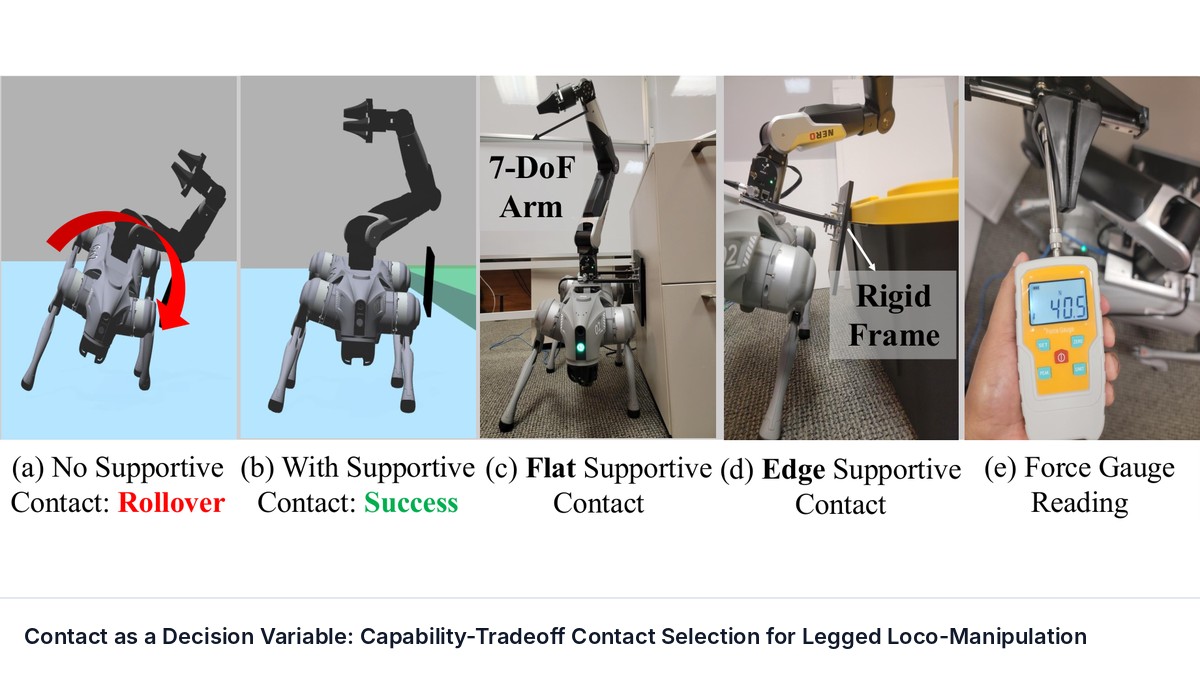
In this paper, we study the joint selection of an environmental support contact and a whole-body configuration for a prescribed loco-manipulation task. A contact may provide greater physical support while restricting the motion required for the task.
Contact-Rich Motion Planning via GPU-Parallel Mode Evaluation
Jiayun Li, Georgia Chalvatzaki
Contact-rich motion planning (CRMP) is essential for robotic manipulation and locomotion, yet remains computationally challenging due to combinatorial contact decisions.
DECOWAM: Decoupled Whole-Body World-Action Model for Legged Mobile Manipulation
Siyuan Ma, Boshi Zhang, Yutian Zhang et al.
Mobile manipulation requires a robot to predict how locomotion and arm motion jointly alter future observations and control. Existing world-action models, developed largely for fixed-base platforms, do not explicitly distinguish camera ego-motion from base and arm actions.
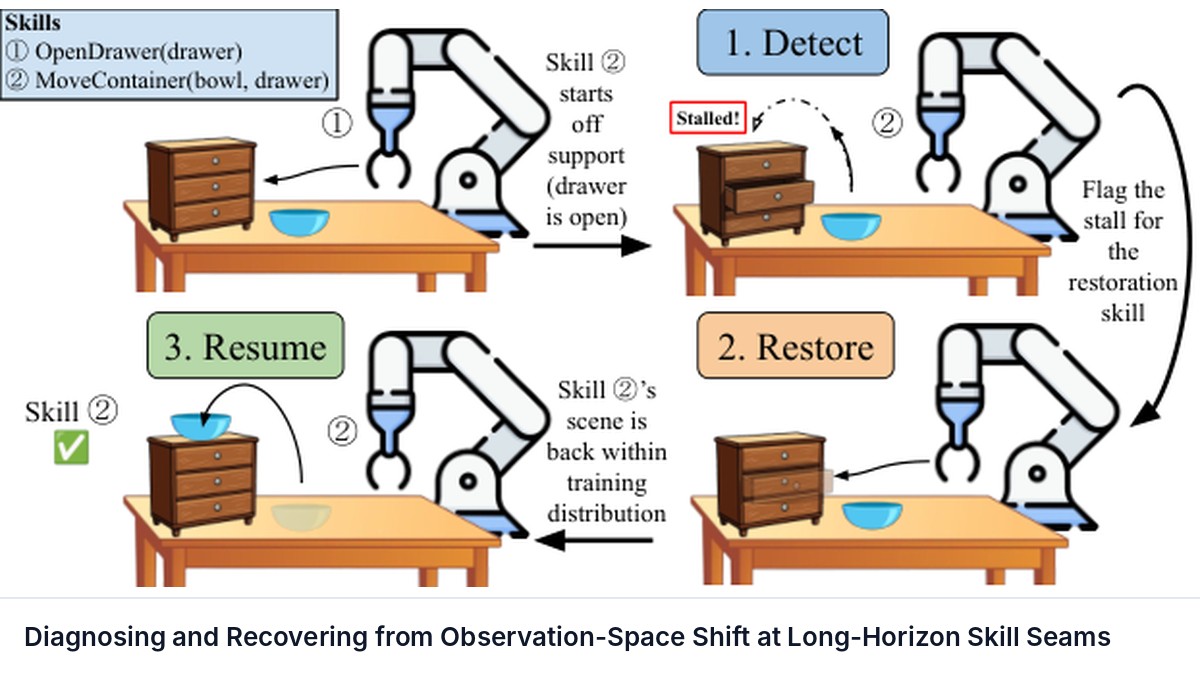
Diagnosing and Recovering from Observation-Space Shift at Long-Horizon Skill Seams
Pranav Wagh, Yu Fang, Yue Yang et al.
Long-horizon robotic manipulation is often built by chaining independently trained skills.