
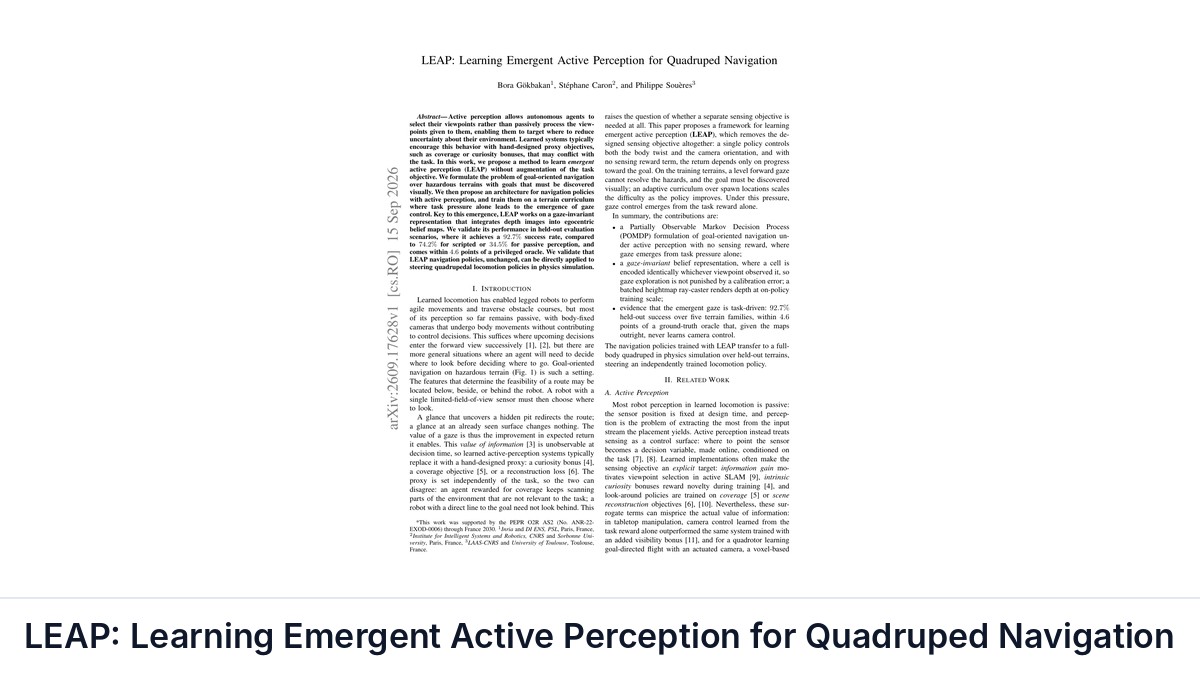
LEAP: Learning Emergent Active Perception for Quadruped Navigation
\"U. Bora G\"okbakan (WILLOW), St\'ephane Caron (ISIR), Philippe Sou\`eres (LAAS-GEPETTO) · N/A · 2026
Framework
N/A
License
N/A
Stars
N/A
Summary
Active perception allows autonomous agents to select their viewpoints rather than passively process the viewpoints given to them, enabling them to target where to reduce uncertainty about their environment.
Abstract Summary
Key Points
- Active perception allows autonomous agents to select their viewpoints rather than passively process the viewpoints given to them, enabling them to target where to reduce uncertainty about their environment.
- Learned systems typically encourage this behavior with hand-designed proxy objectives, such as coverage or curiosity bonuses, that may conflict with the task.
- In this work, we propose a method to learn emergent active perception (LEAP) without augmentation of the task objective.
- We formulate the problem of goal-oriented navigation over hazardous terrains with goals that must be discovered visually.
- We then propose an architecture for navigation policies with active perception, and train them on a terrain curriculum where task pressure alone leads to the emergence of gaze control.
LEAP: Learning Emergent Active Perception for Quadruped Navigation
|Authors: “U. Bora G”okbakan (WILLOW), St’ephane Caron (ISIR), Philippe Sou`eres (LAAS-GEPETTO)
|Venue: arXiv preprint | Year: 2026
|arXiv: 2609.17628
Abstract
Active perception allows autonomous agents to select their viewpoints rather than passively process the viewpoints given to them, enabling them to target where to reduce uncertainty about their environment. Learned systems typically encourage this behavior with hand-designed proxy objectives, such as coverage or curiosity bonuses, that may conflict with the task. In this work, we propose a method to learn emergent active perception (LEAP) without augmentation of the task objective. We formulate the problem of goal-oriented navigation over hazardous terrains with goals that must be discovered visually. We then propose an architecture for navigation policies with active perception, and train them on a terrain curriculum where task pressure alone leads to the emergence of gaze control. Key to this emergence, LEAP works on a gaze-invariant representation that integrates depth images into egocentric belief maps. We validate its performance in held-out evaluation scenarios, where it achieves a 92.7% success rate, compared to 74.2% for scripted or 34.5% for passive perception, and comes within 4.6 points of a privileged oracle. We validate that LEAP navigation policies, unchanged, can be directly applied to steering quadrupedal locomotion policies in physics simulation.
Key Contributions
- Active perception allows autonomous agents to select their viewpoints rather than passively proce…
- Learned systems typically encourage this behavior with hand-designed proxy objectives, such as co…
- In this work, we propose a method to learn emergent active perception (LEAP) without augmentation…
- We formulate the problem of goal-oriented navigation over hazardous terrains with goals that must…
- We then propose an architecture for navigation policies with active perception, and train them on…
Topics
- locomotion
- vision
- planning
- control
- benchmark
Code & Data
No code repository linked in paper metadata.
BibTeX
@article{(WILLOW)2026_260917628,
  title     = {LEAP: Learning Emergent Active Perception for Quadruped Navigation},
  author    = {\"U. Bora G\"okbakan (WILLOW) and St\'ephane Caron (ISIR) and Philippe Sou\`eres (LAAS-GEPETTO)},
  year      = {2026},
  eprint    = {2609.17628},
  archivePrefix = {arXiv},
  primaryClass  = {cs.RO},
  url       = {https://arxiv.org/abs/2609.17628}
}
Related Papers
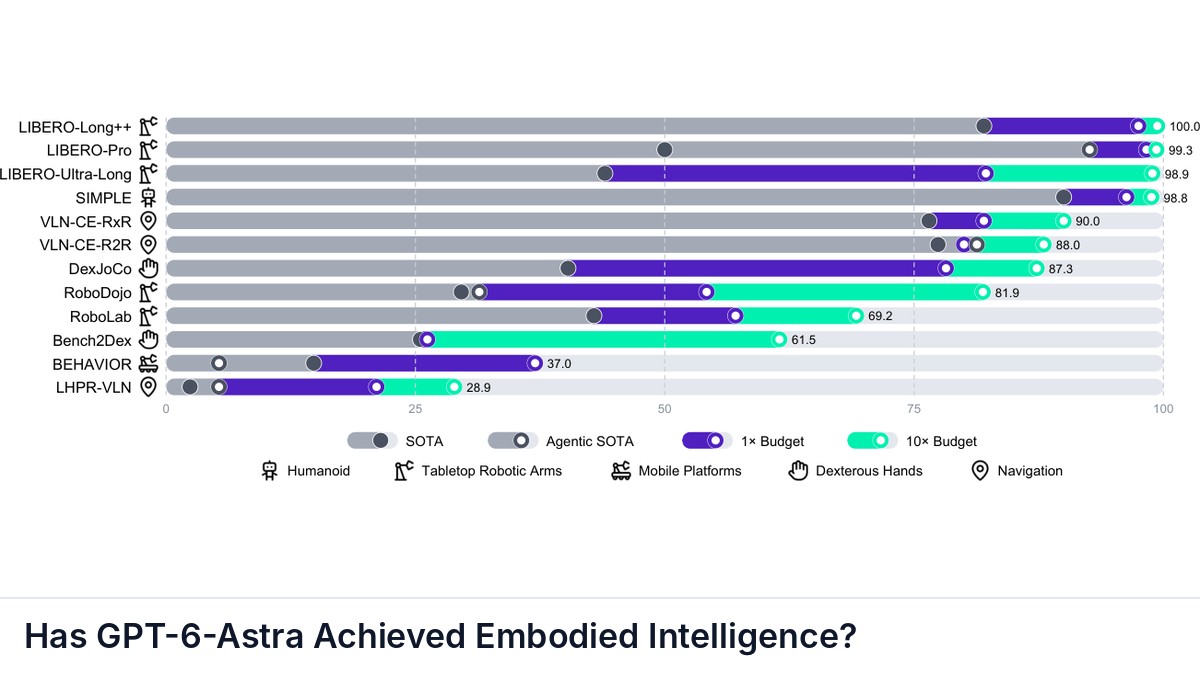
Has GPT-6-Astra Achieved Embodied Intelligence?
SenseNova, Joint Research Team, : et al.
GPT-6-Astra demonstrates a level of competence in robotic manipulation and navigation that challenges the conventional paradigm of building specialized models for individual tasks and embodiments.
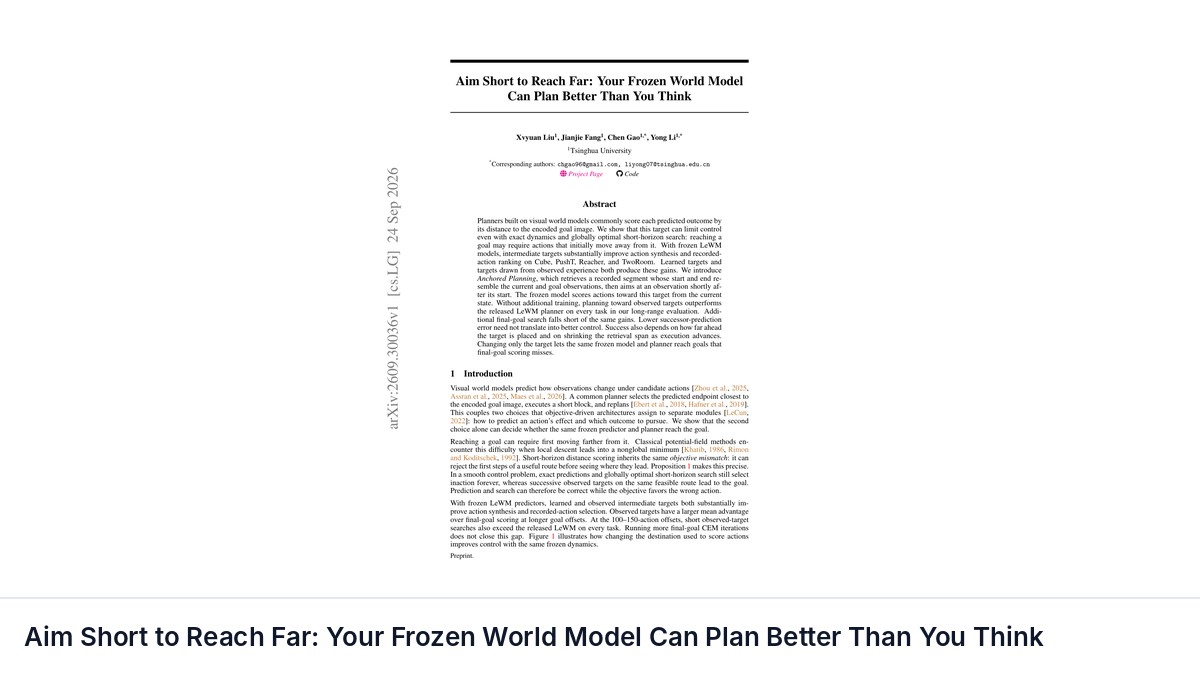
Aim Short to Reach Far: Your Frozen World Model Can Plan Better Than You Think
Xvyuan Liu, Jianjie Fang, Chen Gao et al.
Planners built on visual world models commonly score each predicted outcome by its distance to the encoded goal image. We show that this target can limit control even with exact dynamics and globally optimal short-horizon search: reaching a goal may require actions that initially move away from it.
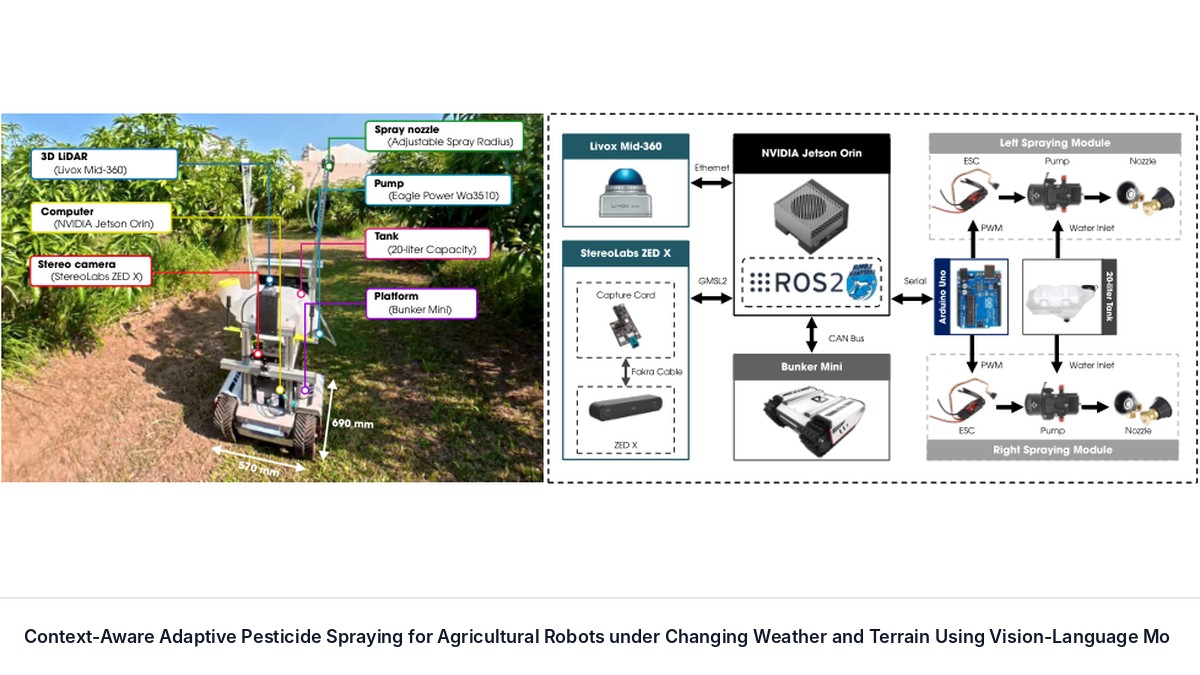
Context-Aware Adaptive Pesticide Spraying for Agricultural Robots under Changing Weather and Terrain Using Vision-Language Models
Cong-Thanh Vu, Yen-Chen Liu
Precision pesticide spraying is essential for optimizing application efficiency and ensuring uniform chemical distribution.
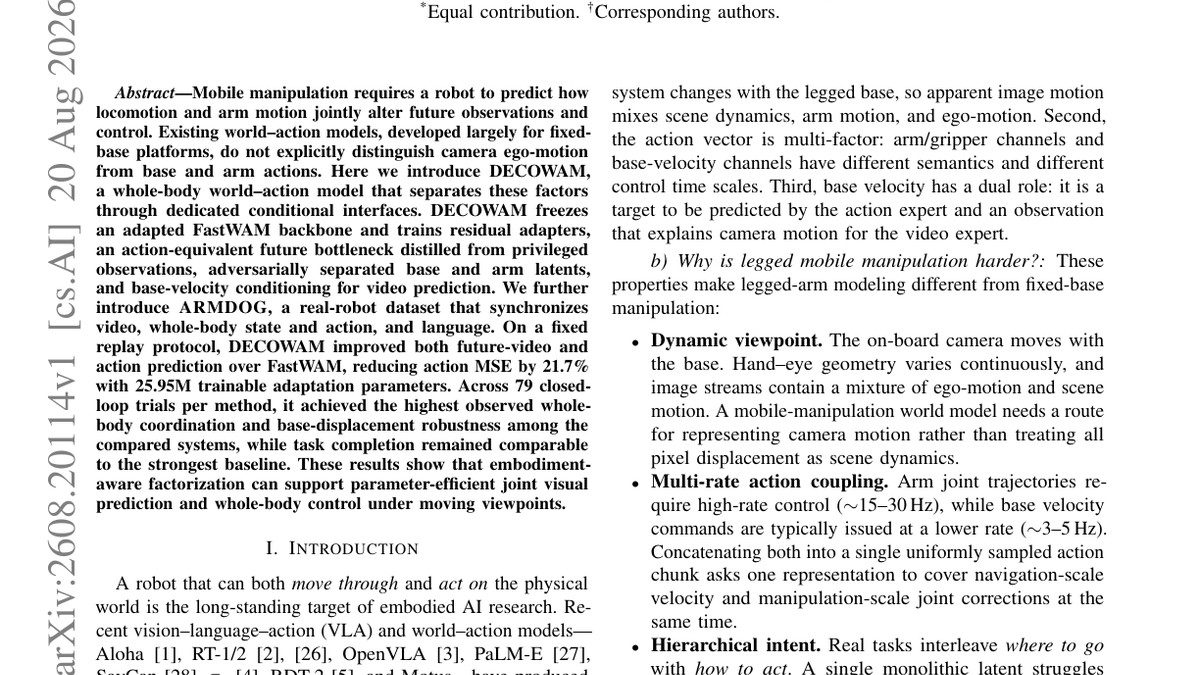
DECOWAM: Decoupled Whole-Body World-Action Model for Legged Mobile Manipulation
Siyuan Ma, Boshi Zhang, Yutian Zhang et al.
Mobile manipulation requires a robot to predict how locomotion and arm motion jointly alter future observations and control. Existing world-action models, developed largely for fixed-base platforms, do not explicitly distinguish camera ego-motion from base and arm actions.