
Temporal Learning for End-Effector Position Estimation under Aerodynamic Disturbances in Aerial Continuum Manipulation
Niloufar Amiri, Houman Masnavi, Farrokh Janabi-Sharifi · N/A · 2026
Framework
N/A
License
N/A
Stars
N/A
Summary
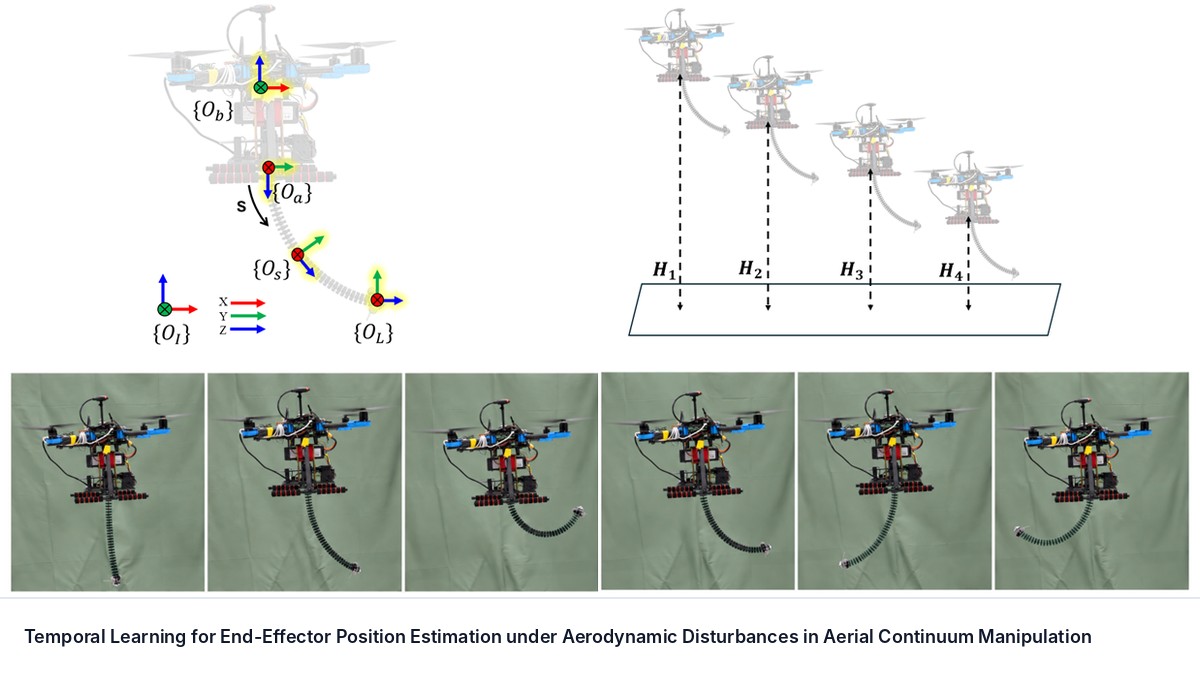
This paper investigates temporal neural networks for \mbox{end-effector} position \mbox{estimation} of an aerial continuum manipulator (ACM) operating under aerodynamic effects induced by the unmanned aerial vehicle (UAV).
Abstract Summary
Key Points
- This paper investigates temporal neural networks for \mbox{end-effector} position \mbox{estimation} of an aerial continuum manipulator (ACM) operating under aerodynamic effects induced by the unmanned aerial vehicle (UAV).
- An experimental dataset is collected under stationary (\mbox{rotor-off}) and \mbox{free-hovering} conditions across continuum robot (CR) configurations and UAV altitudes, providing \mbox{end-effector} position measurements with and without aerodynamic residuals.
- To establish a nominal framework, \mbox{strain-parameterized} kinematic models with progressively richer strain bases are evaluated to balance model complexity and prediction accuracy.
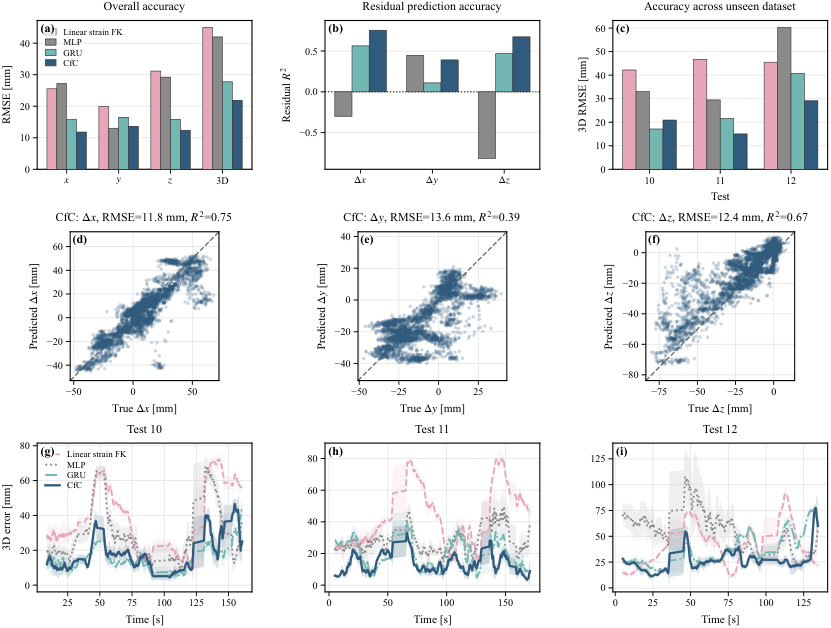
- The selected nominal model then serves as the baseline for 3D position residual estimation using a \mbox{closed-form} \mbox{continuous-time} (CfC) neural network, with a multilayer perceptron (MLP) and a gated recurrent unit (GRU) used for comparison.
- On unseen test experiments, the CfC achieves an RMSE of \(22.00\pm1.70~\mathrm{mm}\) over five random seeds, compared with \(36.38\pm3.58~\mathrm{mm}\) for the MLP and \(27.72\pm2.92~\mathrm{mm}\) for the GRU, corresponding to reductions of \(39.52\%\) and \(20.62\%\), respectively.
Problem Formulation and Methodology
Let $s\in[0,L]$ denote the arc-length coordinate along a CR, where $L$ is its undeformed length. The configuration of a cross-section at $s$ relative to the base frame is represented by where $\bm{R}(s)\in\mathrm{SO}(3)$ and $\bm{r}(s)\in\mathbb{R}^{3}$ denote the cross-section orientation and position, respectively.
Experimental Setup and Dataset Generation
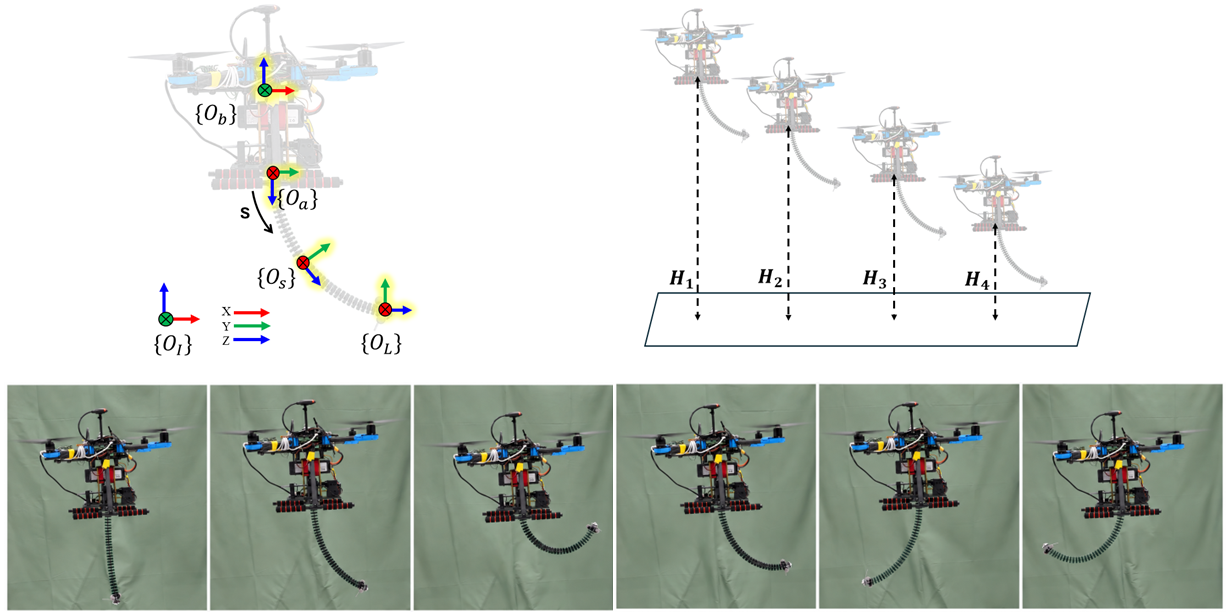
Fig. 1 shows the experimental platform used for dataset generation, consisting of a tendon-driven CR rigidly mounted on a UAV. The CR workspace is partitioned into 12 slices defined by prescribed ranges of $q_{1}$. For each experiment, $q_{1}$ is set to the midpoint of the corresponding range and held constant, while $q_{2}$ undergoes reciprocating motion.
Thus, $\dot{q}_{1}=0$ during each experiment and is not included as a model input.
Results
The nominal CR kinematics is identified from the baseline dataset in two steps. First, strain-parameterized models with constant through cubic spatial bases are compared using Test 17 ($q_{2}=0$), where deformation occurs predominantly in the principal bending plane. Measurements with similar $q_{1}$ values are averaged to approximate the nominal static relationship and reduce variability due to reciprocating motion.
Sources and Demonstrations
Figures are reproduced from Amiri et al. See the full paper for experimental details and the project page, when the paper links one, for demonstrations and videos.
Related Papers

A Sim-to-Real Integration Pipeline for Training and Deployment of Chunk-Based VLA Manipulation Policies
Mathilde Kappel, Clémence Grislain, Mohamed Chetouani et al.
Vision-Language-Action (VLA) models have become a prominent paradigm for mapping multimodal inputs, including semantic instructions, visual observations of the scene, and proprioceptive observations, to robot actions.
A Two-Echelon Covering Tour Vehicle Routing Problem with Drones for Post-Disaster Relief
Dang Viet Anh Nguyen, Rajesh Piplani, Aldy Gunawan
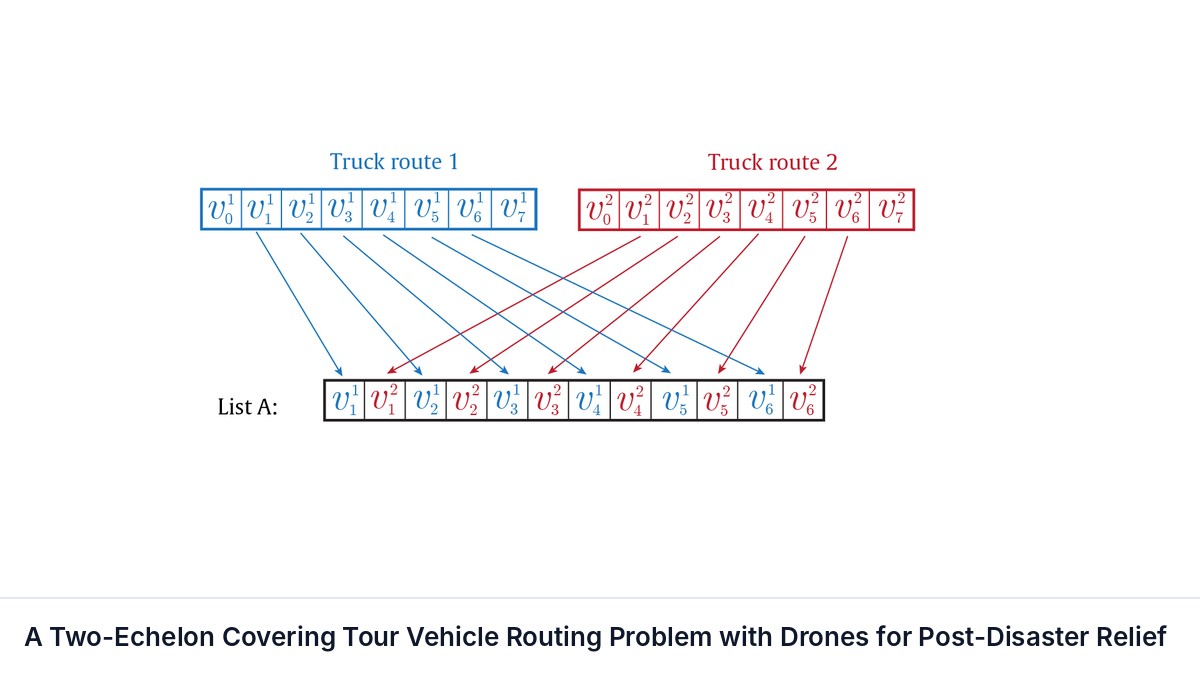
We introduce the two-echelon covering tour vehicle routing problem (2E-CTVRP) for the distribution of relief supplies after a disaster. In the first echelon, a fleet of trucks transports supplies and drones from a central depot to satellites at the periphery of the affected area.
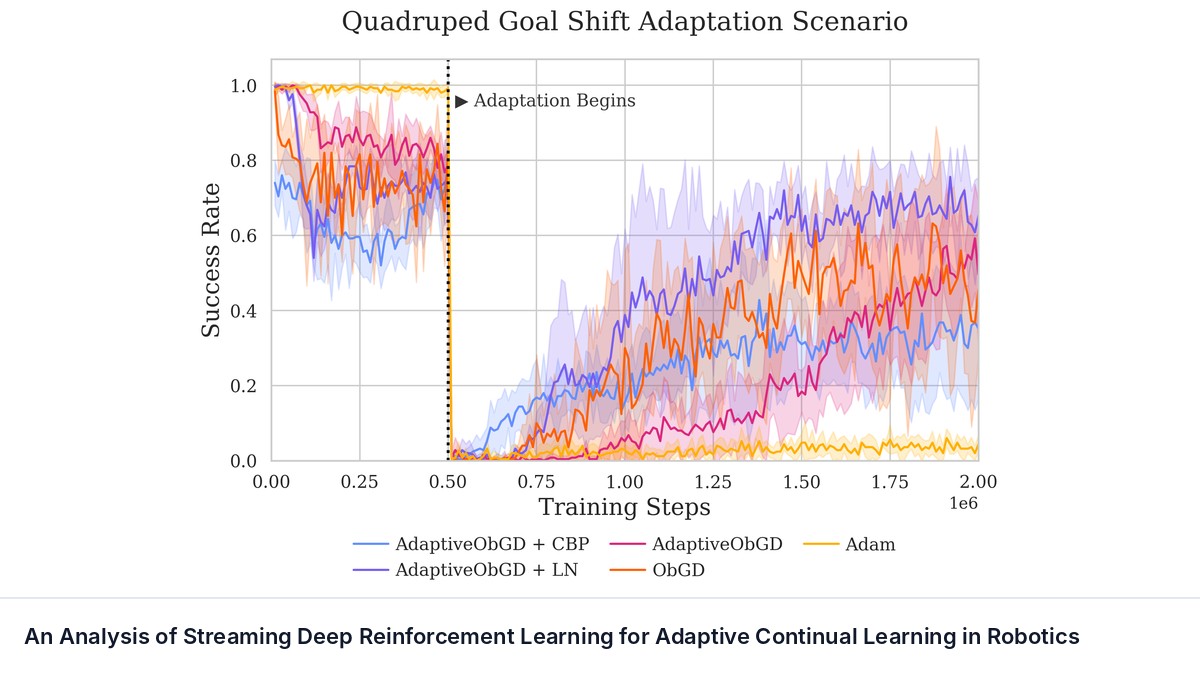
An Analysis of Streaming Deep Reinforcement Learning for Adaptive Continual Learning in Robotics
Teeratham Vitchutripop, Alyssa Quarles, Wenhe Zhang et al.
Over the course of a lifetime, robots may encounter novel scenarios unaccounted for in its original training that result in performance degradation. One common approach to mitigating this issue is to further grow the offline training dataset in hopes of producing a policy robust to these changes.

AXIS: A Growable Community-Driven Data Engine for Scalable Robot Manipulation
Mengfei Zhao, Dihong Huang, Yikai Tang et al.
Learning effective robot manipulation policies requires diverse, high-quality demonstrations, yet existing data pipelines are often difficult to scale because they rely on specialized hardware, centralized operators, or fixed task suites.