
Spatiotemporal Tube-Based Safety-Certificate for Autonomous Navigation of Articulated Vehicles
Mohd. Faizuddin Faruqui, Ratnangshu Das, Ravi Kumar L, Pushpak Jagtap · N/A · 2026
Framework
N/A
License
N/A
Stars
N/A
Summary
Articulated vehicles are the workhorses of freight transportation, and their autonomous navigation is challenging. Their physical characteristics and motion constraints pose significant challenges in manoeuvring these vehicles on narrow routes.
Abstract Summary
Key Points
- Articulated vehicles are the workhorses of freight transportation, and their autonomous navigation is challenging.
- Their physical characteristics and motion constraints pose significant challenges in manoeuvring these vehicles on narrow routes.
- This paper presents a spatiotemporal tube-based approach to plan autonomous navigation of vehicles like tractor semi-trailers, truck/ tractor trailers, towing Automated Guided Vehicles (AGVs), and road trains.
- This planning approach provides a certified path plan for the truck or tractor, ensuring that the towed series of trailers always remains within the road corridor, limited by permissible corrections.
- The planning leverages the kinematics of the linked elements along with sway constraints to arrive at a safe tube for the actuated prime mover.
Notation and Preliminaries
The symbols $\mathbb{R},\mathbb{R}_{0}^{+},\mathbb{R}^{+},\mathbb{Z}^{+},\mathbb{Z}_{0}^{+},\mathbb{S}^{1}$, and $\mathbb{S}^{2}_{++}$ denote sets of reals, non-negative reals, positive reals, positive integers, non-negative integers, unit circle, and $2\times 2$ symmetric positive definite matrices, respectively.
The symbol $u^{\perp}$ represents an orthogonal component of the vector $u$ expressed as $u^{\perp}=R(90^{0})u$, $u\in\mathbb{R}^{2}$ and $R(90^{0})$ is the rotation matrix corresponding to a $90^{0}$ counter-clockwise rotation.
Problem Formulation
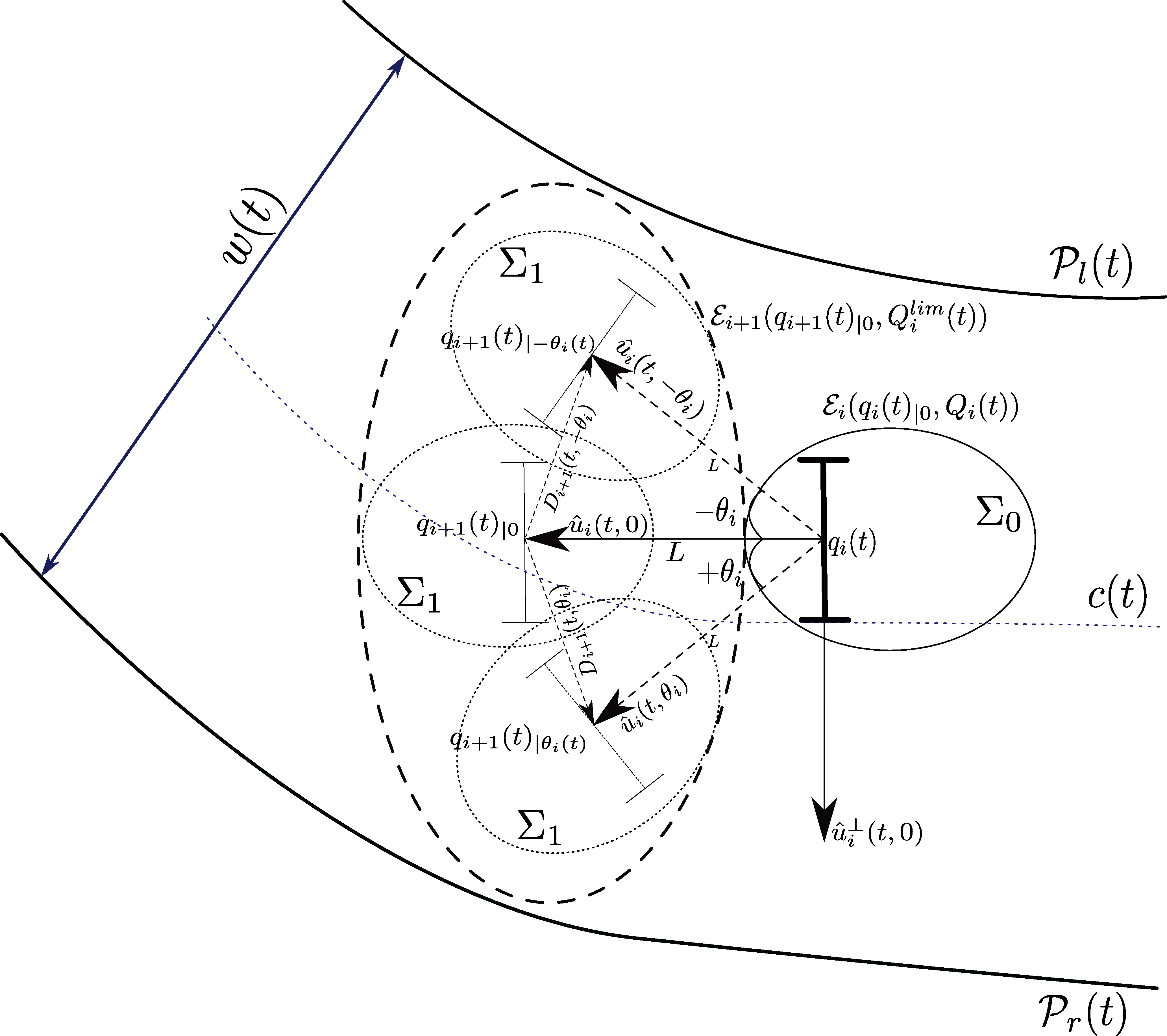
Autonomous navigation of kinematically-coupled interconnected systems is a complex task and reactive approaches cannot guarantee safety. In this study, we consider synthesizing a confinement zone in the form of an STT for the prime mover and subsequently for $N$ trailers using kinematic coupling, such that the complete articulated vehicle remains within the given route at all times, as shown in Figure 1 .
The problem considered in this paper includes the prime mover towing $N$ trailers, each assumed to have one axle.
PATH PLANNING
The path planning problem here now becomes finding the STET of the prime mover such that all trailers remain confined to the route $\mathcal{R}(t)$. We use the kinematic geometry as illustrated in Figure 1 to find the feasible tubes for the towed trailers. Each towed trailer can sway by an angle $\delta_{i}(t)\in[-\theta_{i},\theta_{i}]$ relative to its leading vehicle hinge.
Safe path plan certificate for a route
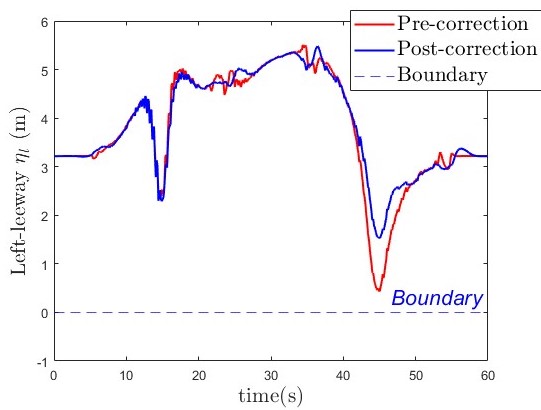
In this section, we arrive at a safety certificate for an articulated vehicle in a particular configuration on a given route.
For a multi-trailer configuration consisting of a prime mover with each body represented by a STET, we deduce an algorithm, as stated in Algorithm 1 , that adjusts the center and shape matrix of the prime mover’s ellipsoid based on violations by the last trailer, and plans the center and shape matrix of the prime mover such that all follower trailers are safe.
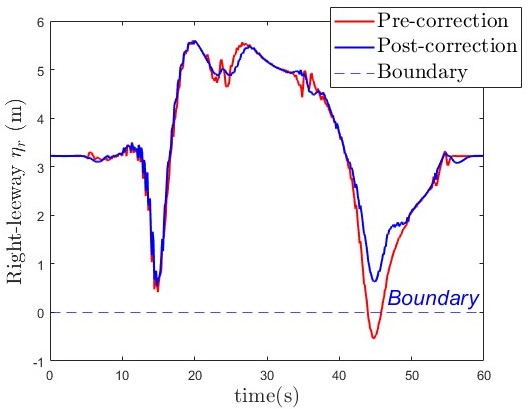
Simulations
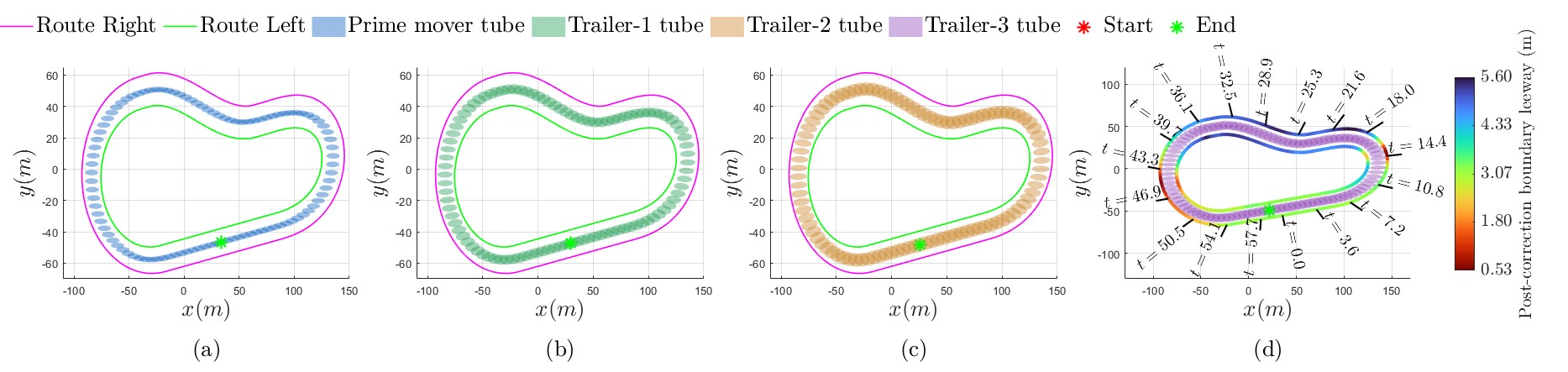
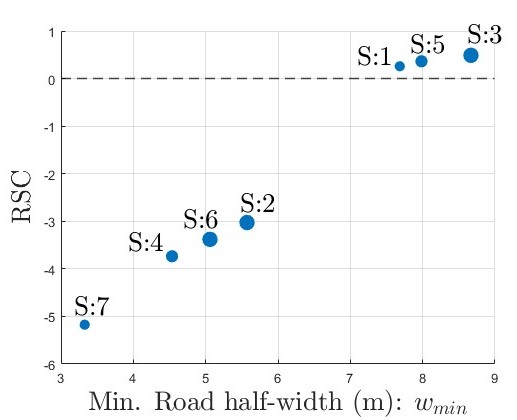
We prove the effectiveness of our planning approach using a truck as a prime mover towing multiple trailers. To test our planning method, we consider multiple scenarios, as listed in Table I , configured using different parameters, viz.
, the number of subsystems $N+1$, hitch length $L$, sway limit $\pm\theta$, trailer dimension $\mathcal{D}(length\times width)$, bounds $h_{\Omega}$ and $h_{\Xi}$, and the minimum route half width $w_{min}$.
Sources and Demonstrations
Figures are reproduced from Faruqui et al. See the full paper for experimental details and the project page, when the paper links one, for demonstrations and videos.
Related Papers
A Browser-Native Digital Test Range for Benchmarking 4D Ocean-Glider Planning Algorithms
Edward Holmberg, Elias Ioup, Mahdi Abdelguerfi
Repeated in-situ evaluation of ocean-glider planners requires scarce vehicles, operators, deployment and recovery resources, and ocean conditions that cannot be reset for competing algorithms.
A Low-Cost, Open Platform for End-to-End Autonomous Driving on a Miniature Ackermann Vehicle
Gustavo Claudio Karl Couto, Eric Aislan Antonelo, Gabriel George Zipperer
This paper presents a low-cost, open experimental platform for research in end-to-end autonomous driving with miniature Ackermann vehicles.
A Physics-Informed Collision Learning Framework for Collaborative Robot Motion Generation
Chen Cai, Steven Liu
Close-proximity multi-arm manipulation requires collision models that are both geometrically accurate and differentiable enough for real-time optimization.
AcousticDiffusion: Semantically Conditioned Audio-Guided Diffusion Policy for Search-and-Rescue Assistance
Iana Zhura, Didar Seyidov, Dmitrii Plotnikov et al.
Navigating toward human callers is an important capability for rescue robots operating where visual contact is degraded or occluded. We present AcousticDiffusion, a semantically conditioned, audio-guided diffusion policy for human-directed navigation.