
Latent Memory Palace: Reasoning for Control as Autoregressive Variational Inference
Chuning Zhu, Eva Xu, Jose Barreiros, Krishnan Srinivasan, Paarth Shah, Abhishek Gupta · N/A · 2026
Framework
N/A
License
N/A
Stars
N/A
Summary
Human decision-making is highly flexible -- some actions are taken immediately; others require longer deliberation.
Abstract Summary
Key Points
- Human decision-making is highly flexible -- some actions are taken immediately; others require longer deliberation.
- Language models have exhibited a similar capacity for adaptive "reasoning." However, transferring this capability to continuous control policies has been challenging, as directly reasoning in language space may lack the granularity for spatial understanding and precise motions.
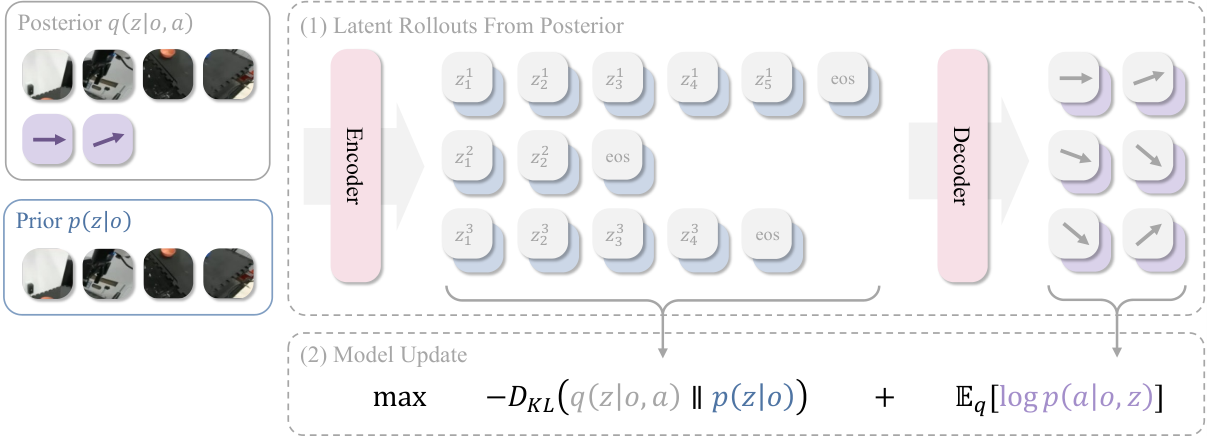
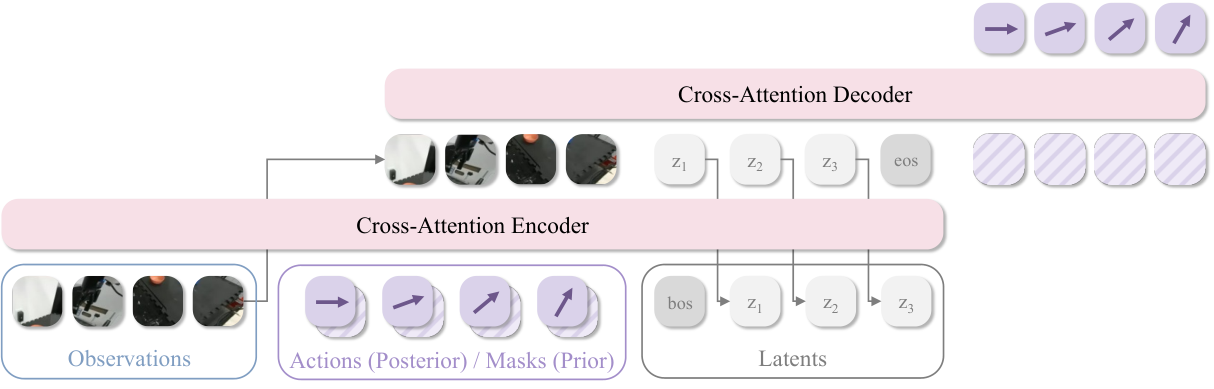
- In this work, we show that reasoning for control policies can emerge by organizing information in an autoregressive latent space reminiscent of a memory palace, where retrieval is iterative and adaptive.
- Our method, Latent Memory Palace (LMP), formulates reasoning as variational inference with an autoregressive latent distribution.
- We derive a latent-space reinforcement learning technique to tractably optimize its variational lower bound.
Latent Memory Palace: Reasoning as Autoregressive Variational Inference
We consider the imitation learning setting, where the goal is to learn a control policy $\pi_{\theta}:\mathcal{O}\rightarrow\mathcal{A}$ from a dataset of expert demonstrations, $\mathcal{D}=\{(o_{i},a_{i})\}_{i=1}^{n}$, with observations $o_{i}$ and actions $a_{i}$. For the sake of practicality, $o_{i}$ may be a stacked history of observations with language instructions, and $a_{i}$ may be a chunk of actions.
Experiments
We conduct experiments to answer the following research questions. (1) Is LMP-$\pi$ a performant generative control policy? (2) Is LMP- tok an effective action tokenizer? (3) Does LMP demonstrate adaptive allocation of test-time compute? (4) Which factors contribute to LMP’s performance? We evaluate our method on real-world and simulated visuomotor control benchmarks as shown in Fig. 4 .
(1) DROID [ 31 ] is a real-world manipulation platform with multitask training data.
Sources and Demonstrations
Figures are reproduced from Zhu et al. See the full paper for experimental details and the project page, when the paper links one, for demonstrations and videos.
Related Papers
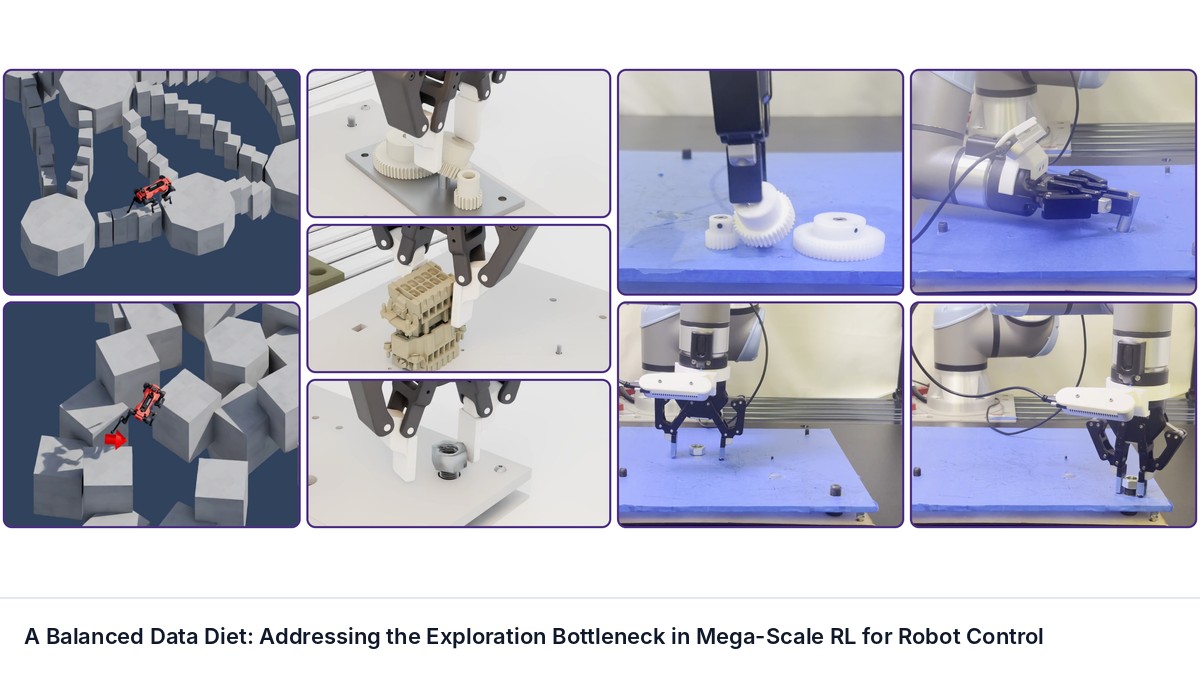
A Balanced Data Diet: Addressing the Exploration Bottleneck in Mega-Scale RL for Robot Control
Octi Zhang, Mateo Guaman Castro, Patrick Yin et al.
General-purpose robots must perform a wide range of tasks from agile locomotion to dexterous manipulation.
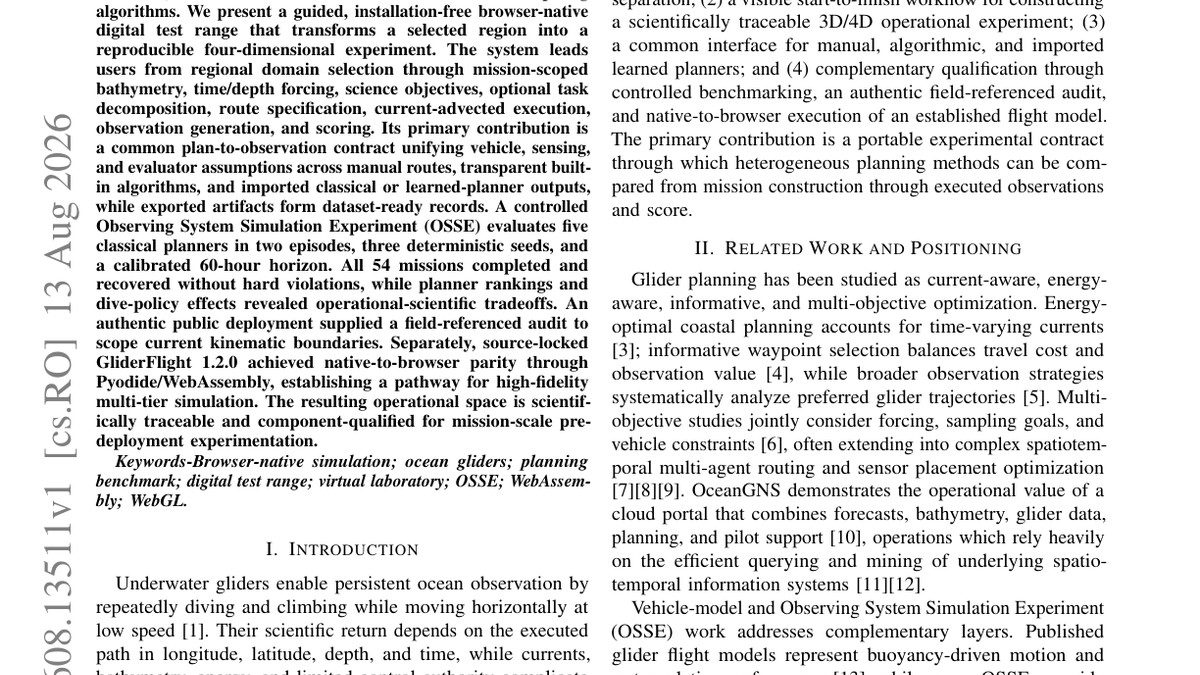
A Browser-Native Digital Test Range for Benchmarking 4D Ocean-Glider Planning Algorithms
Edward Holmberg, Elias Ioup, Mahdi Abdelguerfi
Repeated in-situ evaluation of ocean-glider planners requires scarce vehicles, operators, deployment and recovery resources, and ocean conditions that cannot be reset for competing algorithms.
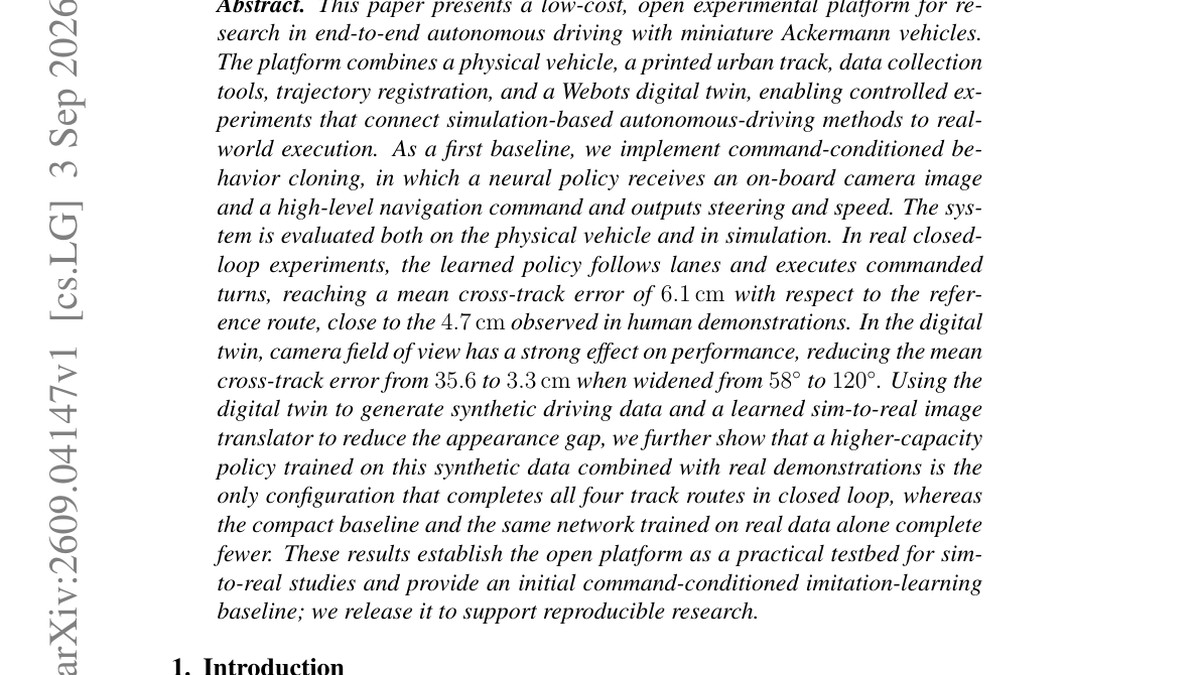
A Low-Cost, Open Platform for End-to-End Autonomous Driving on a Miniature Ackermann Vehicle
Gustavo Claudio Karl Couto, Eric Aislan Antonelo, Gabriel George Zipperer
This paper presents a low-cost, open experimental platform for research in end-to-end autonomous driving with miniature Ackermann vehicles.
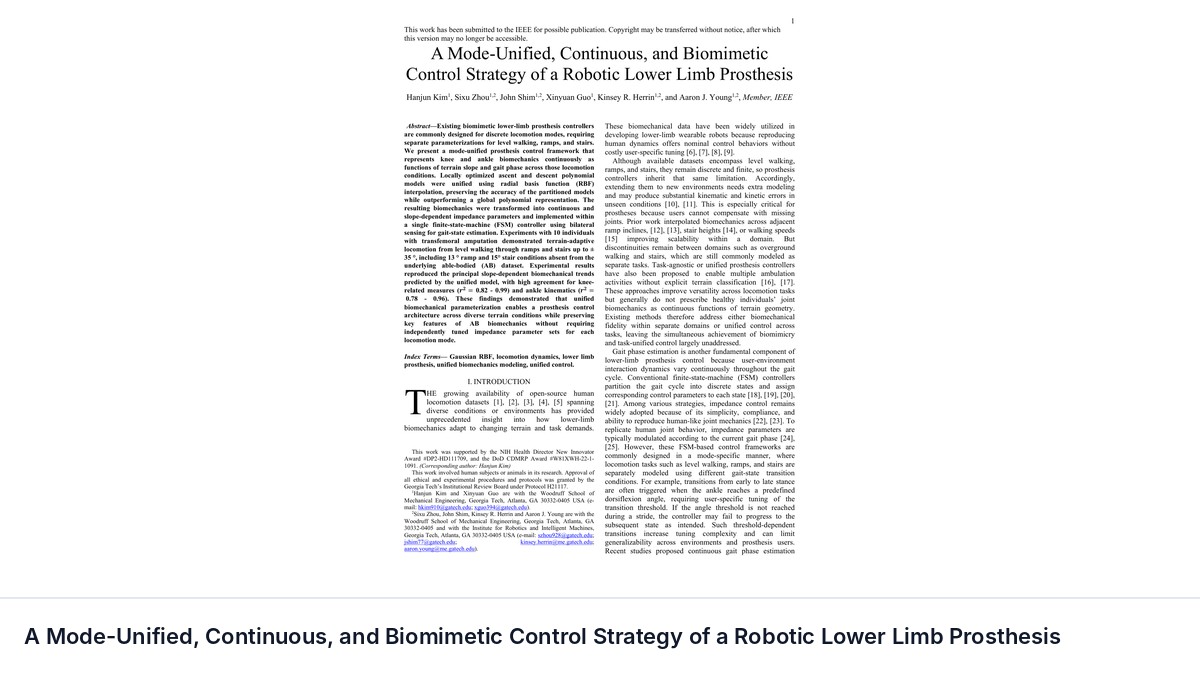
A Mode-Unified, Continuous, and Biomimetic Control Strategy of a Robotic Lower Limb Prosthesis
Hanjun Kim, Sixu Zhou, John Shim et al.
Existing biomimetic lower-limb prosthesis controllers are commonly designed for discrete locomotion modes, requiring separate parameterizations for level walking, ramps, and stairs.