
Distributed Harmonic-Covariance Feedback for Hole Closure in Planar Robot Swarms
Jitian Liu, Subhrajit Bhattacharya · N/A · 2026
Framework
N/A
License
N/A
Stars
N/A
Summary
We consider hole closure in a planar multi-agent system whose sensing disks form a time-varying \v{C}ech complex. We propose a harmonic-covariance feedback that uses harmonic edge signals to locate holes and converts those signals into agent forces.
Abstract Summary
Key Points
- We consider hole closure in a planar multi-agent system whose sensing disks form a time-varying \v{C}ech complex.
- We propose a harmonic-covariance feedback that uses harmonic edge signals to locate holes and converts those signals into agent forces.
- For distributed evaluation, we use a fixed-degree polynomial of the regularized Hodge Laplacian
- This polynomial is evaluated through local operator applications
- The closed loop has a unique global trajectory from every safe initial state
Problem Formulation and Sensing Model
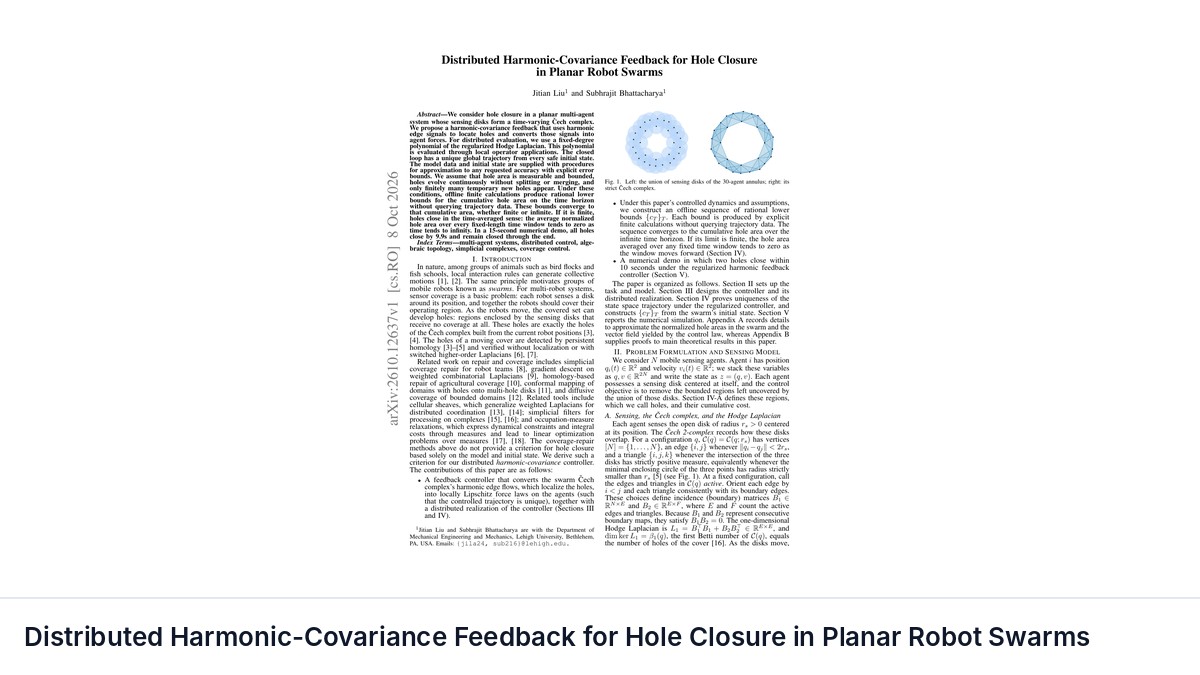
We consider $N$ mobile sensing agents. Agent $i$ has position $q_{i}(t)\in\mathbb{R}^{2}$ and velocity $v_{i}(t)\in\mathbb{R}^{2}$; we stack these variables as $q,v\in\mathbb{R}^{2N}$ and write the state as $z=(q,v)$. Each agent possesses a sensing disk centered at itself, and the control objective is to remove the bounded regions left uncovered by the union of those disks.
Section IV-A defines these regions, which we call holes, and their cumulative cost. Each agent senses the open disk of radius $r_{s}>0$ centered at its position.
Controller Design
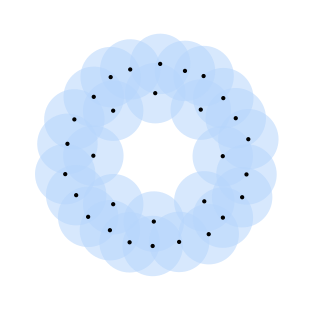
Harmonic information is stored as scalar values on edges, while each agent needs a two-dimensional force at a node. We first convert edge values into node vectors and use these vectors to define force laws on each agent. The ideal law uses the exact harmonic projector of the binary Čech complex; Section III-B replaces it with a fixed-degree polynomial of $L_{w}$ from Section II-A .
Here “exact” and “ideal” refer only to the projector. Let $u(q)=F^{H}(q)$ be the ideal harmonic-covariance force.
Well-Posedness and Bounds on Cumulative Hole Areas
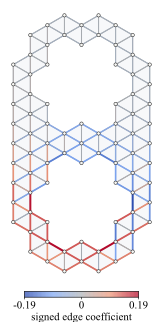
After the regularized controller is defined, it is natural to raise the following questions: Given a safe initial state, does the controller yield one unique trajectory? Given an initial state, without simulation, can we determine whether the holes will eventually close under the controlled dynamics?
Section IV-C gives the first question a positive answer, and Section IV-D answers the second question with an offline construction of a rational sequence $\{c_{T}\}_{T}$ converging to the all-time cumulative hole area, with each term obtained by fi...
Numerical Demo
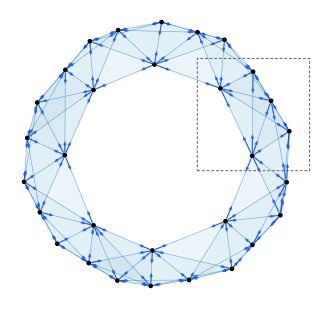
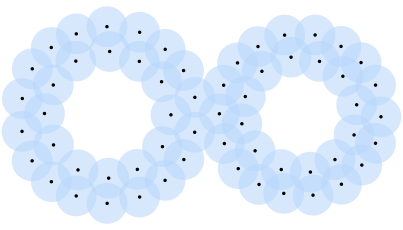
This section shows how the controller behaves on a 60-agent configuration with two initial holes. The snapshots show the agent motion and the numerical Čech complex, while the area plot follows the two holes that are present at the initial time. $t=0.0$ s $t=5.0$ s $t=10.0$ s $t=15.0$ s The initial positions form the two-hole peanut shown on the left of Fig. 4 .
Table I lists the parameters and integrator settings, where the Chebyshev polynomial degree $d=343$ is determined by the stated polynomial-tail tolerance.
Sources and Demonstrations
Figures are reproduced from Liu et al. See the full paper for experimental details and the project page, when the paper links one, for demonstrations and videos.
Related Papers

3D Euler-Angle Orientation Control for Two-Ray Fading Mitigation in Maritime Air-to-Sea Communications
Mohammed Bajja, Abdoul Karim A. H. Saliah, Hajar El Hammouti et al.
Maritime Air-to-Sea links are dominated by a line-of-sight ray and a sea-surface reflected ray whose destructive combination produces deep fades. Existing mitigation strategies optimize Unmanned Aerial Vehicle position or trajectory but leave attitude unexploited.
4D Radar Perception Algorithms for Autonomous Driving: A Review
Xumin Wu, Jun Zhou, Jilin Mei et al.
Research on 4D millimeter-wave radar perception algorithms has flourished in recent years, extending from signal processing and object detection to semantic segmentation, motion estimation, occupancy prediction, and dynamic scene reconstruction.
A Browser-Native Digital Test Range for Benchmarking 4D Ocean-Glider Planning Algorithms
Edward Holmberg, Elias Ioup, Mahdi Abdelguerfi
Repeated in-situ evaluation of ocean-glider planners requires scarce vehicles, operators, deployment and recovery resources, and ocean conditions that cannot be reset for competing algorithms.
A Deployment Study of Identity-Gated Drone Gesture Control
Diyari Mohammed Salih, Ilyes Chaabeni, Naima Ait Oufroukh
Vision-based gesture control accepts commands from any hand in the camera field of view, which is unsafe in shared indoor spaces.