
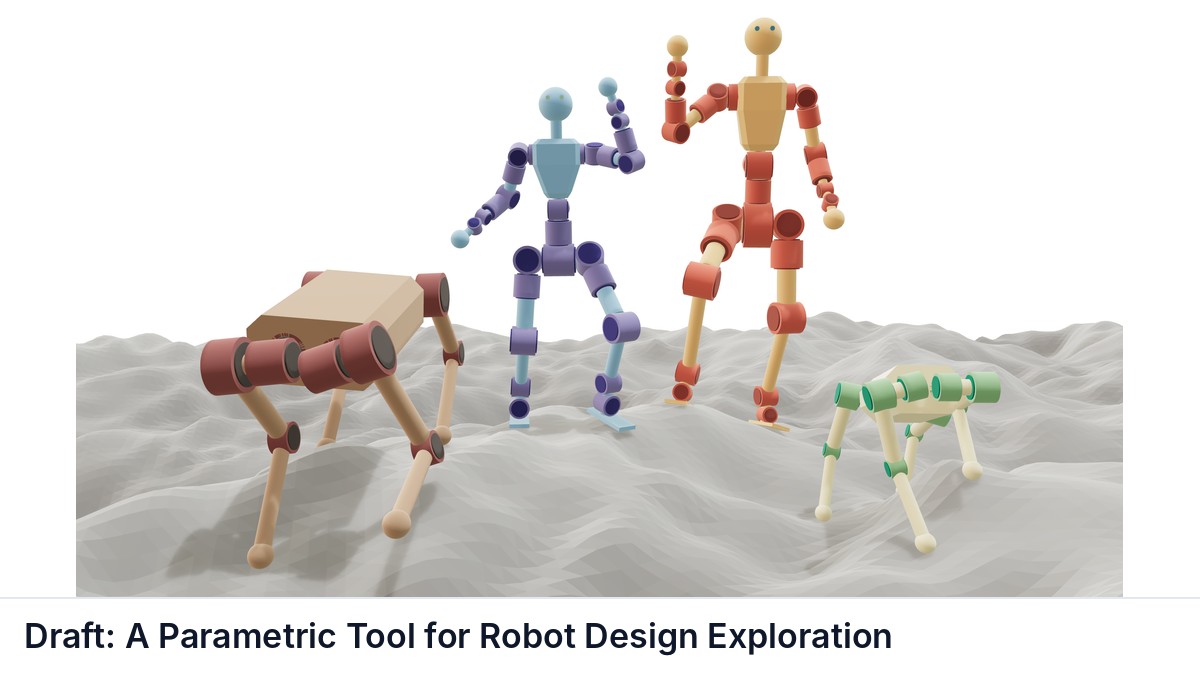
Draft: A Parametric Tool for Robot Design Exploration
David Nguyen, Marcelo Coelho, Sangbae Kim · N/A · 2026
Framework
N/A
License
N/A
Stars
N/A
Summary
Robot performance is often limited by the cost of iterating on morphology and control together, since every computer-aided design (CAD) change has to be carried into a simulation-ready model before control work begins.
Abstract Summary
Key Points
- Robot performance is often limited by the cost of iterating on morphology and control together, since every computer-aided design (CAD) change has to be carried into a simulation-ready model before control work begins.
- Co-design methods attempt to close this gap, but each uses a model generator written for a single platform or lack the use of real-world data to suggest that designs are plausible.
- We present Draft, a parametric generation tool whose generalized engine compiles any parametric tree of serial chains into a simulation-ready MJCF model, without CAD.
- It allows engineers to explore design tradeoffs through easily adjustable models and evaluate how changes influence controller performance.
- Draft grounds the free parameters of each design using trends fitted to a survey of $114$ actuators and $49$ published robot descriptions, so that a generated robot is anchored to real-world hardware.
Parametric Model Generation
In our formulation, a robot is defined by three files. The first is a parameter file that specifies values for link lengths, densities, and motor classes etc. The second is a kinematic tree whose fields are arithmetic expressions which correspond to the parametric file’s values. The third describes the root body mesh.
Because the tree holds expressions rather than numbers, it can be written so that fewer parameters have to be specified. A limb’s radius can be linked to the motor that drives it rather than manually specified.

Fitting Model Parameters to Hardware
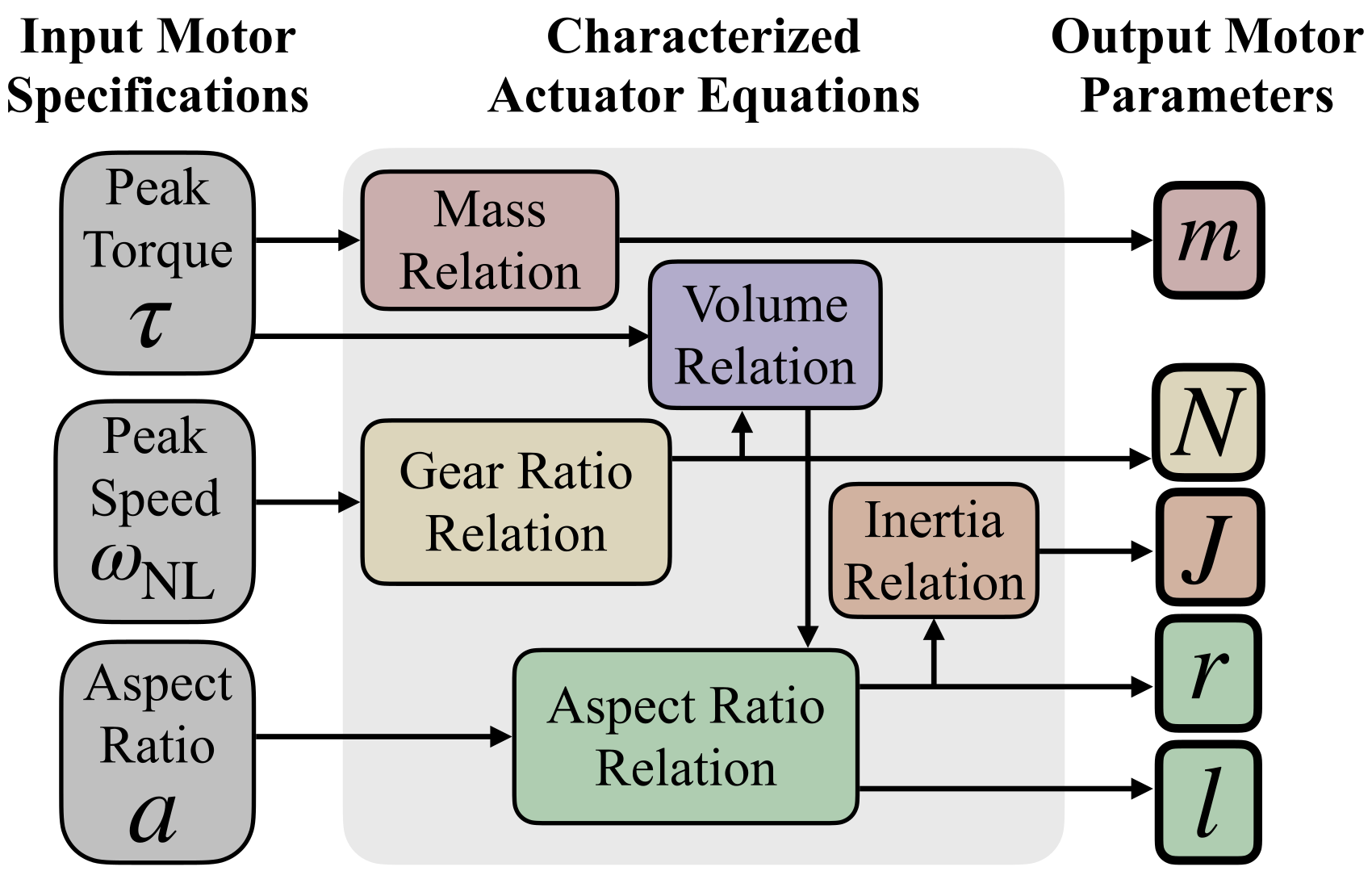
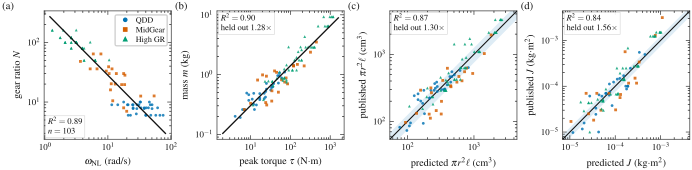
The generator guarantees that a model is internally consistent, not that the design is plausible. Nothing in Sec. III stops a sweep from asking for an actuator with twice the torque density of anything on the market, and would report performance on impossible hardware. We therefore fit equations to surveys of real hardware and compile them back into the generation pipeline as guard rails.
We perform two surveys, one on actuators and another on robot structure. Every actuator fit is scored the same way, using leave-one-out (LOO) validation.
Evaluating Designs with Reinforcement Learning
Our model generation scheme is only useful if it shows how varying parameters influences controller performance. We demonstrate this, by generating quadrupeds with three distinct parameter sets ($\boldsymbol{\theta}_{c},\boldsymbol{\theta}_{g},\boldsymbol{\theta}_{b}$) and training them under one curriculum.
To validate the robustness of the policies, we also perturb the inertial parameters post-training and analyze the results. Each quadruped design in Fig.
Sources and Demonstrations
Figures are reproduced from Nguyen et al. See the full paper for experimental details and the project page, when the paper links one, for demonstrations and videos.
Related Papers
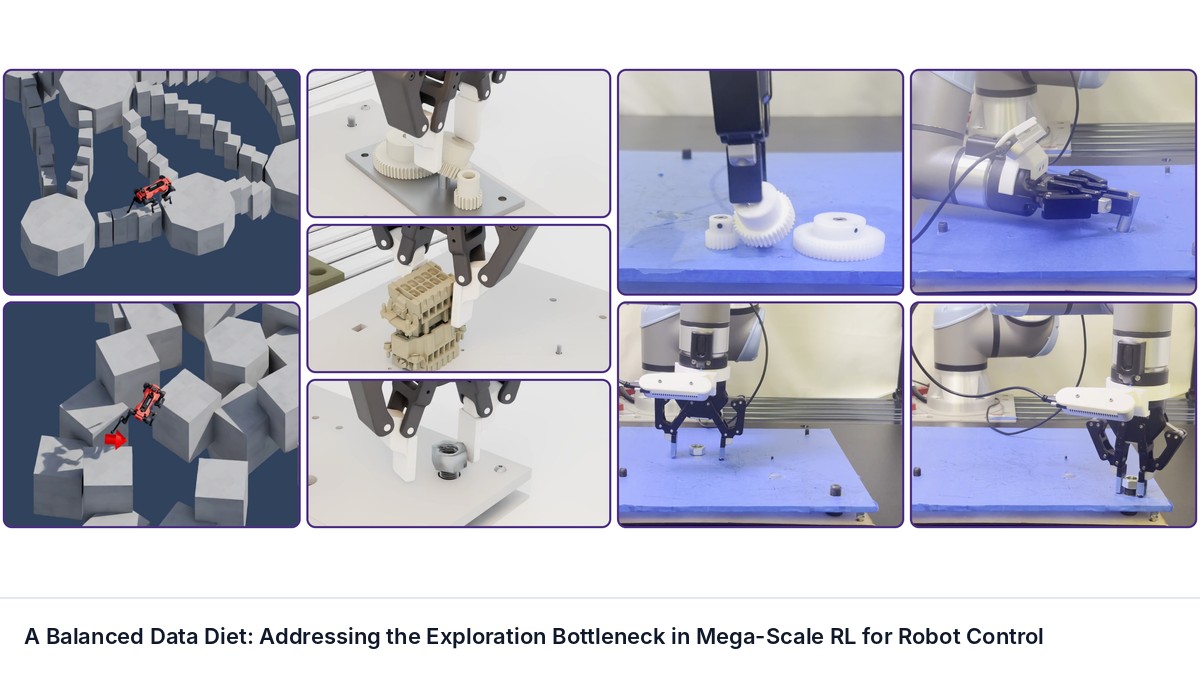
A Balanced Data Diet: Addressing the Exploration Bottleneck in Mega-Scale RL for Robot Control
Octi Zhang, Mateo Guaman Castro, Patrick Yin et al.
General-purpose robots must perform a wide range of tasks from agile locomotion to dexterous manipulation.
A Mode-Unified, Continuous, and Biomimetic Control Strategy of a Robotic Lower Limb Prosthesis
Hanjun Kim, Sixu Zhou, John Shim et al.
Existing biomimetic lower-limb prosthesis controllers are commonly designed for discrete locomotion modes, requiring separate parameterizations for level walking, ramps, and stairs.
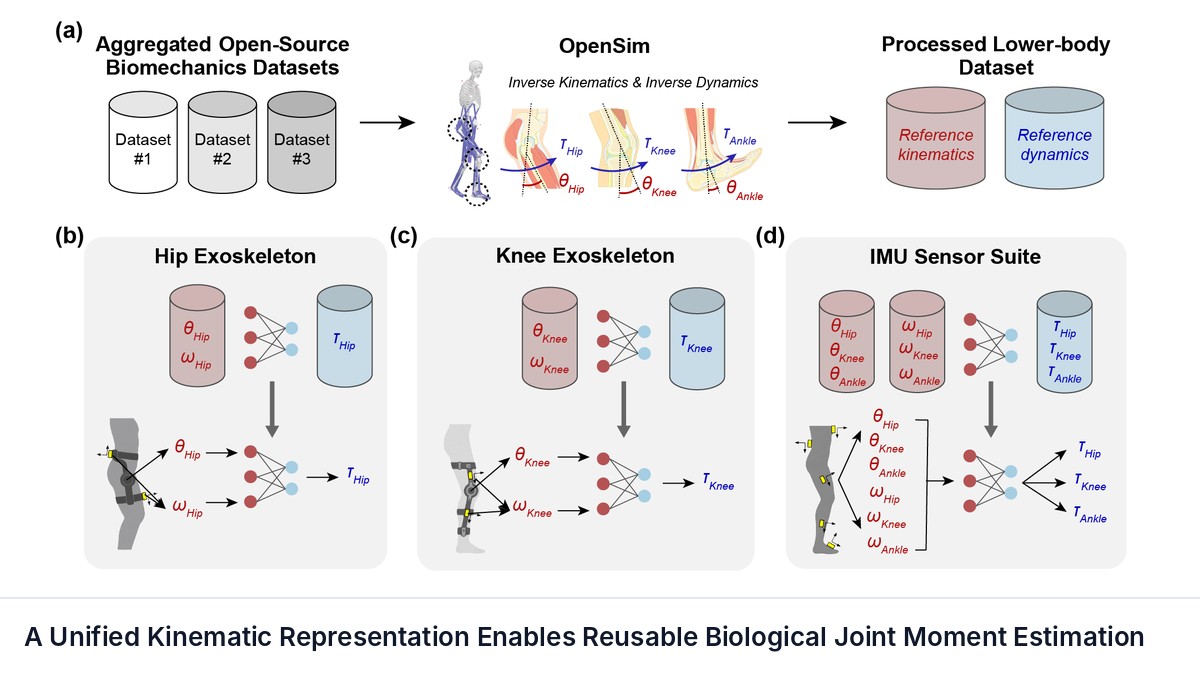
A Unified Kinematic Representation Enables Reusable Biological Joint Moment Estimation
Jinwoo Hwang, Ilseung Park, Changseob Song et al.
Objective: Data-driven models that estimate physiological states, particularly biological joint moments, are widely used in exoskeleton control.
Adaptive Rejection of Unknown Hybrid Sinusoidal Disturbances with Application to Humanoid Walking under Unknown Ground Motion
I-Chia Chang, Jacob Stewart, Petros A. Ioannou et al.
Legged robot control is not yet practical in non-inertial environments, where the ground and surroundings accelerate in the inertial Earth frame, mainly because of the unknown, time-varying, persistent perturbations caused by environmental motion, compounded by the associated hybrid robotic dynamics.