
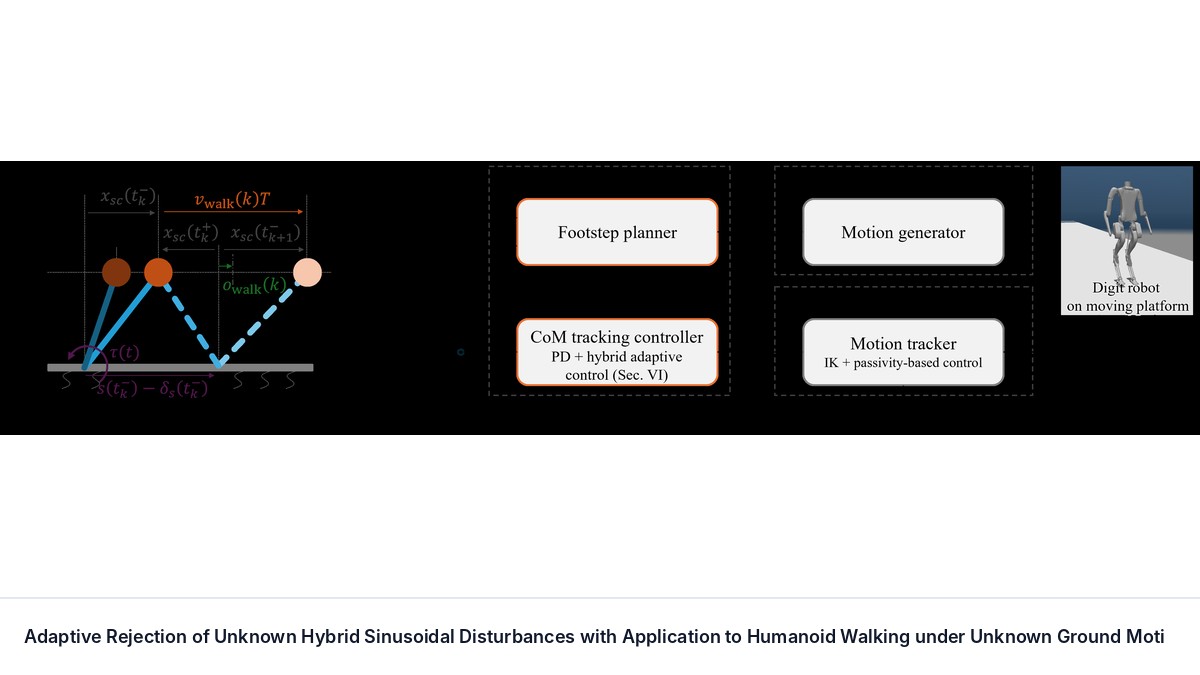
Adaptive Rejection of Unknown Hybrid Sinusoidal Disturbances with Application to Humanoid Walking under Unknown Ground Motion
I-Chia Chang, Jacob Stewart, Petros A. Ioannou, Yan Gu · N/A · 2026
Framework
N/A
License
N/A
Stars
N/A
Summary
Legged robot control is not yet practical in non-inertial environments, where the ground and surroundings accelerate in the inertial Earth frame, mainly because of the unknown, time-varying, persistent perturbations caused by environmental motion, compounded by the associated hybrid robotic dynamics.
Abstract Summary
Key Points
- Legged robot control is not yet practical in non-inertial environments, where the ground and surroundings accelerate in the inertial Earth frame, mainly because of the unknown, time-varying, persistent perturbations caused by environmental motion, compounded by the associated hybrid robotic dynamics.
- We formulate the problem of robot walking control as unknown-disturbance rejection for hybrid linear systems subject to hybrid sinusoidal disturbances (i.e., a linear combination of sinusoidal components with instantaneous phase jumps at discrete events).
- First, necessary and sufficient conditions for solvability of the disturbance rejection problem are derived and used to characterize the control input that rejects the disturbances.
- Second, with the Youla-Kucera parametrization, an output feedback controller capable of rejecting the disturbance is introduced.
- Third, an adaptive law is proposed to estimate the controller parameters that reject the disturbance in the practical case where the disturbance and its parameters are unknown.
Preliminaries and Notation
This section introduces the preliminaries to describe the hybrid error system of a walking robot (see Section VII ) and the notation needed when deriving the adaptive controller.
A linear hybrid dynamical system with the state $\boldsymbol{x}(t)$, continuous phase control input $\boldsymbol{u}_{c}(t)$, discrete phase control input $\boldsymbol{u}_{d}(t)$, and measured output $\boldsymbol{y}(t)$ may be described by where $t_{k}$ are strictly increasing discrete event times indexed by $k\in\mathbb{N}=\{1,2,3,...\}$.
Problem formulation
We formulate the locomotion control problem in non-inertial environments as a disturbance rejection problem for hybrid linear systems subjected to hybrid sinusoidal disturbances (see Section VII ). A general formulation is provided here to enable generalization to other robotics and control applications.
Solvability of disturbance rejection for hybrid linear systems
This section aims to obtain the necessary and sufficient conditions which make the disturbance rejection problem solvable and to characterize the control inputs that reject the disturbance.
Therefore, the analysis below assumes the disturbance state $\boldsymbol{w}(t)$, the plant parameters $(\boldsymbol{A}_{c},\boldsymbol{A}_{d},\boldsymbol{B}_{c},\boldsymbol{B}_{d},\boldsymbol{C}$), and the disturbance parameters $(\boldsymbol{S}_{c},\boldsymbol{S}_{d},\boldsymbol{P}_{c},\boldsymbol{P}_{d},\boldsymbol{Q})$ are known.
Output feedback controller structure design
This section extends the observer-compensator design of the YK parameterization to hybrid linear systems and shows that the proposed control structure is stable for all controller parameters and can reject the disturbance with only output feedback. These characteristics lay the foundation for the use of the adaptive law introduced in the next section.
In this section, the disturbance state is assumed to be unknown but the plant parameters and the disturbance parameters are known.
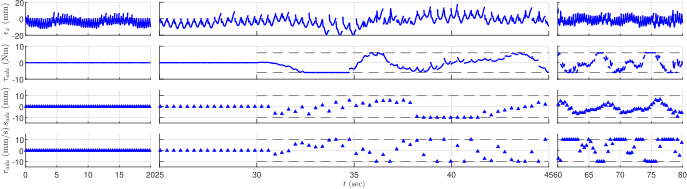
Adaptive Output Feedback with Unknown Disturbance Parameters
Based on the output feedback controller proposed in the previous section, this section extends it to an adaptive version by constructing the linear parameter estimation equation using the Hybrid Swapping Lemma and by adopting a robust adaptive law to estimate the parameters.
Unlike the previous sections, this section removes the assumption of known disturbance states and parameters, making the approach applicable to practical scenarios.
Case study: Bipedal walking on a platform with multi-directional motion
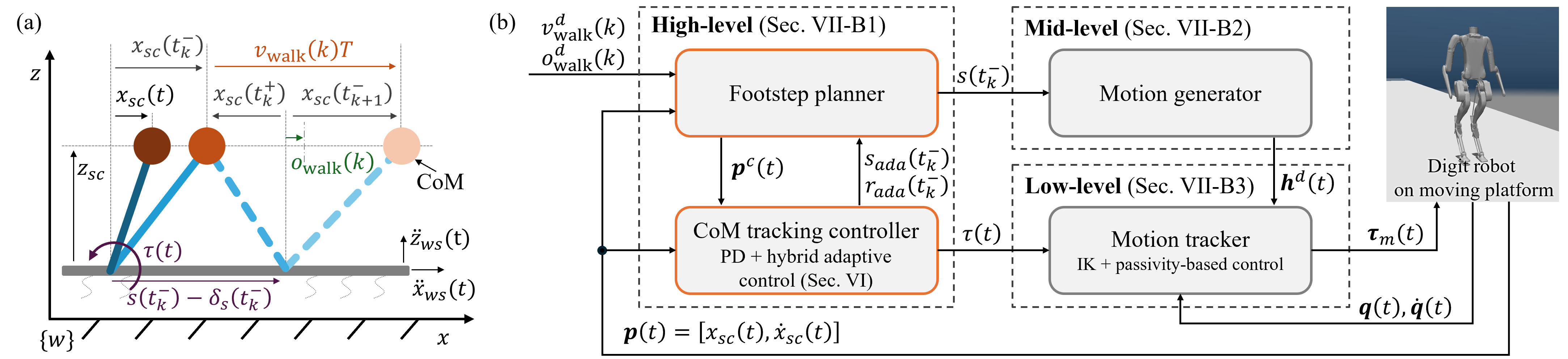
In this section, the proposed adaptive controller is applied to control a bipedal robot walking on a platform with unknown, multi-directional motion. To achieve reactive behavior given the complex robot dynamics, the proposed walking controller is based on the standard three-level hierarchical control framework: high-level motion planner, mid-level motion generator, and low-level motion tracker [ 3 ] .
Simulation Validation
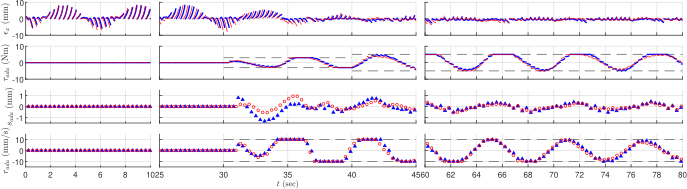
This section evaluates the control framework of Section VII in high-fidelity MuJoCo [ 45 ] simulations of a Digit humanoid robot walking on a moving platform whose motion is unknown to the controller. The test cases cover periodic horizontal motion within the disturbance model of Section III as well as vertical and non-periodic motion outside it, all with one set of controller parameters.
The parameters of the LIP model are set as: $m=47$ kg, $z_{sc}=0.95$ m, $T=0.35$ s, according to the weight of Digit and its nominal pose.
Real-world experiment
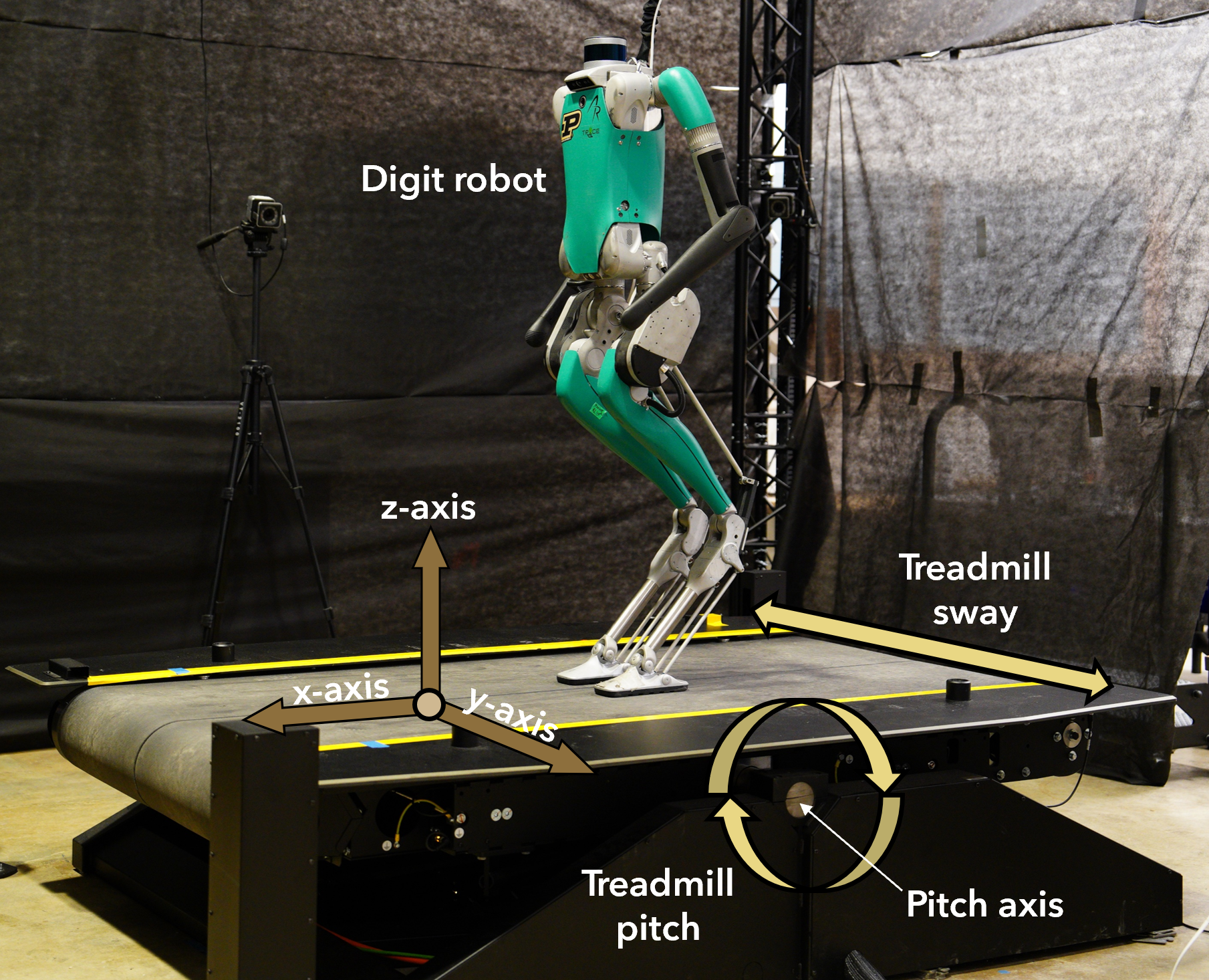
Hardware experiments on the Digit humanoid robot validate the controller’s disturbance rejection and CoM tracking capabilities under real-world uncertainties. An experiment movie is provided in the supplementary material https://youtu.be/2wP6VvRaFQc .
The setup of the high-level motion planner remains largely unchanged other than the following: The $\boldsymbol{Q}_{walk}$ for the footstep planner and the $(k_{p},k_{d})$ for the CoM tracking controller are re-tuned for hardware experiments, for both $x$- and $y$-directions.
Sources and Demonstrations
Figures are reproduced from Chang et al. See the full paper for experimental details and the project page, when the paper links one, for demonstrations and videos.
Related Papers
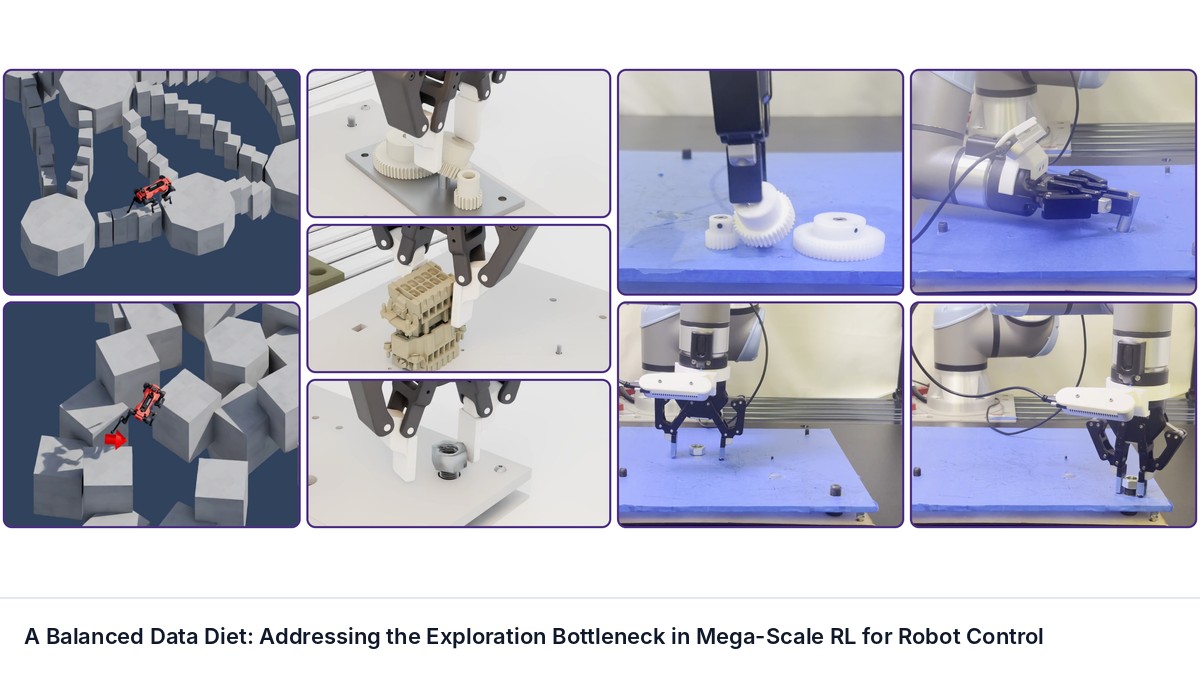
A Balanced Data Diet: Addressing the Exploration Bottleneck in Mega-Scale RL for Robot Control
Octi Zhang, Mateo Guaman Castro, Patrick Yin et al.
General-purpose robots must perform a wide range of tasks from agile locomotion to dexterous manipulation.
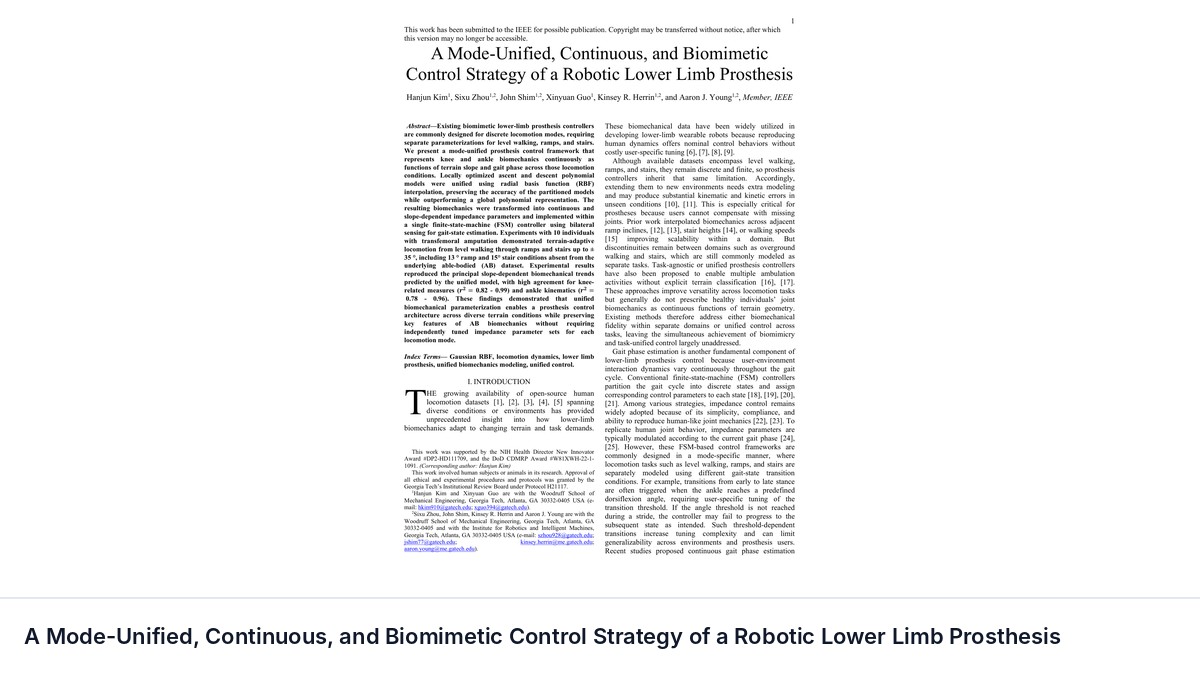
A Mode-Unified, Continuous, and Biomimetic Control Strategy of a Robotic Lower Limb Prosthesis
Hanjun Kim, Sixu Zhou, John Shim et al.
Existing biomimetic lower-limb prosthesis controllers are commonly designed for discrete locomotion modes, requiring separate parameterizations for level walking, ramps, and stairs.
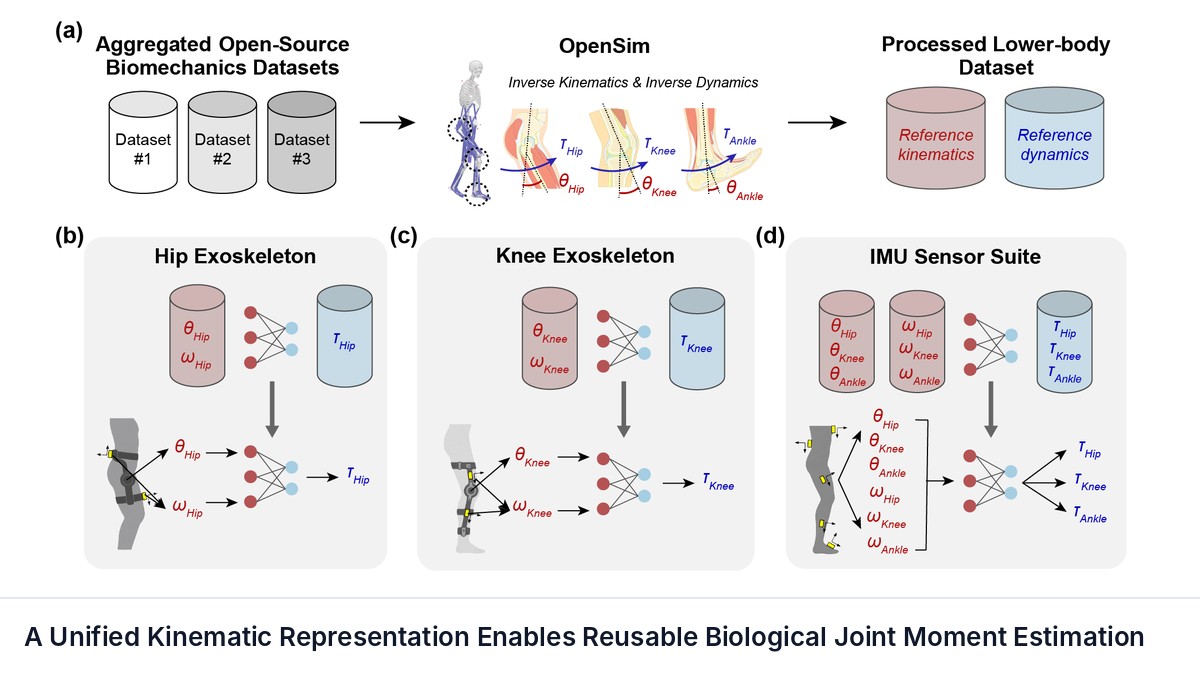
A Unified Kinematic Representation Enables Reusable Biological Joint Moment Estimation
Jinwoo Hwang, Ilseung Park, Changseob Song et al.
Objective: Data-driven models that estimate physiological states, particularly biological joint moments, are widely used in exoskeleton control.
ARDY: Autoregressive Diffusion with Hybrid Representation for Interactive Human Motion Generation
Kaifeng Zhao, Mathis Petrovich, Haotian Zhang et al.
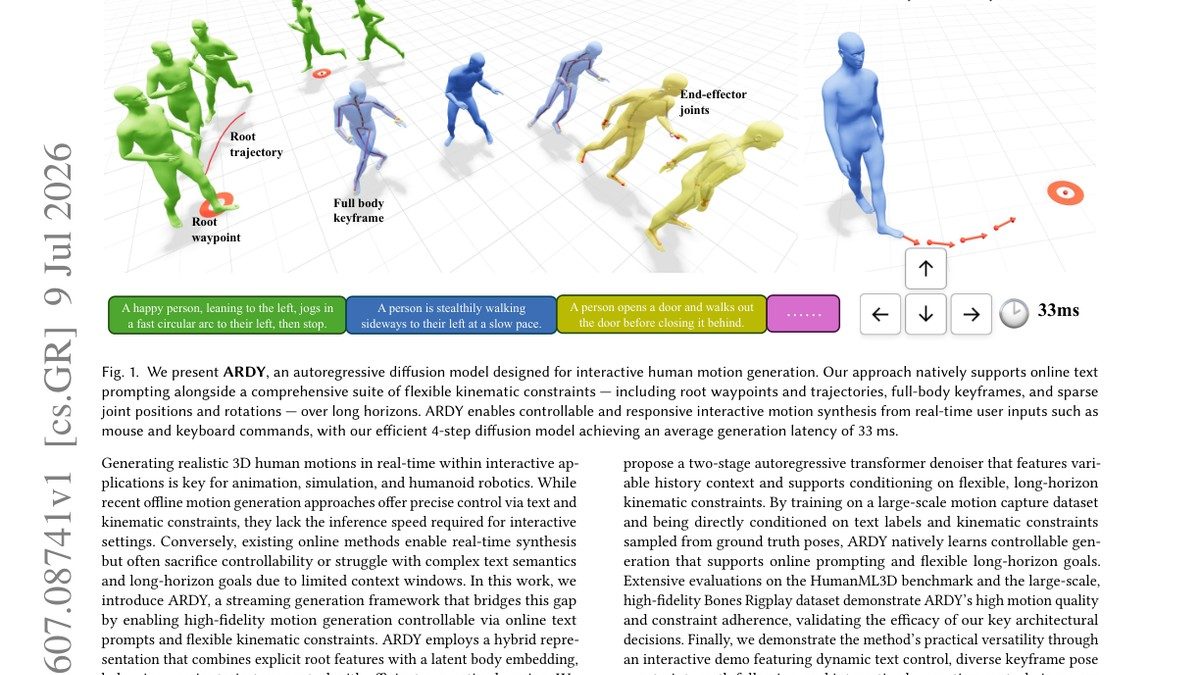
Generating realistic 3D human motions in real-time within interactive applications is key for animation, simulation, and humanoid robotics.