
Synthetic Data Generation and Vision-based Wrinkle and Keypoint Detection for Bimanual Cloth Manipulation
Ariel Herrera, Xueyang Kang, Atal Anil Kumar · N/A · 2026
Framework
N/A
License
N/A
Stars
N/A
Summary
Robotic manipulation of textiles remains challenging because continuous deformation and self-occlusions hinder the robust visual perception required to estimate the cloth's state.
Abstract Summary
Key Points
- Addresses dexterous manipulation challenges
- Uses simulation or synthetic data for training
- Detects fine-grained deformable object features
Method
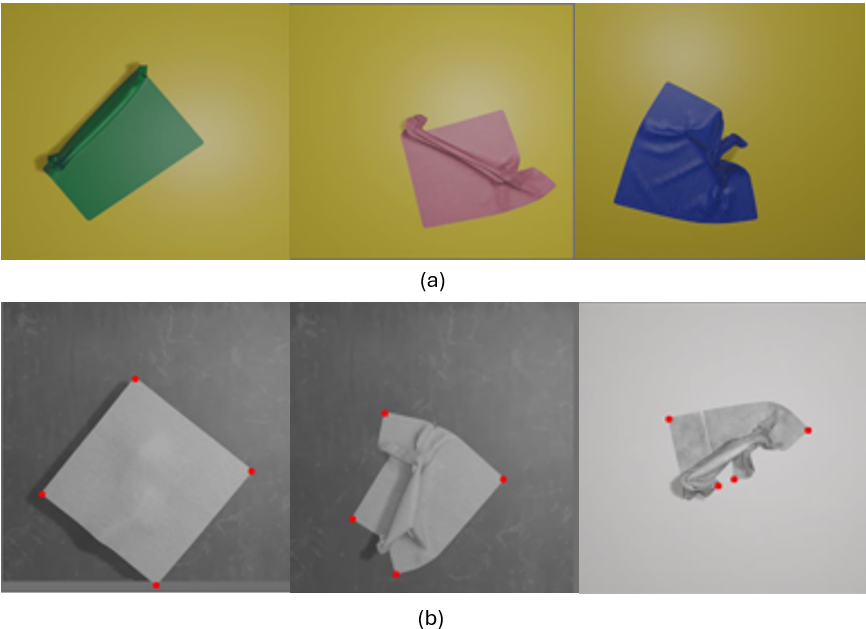
To train the neural networks without manual annotation, we implemented an automated pipeline using Blender [ 10 ] . We generated a large-scale dataset to ensure robust Domain Randomization. The cloth simulation in Blender is governed by a mass-spring physics model based on Newton’s second law. In our pipeline, the garment is dropped from a random height.
Upon impact with the table collision plane, the solver computes the reaction forces, causing the mesh to buckle and generate highly randomized, realistic deformations and folds.
Experiments and Results
We evaluated the keypoint detection model by calculating the Mean Position Error (MPE) between the predicted 2D pixel coordinates and the ground truth from our synthetic test set. Fig. 3 shows the loss and evaluation metrics across all training epochs. Both training and validation loss converged steadily, showing no signs of overfitting.
Furthermore, the validation MPE and PCK@8 (Percentage of Correct Keypoints) stabilized quickly, confirming an effective training process. The model achieves a final MPE of 1.7615 $\pm$ 0.7461 pixels.
Sources and Demonstrations
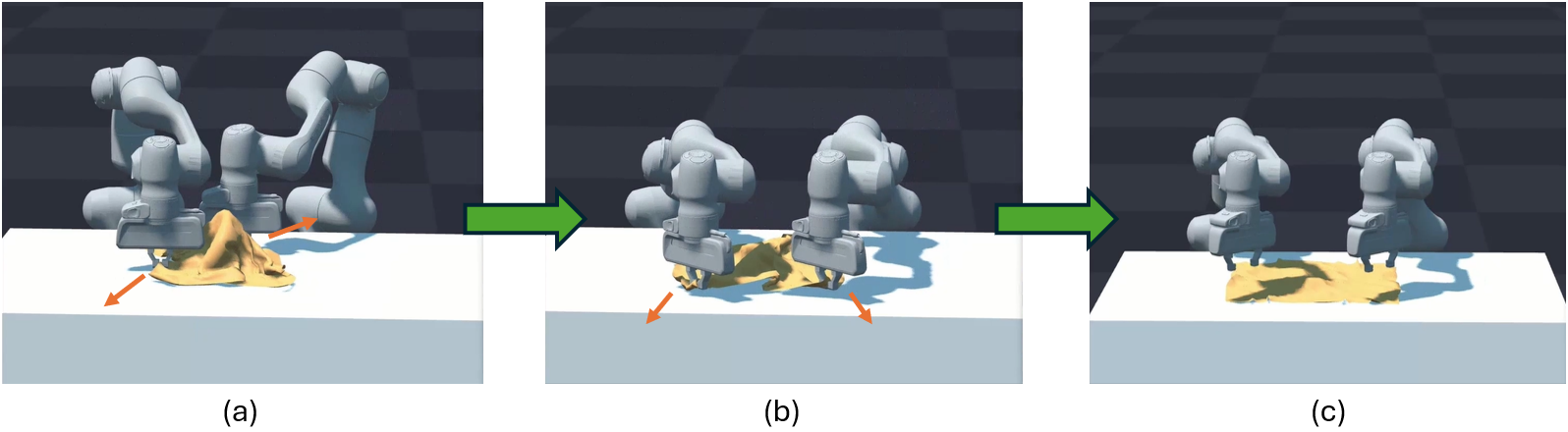
Figures are reproduced from Herrera et al. See the full paper for experimental details and the project page, when the paper links one, for demonstrations and videos.
Related Papers
3DThinkVLA: Endowing Vision-Language-Action Models with Latent 3D Priors via 3D-Thinking-Guided Co-training
Jiaxin Shi, Xidong Zhang, Fucai Zhu et al.
We propose a 3D-thinking-guided co-training framework that enables vision-language-action (VLA) models to perform 3D spatial reasoning implicitly during action prediction.
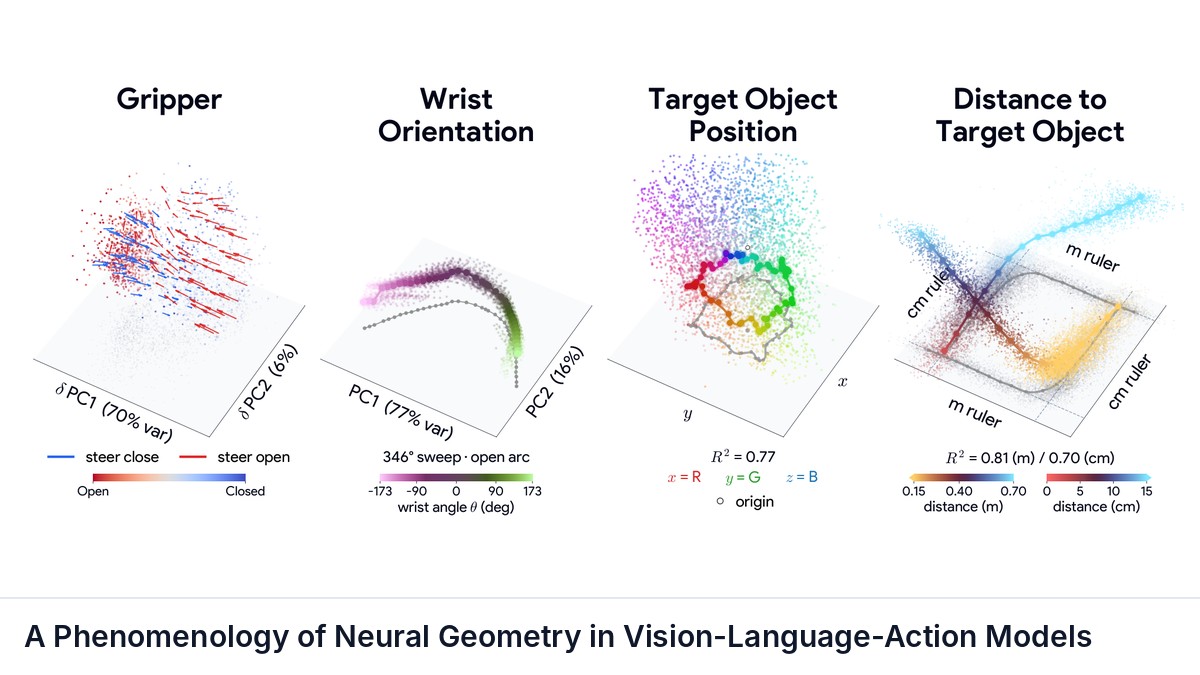
A Phenomenology of Neural Geometry in Vision-Language-Action Models
Mozes Jacobs, Aiden Swann, Mathilde Papillon et al.
Robotic manipulation is inherently geometric, but what shape does the world take inside the policy that performs it?

A Sim-to-Real Integration Pipeline for Training and Deployment of Chunk-Based VLA Manipulation Policies
Mathilde Kappel, Clémence Grislain, Mohamed Chetouani et al.
Vision-Language-Action (VLA) models have become a prominent paradigm for mapping multimodal inputs, including semantic instructions, visual observations of the scene, and proprioceptive observations, to robot actions.
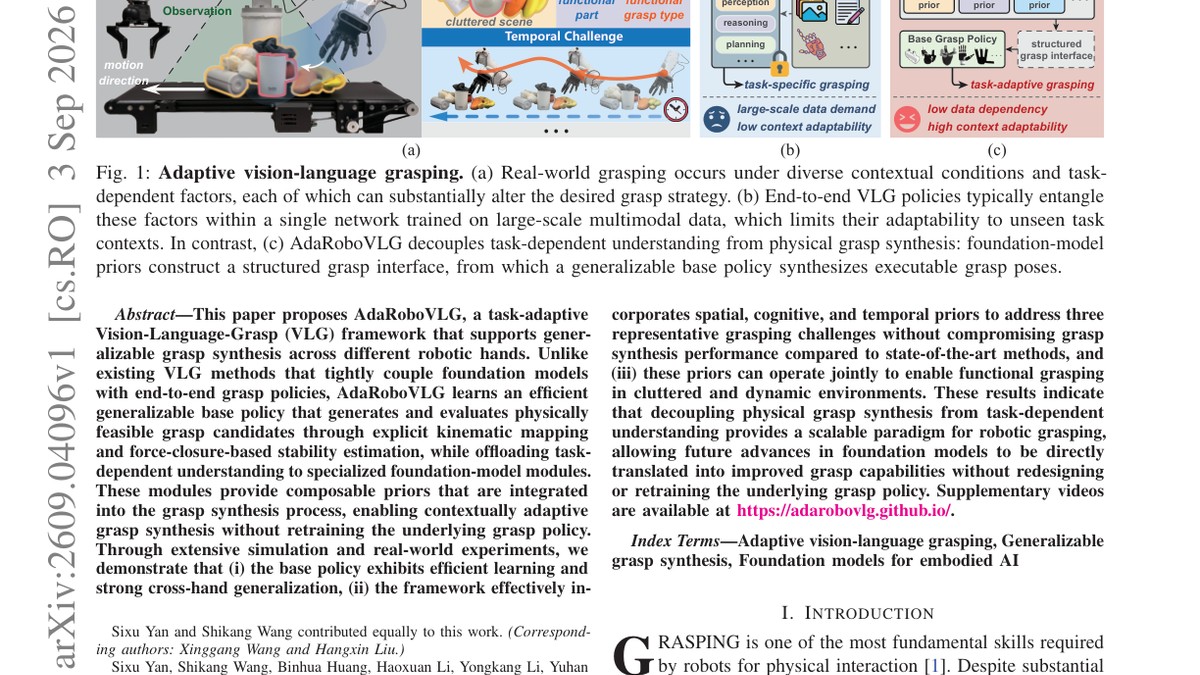
Adaptive Vision-Language Grasping via Composable Foundation Priors and Generalizable Grasp Synthesis
Sixu Yan, Shikang Wang, Binhua Huang et al.
This paper proposes AdaRoboVLG, a task-adaptive Vision-Language-Grasp (VLG) framework that supports generalizable grasp synthesis across different robotic hands.