
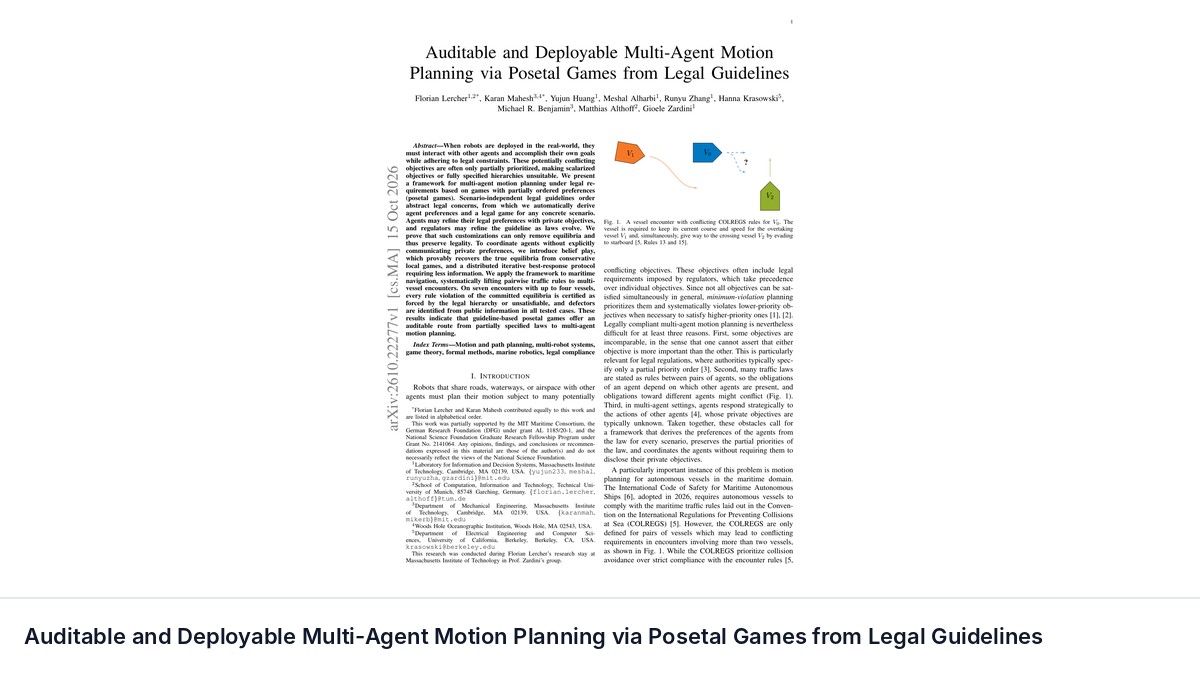
Auditable and Deployable Multi-Agent Motion Planning via Posetal Games from Legal Guidelines
Florian Lercher, Karan Mahesh, Yujun Huang, Meshal Alharbi, Runyu Zhang, Hanna Krasowski, Michael R. Benjamin, Matthias Althoff, Gioele Zardini · N/A · 2026
Framework
N/A
License
N/A
Stars
N/A
Summary
When robots are deployed in the real-world, they must interact with other agents and accomplish their own goals while adhering to legal constraints. These potentially conflicting objectives are often only partially prioritized, making scalarized objectives or fully specified hierarchies unsuitable.
Abstract Summary
Key Points
- When robots are deployed in the real-world, they must interact with other agents and accomplish their own goals while adhering to legal constraints.
- These potentially conflicting objectives are often only partially prioritized, making scalarized objectives or fully specified hierarchies unsuitable.
- We present a framework for multi-agent motion planning under legal requirements based on games with partially ordered preferences (posetal games).
- Scenario-independent legal guidelines order abstract legal concerns, from which we automatically derive agent preferences and a legal game for any concrete scenario.
- Agents may refine their legal preferences with private objectives, and regulators may refine the guideline as laws evolve.
Preliminaries and Problem Statement
In this section, we recall the necessary background on games with partially ordered preferences and then state the problem addressed in this paper. In classical games, every agent possesses a scalar utility function to evaluate the outcomes of the game.
Games with partially ordered preferences, or posetal games , are more general in that they allow each agent to evaluate an outcome with respect to multiple metrics that are prioritized according to a partial order [ 4 ] .

From Legal Requirements to Posetal Games
$m_{1}$ $m_{2}$ $m_{3}$ … $m^{\prime}_{1}$ $m^{\prime}_{2}$ $m^{\prime}_{3}$ $m^{\prime}_{4}$ $m^{\prime}_{5}$ … … $m_{1}$ $m_{2}$ $m_{3}$ … $m^{\prime}_{1}$ $m^{\prime}_{2}$ $m^{\prime}_{3}$ $m^{\prime}_{4}$ $m^{\prime}_{5}$ … … Scenario Legal metrics Legal preferences $\Phi$ $\mathsf{G}$ Fig. 4: Deriving legal preferences from a generic rule set $\Phi$ and a scenario-independent guideline $\mathsf{G}$.

Solution Protocols
In this section, we address part (ii) of Problem 1 , which requires computing the socially optimal NE $\gamma^{*}$ ( 3 ) of the true game $G_{\mathtt{true}}$ derived in Sec. III . To this end, we propose the solution protocols summarized in Tab. I . The design of a solution protocol depends strongly on which information each agent has about the others.
If the agents have complete information about the others, every agent can independently compute $\gamma^{*}$ without communication as they can directly construct $G_{\mathtt{true}}$.

Case Study: COLREGS-Compliant Planning
G S Give-way vessel Stand-on vessel (a) G S (a) G G (b) G S (c) Fig. 8: COLREGS encounter situations (adapted from [ 22 , Fig. 2] ). (a) In an overtaking situation, the overtaking vessel evades to either direction, while the overtaken vessel stands on. (b) In a head-on situation, both vessels evade to starboard.
(c) In a crossing situation, the vessel coming from the left evades to starboard, while the vessel coming from the right stands on. In this section, we apply the modeling framework developed in Sec.

Evaluation
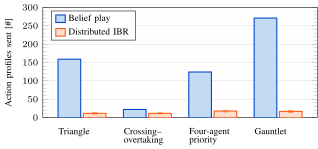
We evaluate the framework in one-shot COLREGS motion-planning games, in which each agent commits to a complete dynamically feasible trajectory before the encounter begins. Our goals are threefold. First, we verify that every rule violation at the committed equilibria can be audited and that defectors can be identified from public information.
Second, we confirm that private and regulatory customizations shrink the set of equilibria as predicted by Theorem 2 and Proposition 4 , and we quantify the efficiency cost of private preferences.
Sources and Demonstrations
Figures are reproduced from Lercher et al. See the full paper for experimental details and the project page, when the paper links one, for demonstrations and videos.
Related Papers
A Browser-Native Digital Test Range for Benchmarking 4D Ocean-Glider Planning Algorithms
Edward Holmberg, Elias Ioup, Mahdi Abdelguerfi
Repeated in-situ evaluation of ocean-glider planners requires scarce vehicles, operators, deployment and recovery resources, and ocean conditions that cannot be reset for competing algorithms.
A Low-Cost, Open Platform for End-to-End Autonomous Driving on a Miniature Ackermann Vehicle
Gustavo Claudio Karl Couto, Eric Aislan Antonelo, Gabriel George Zipperer
This paper presents a low-cost, open experimental platform for research in end-to-end autonomous driving with miniature Ackermann vehicles.
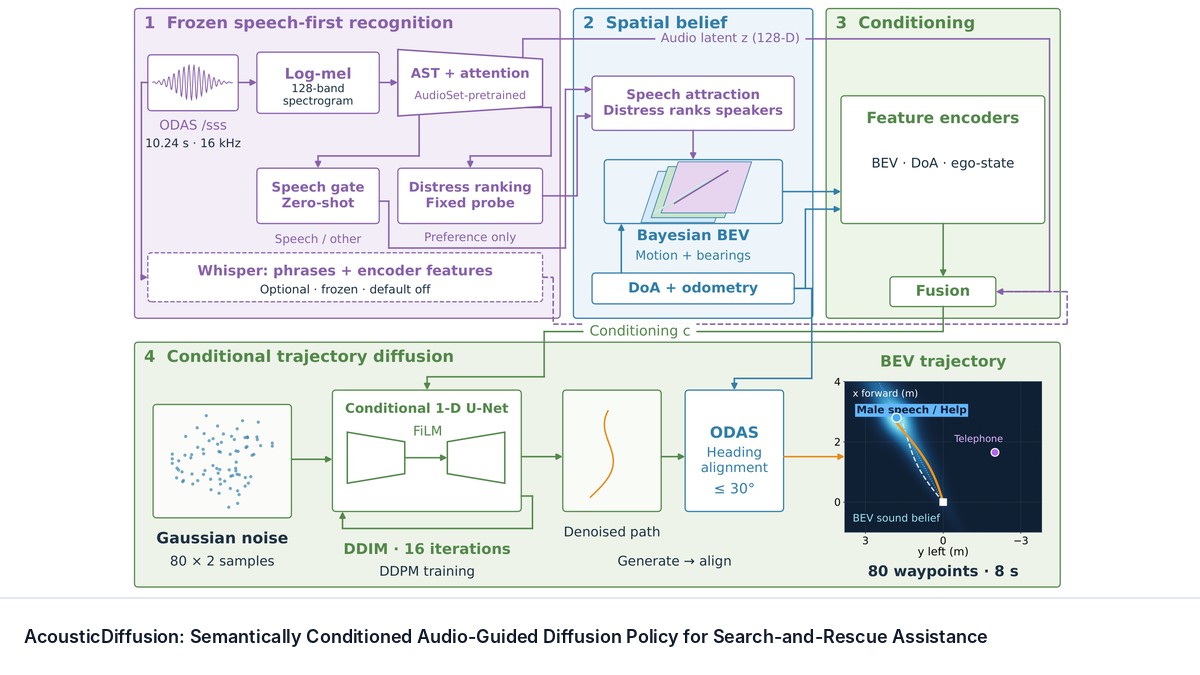
AcousticDiffusion: Semantically Conditioned Audio-Guided Diffusion Policy for Search-and-Rescue Assistance
Iana Zhura, Didar Seyidov, Dmitrii Plotnikov et al.
Navigating toward human callers is an important capability for rescue robots operating where visual contact is degraded or occluded. We present AcousticDiffusion, a semantically conditioned, audio-guided diffusion policy for human-directed navigation.
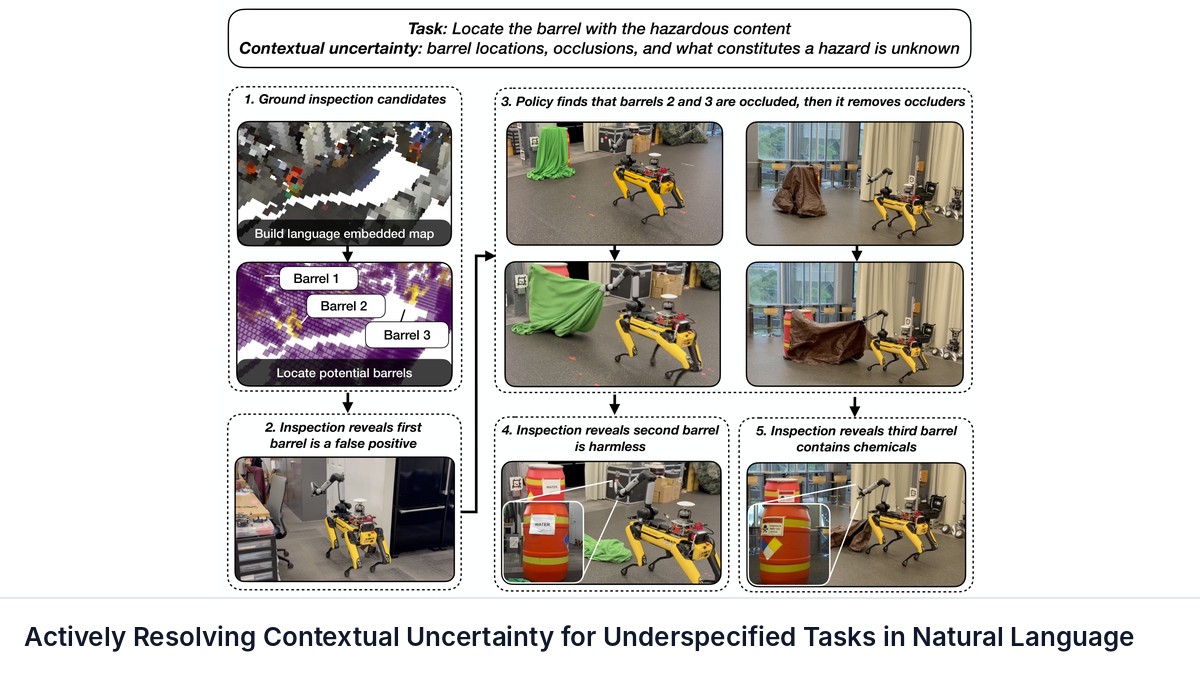
Actively Resolving Contextual Uncertainty for Underspecified Tasks in Natural Language
Zachary Ravichandran, Jonathan Diller, Fernando Cladera et al.
Foundation models provide robots with the ability to interpret natural language and reason about environmental context, yet most language-conditioned policies assume that goals are well-specified and that task-relevant information is provided upfront via a prior map.