
At a glance
- Problem: collecting humanoid demonstrations normally ties up the target robot. Source
- Idea: predict sparse body keypoints, retarget them, then track whole-body references. Source
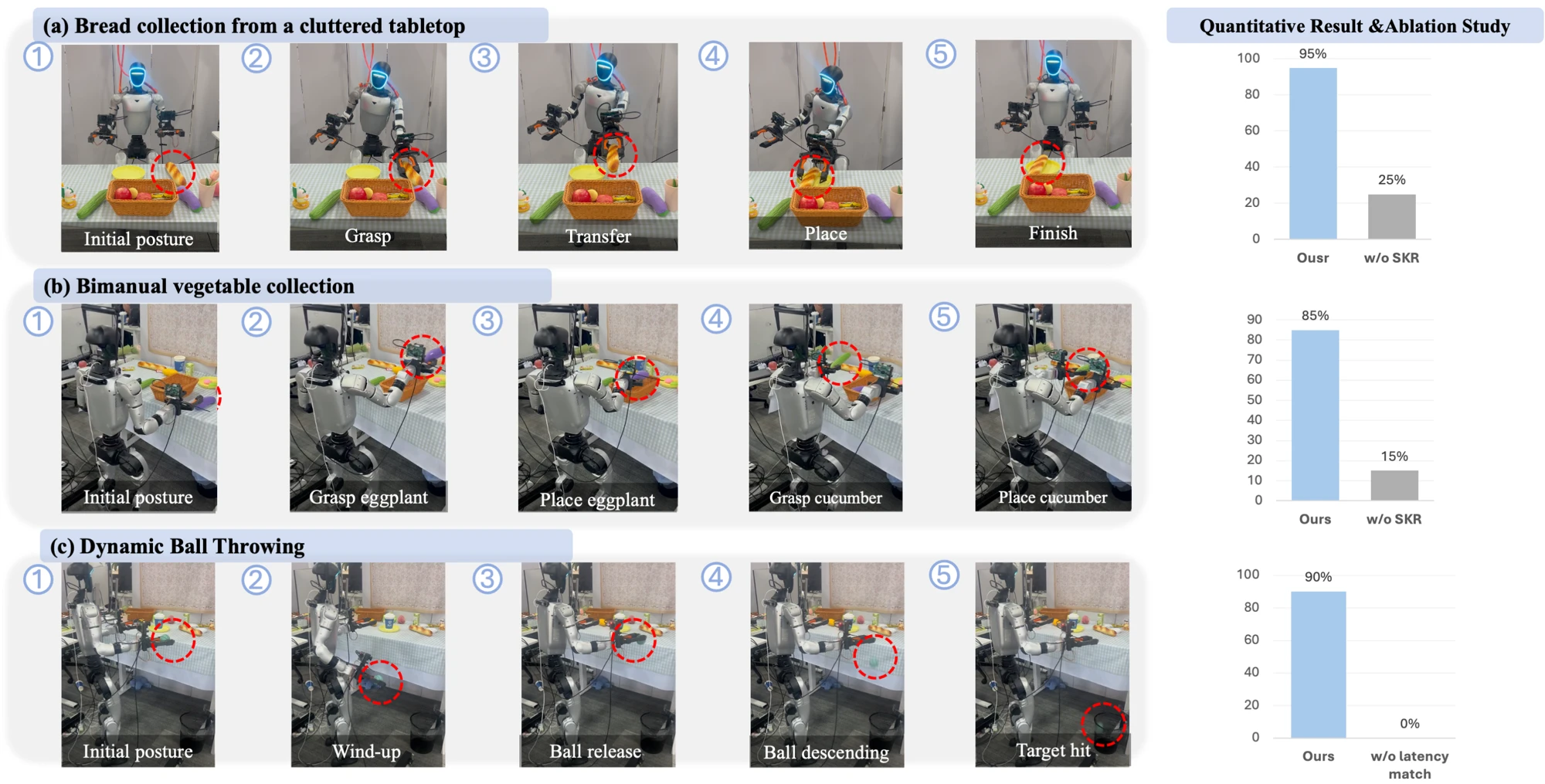
- Evidence: physical G1 demonstrations cover manipulation, throwing, bending and walking. Source
Evaluation scope The collection-throughput comparison uses two operators, including a novice given ten minutes of instruction. Source
How it works
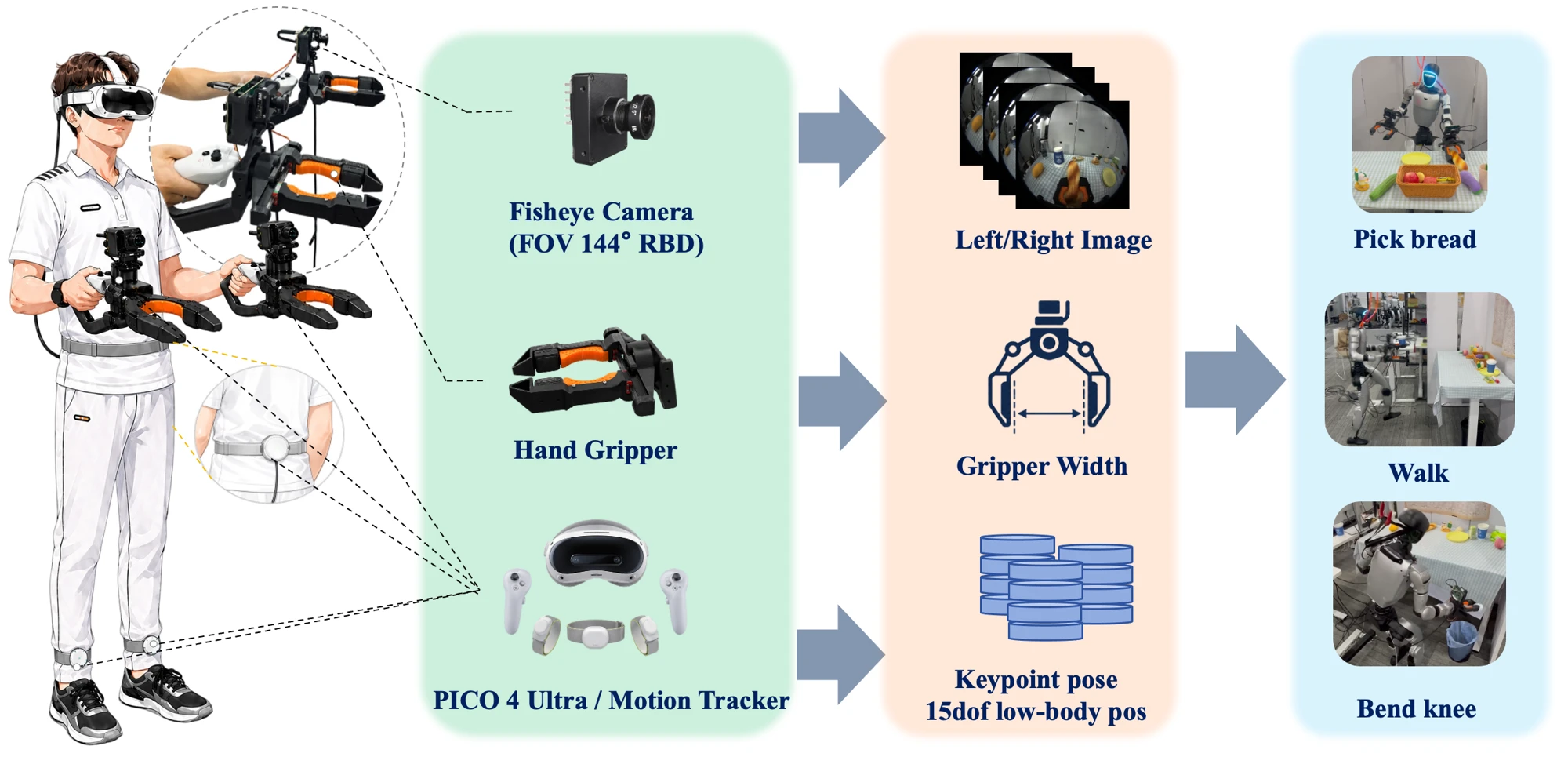
- Record synchronized wrist images, tracked body points and gripper openings using the portable VR interface. Source
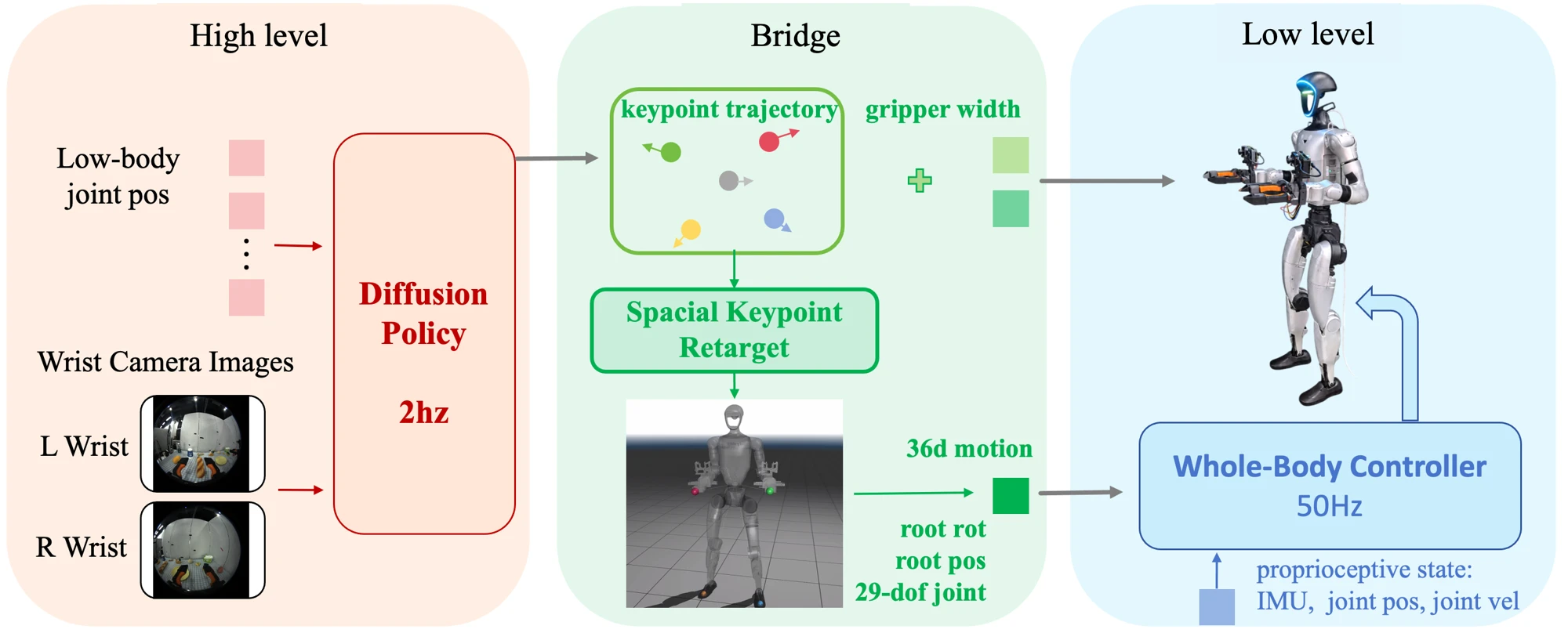
- Predict keypoint trajectories with a diffusion policy and convert them into robot-native references. Source
- Track those references with the low-level whole-body controller. Source
Evidence & results
- In ten-minute bimanual collection sessions, the novice gathered 55 valid demonstrations versus 25 with TWIST2; the experienced operator gathered 55 versus 30. Evidence
- Adding knee keypoints improves lower-body coordination for waste disposal and walking delivery compared with the default five-keypoint configuration. Evidence
Limitations & boundaries
Takeaway
Robot-free collection is useful only when retargeting and whole-body execution preserve the demonstrated spatial relationships. Source
Resources
Figures: the paper's authors. Editorial source and image review: 2026-10-21. Findings are author-reported, not independently reproduced by Robotics Research Hub.
Citation
@article{Wang2026_260627239v1, title={HumanoidUMI: Bridging Robot-Free Demonstrations and Humanoid Whole-Body Manipulation}, author={Hongwu Wang and Chenhao Yu and Youhao Hu and Jiachen Zhang and Yuanyuan Li and Shaqi Luo}, journal={arXiv preprint arXiv:2606.27239v1}, year={2026}}