

Scalable Behavior Cloning with Open Data, Training, and Evaluation
FeaturedArthur Allshire, Himanshu Gaurav Singh, Ritvik Singh, Adam Rashid, Hongsuk Choi, David McAllister, Justin Yu, Yiyuan Chen, Huang Huang, Pieter Abbeel, Xi Chen, Rocky Duan, Phillip Isola, Jitendra Malik, Fred Shentu, Guanya Shi, Philipp Wu, Angjoo Kanazawa · · 2026
Framework
Python
License
Apache-2.0
Stars
200
Summary
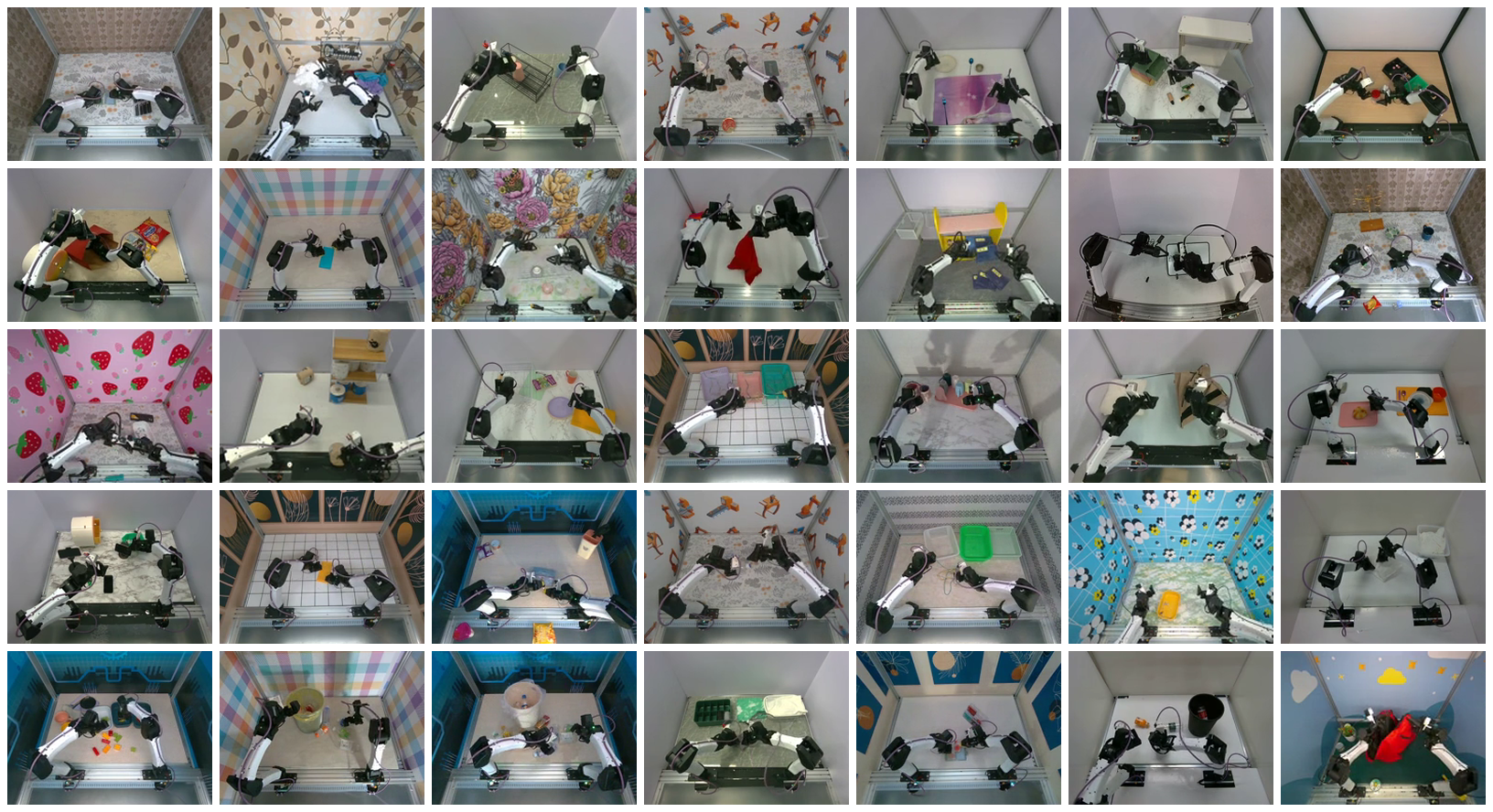
We introduce ABC, a fully open-source stack for manipulation with behavior cloning. At its core is ABC-130K: the largest open-source teleoperation dataset to date, featuring 3,500 hours of data spanning over 130K episodes across 195 diverse tasks.
Abstract Summary
Key Points
- We introduce ABC, a fully open-source stack for manipulation with behavior cloning. At its core is ABC-130K: the largest open-source teleoperation dataset to date, featuring 3,500 hours of data spanning over 130K episodes across 195 diverse tasks.
ABC-130K Dataset
Publicly available robot data for policy learning has grown substantially in recent years. DROID [ 4 ] and BridgeData-V2 [ 6 ] provide high-quality single-arm data on the Franka and WidowX robots, respectively, but on tasks that are largely single-step pick-and-place.
Open X-Embodiment [ 5 ] spans many embodiments and tasks, but its wide variation in quality along with noisy language and action-space metadata makes it hard to use. AgiBot-World [ 7 ] offers 3,000 hours of bimanual data, although on a $30,000 robot.
ABC-Models
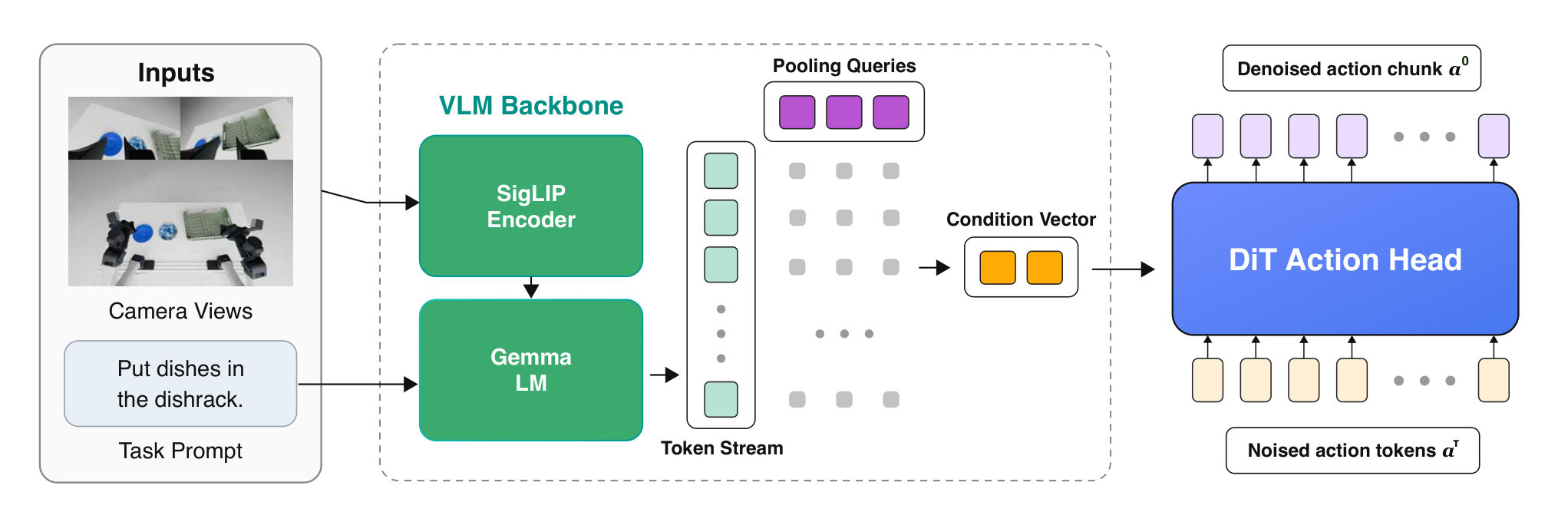
ABC-DiT , a diffusion-transformer policy with lightweight vision and language encoders, and ABC-VLA , a VLM-backed policy with a diffusion action head. These two models reflect common design choices in recent robot learning systems: diffusion policies built on pretrained visual representations [ 9 , 10 ] , and vision-language-action models that adapt pretrained VLM backbones for robot control [ 11 , 12 , 13 , 14 ] .
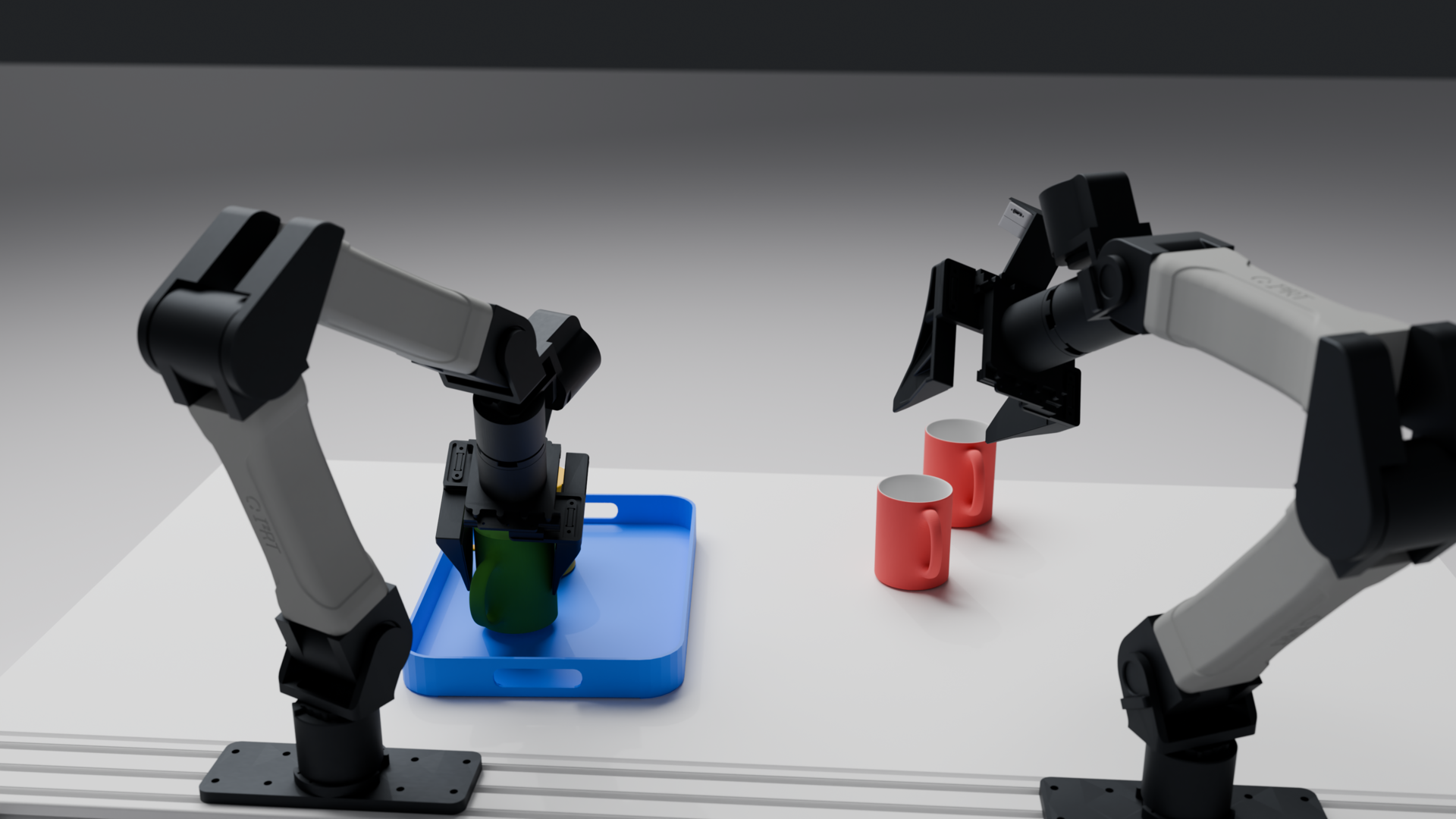
ABC-Sim
$10$ $20$ $30$ $40$ $50$ $60$ $10$ $20$ $30$ $40$ $40$ $50$ $60$ $70$ $80$ $50$ $60$ $70$ $n=12$ $r=0.85$ , $p=4.2{\times}10^{-4}$ Sim strict success (%) Real strict success (%) Strict success $n=12$ $r=0.91$ , $p=5.0{\times}10^{-5}$ Sim task progress (%) Real task progress (%) Task progress Fit DiT VLA Figure 9 : Sim-to-real performance correlation.
Task-level simulation progress correlation with real-world progress across DiT and VLA checkpoints.
Real-World Capabilities
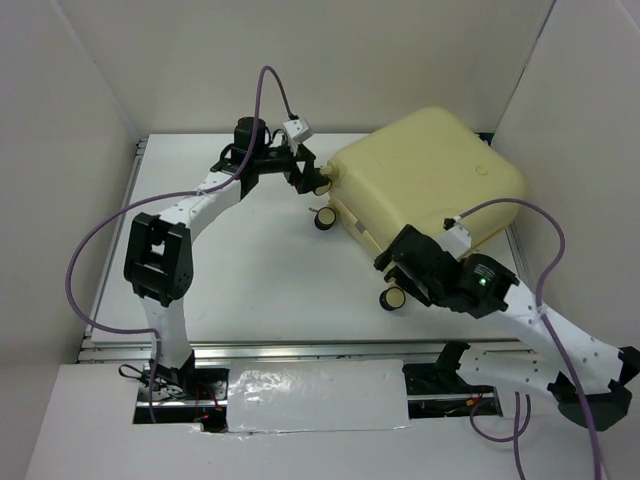
Bottles Dishrack Mug flip $0$ $20$ $40$ $60$ $80$ $100$ Real progress (%) ABC-DiT ABC-VLA $0$ $50$ $100$ $150$ $200$ $0$ $25$ $50$ $75$ $100$ Checkpoint step (k) Sim progress (%) Bottles $0$ $50$ $100$ $150$ $200$ Checkpoint step (k) Dishrack $0$ $50$ $100$ $150$ $200$ Checkpoint step (k) Mug flip DiT 9.2kBS VLA 9.2kBS In this section, we demonstrate the capabilities of our trained policies on the publicly released ABC-130K set.
We begin by showing the performance of the pretrained base policies in Section 5.1 .
Infrastructure
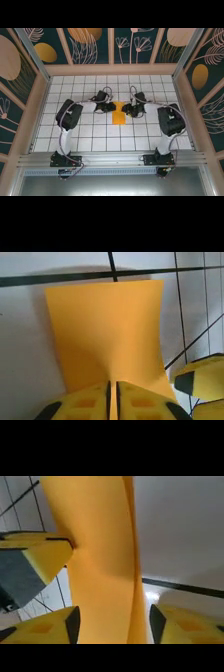
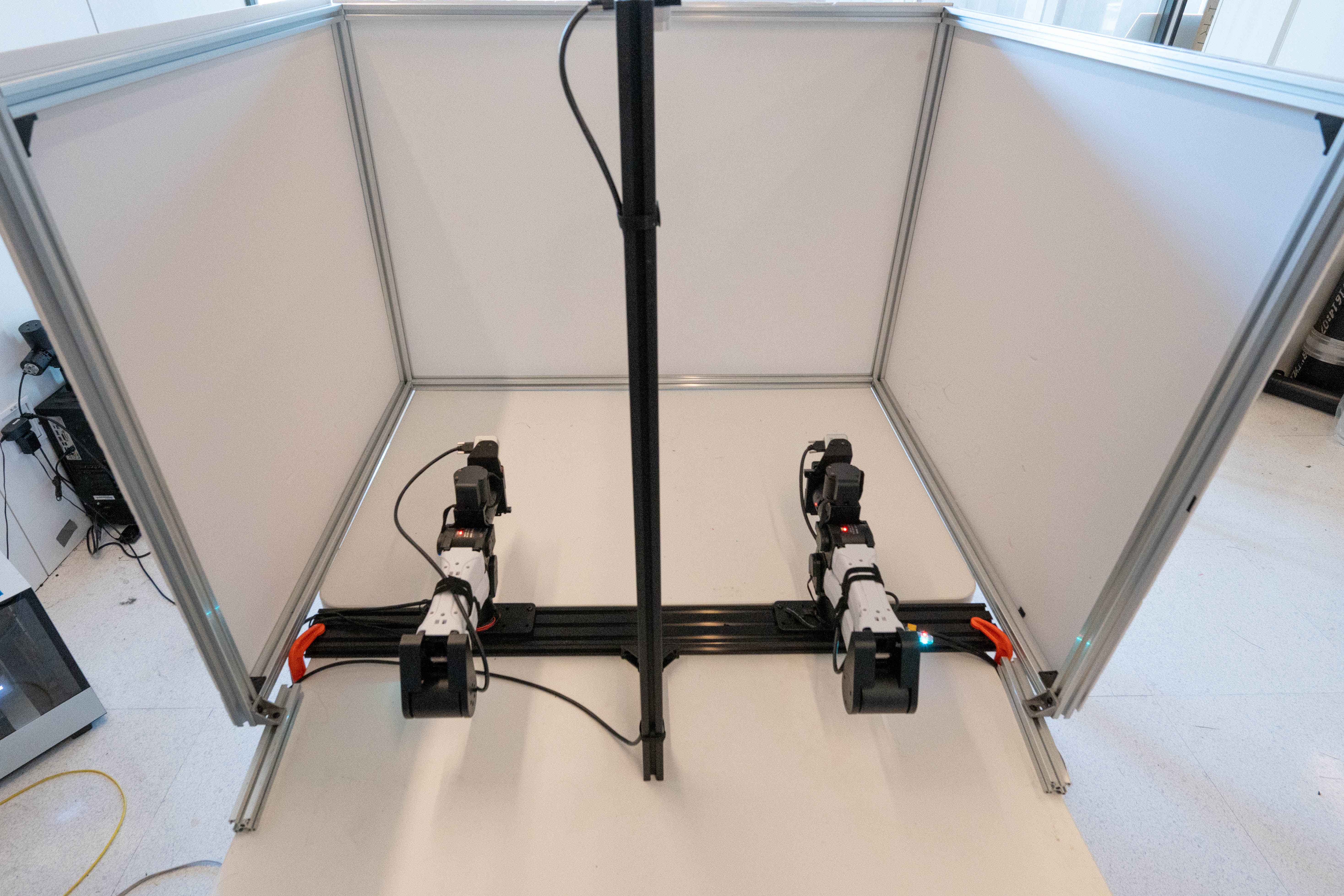
Beyond the usual data and modeling details, the low-level systems implementations are equally important. To this end, we also release the surrounding infrastructure for this project. Appendix B.1 contains the details for efficient data loading from multiple video streams to improve training time. Appendix C details our lightweight and extensible real robot code framework.
Appendix D describes the inference optimizations for both ABC-DiT and ABC-VLA.
Requests for Research
We present ABC-130K, ABC-Models, and ABC-Sim with the aim of seeding an open-source, reproducible ecosystem for robot learning research. Many interesting open questions remain to be answered for large-scale real-world robot learning, including but not limited to: History conditioning : policies that condition on a sequence of past observations rather than the current frame alone.
Scaling laws for BC : how performance scales with model and data size for imitation learning.
Sources and Demonstrations
Figures are reproduced from Allshire et al. See the full paper for experimental details and the project page, when the paper links one, for demonstrations and videos.
Related Papers

LA4VLA: Learning to Act without Seeing via Language-Action Pretraining
Tao Lin, Yuxin Du, Yiran Mao et al.
Vision-Language-Action (VLA) models are commonly pretrained on robot demonstrations by jointly mapping visual observations and language instructions to actions. However, dense visual-action supervision can dominate the comparatively sparse language-action signal.

E-TTS: A New Embodied Test-Time Scaling Framework for Robotic Manipulation
Wen Ye, Peiyan Li, Tingyu Yuan et al.
Recently, a few works have made early attempts to study test-time scaling for embodied tasks.

Hand-in-the-Loop: Improving Dexterous VLA via Seamless Interventional Correction
Zhuohang Li, Liqun Huang, Wei Xu et al.
Vision-Language-Action (VLA) models are prone to compounding errors in dexterous manipulation, where high-dimensional action spaces and contact-rich dynamics amplify small policy deviations over long horizons.
HumanoidUMI: Bridging Robot-Free Demonstrations and Humanoid Whole-Body Manipulation
Hongwu Wang, Chenhao Yu, Youhao Hu et al.
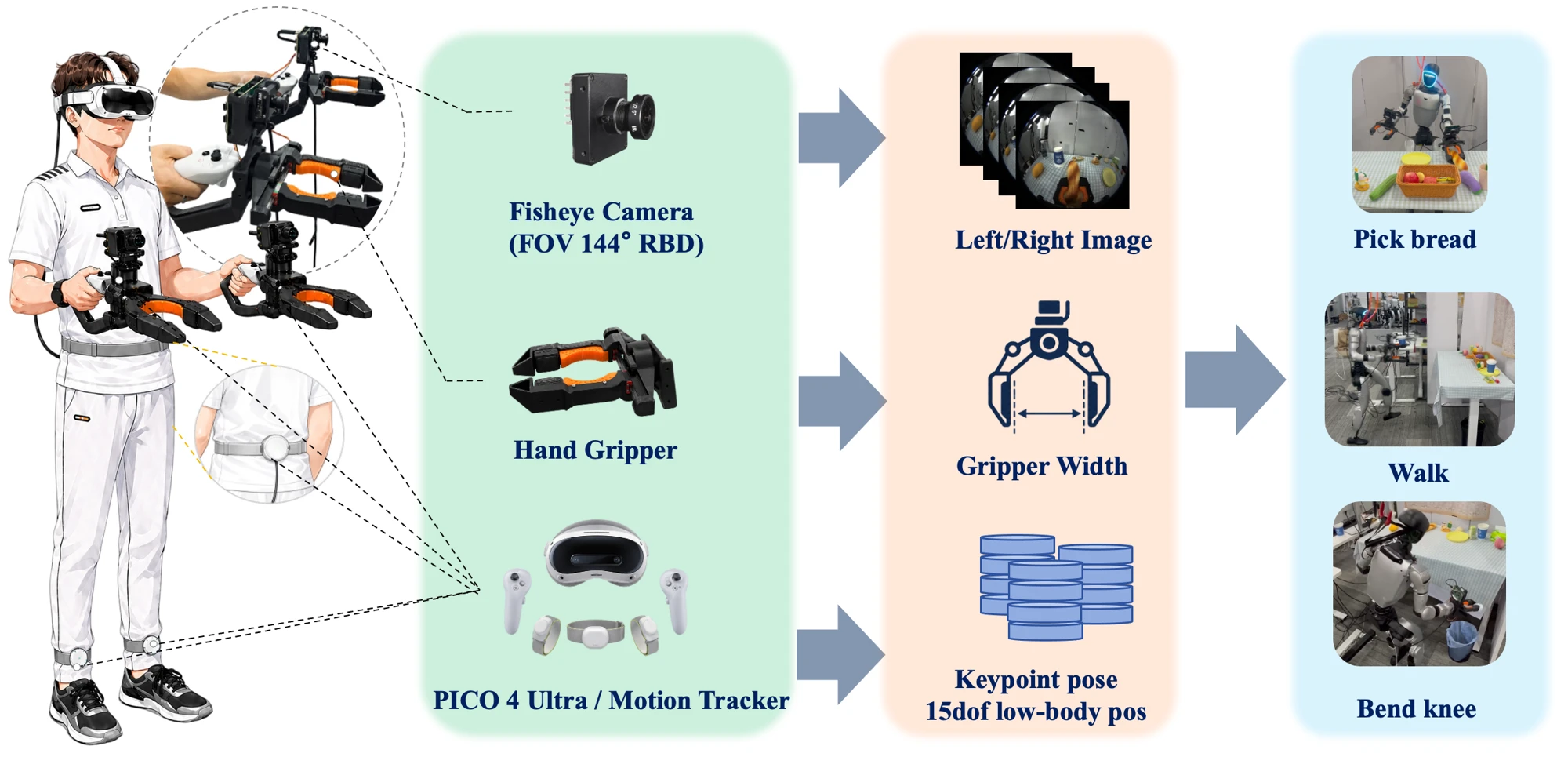
HumanoidUMI moves demonstration collection off the robot, then translates human motion into executable humanoid skills.