
VIDP: Variable Impedance Diffusion Policy for Compliant Robot Manipulation from Diverse Demonstrations
Hisham Khalil, Neil Fernandes, Thomas M. Kwok, Hsiu-Chin Lin, Yue Hu · N/A · 2026
Framework
N/A
License
N/A
Stars
N/A
Summary
Contact-rich manipulation requires precise tracking and mechanical compliance, where variable impedance control can improve robustness in task success, whereas static compliance cannot adapt to varying contact constraints.
Abstract Summary
Key Points
- Contact-rich manipulation requires precise tracking and mechanical compliance, where variable impedance control can improve robustness in task success, whereas static compliance cannot adapt to varying contact constraints.
- Variable impedance skills can be learned from demonstrations, avoiding complex modeling, but compliance is a hidden variable in force-agnostic kinematic data.
- While existing methods infer compliance from trajectory variations, these variations may reflect geometric adaptation and not intentional compliance when subject to changing spatial layouts.
- Therefore, this letter introduces Variable Impedance Diffusion Policy (VIDP), an imitation learning-based variable impedance control framework leveraging a Task-Parameterized Directionality-Aware Mixture Model (TP-DAMM) to extract physically consistent trajectory distributions from diverse demonstrations.
- By mapping distributions to stiffness profiles, VIDP jointly predicts pose actions and task compliance without force sensors.
Methodology
VIDP bridges kinematic demonstrations and compliant policy execution through three stages, as shown in Fig. 1 . First, TP-DAMM extracts spatially and directionally consistent trajectory distributions from diverse demonstrations. Their variance is then mapped to target Cartesian stiffness profiles, which supervise a Diffusion Policy to jointly predict pose actions and compliance from visual and state observations.
Experimental Evaluation
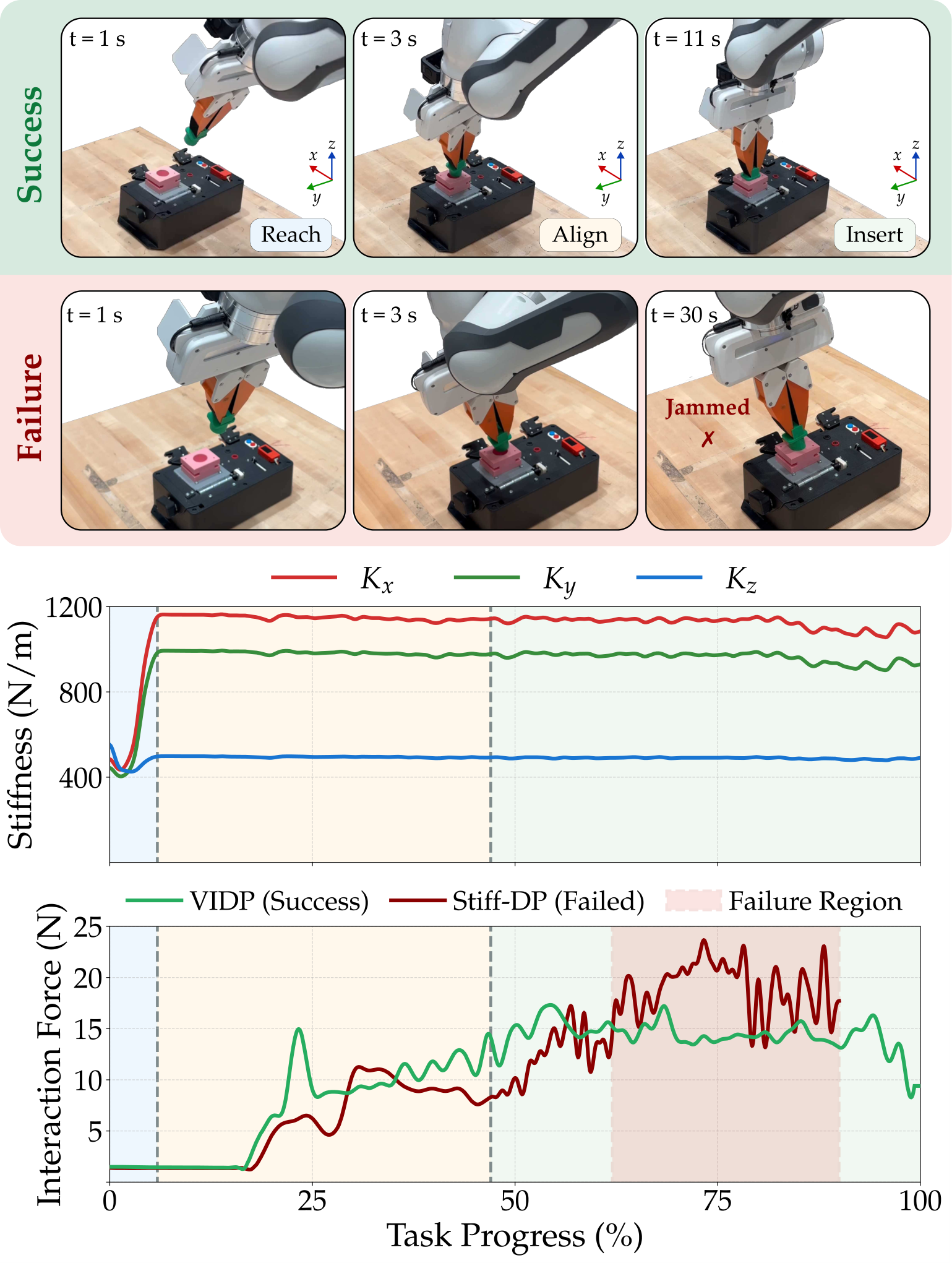
Does TP-DAMM extract more directionally consistent and representative task trajectory distributions from spatially diverse demonstrations compared to standard clustering methods? RQ2: Does VIDP outperform fixed-impedance baselines in success rate across tasks characterized by varying contact constraints and diverse spatial layouts?
RQ3: How does the inferred variable impedance profile optimize the physical interaction metrics, specifically interaction forces, tracking errors, and energy efficiency, during critical execution phases? We collect d...
Sources and Demonstrations
Figures are reproduced from Khalil et al. See the full paper for experimental details and the project page, when the paper links one, for demonstrations and videos.
Related Papers
A Balanced Data Diet: Addressing the Exploration Bottleneck in Mega-Scale RL for Robot Control
Octi Zhang, Mateo Guaman Castro, Patrick Yin et al.
General-purpose robots must perform a wide range of tasks from agile locomotion to dexterous manipulation.

A Sim-to-Real Integration Pipeline for Training and Deployment of Chunk-Based VLA Manipulation Policies
Mathilde Kappel, Clémence Grislain, Mohamed Chetouani et al.
Vision-Language-Action (VLA) models have become a prominent paradigm for mapping multimodal inputs, including semantic instructions, visual observations of the scene, and proprioceptive observations, to robot actions.
AHEAD: Anticipatory Hand-Driven Teleoperation via Human Intent Prediction
Seok Joon Kim, Junho Lee, Federica Spinola et al.
Direct hand-driven teleoperation maps an operator's hand motion to robot end-effector commands at every frame, enabling precise control, but it requires constant monitoring and correction during approach, grasp, and placement, which can be slow and fatiguing.
Behavioral Cloning Mystery
Seohong Park, Sergey Levine
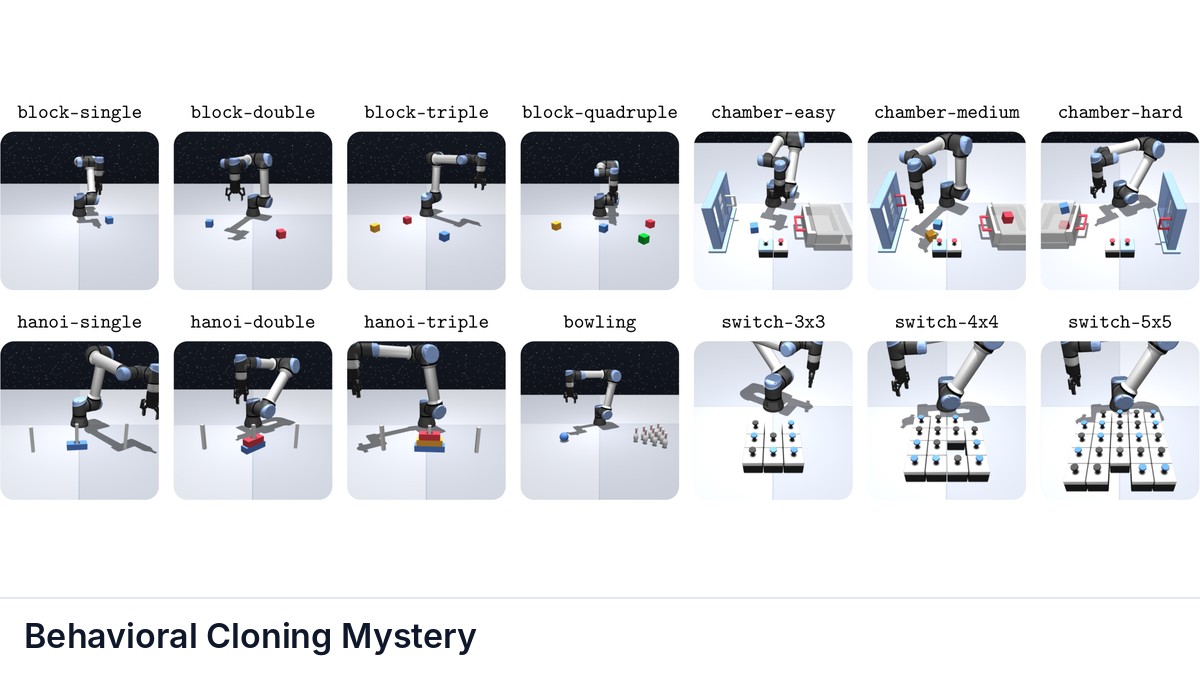
Behavioral cloning (BC), despite its simplicity, exhibits many counterintuitive phenomena in the real world. For example, the performance of BC often keeps increasing as the model overfits more to the dataset, and fully closed-loop policies often completely fail without action chunking.