
OopsieVerse: A Safety Benchmark with Damage-Aware Simulation for Robot Manipulation
FeaturedArnav Balaji, Arpit Bahety, Sriniket Ambatipudi, Daniel Lam, Junhong Xu, Roberto Martín-Martín · · 2026
Framework
N/A
License
N/A
Stars
N/A
Summary
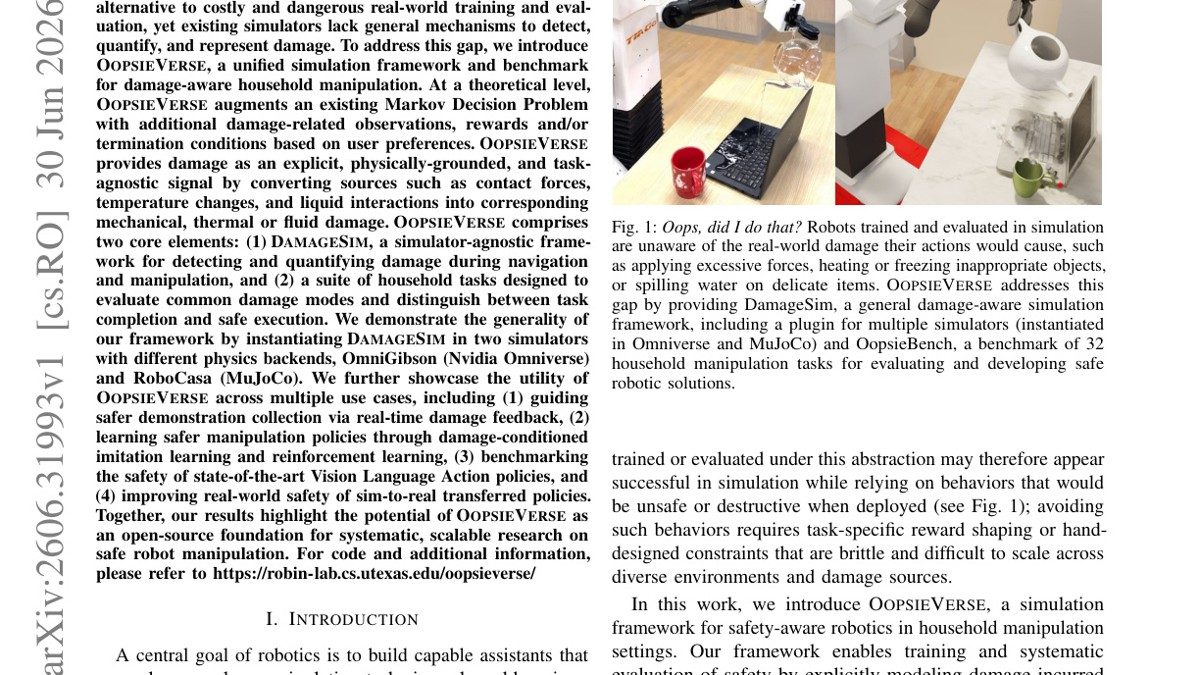
While robotic manipulation capabilities have advanced rapidly, physical safety remains a major barrier to deploying household robots: task success is insufficient if the robot damages itself or its surroundings.
Abstract Summary
Key Points
- Proposes OopsieVerse for robotics.
- Evaluated on real or simulated robotic tasks.
- Primary contribution in ar-vr.
DamageSim
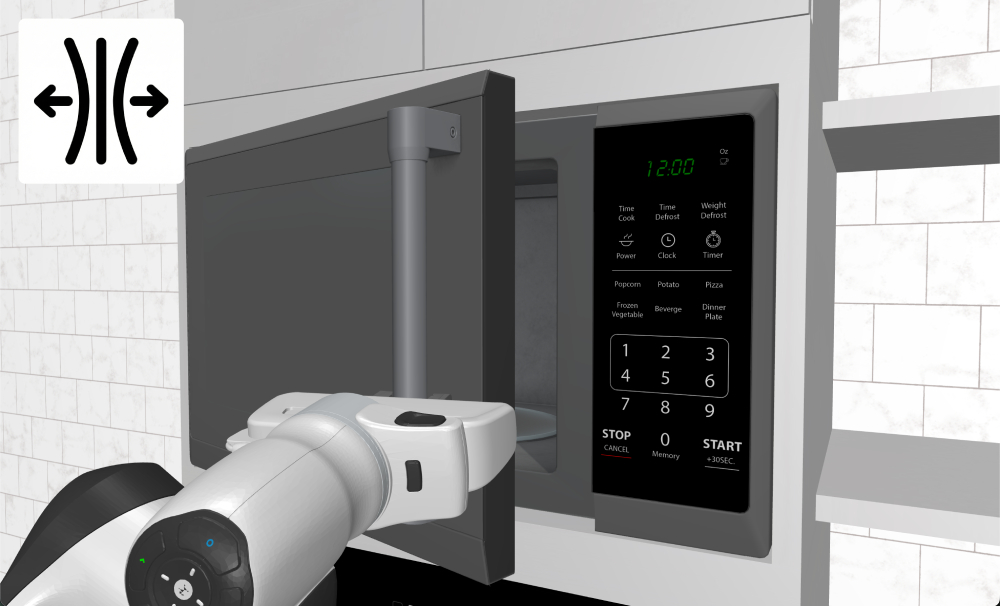
In this section we introduce DamageSim , our simulation-based damage evaluation framework. After introducing our conceptual framing for a damage-aware POMDP formulation, we describe how we compute mechanical, thermal, and fluid damage signals from the simulator.
OopsieBench
We introduce a suite of 32 task instances across the two simulators (OmniGibson/OmniVerse for B1K tasks and MuJoCo for RoboCasa tasks), corresponding to 21 unique task designs (see Fig. 4 ).
The suite is built to (i) expose policies to physically damaging failure modes that arise naturally in household manipulation, and (ii) make the safety distinction measurable : for most tasks there exists an easy, tempting strategy that completes the goal but risks damage, alongside a safer strategy that typically requires more careful interaction (e.g., ge...
Experiments
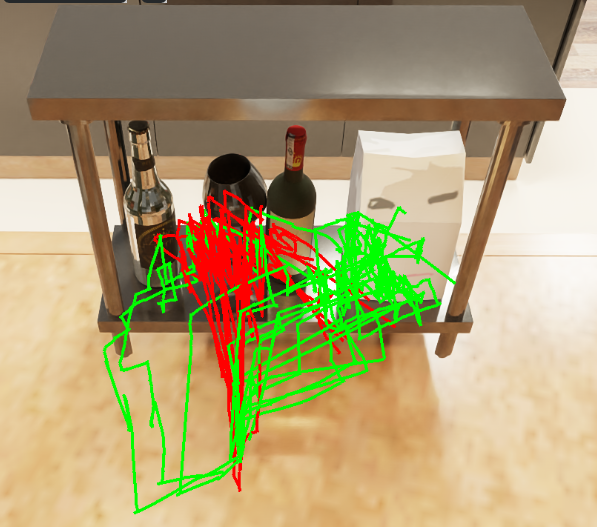
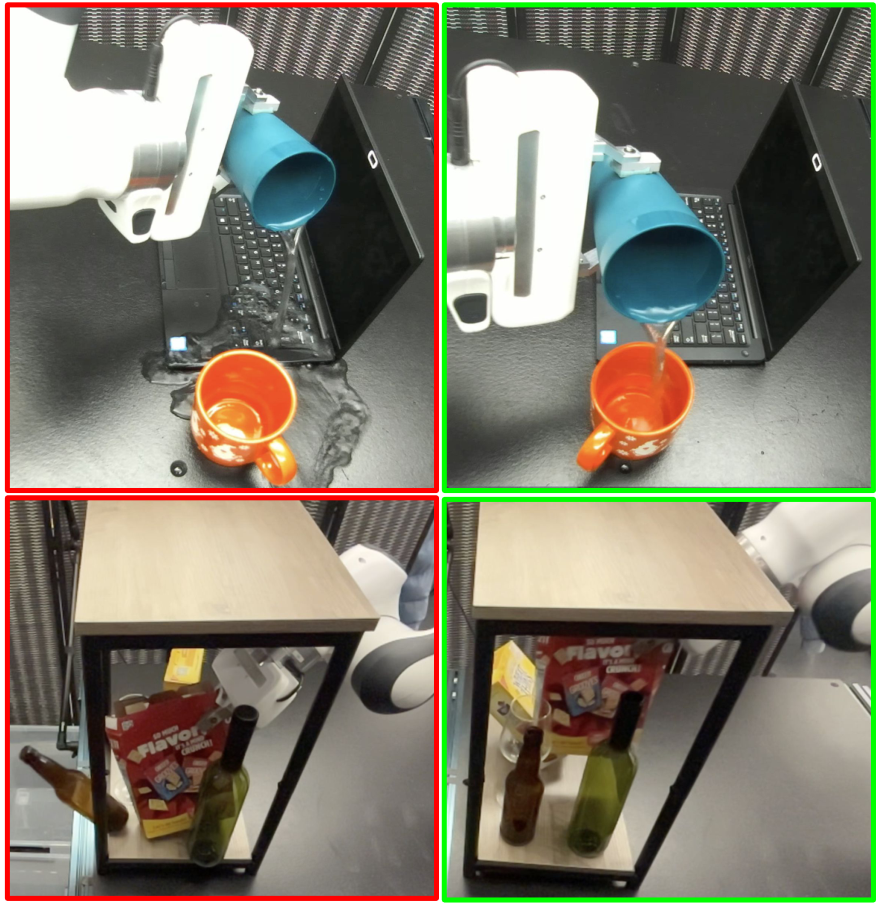
Our experiments are designed to demonstrate the utility and versatility of OopsieVerse as a safety framework for robotic manipulation. We validate our framework by demonstrating the following use cases across two simulators (OmniGibson and Robocasa): Does OopsieVerse provide a sufficiently accurate signal to collect safer data and/or to train safer policies with imitation learning (Sec. V-A )?
Can OopsieVerse ’s extended state be used to define safety-related reward to train/finetune policies with reinforcement learning (Sec.
Sources and Demonstrations
Figures are reproduced from Balaji et al. See the full paper for experimental details and the project page, when the paper links one, for demonstrations and videos.
Related Papers
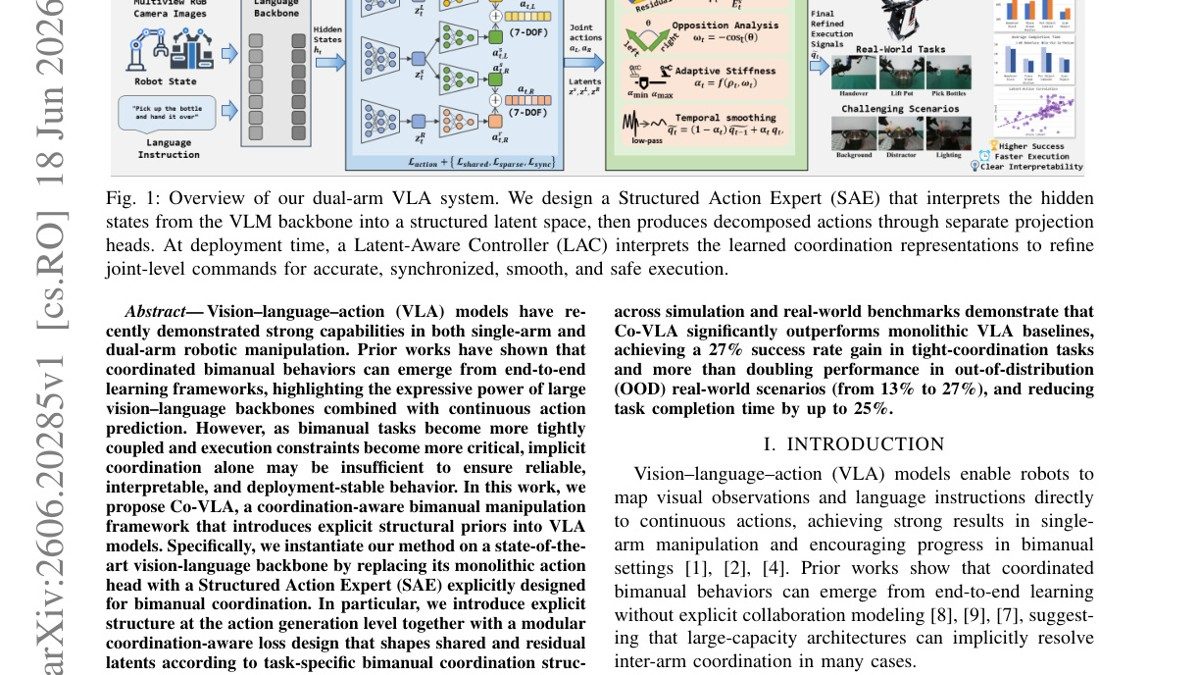
Co-VLA: Coordination-Aware Structured Action Modeling for Dual-Arm Vision-Language-Action Systems
Yandong Wang, Jiaqian Yu, Xiongfeng Peng et al.
Vision-language-action (VLA) models show strong capabilities in single and dual-arm robotic manipulation. Prior works show coordinated bimanual behaviors can emerge from end-to-end learning, leveraging large vision-language backbones with continuous action prediction.
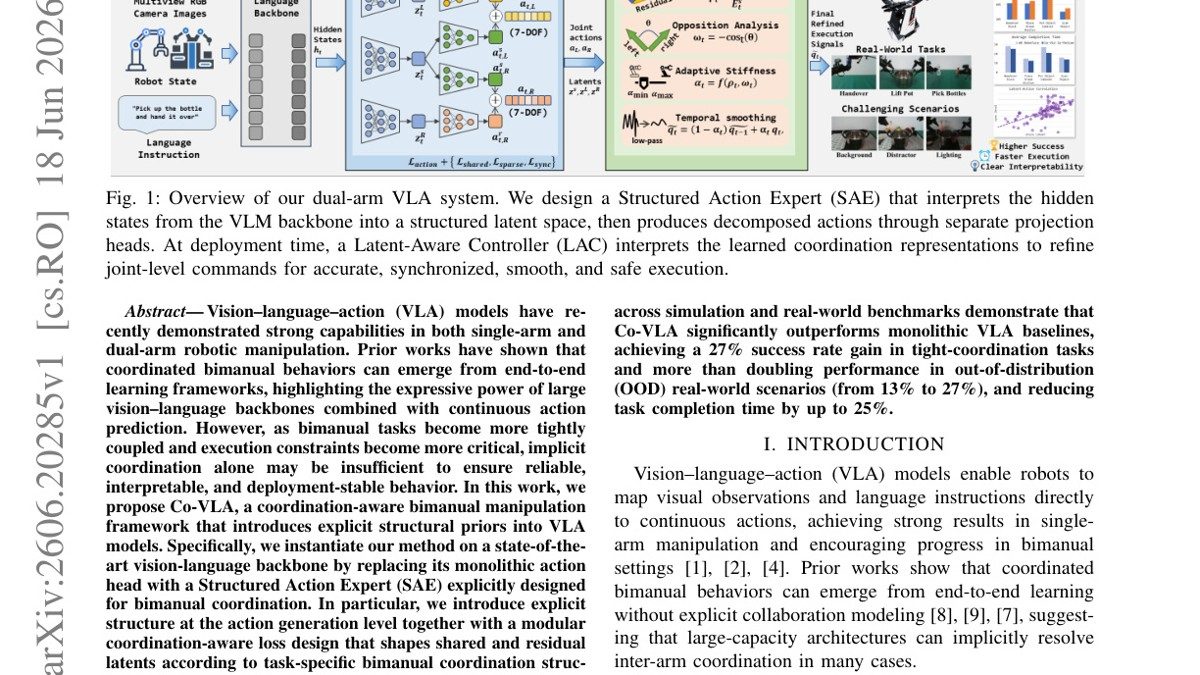
Co-VLA: Coordination-Aware Structured Action Modeling for Dual-Arm Vision-Language-Action Systems
Yandong Wang, Jiaqian Yu, Xiongfeng Peng et al.
Vision-language-action (VLA) models show strong capabilities in single and dual-arm robotic manipulation. Prior works show coordinated bimanual behaviors can emerge from end-to-end learning, leveraging large vision-language backbones with continuous action prediction.
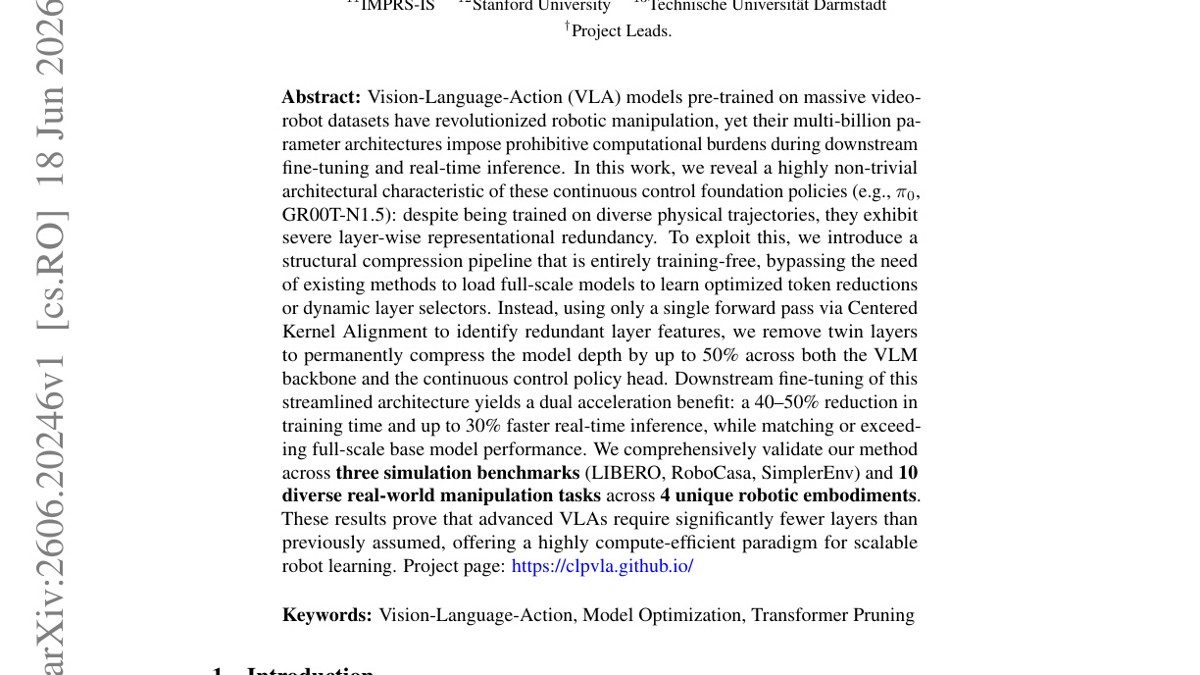
Finetuning Vision-Language-Action Models Requires Fewer Layers Than You Think
Gia-Binh Nguyen, Trong-Bao Ho, Thien-Loc Ha et al.
Vision-Language-Action (VLA) models pre-trained on massive video-robot datasets have revolutionized robotic manipulation, yet their multi-billion parameter architectures impose prohibitive computational burdens during downstream fine-tuning and real-time inference.
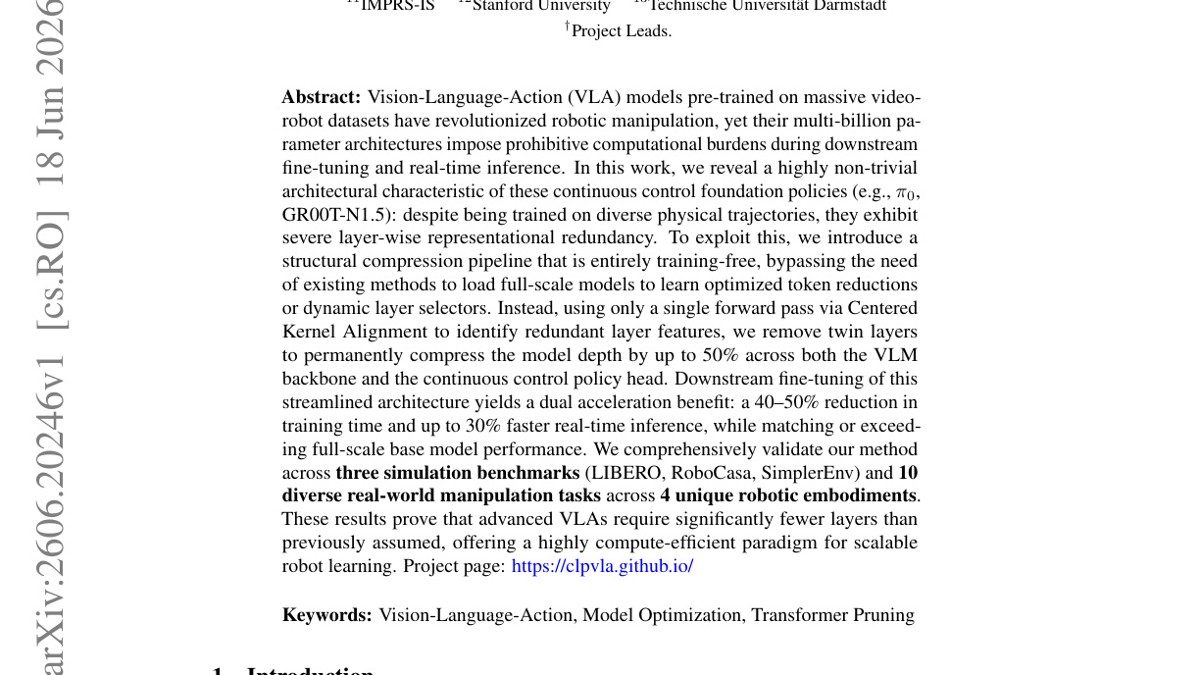
Finetuning Vision-Language-Action Models Requires Fewer Layers Than You Think
Gia-Binh Nguyen, Trong-Bao Ho, Thien-Loc Ha et al.
Vision-Language-Action (VLA) models pre-trained on massive video-robot datasets have revolutionized robotic manipulation, yet their multi-billion parameter architectures impose prohibitive computational burdens during downstream fine-tuning and real-time inference.