
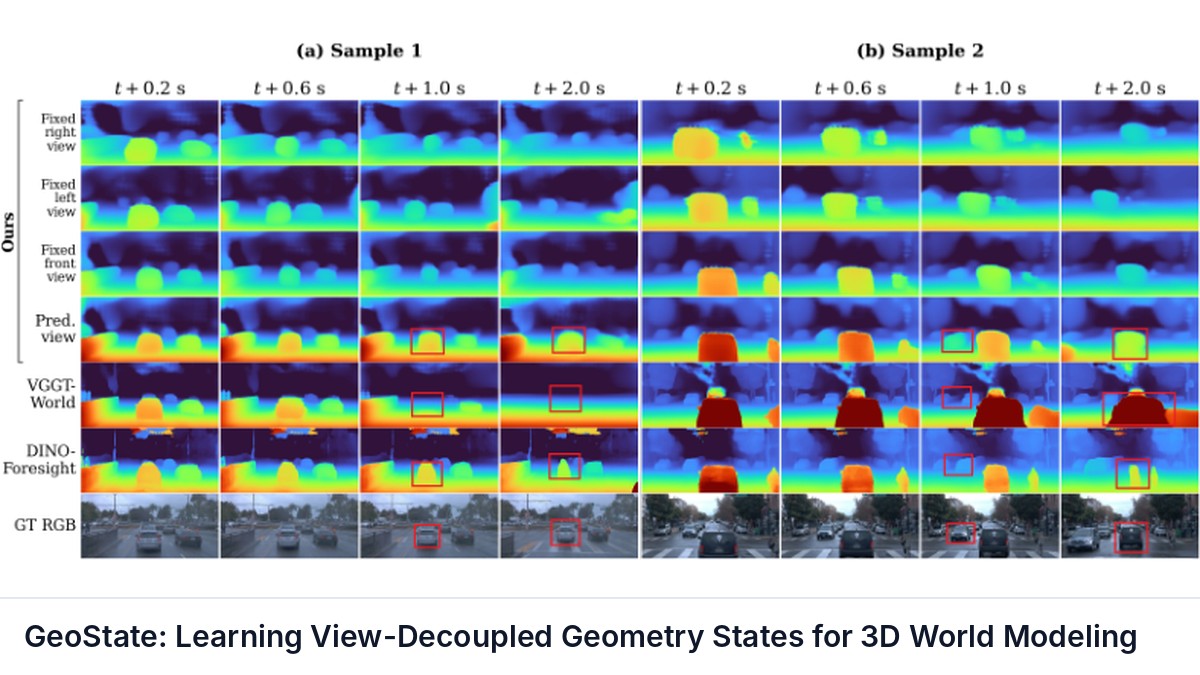
GeoState: Learning View-Decoupled Geometry States for 3D World Modeling
Hongchang Liu, Jian Liu, Yujuan Ding, Liang Peng, Xun Jiang, Fei Ma, Xing Xu, Yi Bin · N/A · 2026
Framework
N/A
License
N/A
Stars
N/A
Summary
Recent 3D world models increasingly use features from geometry foundation models (GFMs) as predictive world states, benefiting from their rich geometric priors.
Abstract Summary
Key Points
- Recent 3D world models increasingly use features from geometry foundation models (GFMs) as predictive world states, benefiting from their rich geometric priors.
- However, the view dependence of these features entangles scene dynamics with camera-induced variation, making the resulting state evolution harder to predict.
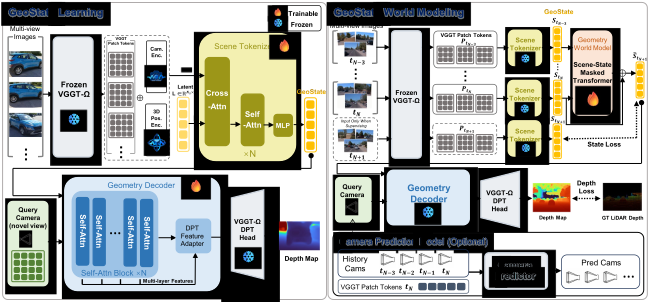
- We propose GeoState, a view-decoupled geometry representation for predictive 3D world modeling that separates scene-state evolution from camera-dependent observation.
- Specifically, a scene tokenizer aggregates multi-view GFM features into a view-decoupled scene state, which a geometry decoder queries using camera rays.
- An autoregressive world model then predicts future scene states, while camera motion is modeled separately.
Method
Our goal is to predict future scene geometry without requiring the world model to simultaneously account for variations induced by camera motion. To this end, as illustrated in Figure 1 , we first construct a view-decoupled geometry state from multi-view observations, and then model its temporal evolution while handling camera evolution separately. GeoState learning.
Experiments
We pretrain the Scene Tokenizer and ray-conditioned decoder on approximately 10k multi-view scenes from DL3DV ( Ling et al., 2024 ) , TartanAir ( Wang et al., 2020 ) , RealEstate10K ( Zhou et al., 2018 ) , CO3D ( Reizenstein et al., 2021 ) , and WildRGB-D ( Xia et al., 2024 ) , using ground-truth depth where available and VGGT-$\Omega$ ( Wang et al., 2026 ) pseudo-depth otherwise.
We then adapt both modules on a subset of the Waymo Open Dataset ( Sun et al., 2020 ) selected for static scene content.
Sources and Demonstrations
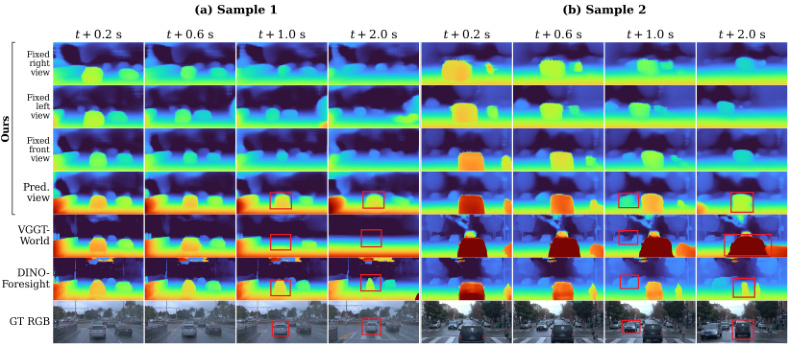
Figures are reproduced from Liu et al. See the full paper for experimental details and the project page, when the paper links one, for demonstrations and videos.
Related Papers
3DThinkVLA: Endowing Vision-Language-Action Models with Latent 3D Priors via 3D-Thinking-Guided Co-training
Jiaxin Shi, Xidong Zhang, Fucai Zhu et al.
We propose a 3D-thinking-guided co-training framework that enables vision-language-action (VLA) models to perform 3D spatial reasoning implicitly during action prediction.
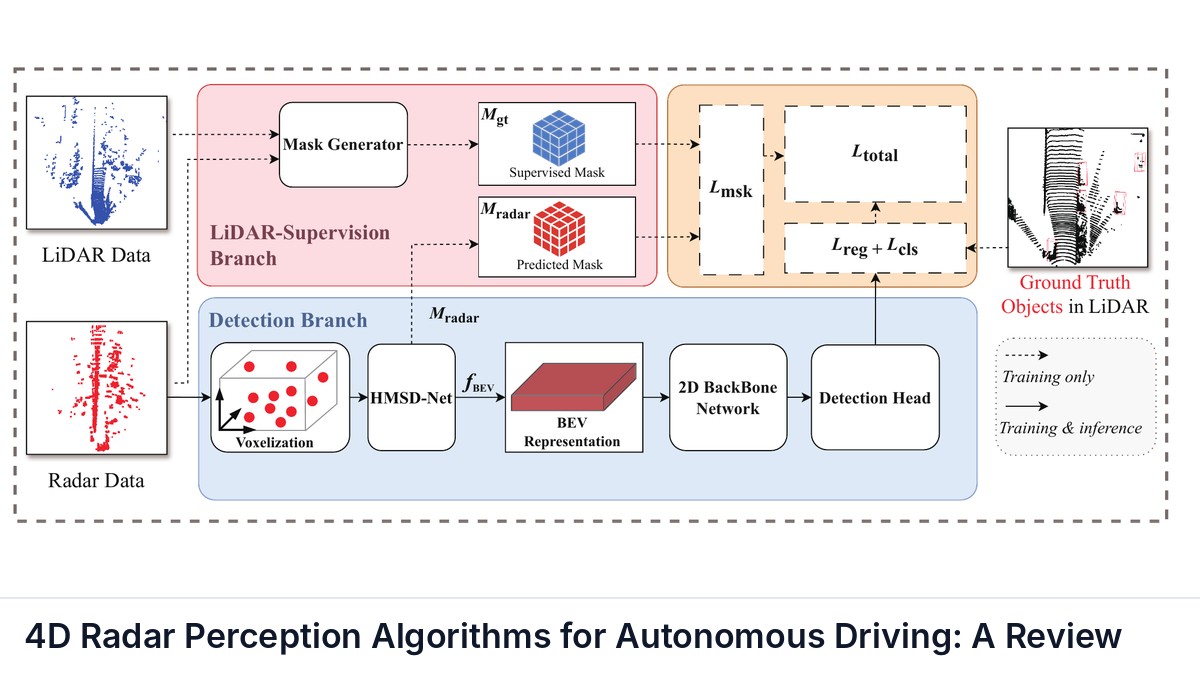
4D Radar Perception Algorithms for Autonomous Driving: A Review
Xumin Wu, Jun Zhou, Jilin Mei et al.
Research on 4D millimeter-wave radar perception algorithms has flourished in recent years, extending from signal processing and object detection to semantic segmentation, motion estimation, occupancy prediction, and dynamic scene reconstruction.
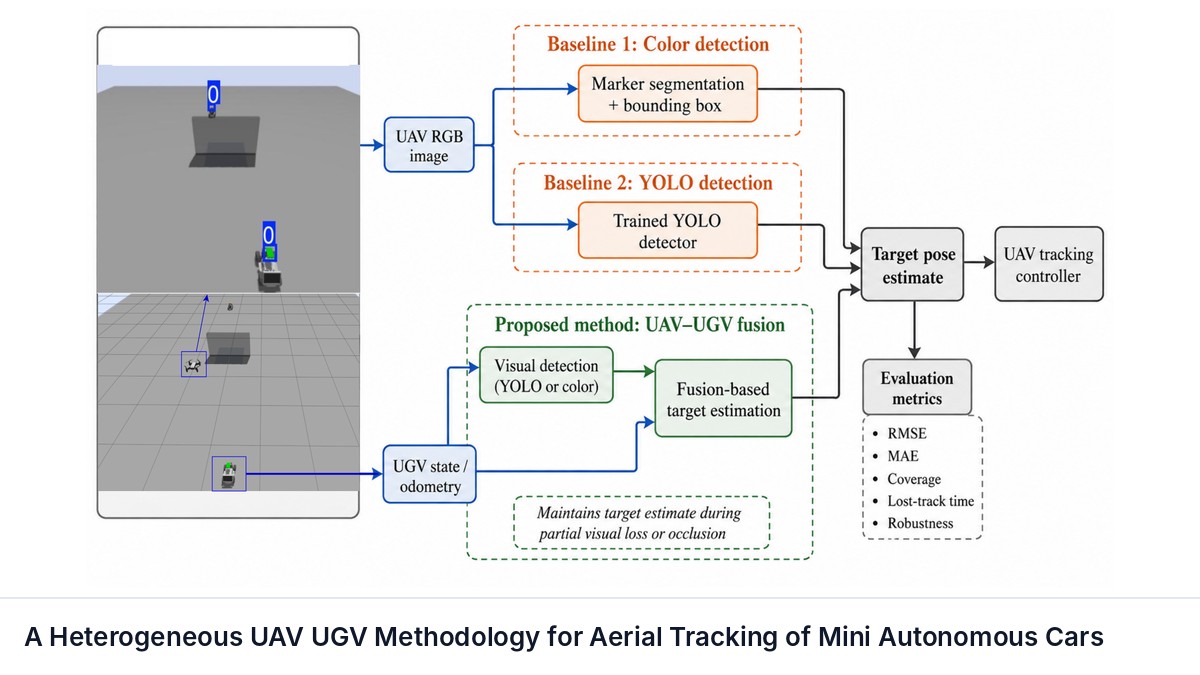
A Heterogeneous UAV UGV Methodology for Aerial Tracking of Mini Autonomous Cars
Santiago Fernandez, Angel da Silva, Hiago Sodre et al.
Aerial tracking of autonomous ground vehicles can provide useful situational awareness in environments where fixed external perception infrastructure is unavailable.
A Low-Cost, Open Platform for End-to-End Autonomous Driving on a Miniature Ackermann Vehicle
Gustavo Claudio Karl Couto, Eric Aislan Antonelo, Gabriel George Zipperer
This paper presents a low-cost, open experimental platform for research in end-to-end autonomous driving with miniature Ackermann vehicles.