
A Heterogeneous UAV UGV Methodology for Aerial Tracking of Mini Autonomous Cars
Santiago Fernandez, Angel da Silva, Hiago Sodre, Pablo Moraes, Bruna Gutterres, Ricardo B. Grando · N/A · 2026
Framework
N/A
License
N/A
Stars
N/A
Summary
Aerial tracking of autonomous ground vehicles can provide useful situational awareness in environments where fixed external perception infrastructure is unavailable.
Abstract Summary
Key Points
- Aerial tracking of autonomous ground vehicles can provide useful situational awareness in environments where fixed external perception infrastructure is unavailable.
- However, visual-only tracking from an unmanned aerial vehicle (UAV) is limited by camera field of view, viewpoint changes, occlusions, and temporary loss of target visibility.
- This paper presents a heterogeneous UAV--UGV methodology for aerial tracking of small-scale autonomous ground vehicles in simulation.
- The system is implemented in ROS~2 and Gazebo Sim using a Tello-like UAV equipped with a front-facing RGB camera and multiple LIMO-like unmanned ground vehicles (UGVs).
- Three approaches are evaluated: a training-free color-marker baseline, a YOLO-based visual baseline, and a proposed UAV--UGV fusion method.
Methodology
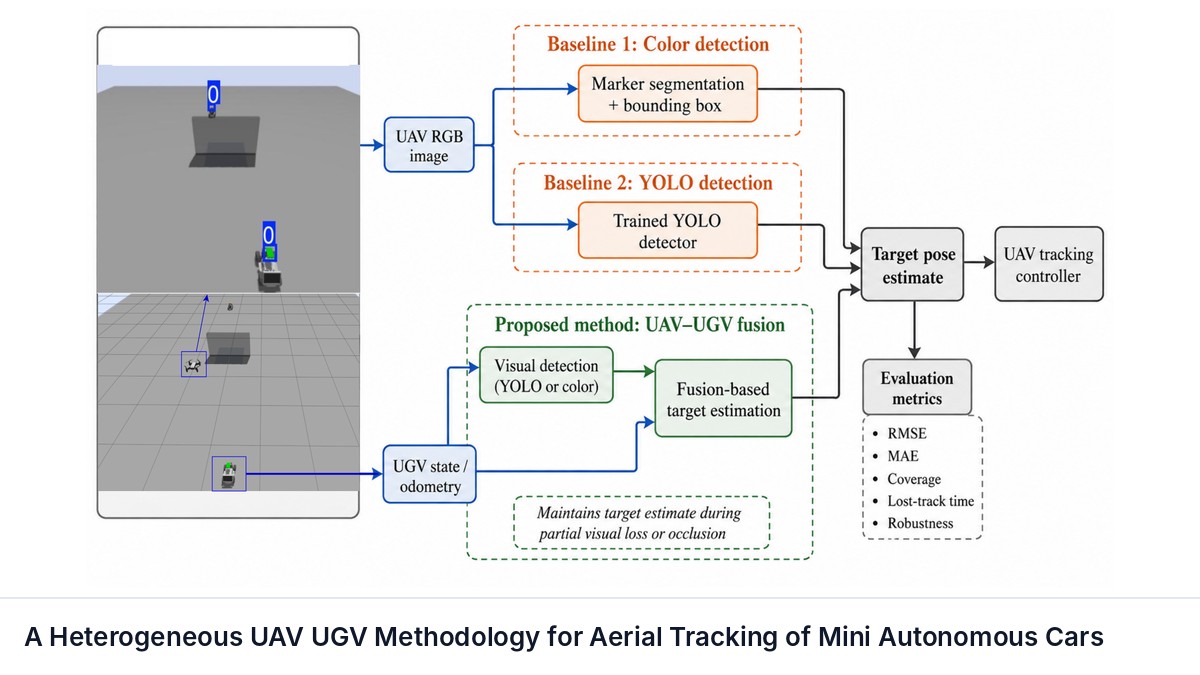
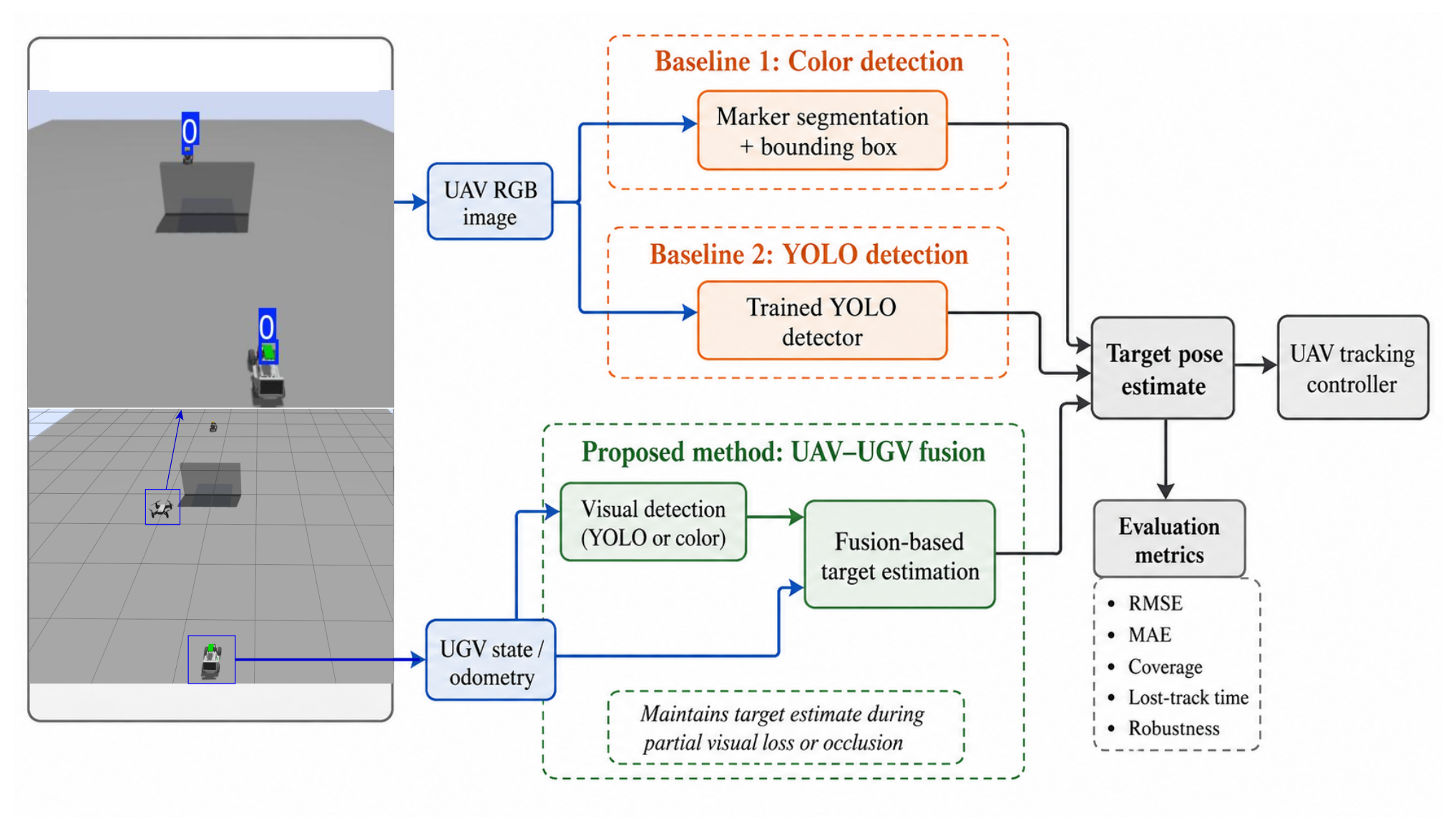
The proposed methodology (Figure 1 ) is implemented in ROS 2 Jazzy and Gazebo Sim. The simulated heterogeneous team consists of a mini UAV and one or more UGVs. The UAV is equipped with a front-facing RGB camera and observes the UGVs from an elevated viewpoint. The UGVs follow predefined trajectories according to the selected scenario, while the UAV provides aerial visual information.
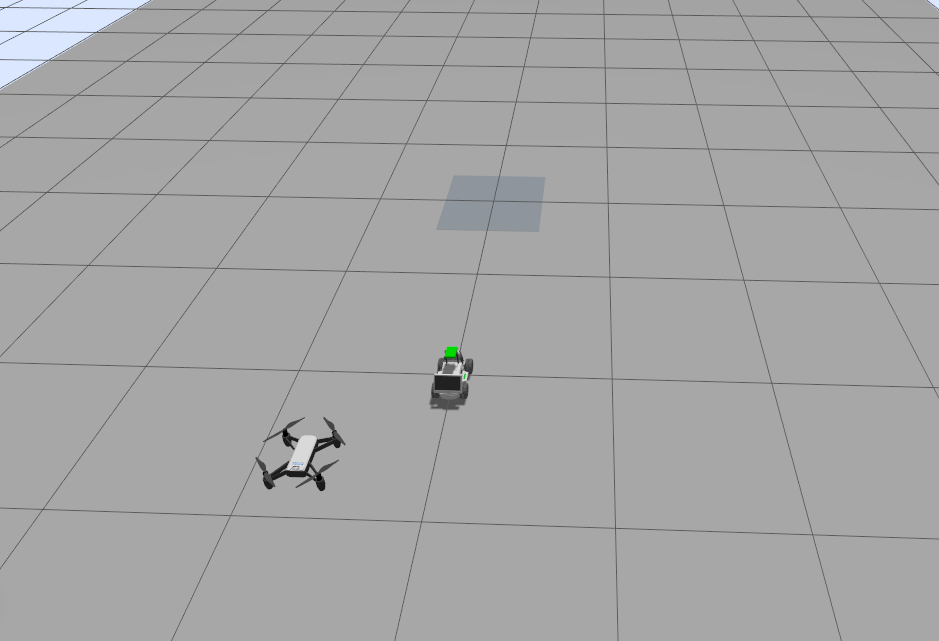
The simulation considers a Tello-like UAV and an Agilex-like UGV.
Results
All three methods completed the full evaluation matrix. Each method produced 200 valid runs, with 50 runs per scenario. The YOLO baseline and the proposed fusion method loaded the trained YOLO model correctly in all runs, with no fallback to the color proxy detector. No false positives or ID switches were observed. Table II summarizes the evaluation validity. Table III presents the full quantitative comparison.
The color baseline provides a simple visual reference, but its localization error is high.
Sources and Demonstrations
Figures are reproduced from Fernandez et al. See the full paper for experimental details and the project page, when the paper links one, for demonstrations and videos.
Related Papers
3DThinkVLA: Endowing Vision-Language-Action Models with Latent 3D Priors via 3D-Thinking-Guided Co-training
Jiaxin Shi, Xidong Zhang, Fucai Zhu et al.
We propose a 3D-thinking-guided co-training framework that enables vision-language-action (VLA) models to perform 3D spatial reasoning implicitly during action prediction.
4D Radar Perception Algorithms for Autonomous Driving: A Review
Xumin Wu, Jun Zhou, Jilin Mei et al.
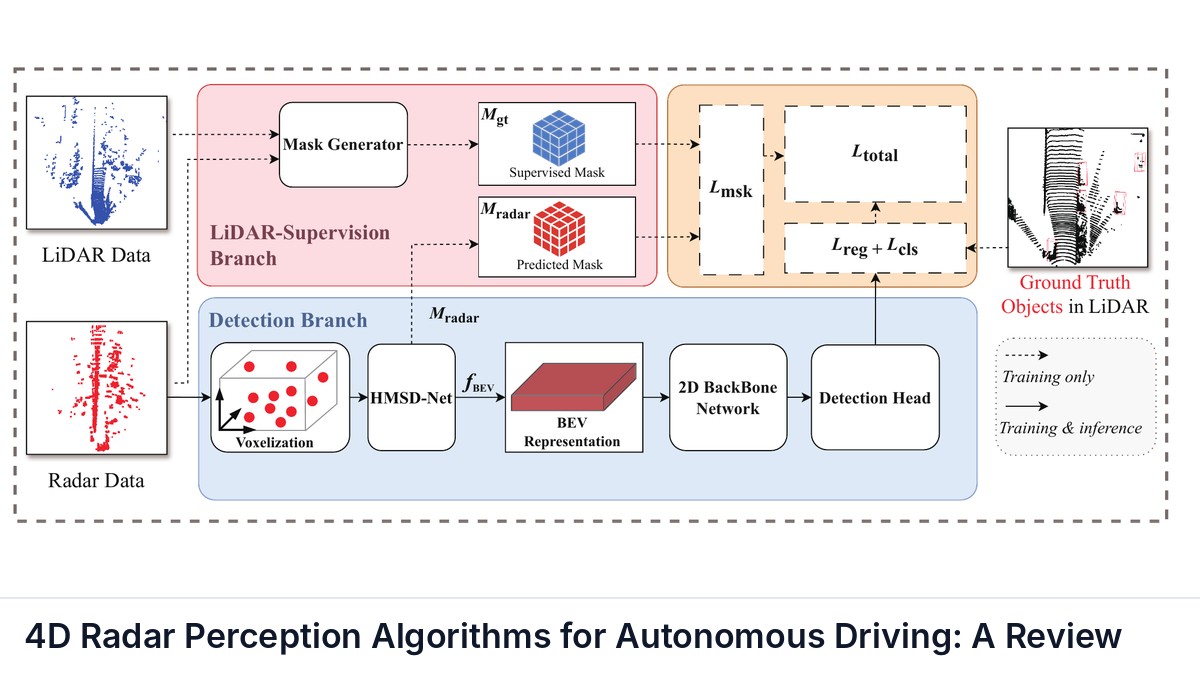
Research on 4D millimeter-wave radar perception algorithms has flourished in recent years, extending from signal processing and object detection to semantic segmentation, motion estimation, occupancy prediction, and dynamic scene reconstruction.
A Low-Cost, Open Platform for End-to-End Autonomous Driving on a Miniature Ackermann Vehicle
Gustavo Claudio Karl Couto, Eric Aislan Antonelo, Gabriel George Zipperer
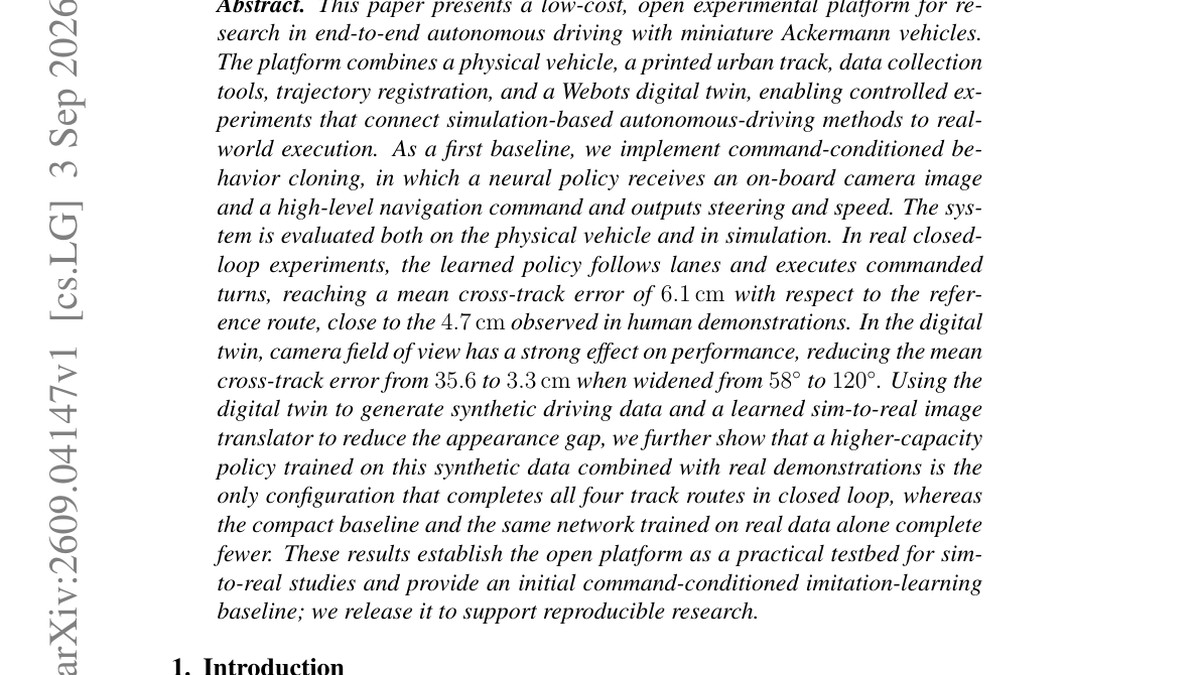
This paper presents a low-cost, open experimental platform for research in end-to-end autonomous driving with miniature Ackermann vehicles.
A Phenomenology of Neural Geometry in Vision-Language-Action Models
Mozes Jacobs, Aiden Swann, Mathilde Papillon et al.
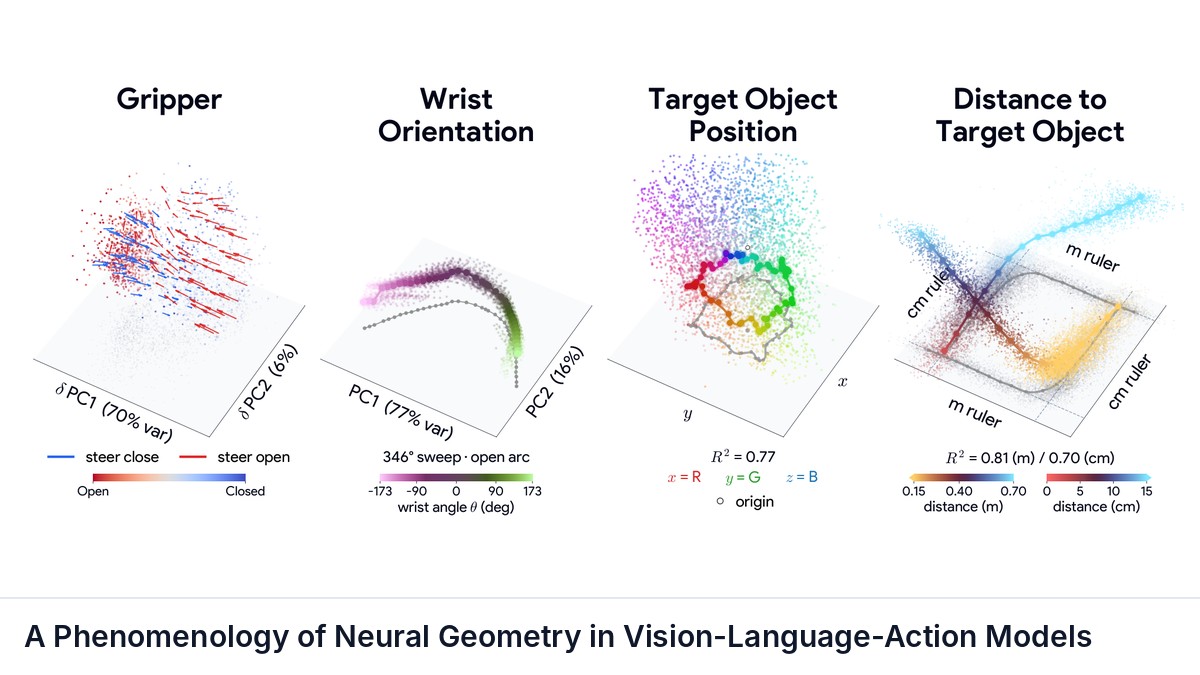
Robotic manipulation is inherently geometric, but what shape does the world take inside the policy that performs it?