
TinyCVIO: A Constellation-Aided Visual-Inertial Odometry System for Nanodrones
Derin Ozturk, Kaan Akan, Irwin Wang, Christopher Batten · N/A · 2026
Framework
N/A
License
N/A
Stars
N/A
Summary
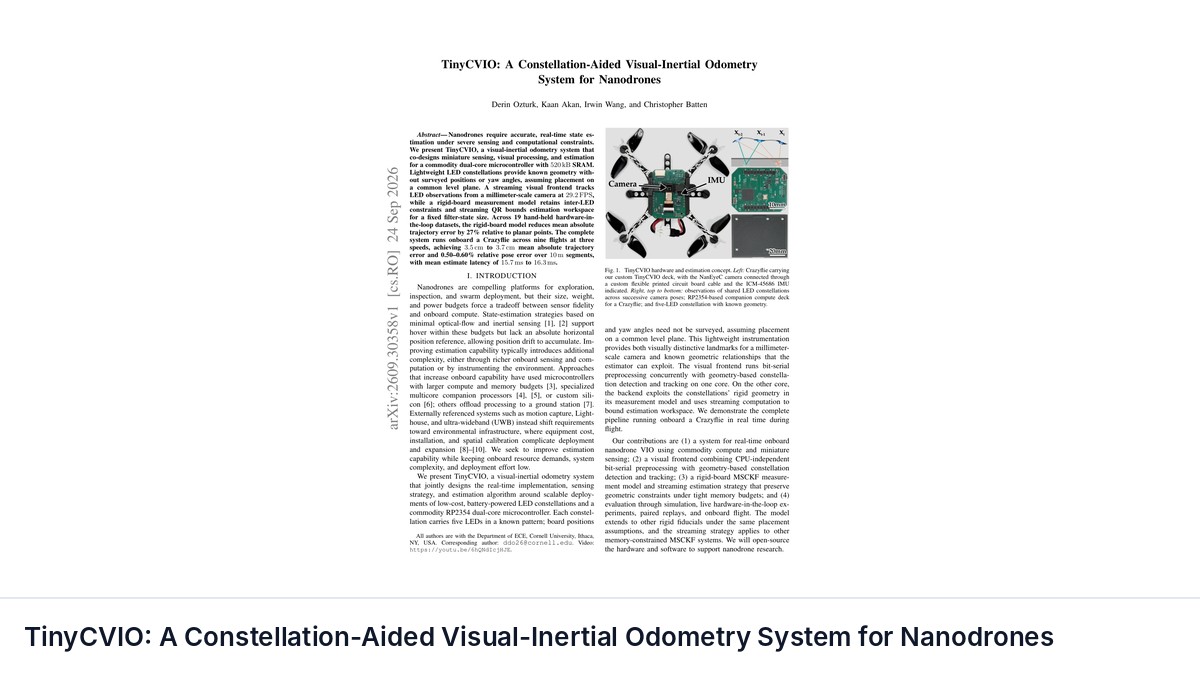
Nanodrones require accurate, real-time state estimation under severe sensing and computational constraints. We present TinyCVIO, a visual-inertial odometry system that co-designs miniature sensing, visual processing, and estimation for a commodity dual-core microcontroller with 520 kB SRAM.
Abstract Summary
Key Points
- Nanodrones require accurate, real-time state estimation under severe sensing and computational constraints.
- We present TinyCVIO, a visual-inertial odometry system that co-designs miniature sensing, visual processing, and estimation for a commodity dual-core microcontroller with 520 kB SRAM.
- Lightweight LED constellations provide known geometry without surveyed positions or yaw angles, assuming placement on a common level plane.
- A streaming visual frontend tracks LED observations from a millimeter-scale camera at 29.2 FPS, while a rigid-board measurement model retains inter-LED constraints and streaming QR bounds estimation workspace for a fixed filter-state size.
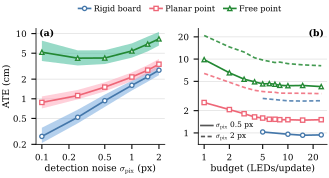
- Across 19 hand-held hardware-in-the-loop datasets, the rigid-board model reduces mean absolute trajectory error by 27% relative to planar points.
System Design
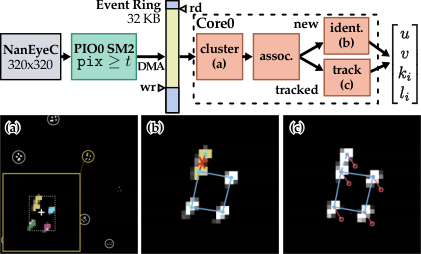
TinyCVIO combines a monocular camera and IMU with dual-core processing on a custom nanodrone PCB. Programmable I/O offloads camera readout and thresholding, while separate cores execute the visual frontend (Sec. IV ) and visual-inertial backend (Sec. V ), respectively (Fig. 2 ).
TinyCVIO uses an RP2354 dual-core Cortex-M33 microcontroller clocked at $300\text{\,}\mathrm{MHz}$, with $520\text{\,}\mathrm{kB}$ SRAM and $2\text{\,}\mathrm{MB}$ on-chip flash [ 18 ] .
Visual Frontend
The frontend converts threshold events into labeled LED observations for visual-inertial estimation (Fig. 3 ). Known constellation geometry and temporal tracking maintain correspondences as viewing distance changes: nearby constellations may fragment into separate spatial groups, while individual LED images may merge into a single connected component.
Threshold events arrive in raster order and are processed in a single pass.
Visual-Inertial Backend
Our visual-inertial estimation framework is modeled after OpenVINS [ 14 ] , with a focus on embedded execution. Like OpenVINS, it separates the measurement model from propagation, nuisance elimination, measurement compression, and the filter update.
Within the Multi-State Constraint Kalman Filter (MSCKF) framework [ 15 ] , we present our streaming QR strategy and rigid-board measurement model, then describe sensor compensation and initialization before comparing independent-point models.
Experimental Methodology
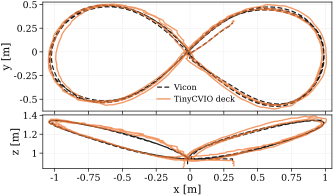
We combine controlled simulation, HITL end-to-end captures, and on-drone experiments to evaluate the proposed system. To isolate the effects of modeling assumptions, we generate trajectories in Webots [ 22 ] using a quadrotor model extended from CrazySim [ 23 ] , with the Crazyflie firmware’s estimator and controller. Figure-eight paths vary in lap period, amplitude, and altitude.
Results
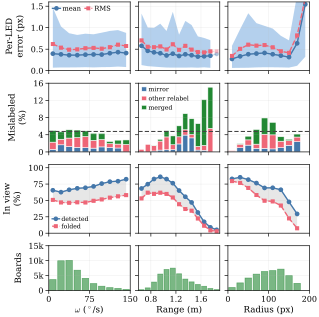
We evaluate TinyCVIO in three stages: frontend detection and tracking on real hardware with Vicon ground truth, backend estimation in simulation, and the end-to-end system. We evaluate LED localization, labeling accuracy, and detection recall against the surveyed ground truth described in Sec. VI-C . Detected constellations have an overall LED localization RMS error of $0.6\text{\,}\mathrm{p}\mathrm{x}$ (Fig. 4 ).
Error varies little across the tested viewing distances and angular velocities.
Sources and Demonstrations
Figures are reproduced from Ozturk et al. See the full paper for experimental details and the project page, when the paper links one, for demonstrations and videos.
Related Papers
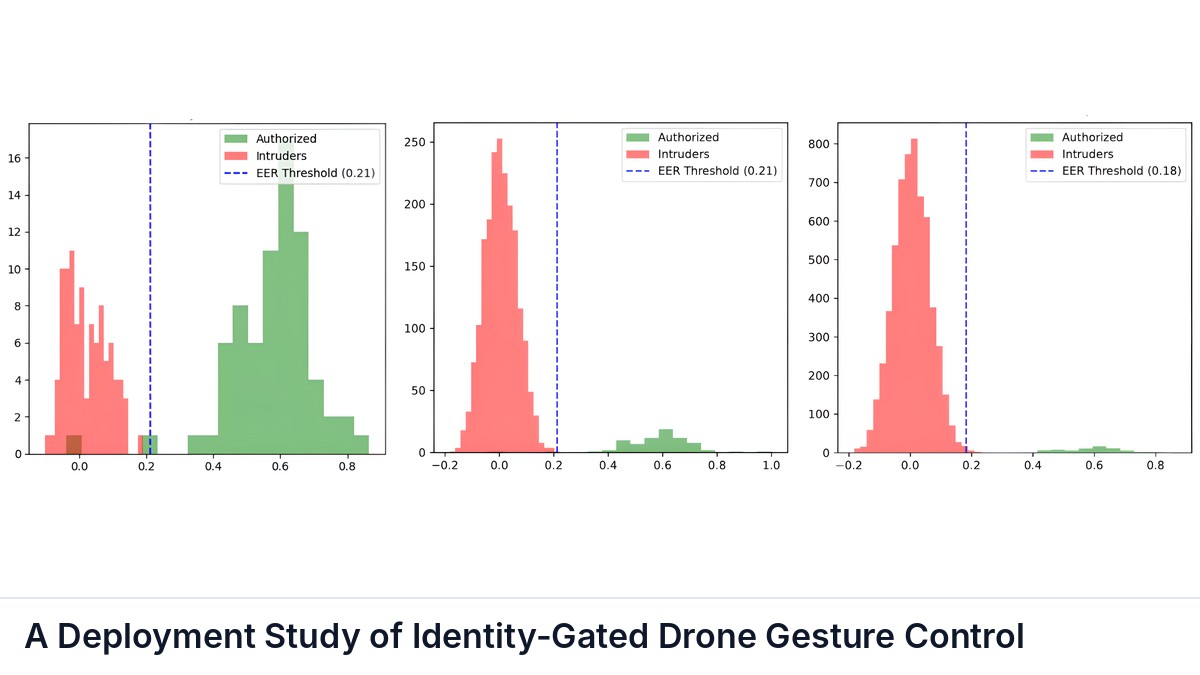
A Deployment Study of Identity-Gated Drone Gesture Control
Diyari Mohammed Salih, Ilyes Chaabeni, Naima Ait Oufroukh
Vision-based gesture control accepts commands from any hand in the camera field of view, which is unsafe in shared indoor spaces.

A Sim-to-Real Integration Pipeline for Training and Deployment of Chunk-Based VLA Manipulation Policies
Mathilde Kappel, Clémence Grislain, Mohamed Chetouani et al.
Vision-Language-Action (VLA) models have become a prominent paradigm for mapping multimodal inputs, including semantic instructions, visual observations of the scene, and proprioceptive observations, to robot actions.
Aim Short to Reach Far: Your Frozen World Model Can Plan Better Than You Think
Xvyuan Liu, Jianjie Fang, Chen Gao et al.
Planners built on visual world models commonly score each predicted outcome by its distance to the encoded goal image. We show that this target can limit control even with exact dynamics and globally optimal short-horizon search: reaching a goal may require actions that initially move away from it.
Beyond Reconstruction: What Matters in Action Tokenization for Robot Policies?
Haoran Chen, Jingtian Ji, Samuel Wheeler et al.
Autoregressive action-token policies such as vision-language-action models require action tokenizers to translate discrete token sequences into precise control actions in continuous space. Many action tokenizers learn the mapping between tokens and actions via a reconstruction objective.