
Object-Centric Residual RL for Zero-Shot Sim-to-Real VLA Enhancement
FeaturedKinam Kim, Namiko Saito, Heecheol Kim, Katsushi Ikeuchi, Jaegul Choo, Yasuyuki Matsushita · · 2026
Framework
N/A
License
N/A
Stars
N/A
Summary
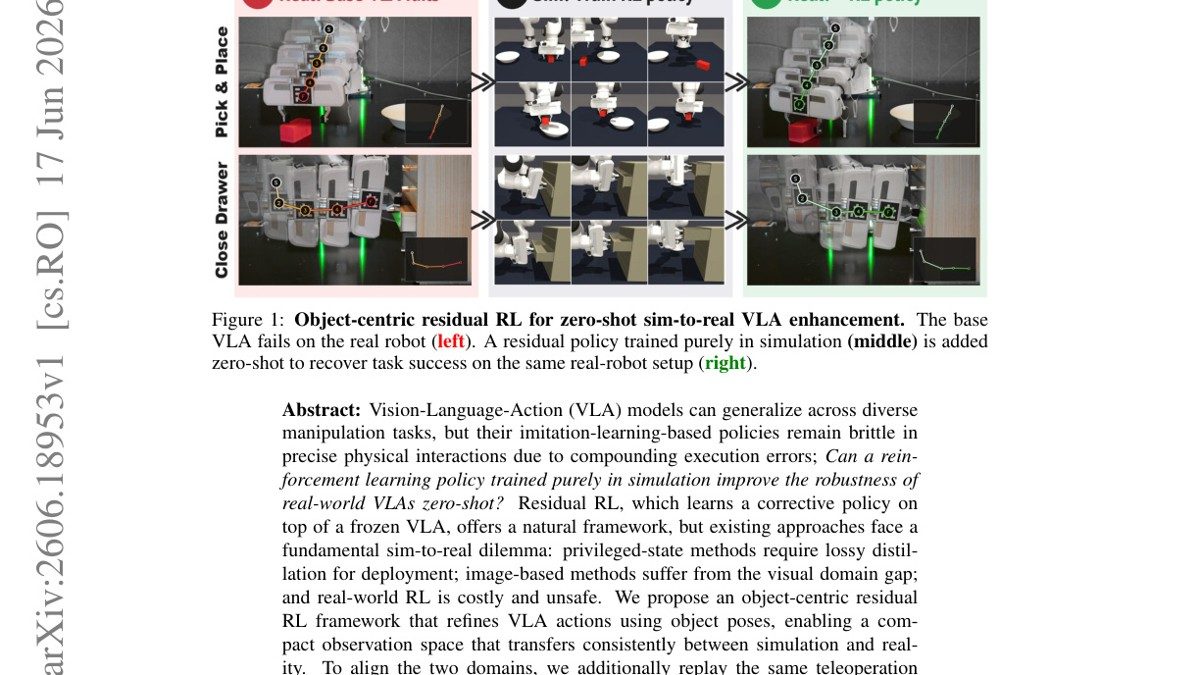
Vision-Language-Action (VLA) models can generalize across diverse manipulation tasks, but their imitation-learning-based policies remain brittle in precise physical interactions due to compounding execution errors; Can a reinforcement learning policy trained purely in simulation improve the robustness of real-world VLAs zero-shot?
Abstract Summary
Key Points
- Proposes Object-Centric Residual RL for Zero-Shot Sim-to-Real VLA Enh for robotics.
- Evaluated on real or simulated robotic tasks.
- Primary contribution in ar-vr.
Method
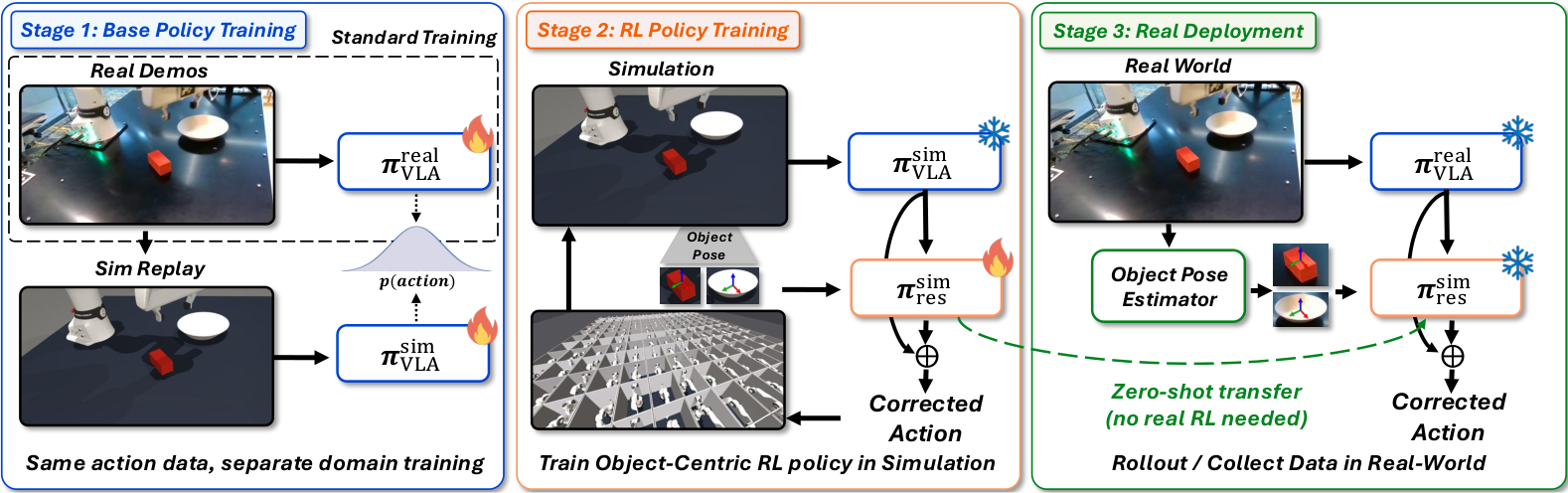
Given a VLA trained on real-robot demonstrations, our framework enhances it with a sim-trained residual policy through three stages (Fig. 2 ): (1) building a simulation counterpart of the VLA via teleoperation replay (Section 3.1 ), (2) training an object-centric residual policy in simulation (Section 3.2 ), and (3) zero-shot deployment on the real robot (Section 3.3 ).
Experimental Setup
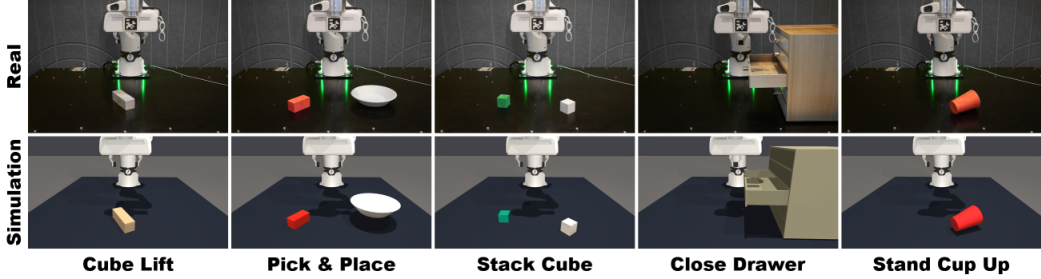
We evaluate on five tabletop manipulation tasks, instantiated both in MuJoCo [ 35 ] simulation (for residual training) and on a real FR3 robot (for zero-shot deployment): Cube Lift (Lift) : Grasp a cube from the table and lift it $3$ cm. Pick-and-Place (PnP) : Pick up a cube and place it into a bowl. Stack Cube (Stack) : Pick up a white cube and stack it on top of a green cube.
Close Drawer (Close) : Push an open cabinet drawer closed. Stand Cup Up (Stand) : Grasp a cup lying on its side and stand it upright.
Results
Does the residual improve the base VLA zero-shot on a real robot? (Section 5.1 ) What observation and robustness designs enable sim-to-real transfer? (Section 5.2 ) When and how does the residual intervene? (Section 5.3 ) Can residual-corrected rollouts bootstrap VLA self-improvement?
(Section 5.4 ) We first examine whether a residual policy trained entirely in simulation can improve the base VLA on a real robot without any adaptation. Table 1 reports success rates across all five tasks.
Sources and Demonstrations
Figures are reproduced from Kim et al. See the full paper for experimental details and the project page, when the paper links one, for demonstrations and videos.
Related Papers
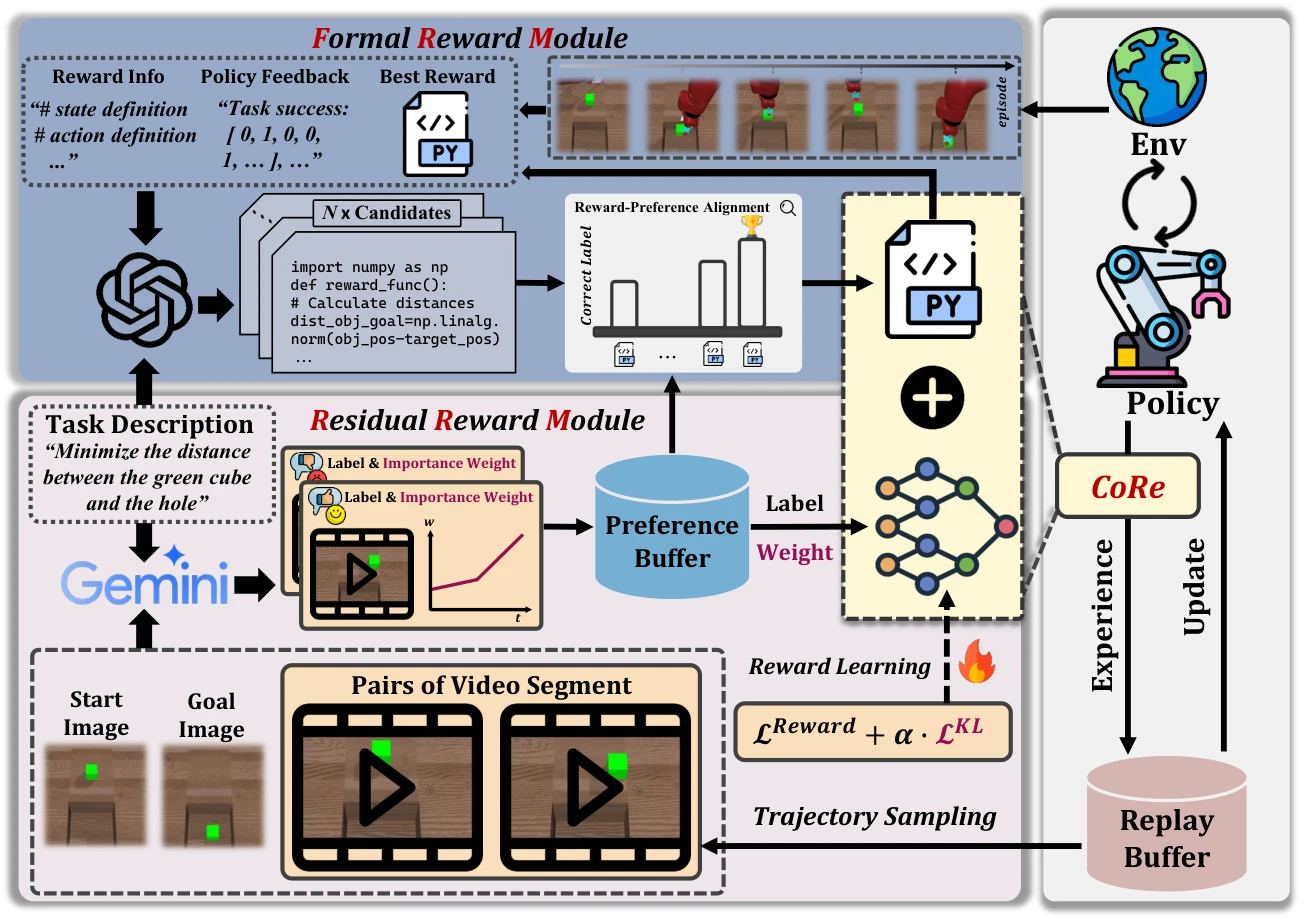
CoRe: Combined Rewards with Vision-Language Model Feedback for Preference-Aligned Reinforcement Learning
Hexian Ni, Tao Lu, Yinghao Cai
CoRe combines code-based rewards with learned visual preferences so that neither reward source has to capture the entire task alone.
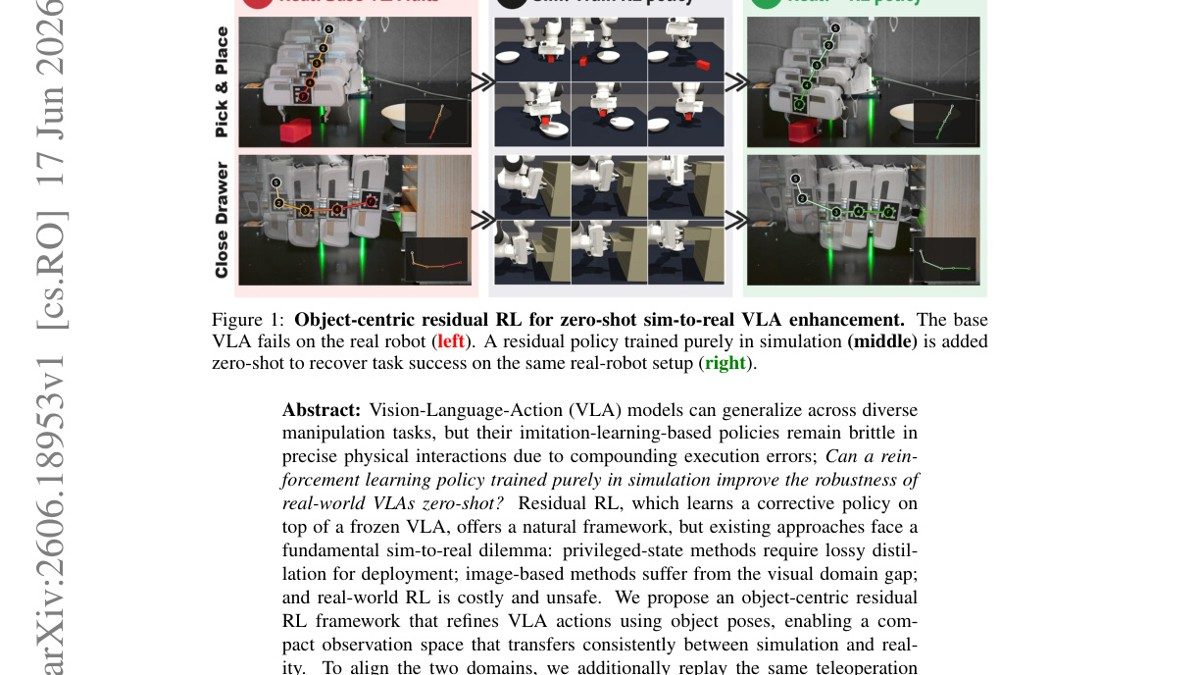
Object-Centric Residual RL for Zero-Shot Sim-to-Real VLA Enhancement
Kinam Kim, Namiko Saito, Heecheol Kim et al.
Vision-Language-Action (VLA) models can generalize across diverse manipulation tasks, but their imitation-learning-based policies remain brittle in precise physical interactions due to compounding execution errors; Can a reinforcement learning policy trained purely in simulation improve the robustness of real-world VLAs zero-shot?

Pose6DAug: Physically Plausible Multi-view Object Swapping for Robot Data Augmentation
Jonghoon Lee, Seong Hyeon Park, Byungwoo Jeon et al.
Vision-language-action (VLA) policies have shown strong potential for general-purpose manipulation, yet they often fail on novel, out-of-distribution objects whose appearance or geometry deviates from the training distribution.
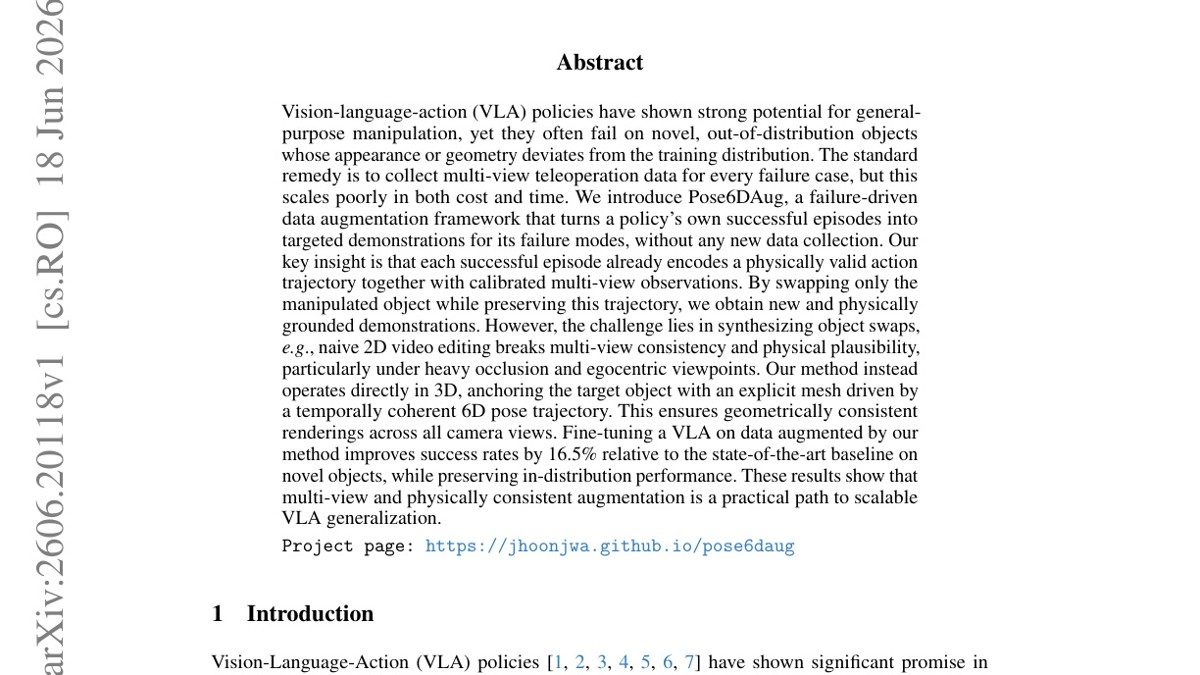
Pose6DAug: Physically Plausible Multi-view Object Swapping for Robot Data Augmentation
Jonghoon Lee, Seong Hyeon Park, Byungwoo Jeon et al.
Vision-language-action (VLA) policies have shown strong potential for general-purpose manipulation, yet they often fail on novel, out-of-distribution objects whose appearance or geometry deviates from the training distribution.