
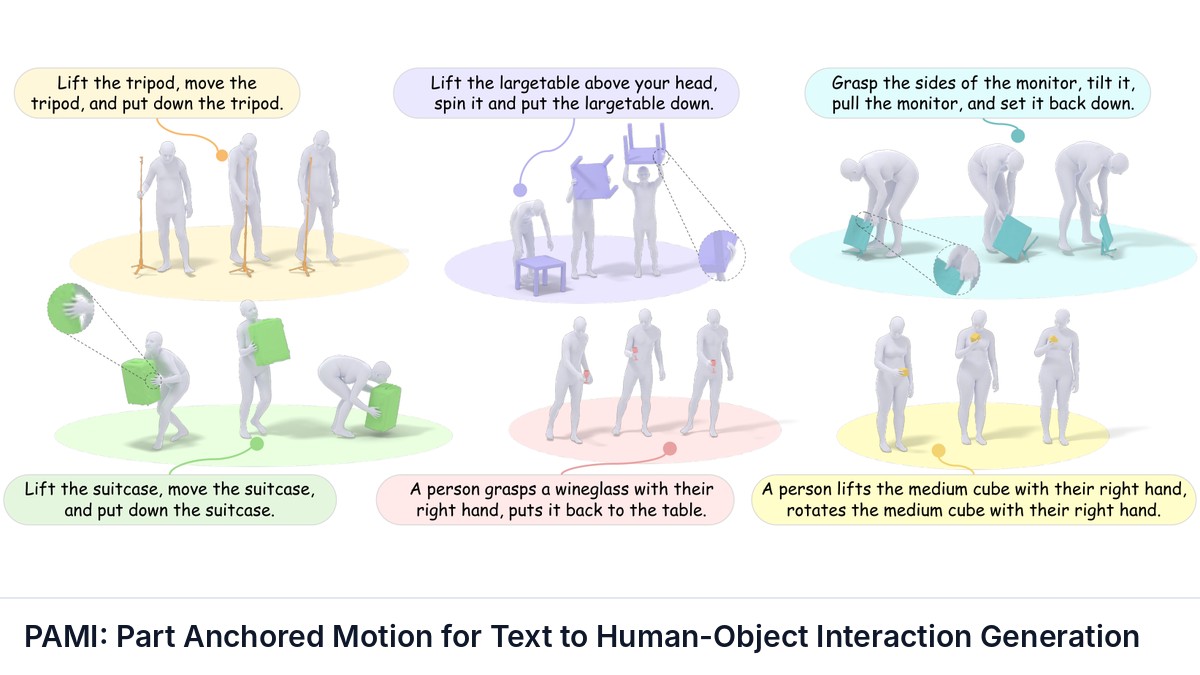
PAMI: Part Anchored Motion for Text to Human-Object Interaction Generation
Li, Chuqiao, Xie, Xianghui, Cao, Yong, Geiger, Andreas, Pons-Moll, Gerard · N/A · 2026
Framework
N/A
License
N/A
Stars
N/A
Summary
Text-conditioned full-body human-object interaction (HOI) generation requires synthesizing human motion and object trajectories that match the input text while remaining precisely coordinated over time.
Abstract Summary
Key Points
- Text-conditioned full-body human-object interaction (HOI) generation requires synthesizing human motion and object trajectories that match the input text while remaining precisely coordinated over time.
- Most methods represent the human and object as separate trajectories and predict the global human-object couplings.
- Learning this complex, dynamically changing relationship implicitly, however, often yields object drift, missed contact, and penetration.
- We introduce PAMI, a Part-Anchored Motion framework for Interaction generation
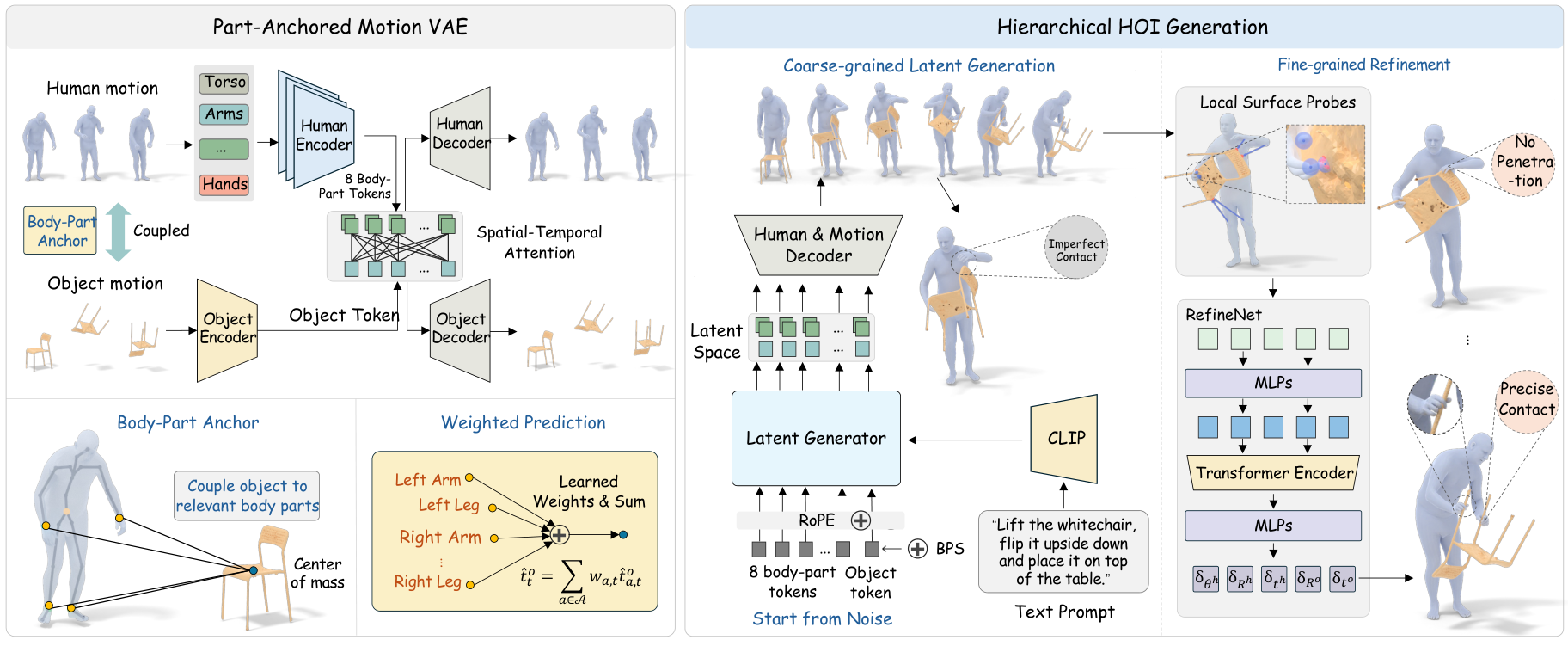
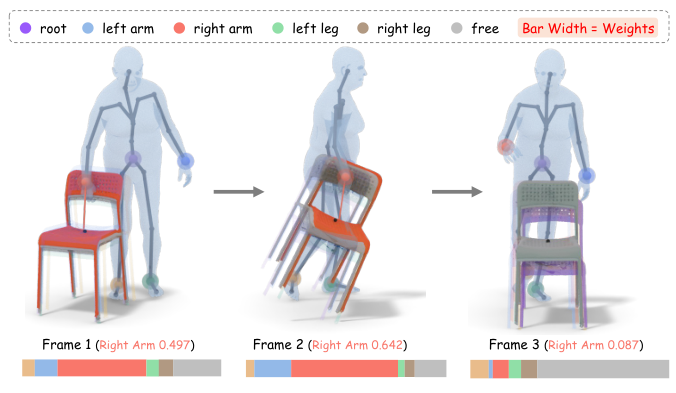
- Inspired by the classic Hough Transform, our key idea is to localize object motion by letting body-part anchors vote for it: we express object motion relative to multiple body-part anchors and use PamiVAE to learn an interaction latent space, decoding frame-wise weights that aggregate these part-specific votes.
Method
Given a text prompt $c$, a canonical object mesh $\mathcal{M}$, our goal is to generate a human motion $\mathbf{x}^{h}_{1:T}$ and a rigid-object trajectory $\mathbf{x}^{o}_{1:T}$ of $T$ frames that form one coordinated interaction. We use SMPL-H Loper et al. (2015) ; Romero et al. (2017) to represent human motion.
Since the generation must jointly satisfy the text, the human motion, and their fine-grained coupling, we adopt a coarse-to-fine design, illustrated in Fig. 2 .
Experiments
We compare against existing baselines and ablate key components: our method outperforms prior approaches on most metrics, and the ablations confirm the value of each design. PamiRefiner also generalizes zero-shot to interactions produced by other methods, improving their geometry. Experimental and evaluation setup.
Sources and Demonstrations
Figures are reproduced from Li et al. See the full paper for experimental details and the project page, when the paper links one, for demonstrations and videos.
Related Papers
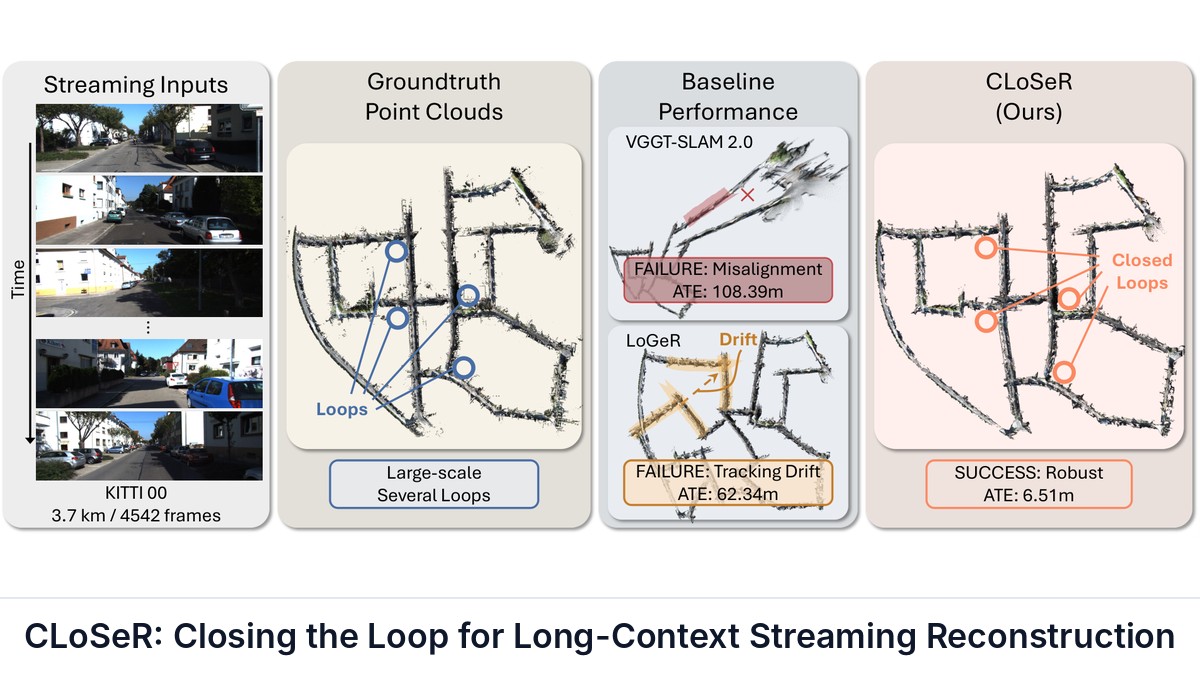
CLoSeR: Closing the Loop for Long-Context Streaming Reconstruction
Moyang Li, Zihan Zhu, Wei Zhang et al.
Feedforward foundation models have recently shown remarkable 3D reconstruction capabilities. However, existing models exhibit large tracking drift in long-context streaming reconstruction due to error accumulation.