
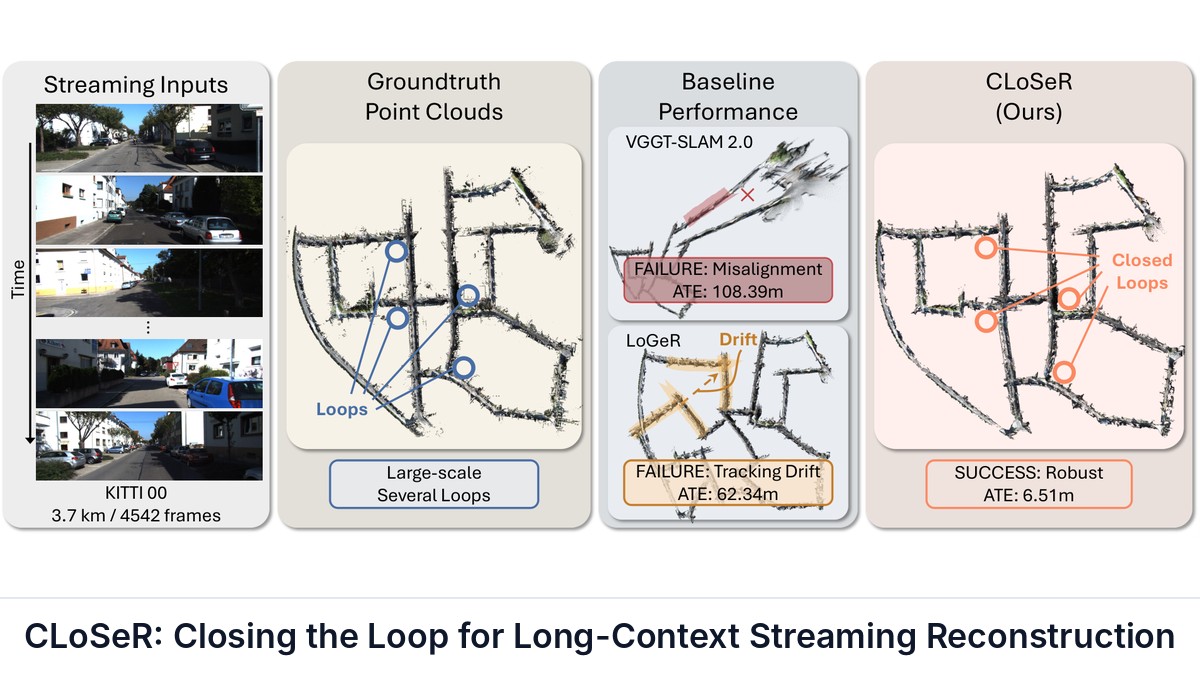
CLoSeR: Closing the Loop for Long-Context Streaming Reconstruction
Moyang Li, Zihan Zhu, Wei Zhang, Marc Pollefeys, Daniel Barath · N/A · 2026
Framework
N/A
License
N/A
Stars
N/A
Summary
Feedforward foundation models have recently shown remarkable 3D reconstruction capabilities. However, existing models exhibit large tracking drift in long-context streaming reconstruction due to error accumulation.
Abstract Summary
Key Points
- Feedforward foundation models have recently shown remarkable 3D reconstruction capabilities
- However, existing models exhibit large tracking drift in long-context streaming reconstruction due to error accumulation.
- In this paper, we revisit loop closure with streaming reconstruction foundation models to enable accurate, drift-free, kilometer-scale reconstruction.
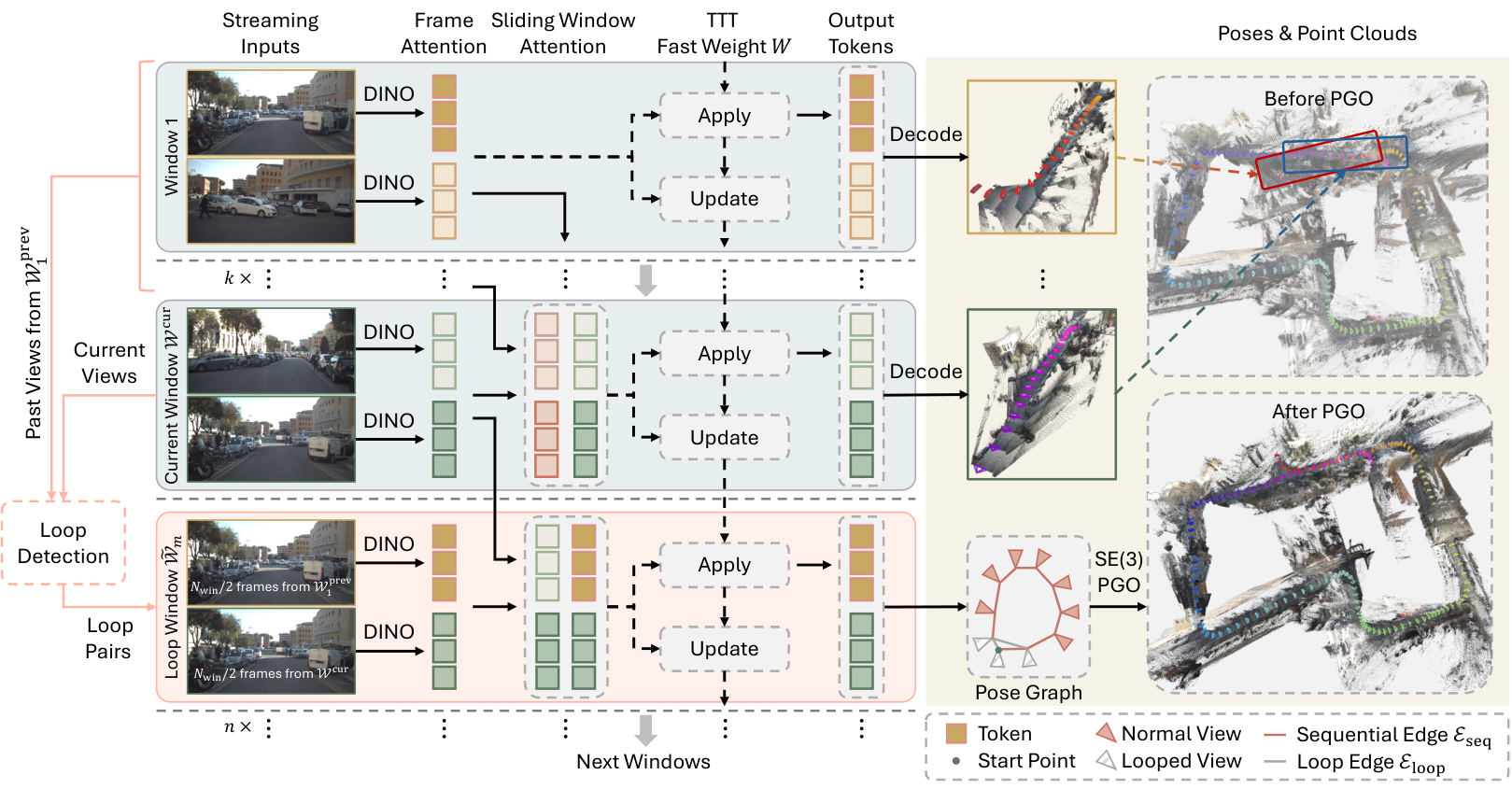
- Specifically, our method detects loop candidates through global descriptor retrieval, and constructs loop-conditioned windows to estimate the relative poses between looped frames.
- Given the observation that our adopted streaming reconstruction backbone produces a globally consistent scale, we optimize all frame poses on the SE(3) manifold with sequential and loop closure constraints, avoiding the pose graph optimization on the Sim(3) or higher-dimensional SL(4) manifolds employed in prior works.
Method
Our proposed method, CLoSeR , enables accurate kilometer-scale streaming reconstruction from monocular sequences by augmenting a feedforward backbone ( Zhang et al., 2026 ) with a loop closure module. In Sec. 3.1 , we introduce the preliminaries of the streaming reconstruction backbone that our framework builds upon. In Sec. 3.2 , we present loop detection and relative pose estimation between looped frames.
Finally, in Sec. 3.3 , we describe the global pose graph optimization over all frames with sequential and loop closure constraints.
Experiments
We evaluate our method on (a) three representative long-context reconstruction benchmarks: the VBR dataset ( Brizi et al., 2024 ) , the autonomous driving benchmark KITTI Odometry ( Geiger et al., 2013 ) , and the challenging Oxford Spires dataset ( Tao et al., 2024 ) ; and (b) one outdoor dynamic benchmark, DROID-W ( Li et al., 2026 ) .
VBR is captured in Rome and provides RGB sequences, 3D point clouds, IMU measurements, and ground-truth trajectories obtained via bundle adjustment.
Sources and Demonstrations
Figures are reproduced from Li et al. See the full paper for experimental details and the project page, when the paper links one, for demonstrations and videos.
Related Papers
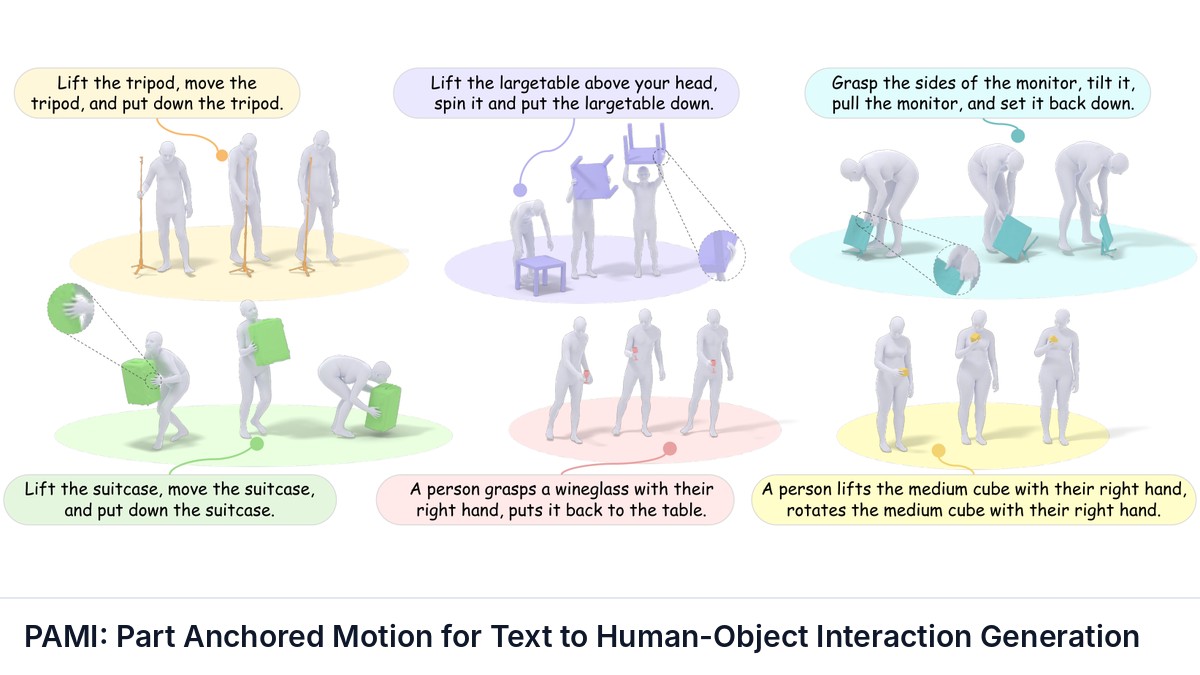
PAMI: Part Anchored Motion for Text to Human-Object Interaction Generation
Li, Chuqiao, Xie, Xianghui, Cao, Yong et al.
Text-conditioned full-body human-object interaction (HOI) generation requires synthesizing human motion and object trajectories that match the input text while remaining precisely coordinated over time.