
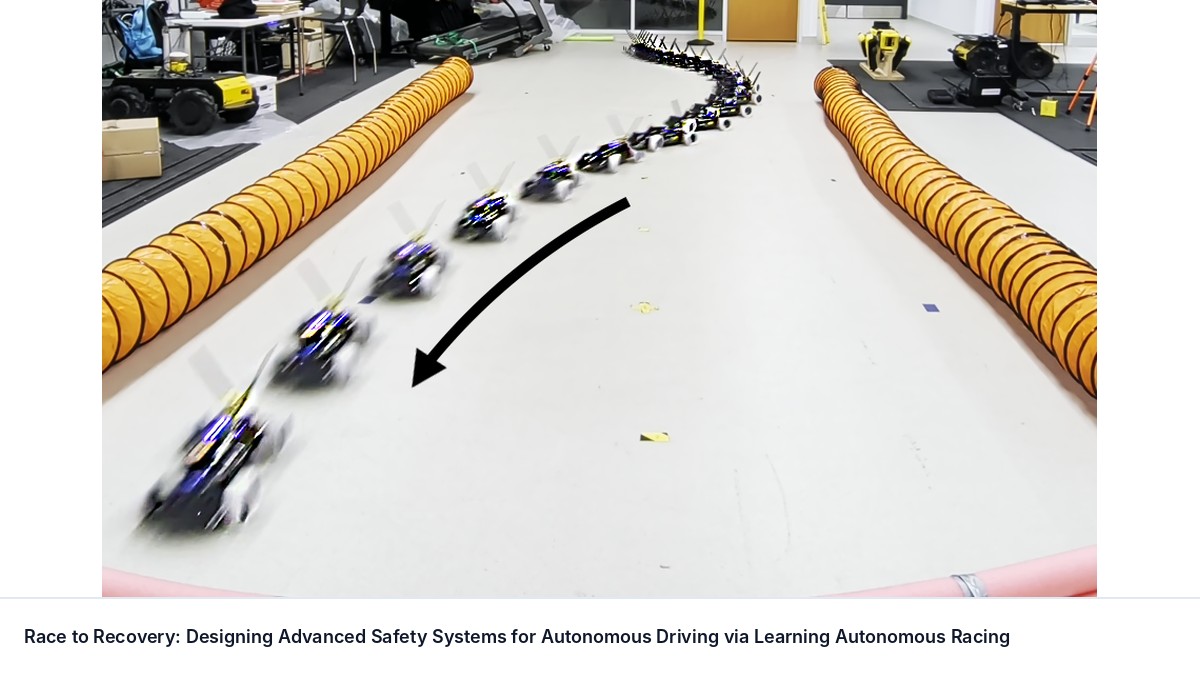
Race to Recovery: Designing Advanced Safety Systems for Autonomous Driving via Learning Autonomous Racing
Teodor Ilie, Kleber Cabral, Sidney Givigi · N/A · 2026
Framework
N/A
License
N/A
Stars
N/A
Summary
Vehicles that lose control at the handling limit through icing, hydroplaning, or an abrupt evasive maneuver fall outside the operating envelope of production safety systems such as electronic stability control, which focus on preventing instability rather than recovering from it.
Abstract Summary
Key Points
- Vehicles that lose control at the handling limit through icing, hydroplaning, or an abrupt evasive maneuver fall outside the operating envelope of production safety systems such as electronic stability control, which focus on preventing instability rather than recovering from it.
- Expert drivers regain authority in these conditions by drifting
- Existing autonomous recovery approaches are validated on idealized scenarios, define "recovered" states empirically and inconsistently, or rely on offline-planned trajectories rather than acting online.
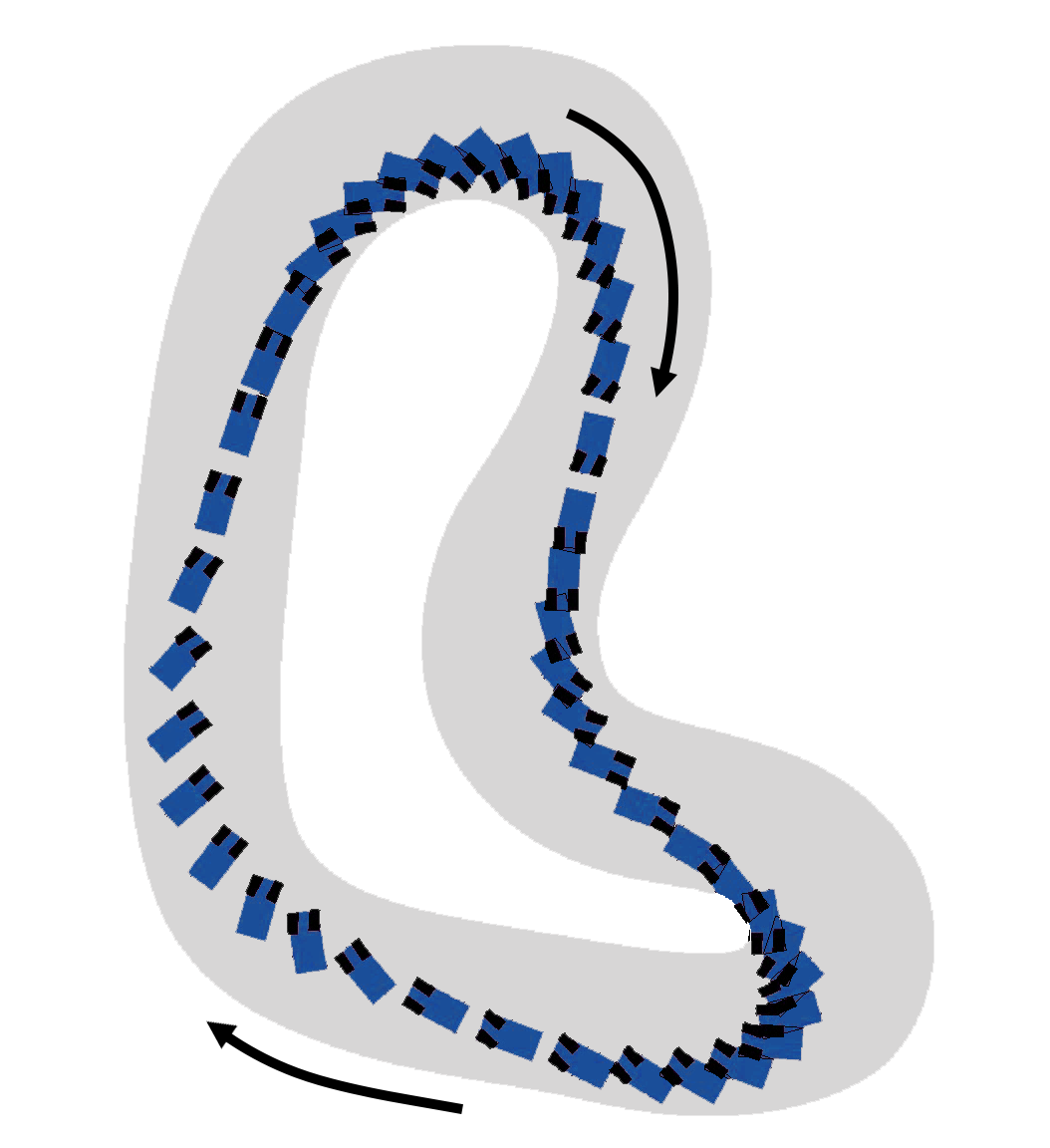
- We address these gaps by first training a racing policy with reinforcement learning that learns drifting as a time-optimal maneuver, then adapting it to recovery through continued training with a minimum-time reward.
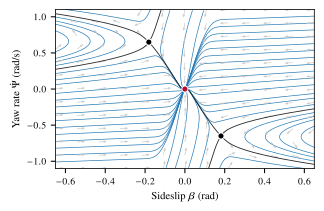
- We define recovery relative to a phase-plane-grounded stable equilibrium and introduce Gym-Khana for controller training and evaluation.
Problem Formulation
Our goal is to solve the control task of returning a vehicle that has lost control while tracking a straight reference path, such as a driving lane, to a safe operating regime. Formulating this task requires two components: a vehicle and tire model, which we describe in Section III-A , and a rigorous definition of the recovered state, described in Section III-B .
The recovery task requires a dynamics model that represents the vehicle at a suitable level of complexity.
Recovery Controller Design
1. Racing pretraining 120 M steps, $\times$64 envs 50 M steps, $\times$64 envs 3.
Recovery fine-tuning Actor $\pi_{\text{race}}$ Critic $V_{\phi}$ $\mathbf{o}_{t}$ $\mathbf{a}_{t}$ $r_{t}$ progress $\hat{A}_{t}$ $\mathcal{U}$ $\mathcal{R}$ $\mathbf{z}_{0}\in\mathcal{U}$ $\mathbf{z}_{T}\in\mathcal{R}$ Actor $\pi_{\text{race}\to\text{rec}}$ Critic $V_{\phi^{\prime}}$ $\mathbf{o}_{t}$ $\mathbf{a}_{t}$ $r_{t}$ reach $\mathcal{R}$ $\hat{A}_{t}$ 2.
Simulation Experiments
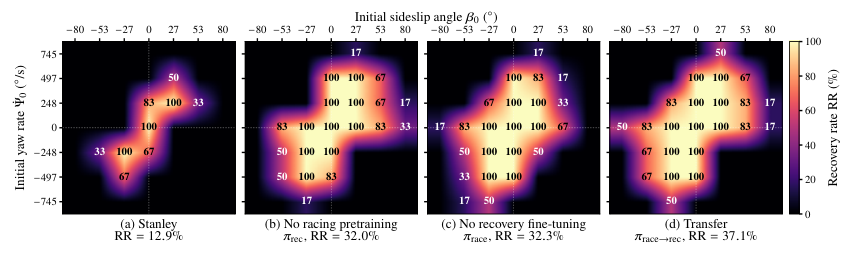
This section evaluates the recovery controllers in simulation, first establishing the evaluation metrics and experimental protocol, and then comparing the proposed controller against classical baselines and alternative training strategies. We choose two classical control methods as baselines: a geometric path-tracking Stanley controller and a nonlinear MPC formulation.
Hardware Validation
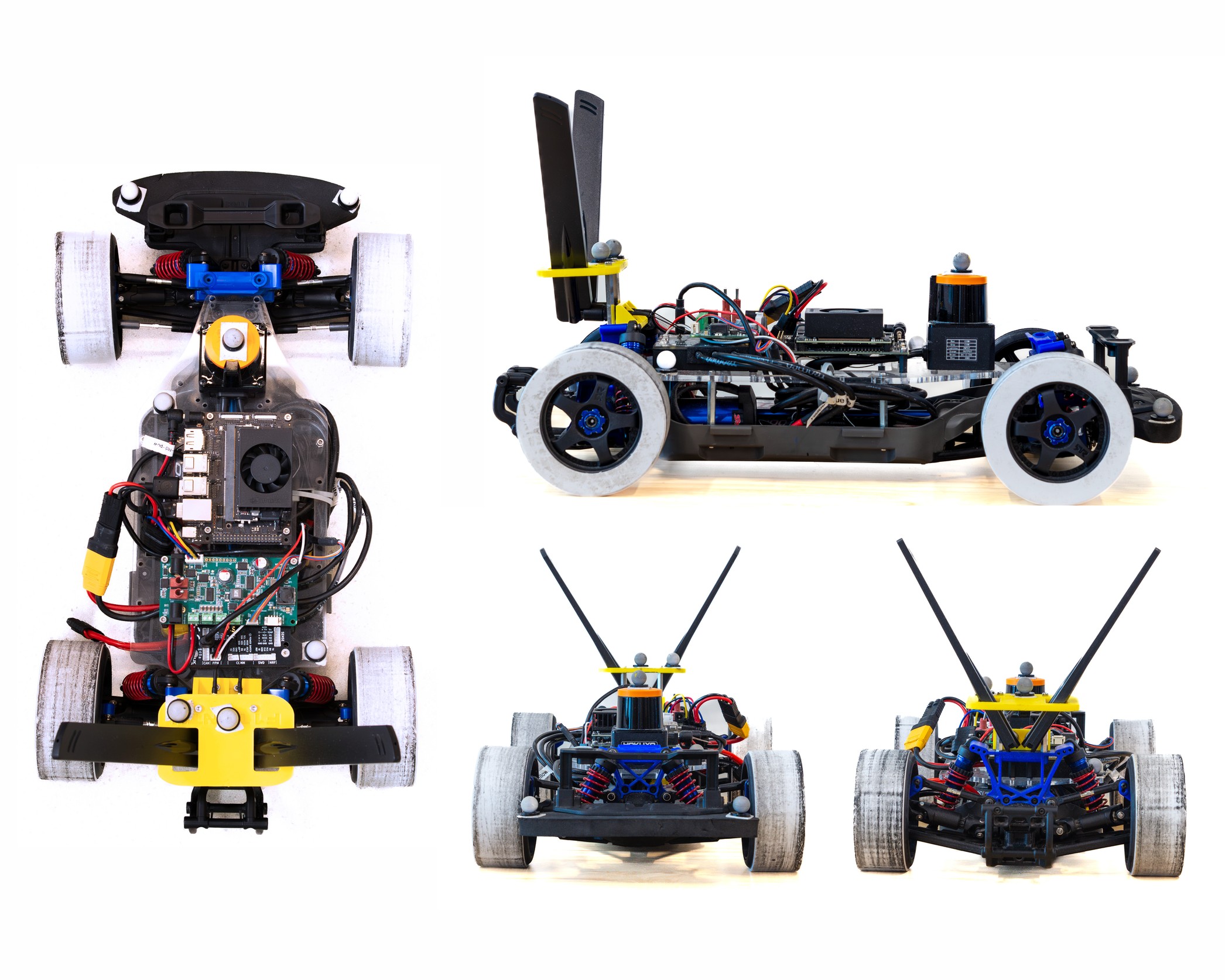
Deploying the recovery controller of Section IV-C on a physical vehicle is the most demanding validation of the approach, as physical testing exposes limitations that simulation does not: vehicle parameter mismatch, actuator delays, and state observation noise.
The results of Section V use the nominal vehicle parameters of Section IV-B ; here they are replaced by parameters identified on the physical vehicle as in Section IV-D , and the controller is retrained on them.
Sources and Demonstrations
Figures are reproduced from Ilie et al. See the full paper for experimental details and the project page, when the paper links one, for demonstrations and videos.
Related Papers

A Sim-to-Real Integration Pipeline for Training and Deployment of Chunk-Based VLA Manipulation Policies
Mathilde Kappel, Clémence Grislain, Mohamed Chetouani et al.
Vision-Language-Action (VLA) models have become a prominent paradigm for mapping multimodal inputs, including semantic instructions, visual observations of the scene, and proprioceptive observations, to robot actions.
Dexterity from Supervised Play
Botao He, Yiming Dou, Yiannis Aloimonos et al.
How can robots autonomously collect the contact-rich experience needed to learn dexterous manipulation?
Generalizable Robustness Testing of DNN-Based Robotic Navigation Systems via XAI-Guided Search
Khizra Sohail, Miren Illarramendi, Aitor Arrieta
**Context:** Deep Neural Networks (DNNs) increasingly control Cyber-Physical Systems (CPSs), yet small input perturbations can cause unsafe system-level behavior.
Norm2Tex: Augmenting Visuo-Tactile Simulations with Texture
Seongjin Bien, D\'ebora Oliveira Makowski, Roberto Calandra et al.
Large-scale datasets are essential for training generalist robot control policies. Collecting real-world tactile data is costly and time-consuming, motivating the use of tactile simulations. However, current tactile simulators capture only overall contact geometry and miss fine details like texture.