
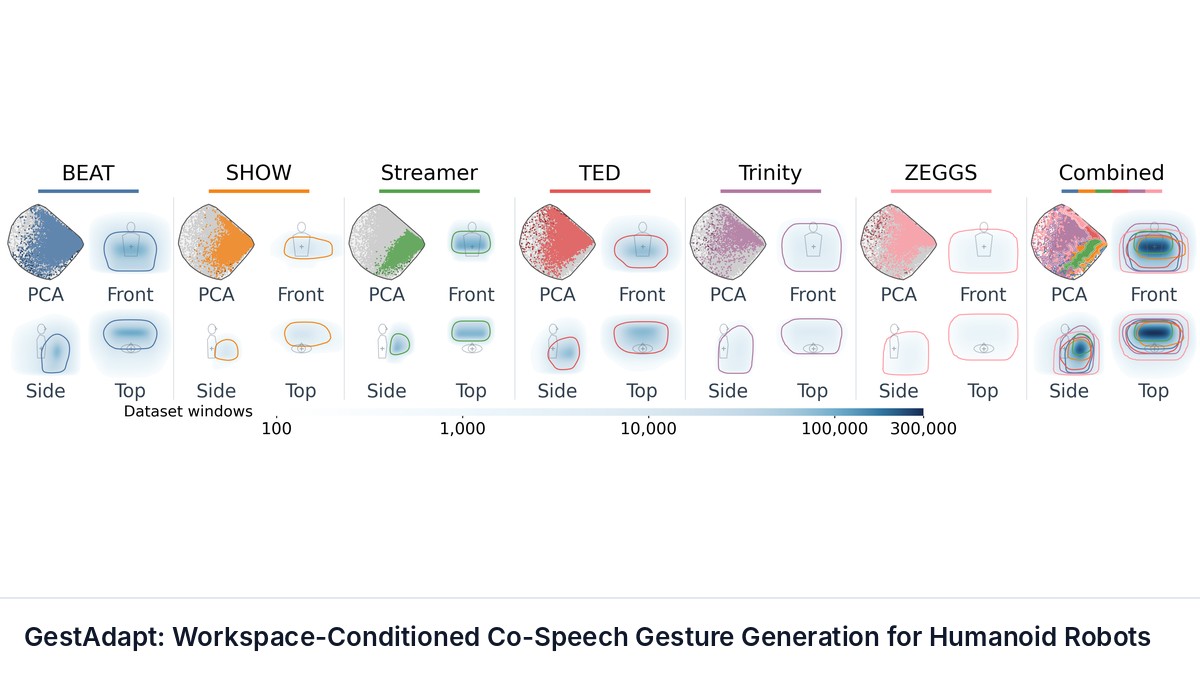
GestAdapt: Workspace-Conditioned Co-Speech Gesture Generation for Humanoid Robots
Bosong Ding, Xianglin Zhang, Miao Xin, Murat Kirtay, Giacomo Spigler · N/A · 2026
Framework
N/A
License
N/A
Stars
N/A
Summary
Co-speech gestures for robots must adapt not only to speech and embodiment, but also to the workspace available for performing the motion. Since the same speech can be accompanied by different gestures, a robot can respond to workspace constraints, e.g., gestures for speech next to a wall.
Abstract Summary
Key Points
- Co-speech gestures for robots must adapt not only to speech and embodiment, but also to the workspace available for performing the motion.
- Since the same speech can be accompanied by different gestures, a robot can respond to workspace constraints, e.g., gestures for speech next to a wall.
- In these scenarios, the robot should gesture in a suitable motion rather than simply correcting an unconstrained one.
- To achieve this goal, we present GestAdapt, a workspace-conditioned framework that conditions co-speech gesture generation on a prescribed wrist workspace.
- The GestAdapt framework learns from six complementary co-speech corpora through a shared motion representation and supports retargeting to different robot embodiments.
Unified Dataset
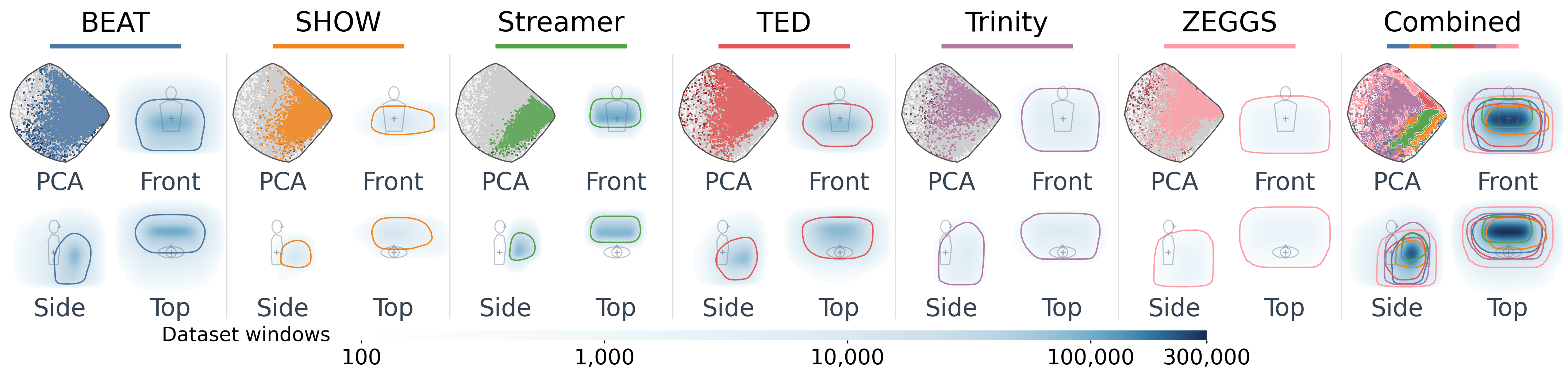
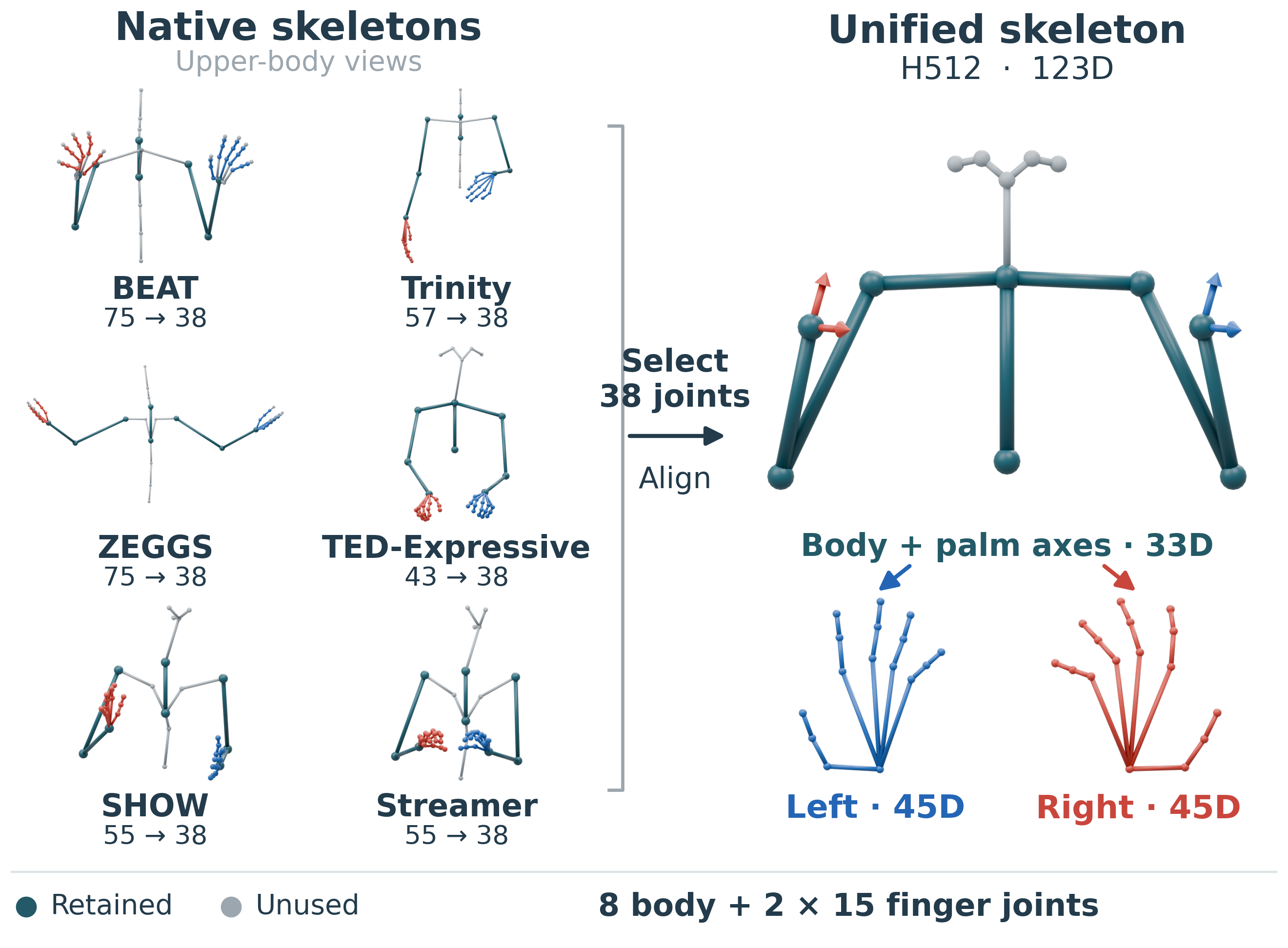
Learning spatially adaptive gestures ideally requires the same speech to be performed under different physical constraints. Existing co-speech datasets do not provide such paired recordings or explicit free-space annotations. Therefore, we combine six datasets with aligned speech and motion: BEAT [ 4 ] , SHOW [ 17 ] , Streamer [ 18 ] , TED-Expressive [ 19 ] , Trinity [ 20 ] , and ZEGGS [ 14 ] .
Method
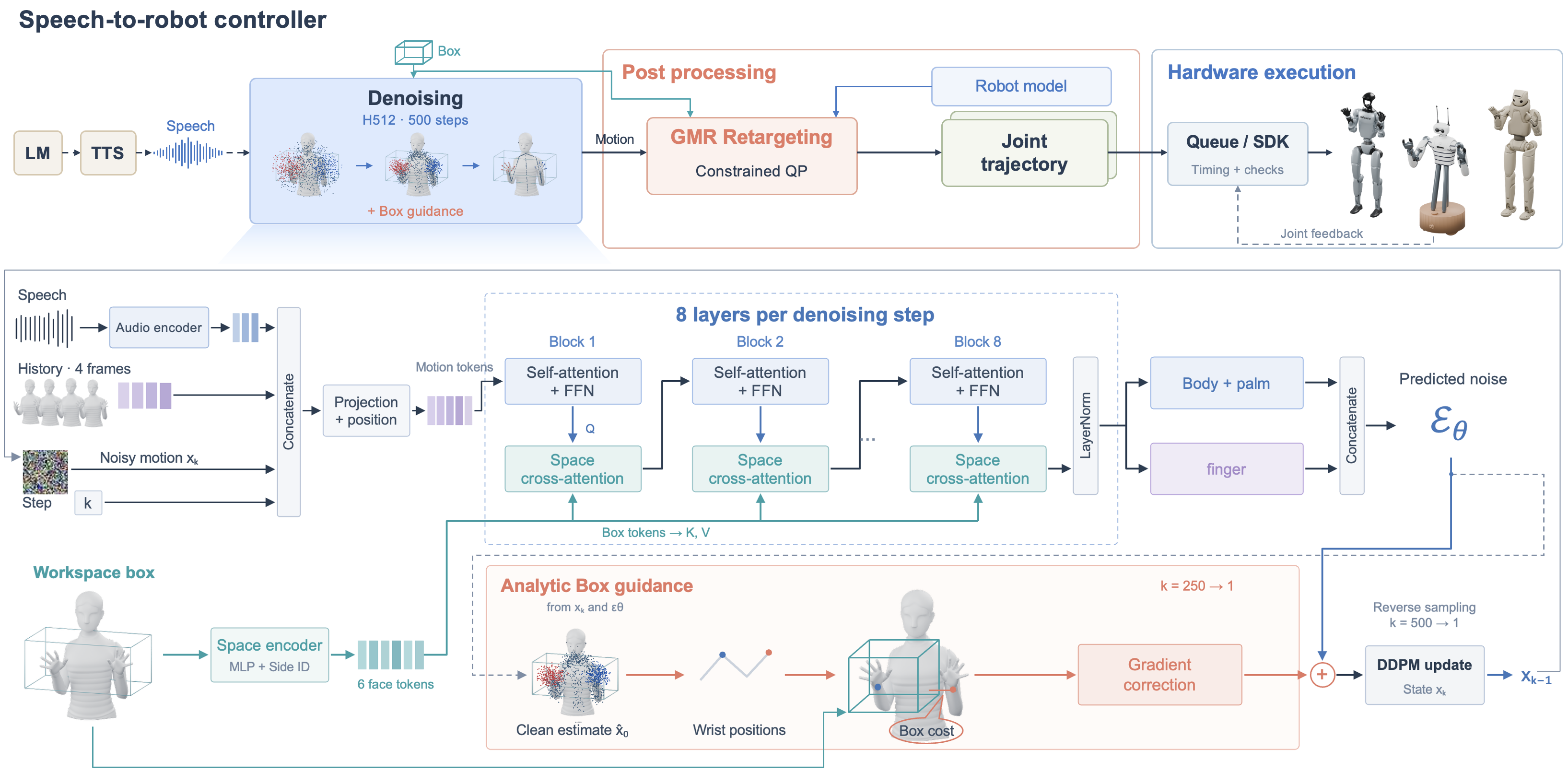
Our framework generates co-speech gestures that adapt to a specified workspace and can be executed on different robot embodiments. As illustrated in Fig. 4 , given speech, recent motion history, and a workspace box, GestAdapt generates motion with a workspace-conditioned diffusion model, applies analytic denoising guidance, and retargets the result under embodiment-specific execution constraints.
Experiments
Our primary goal is that, when the workspace changes, the generated motion should remain plausible under the distribution of real human gestures, remain responsive to the accompanying speech, and stay smooth, while placing the wrists within the prescribed spatial region. Therefore, we evaluate these complementary properties using four metrics.
FGD (Fréchet Gesture Distance) measures the distributional discrepancy between generated and real gestures in the feature space of a pretrained gesture encoder.
Sources and Demonstrations
Figures are reproduced from Ding et al. See the full paper for experimental details and the project page, when the paper links one, for demonstrations and videos.
Related Papers
4D Radar Perception Algorithms for Autonomous Driving: A Review
Xumin Wu, Jun Zhou, Jilin Mei et al.
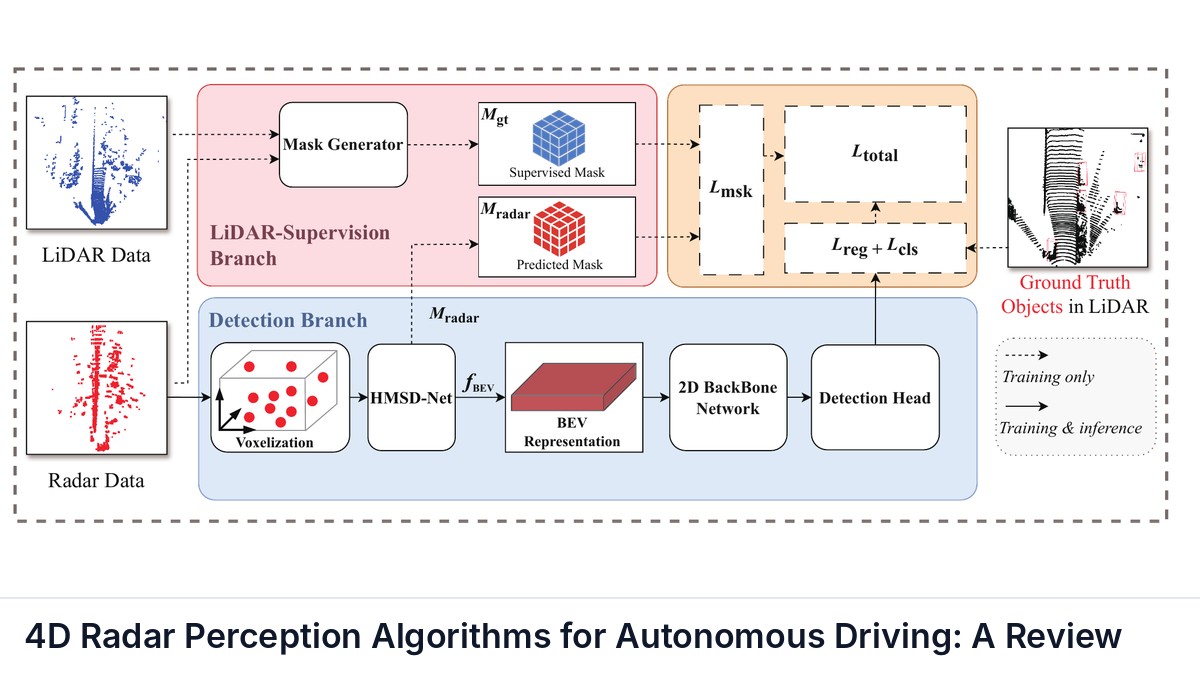
Research on 4D millimeter-wave radar perception algorithms has flourished in recent years, extending from signal processing and object detection to semantic segmentation, motion estimation, occupancy prediction, and dynamic scene reconstruction.
A Browser-Native Digital Test Range for Benchmarking 4D Ocean-Glider Planning Algorithms
Edward Holmberg, Elias Ioup, Mahdi Abdelguerfi
Repeated in-situ evaluation of ocean-glider planners requires scarce vehicles, operators, deployment and recovery resources, and ocean conditions that cannot be reset for competing algorithms.
A Mode-Unified, Continuous, and Biomimetic Control Strategy of a Robotic Lower Limb Prosthesis
Hanjun Kim, Sixu Zhou, John Shim et al.
Existing biomimetic lower-limb prosthesis controllers are commonly designed for discrete locomotion modes, requiring separate parameterizations for level walking, ramps, and stairs.
A Review Of Robotic World Models For Dynamic Environments Based On Factor And Scene Graphs
Marco Giberna, Miguel Fernandez-Cortizas, Jose Luis Sanchez Lopez et al.
Models based on graphs have emerged in robotics as a powerful foundation for internal world representations, where factor and scene graphs are among the most prominent model types found in the related literature and in successful robotic solutions.