
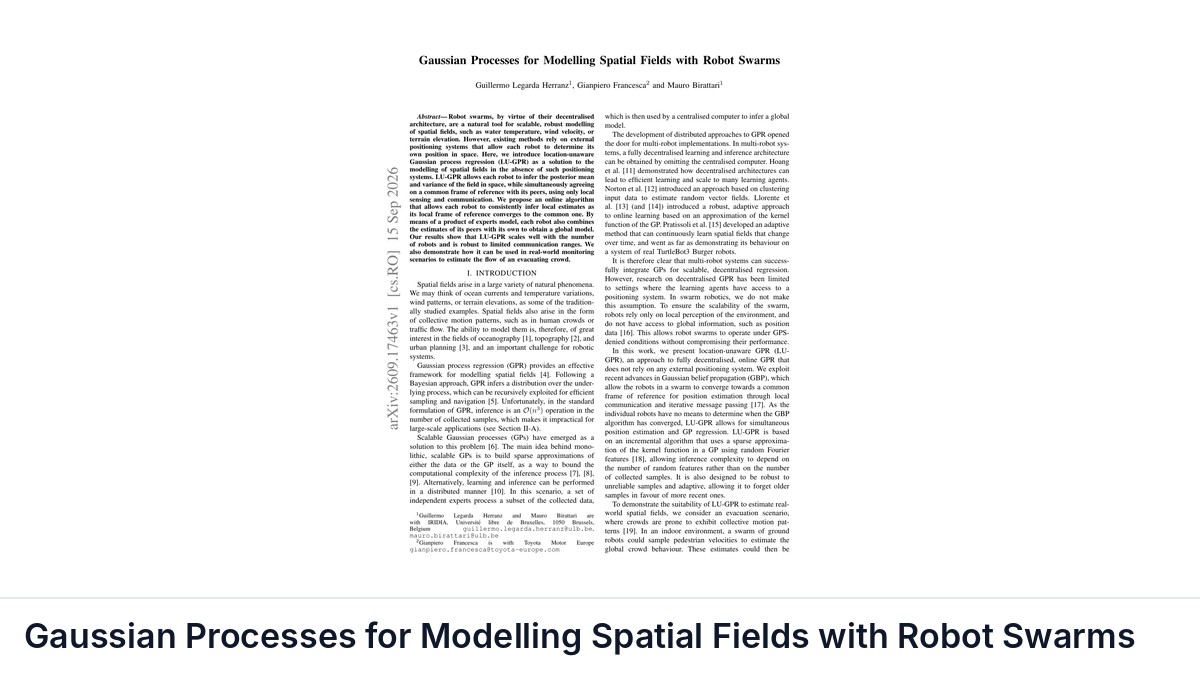
Gaussian Processes for Modelling Spatial Fields with Robot Swarms
Guillermo Legarda Herranz, Gianpiero Francesca, Mauro Birattari · N/A · 2026
Framework
N/A
License
N/A
Stars
N/A
Summary
Robot swarms, by virtue of their decentralised architecture, are a natural tool for scalable, robust modelling of spatial fields, such as water temperature, wind velocity, or terrain elevation.
Abstract Summary
Key Points
- Robot swarms, by virtue of their decentralised architecture, are a natural tool for scalable, robust modelling of spatial fields, such as water temperature, wind velocity, or terrain elevation.
- However, existing methods rely on external positioning systems that allow each robot to determine its own position in space.
- Here, we introduce location-unaware Gaussian process regression (LU-GPR) as a solution to the modelling of spatial fields in the absence of such positioning systems.
- LU-GPR allows each robot to infer the posterior mean and variance of the field in space, while simultaneously agreeing on a common frame of reference with its peers, using only local sensing and communication.
- We propose an online algorithm that allows each robot to consistently infer local estimates as its local frame of reference converges to the common one.
SPATIAL FIELD MODELLING
We now introduce LU-GPR, our proposed approach to modelling spatial fields with a robot swarm, where the robots have no knowledge of their position in space, and can only communicate within a limited range. Each robot runs the GBP algorithm of Jones et al. [ 17 ] , while simultaneously updating its GP model using data collected in time, as we describe in Section III-A .
To build a global model of the latent function, robots collect the models of their peers and fuse them with their own, as we describe in Section III-B .
EXPERIMENTAL VALIDATION
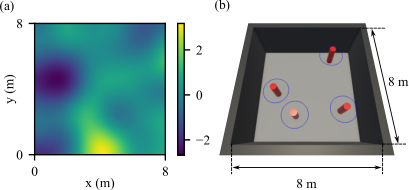
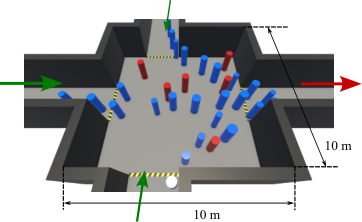
We validate LU-GPR using two different scenarios. First, using a randomly generated synthetic function, we study how the number of robots and the communication range affect estimation quality. Then, we demonstrate how LU-GPR can be used to model the behaviour of an evacuating crowd. For simplicity, we follow the common practice of assuming that the means of the GPs are zero in both scenarios [ 4 ] .
Sources and Demonstrations
Figures are reproduced from Herranz et al. See the full paper for experimental details and the project page, when the paper links one, for demonstrations and videos.
Related Papers
3DThinkVLA: Endowing Vision-Language-Action Models with Latent 3D Priors via 3D-Thinking-Guided Co-training
Jiaxin Shi, Xidong Zhang, Fucai Zhu et al.
We propose a 3D-thinking-guided co-training framework that enables vision-language-action (VLA) models to perform 3D spatial reasoning implicitly during action prediction.
4D Radar Perception Algorithms for Autonomous Driving: A Review
Xumin Wu, Jun Zhou, Jilin Mei et al.
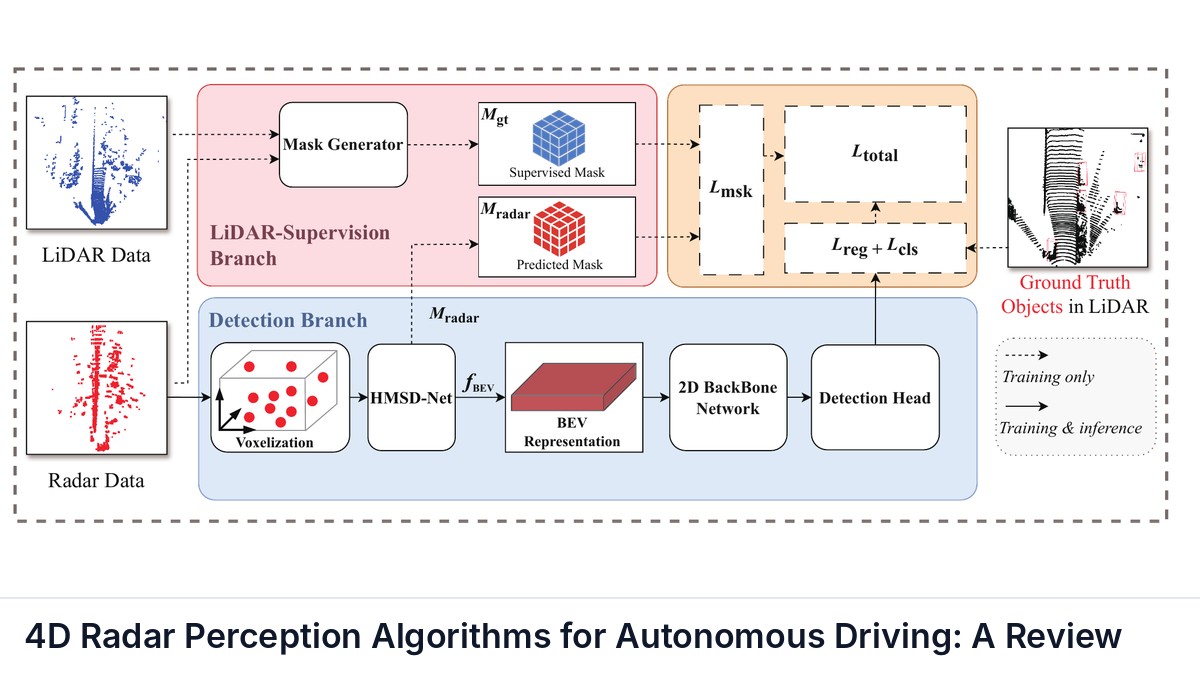
Research on 4D millimeter-wave radar perception algorithms has flourished in recent years, extending from signal processing and object detection to semantic segmentation, motion estimation, occupancy prediction, and dynamic scene reconstruction.
A Balanced Data Diet: Addressing the Exploration Bottleneck in Mega-Scale RL for Robot Control
Octi Zhang, Mateo Guaman Castro, Patrick Yin et al.
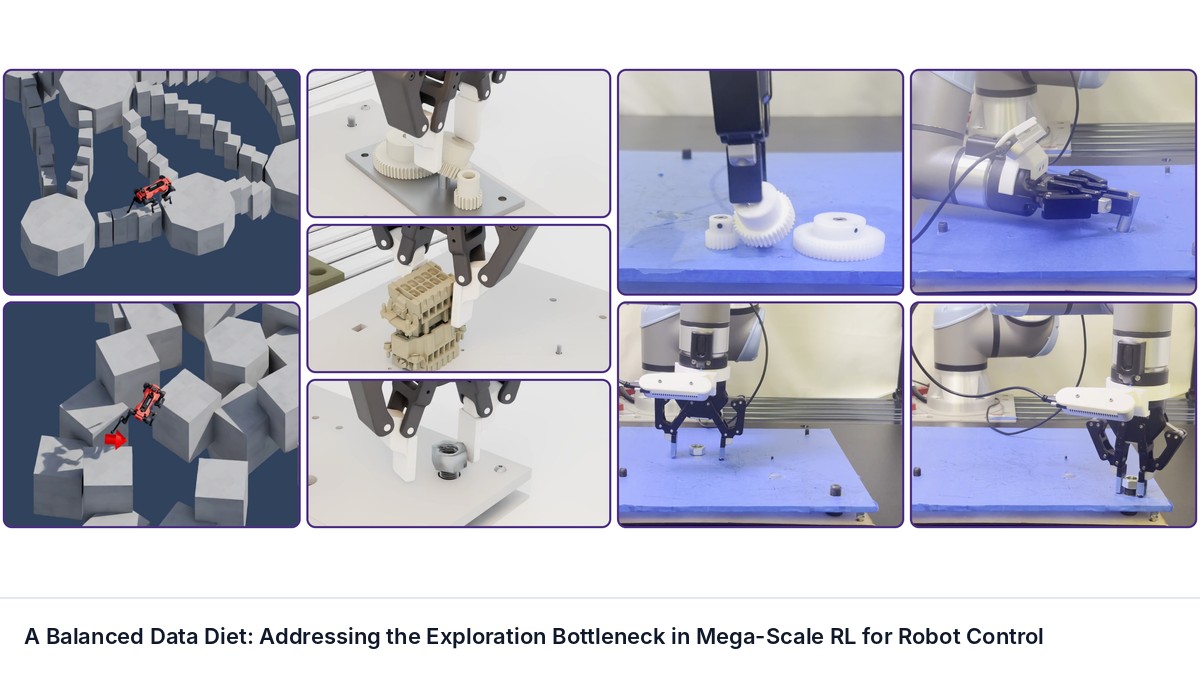
General-purpose robots must perform a wide range of tasks from agile locomotion to dexterous manipulation.
A Browser-Native Digital Test Range for Benchmarking 4D Ocean-Glider Planning Algorithms
Edward Holmberg, Elias Ioup, Mahdi Abdelguerfi
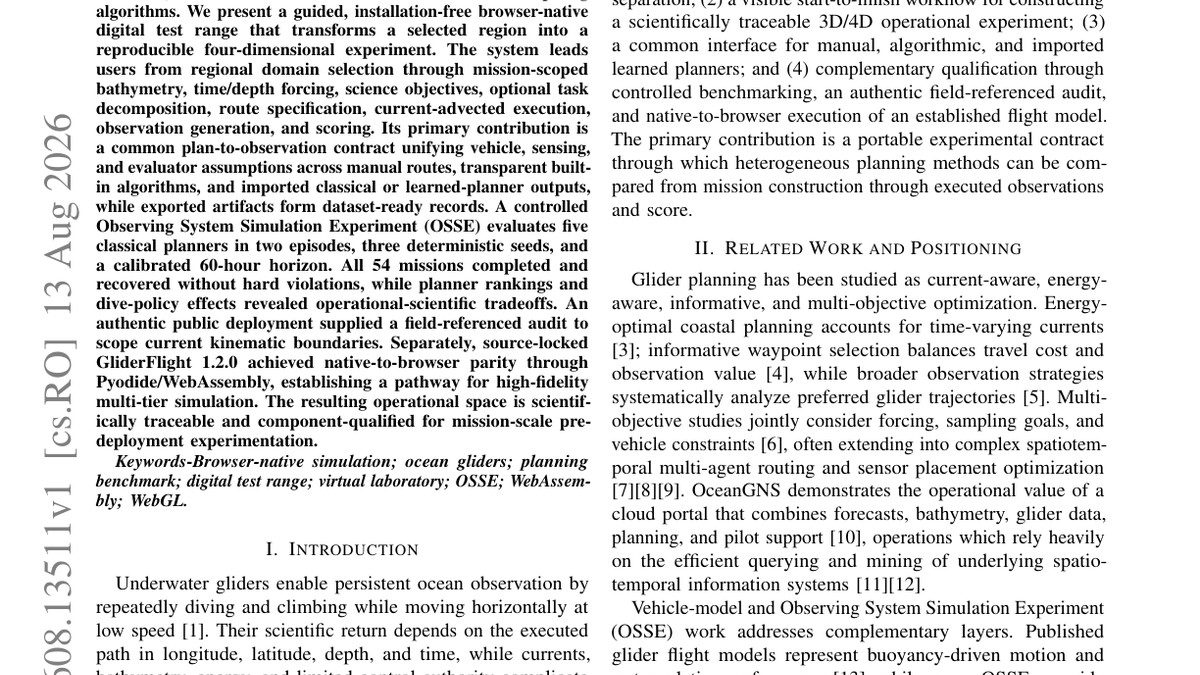
Repeated in-situ evaluation of ocean-glider planners requires scarce vehicles, operators, deployment and recovery resources, and ocean conditions that cannot be reset for competing algorithms.