
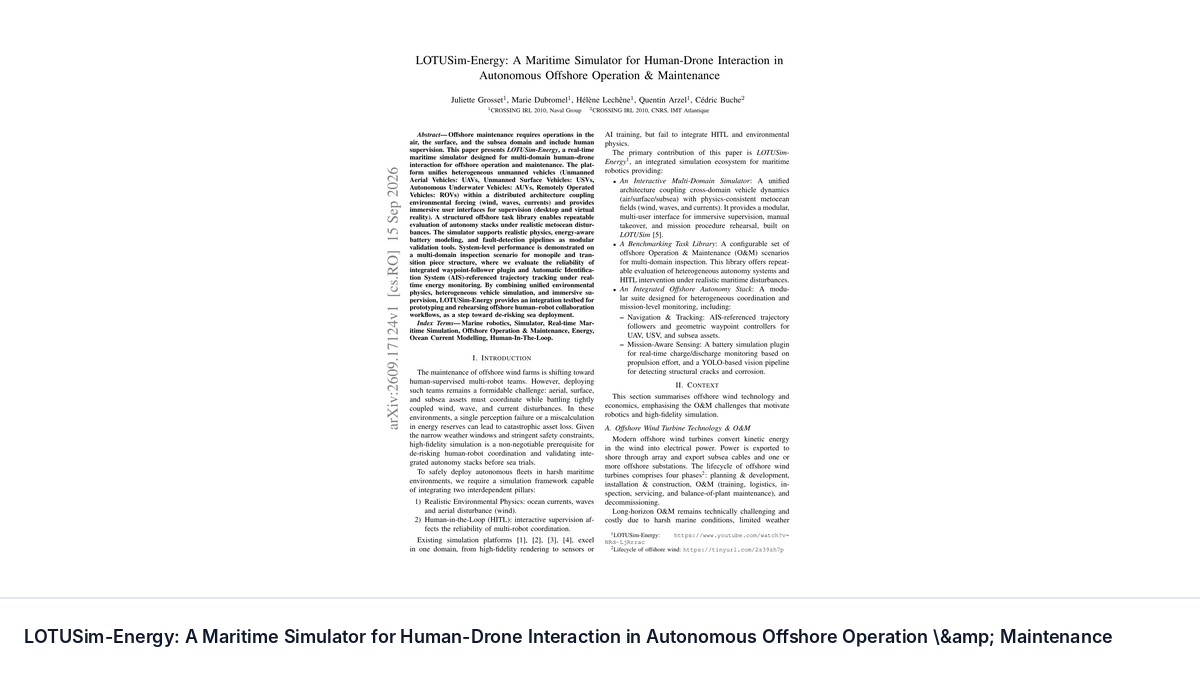
LOTUSim-Energy: A Maritime Simulator for Human-Drone Interaction in Autonomous Offshore Operation \& Maintenance
Juliette Grosset, Marie Dubromel, Hélène Lechêne, Quentin Arzel, Cédric Buche · N/A · 2026
Framework
N/A
License
N/A
Stars
N/A
Summary
Offshore maintenance requires operations in the air, the surface, and the subsea domain and include human supervision. This paper presents LOTUSim-Energy, a real-time maritime simulator designed for multi-domain human--drone interaction for offshore operation and maintenance.
Abstract Summary
Key Points
- Offshore maintenance requires operations in the air, the surface, and the subsea domain and include human supervision.
- This paper presents LOTUSim-Energy, a real-time maritime simulator designed for multi-domain human--drone interaction for offshore operation and maintenance.
- The plat- form unifies heterogeneous unmanned vehicles (Unmanned Aerial Vehicles: UAVs, Unmanned Surface Vehicles: USVs, Autonomous Underwater Vehicles: AUVs, Remotely Operated Vehicles: ROVs) within a distributed architecture coupling environment forcing (wind, waves, currents) and provides immersive user interfaces for supervision (desktop and virtual reality).
- A structured offshore task library enables repeatable evaluation of autonomy stacks under realistic metocean disturbances.
- The simulator supports realistic physics, energy-aware battery modeling, and fault-detection pipelines as modular validation tools.
LOTUSim-Energy: A Maritime Simulator for Human-Drone Interaction in Autonomous Offshore Operation & Maintenance
|Authors: Juliette Grosset, Marie Dubromel, Hélène Lechêne, Quentin Arzel, Cédric Buche
|Venue: arXiv preprint | Year: 2026
|arXiv: 2609.17124v1
Abstract
Offshore maintenance requires operations in the air, the surface, and the subsea domain and include human supervision. This paper presents LOTUSim-Energy, a real-time maritime simulator designed for multi-domain human—drone interaction for offshore operation and maintenance. The plat- form unifies heterogeneous unmanned vehicles (Unmanned Aerial Vehicles: UAVs, Unmanned Surface Vehicles: USVs, Autonomous Underwater Vehicles: AUVs, Remotely Operated Vehicles: ROVs) within a distributed architecture coupling environment forcing (wind, waves, currents) and provides immersive user interfaces for supervision (desktop and virtual reality). A structured offshore task library enables repeatable evaluation of autonomy stacks under realistic metocean disturbances. The simulator supports realistic physics, energy-aware battery modeling, and fault-detection pipelines as modular validation tools. System-level performance is demonstrated on a multi-domain inspection scenario for monopile and transition piece structure, where we evaluate the reliability of integrated waypoint-follower plugin and Automatic Identification System (AIS)-referenced trajectory tracking under real-time energy monitoring. By combining unified environmental physics, heterogeneous vehicle simulation, and immersive supervision, LOTUSim-Energy provides an integration testbed for prototyping and rehearsing offshore human—robot collaboration workflows, as a step toward de-risking sea deployment.
Key Contributions
- Offshore maintenance requires operations in the air, the surface, and the subsea domain and inclu…
- This paper presents LOTUSim-Energy, a real-time maritime simulator designed for multi-domain huma…
- The plat- form unifies heterogeneous unmanned vehicles (Unmanned Aerial Vehicles: UAVs, Unmanned …
- A structured offshore task library enables repeatable evaluation of autonomy stacks under realist…
- The simulator supports realistic physics, energy-aware battery modeling, and fault-detection pipe…
Topics
- vision
- reinforcement-learning
- benchmark
Code & Data
No code repository linked in paper metadata.
BibTeX
@article{Grosset2026_260917124v1,
  title     = {LOTUSim-Energy: A Maritime Simulator for Human-Drone Interaction in Autonomous Offshore Operation \& Maintenance},
  author    = {Juliette Grosset and Marie Dubromel and Hélène Lechêne and Quentin Arzel and Cédric Buche},
  year      = {2026},
  eprint    = {2609.17124v1},
  archivePrefix = {arXiv},
  primaryClass  = {cs.RO},
  url       = {https://arxiv.org/abs/2609.17124v1}
}
Related Papers
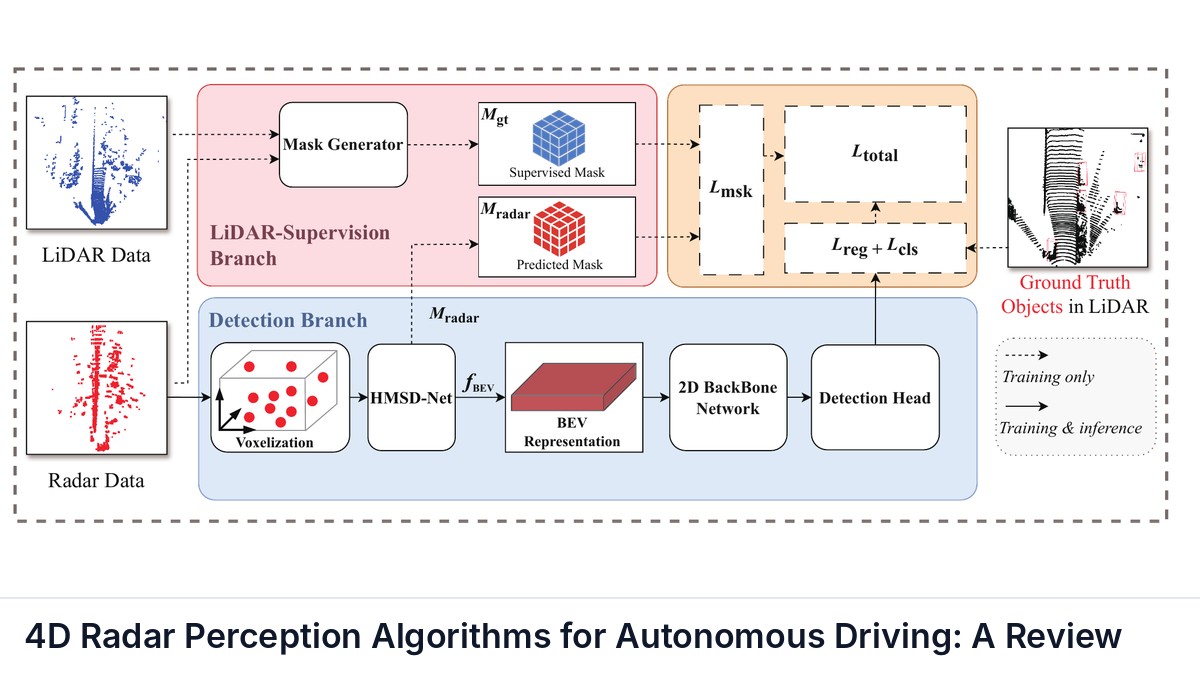
4D Radar Perception Algorithms for Autonomous Driving: A Review
Xumin Wu, Jun Zhou, Jilin Mei et al.
Research on 4D millimeter-wave radar perception algorithms has flourished in recent years, extending from signal processing and object detection to semantic segmentation, motion estimation, occupancy prediction, and dynamic scene reconstruction.
A Review Of Robotic World Models For Dynamic Environments Based On Factor And Scene Graphs
Marco Giberna, Miguel Fernandez-Cortizas, Jose Luis Sanchez Lopez et al.
Models based on graphs have emerged in robotics as a powerful foundation for internal world representations, where factor and scene graphs are among the most prominent model types found in the related literature and in successful robotic solutions.

A Sim-to-Real Integration Pipeline for Training and Deployment of Chunk-Based VLA Manipulation Policies
Mathilde Kappel, Clémence Grislain, Mohamed Chetouani et al.
Vision-Language-Action (VLA) models have become a prominent paradigm for mapping multimodal inputs, including semantic instructions, visual observations of the scene, and proprioceptive observations, to robot actions.
Aim Short to Reach Far: Your Frozen World Model Can Plan Better Than You Think
Xvyuan Liu, Jianjie Fang, Chen Gao et al.
Planners built on visual world models commonly score each predicted outcome by its distance to the encoded goal image. We show that this target can limit control even with exact dynamics and globally optimal short-horizon search: reaching a goal may require actions that initially move away from it.