
WM-VS: Progress-Aligned World Models for Closed-Loop Visual Servoing
Guanzhong Sun, Junyi Ma, Yixuan Zhou, Yuxuan Wu, Yanzi Miao, Hesheng Wang · N/A · 2026
Framework
N/A
License
N/A
Stars
N/A
Summary
Closed-loop visual servoing requires predictions that indicate whether an action reduces task error, not only whether the action is plausible.
Abstract Summary
Key Points
- Closed-loop visual servoing requires predictions that indicate whether an action reduces task error, not only whether the action is plausible.
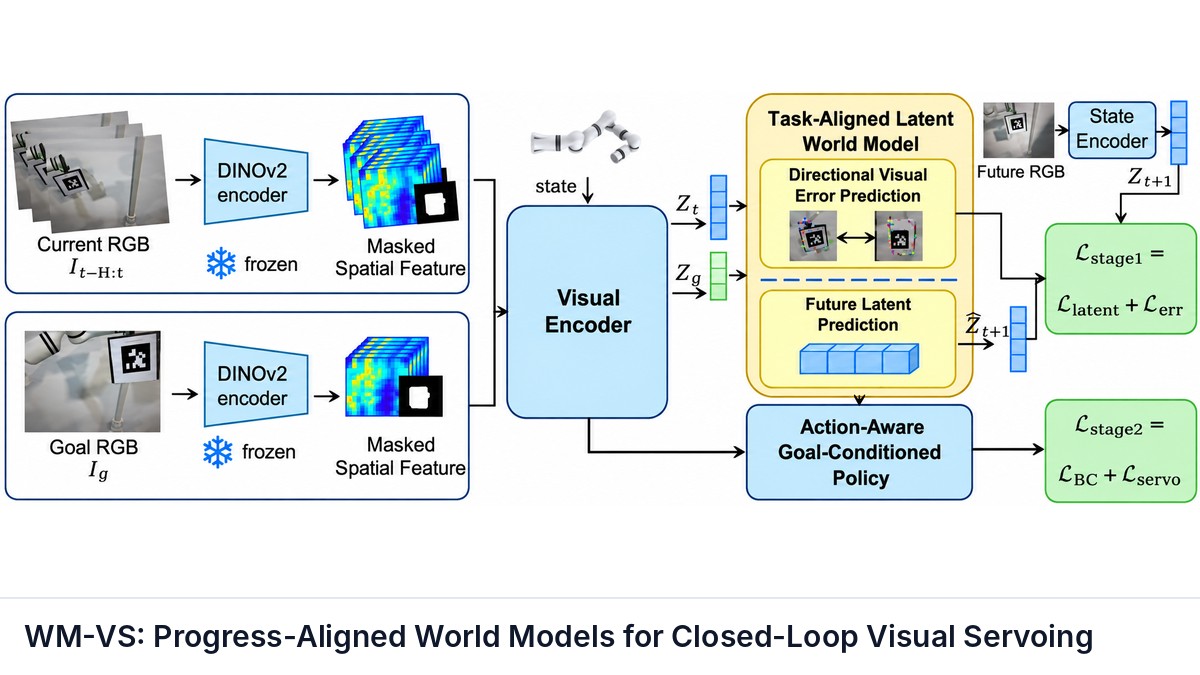
- We call this gap the prediction-control mismatch and introduce WM-VS, a target-centric progress-aligned world-model framework for closed-loop visual servoing.
- Offline target-region DINOv2 correspondences define a signed four-dimensional servo coordinate for translation, scale, and in-plane rotation.
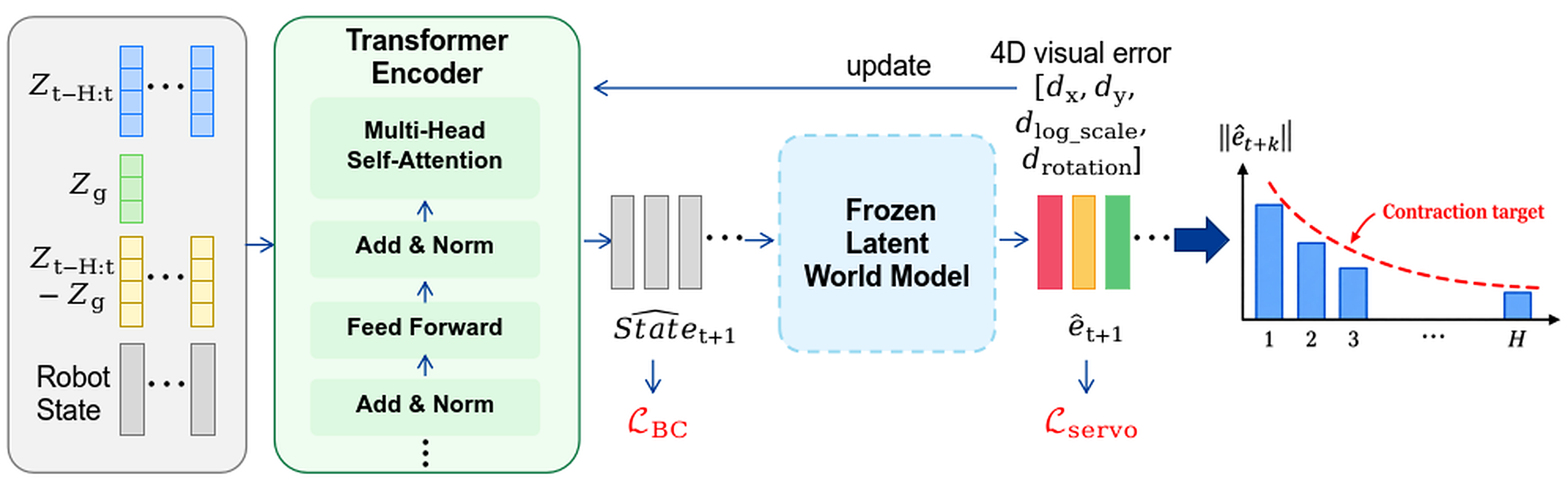
- Stage 1 aligns action-conditioned latent transitions with this coordinate; Stage 2 freezes the world model and trains a reactive joint-velocity policy with action imitation, consequence supervision, and short imagined rollouts that favor error contraction.
- Deployment is RGB-only and reactive, without online trajectory optimization
Method
We consider a fixed eye-to-hand camera observing a robot whose end-effector carries the task target. At time $t$, the controller receives an RGB image $I_{t}$, joint state $\mathbf{q}_{t}$, recent joint and action history, and a desired RGB image $I_{g}$, and outputs a seven-joint velocity command $\dot{\mathbf{q}}_{t}$.
At every control cycle WM-VS refreshes the observation and robot state and recomputes the command, so it operates as a reactive closed-loop servo controller rather than replaying an open-loop action sequence.
Experiments
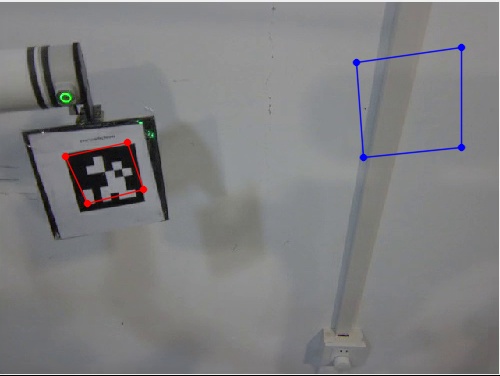
We use the suffix E2H to denote the fixed-camera eye-to-hand adaptations of the corresponding methods. Experiments use a fixed eye-to-hand Gemini 2 RGB-D camera and a seven-axis RealMan RMC-DA robot. The RGB stream is $640\times 480$ (4:3), with horizontal, vertical, and diagonal fields of view of $63.55^{\circ}$, $49.82^{\circ}$, and $75.49^{\circ}$, respectively.
A custom-designed, 3D-printed end-effector is rigidly bolted to the robot flange and carries the task target.
Sources and Demonstrations
Figures are reproduced from Sun et al. See the full paper for experimental details and the project page, when the paper links one, for demonstrations and videos.
Related Papers
A Low-Cost, Open Platform for End-to-End Autonomous Driving on a Miniature Ackermann Vehicle
Gustavo Claudio Karl Couto, Eric Aislan Antonelo, Gabriel George Zipperer
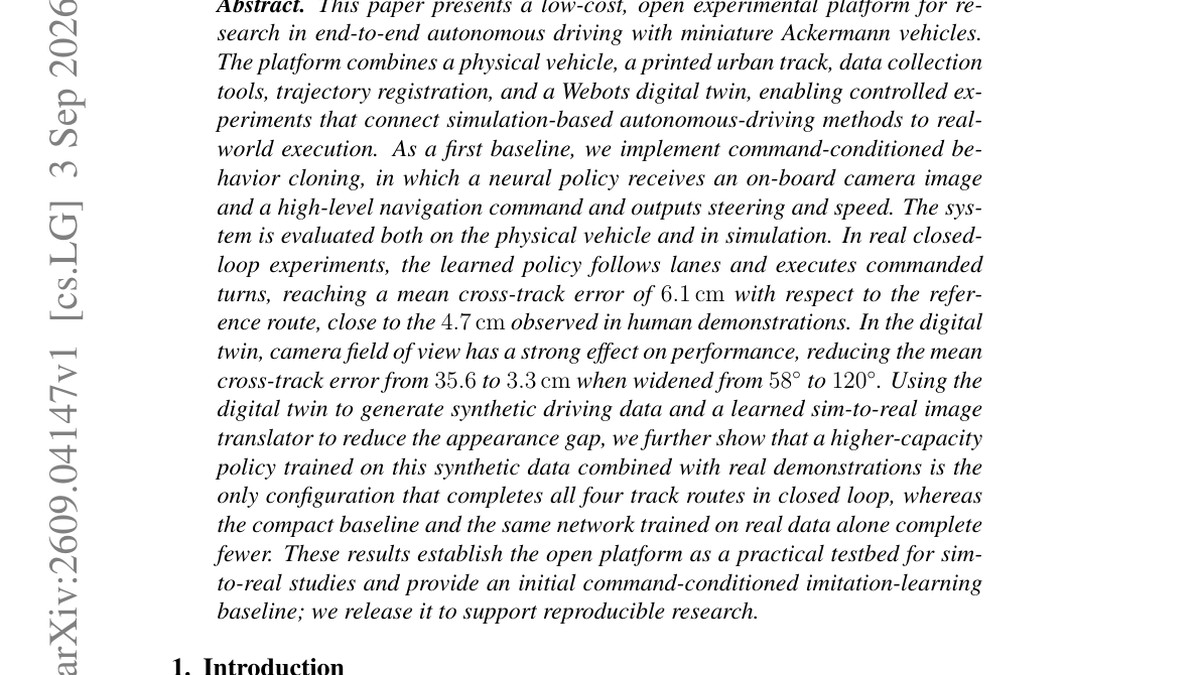
This paper presents a low-cost, open experimental platform for research in end-to-end autonomous driving with miniature Ackermann vehicles.
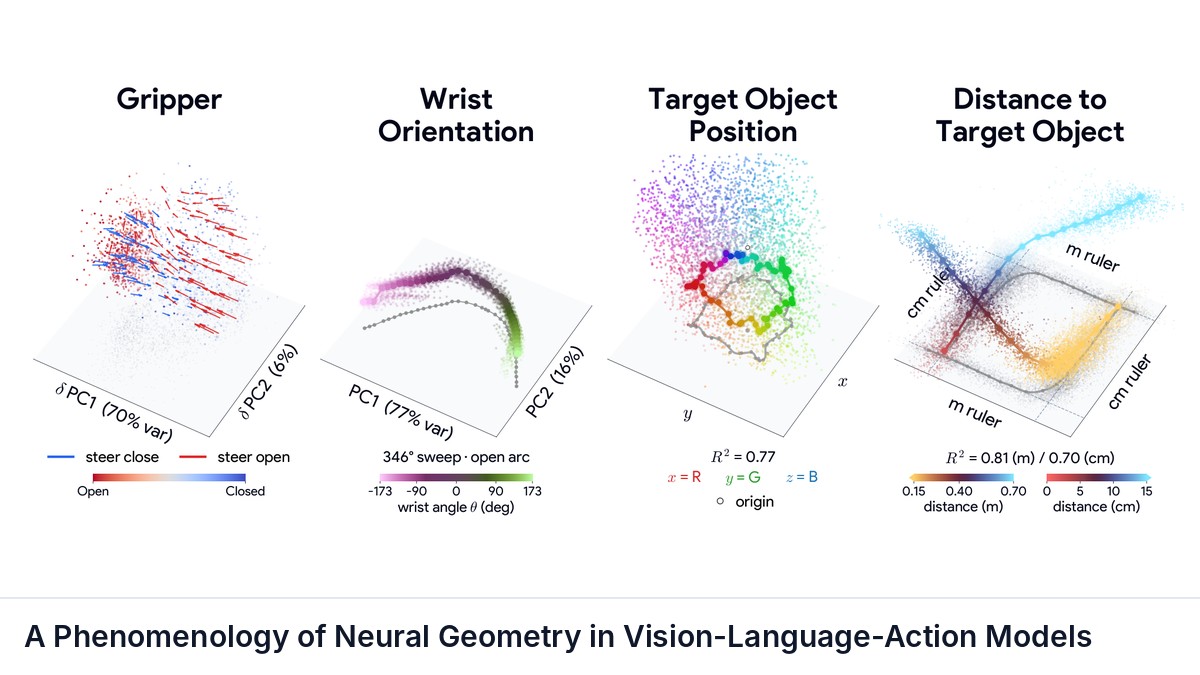
A Phenomenology of Neural Geometry in Vision-Language-Action Models
Mozes Jacobs, Aiden Swann, Mathilde Papillon et al.
Robotic manipulation is inherently geometric, but what shape does the world take inside the policy that performs it?

A Sim-to-Real Integration Pipeline for Training and Deployment of Chunk-Based VLA Manipulation Policies
Mathilde Kappel, Clémence Grislain, Mohamed Chetouani et al.
Vision-Language-Action (VLA) models have become a prominent paradigm for mapping multimodal inputs, including semantic instructions, visual observations of the scene, and proprioceptive observations, to robot actions.
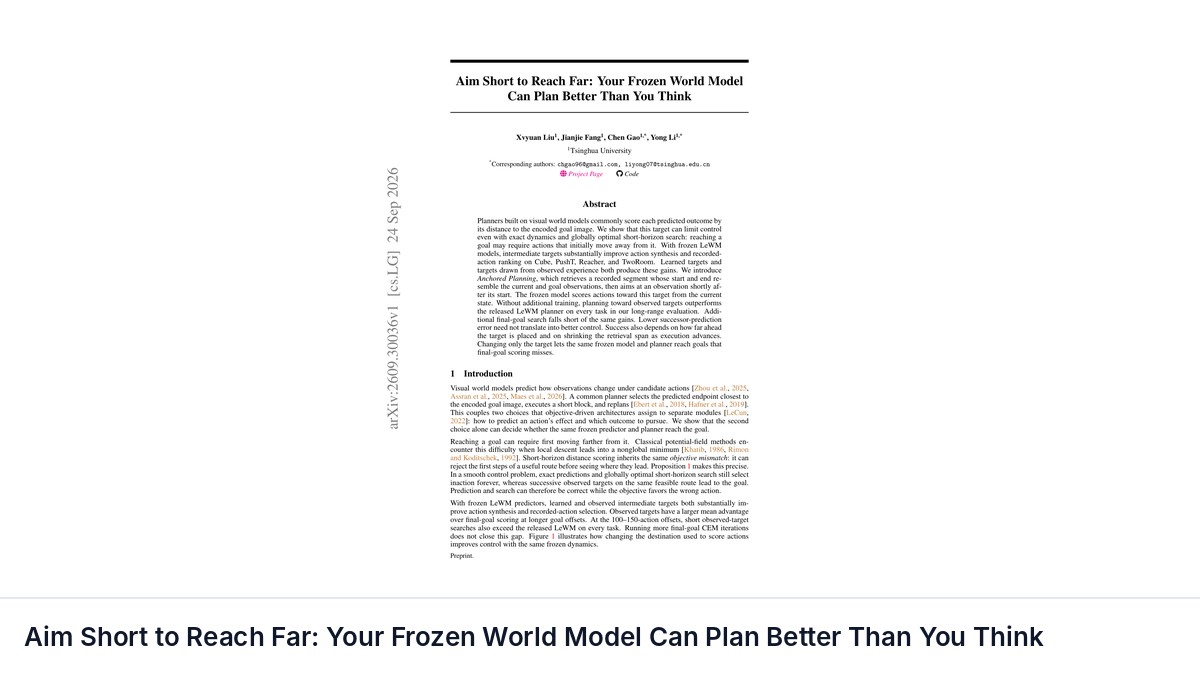
Aim Short to Reach Far: Your Frozen World Model Can Plan Better Than You Think
Xvyuan Liu, Jianjie Fang, Chen Gao et al.
Planners built on visual world models commonly score each predicted outcome by its distance to the encoded goal image. We show that this target can limit control even with exact dynamics and globally optimal short-horizon search: reaching a goal may require actions that initially move away from it.