
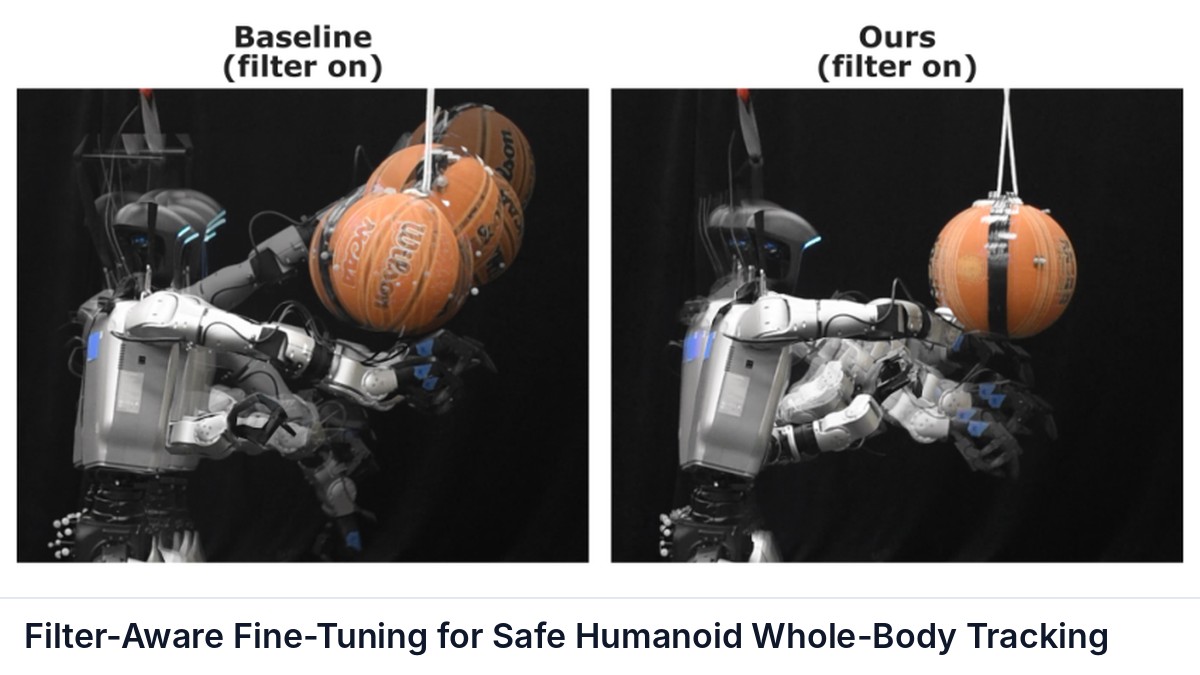
Filter-Aware Fine-Tuning for Safe Humanoid Whole-Body Tracking
Pranit Mohnot, Christian Helten, Daniele Gammelli, Marco Pavone · N/A · 2026
Framework
N/A
License
N/A
Stars
N/A
Summary
Safe whole-body motion is essential for deploying humanoid robots in unstructured environments.
Abstract Summary
Key Points
- Safe whole-body motion is essential for deploying humanoid robots in unstructured environments
- Modern humanoid control commonly separates reference specification from execution, with a planner, teleoperator, or motion generator providing a reference that a reinforcement-learning policy tracks through dynamically feasible whole-body control.
- Runtime safety filters, such as control barrier functions (CBFs), offer a promising approach for enforcing newly introduced constraints via interventions on the tracker's outputs.
- We show, however, that treating the tracking policy and safety filter independently induces fundamental mismatches, as filtering alters both the executed actions and the induced state distribution.
- We study this policy-filter interface through case studies that isolate dynamics, objective, and information mismatches, highlight their root causes, and use these insights to develop CoFiT (Constrained Filter-aware Tuning), a filter-aware fine-tuning method for pretrained trackers.
Preliminaries
In this section, we first briefly review the relative-degree-two CBF formulation used to encode safety constraints (Section III-A ), and then describe the whole-body filtering framework through which these constraints modify the tracking policy’s nominal commands (Section III-B ). A control barrier function expresses a state constraint as a condition on the control input [ 5 ] .
Failure Modes of Independently Designed Policies and Safety Filters
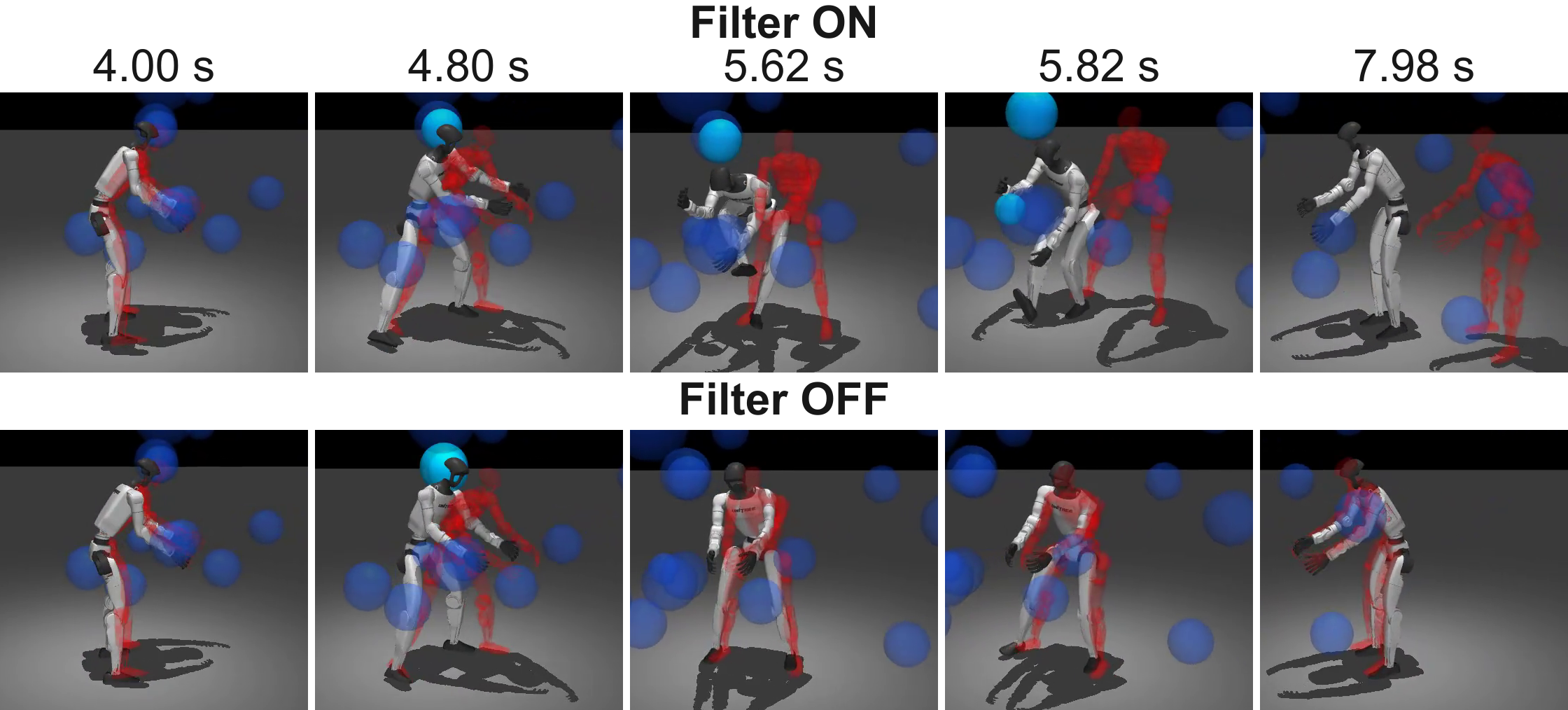
Base trackers were trained with a nominal unconstrained model of the actuators, but applying filters at runtime introduces a distribution shift that impacts the tracking and stability performance of the underlying policy. We distinguish three interacting mismatches in the composed policy-filter loop, regarding dynamics, objective, and information.
CBFs produce endogenous and autocorrelated perturbations on unfiltered dynamics.
Filter-Aware Policy Design
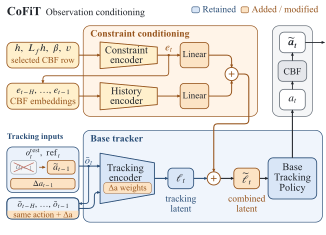
CoFiT (illustrated in Fig. 3 ) fine-tunes whole-body trackers to cooperate with a safety filter while maintaining performance. We retain the base tracker’s MLP structure and native tracking rewards as a backbone, with the ConstrainedMimic whole-body filter active throughout training and deployment [ 7 ] . As motivated in Sec.
IV-C , we endow the base policy with information regarding which directions would lead to violation, and how urgent the constraint is.
Experiments
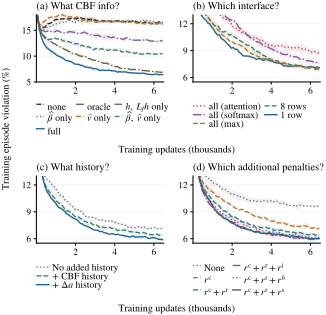
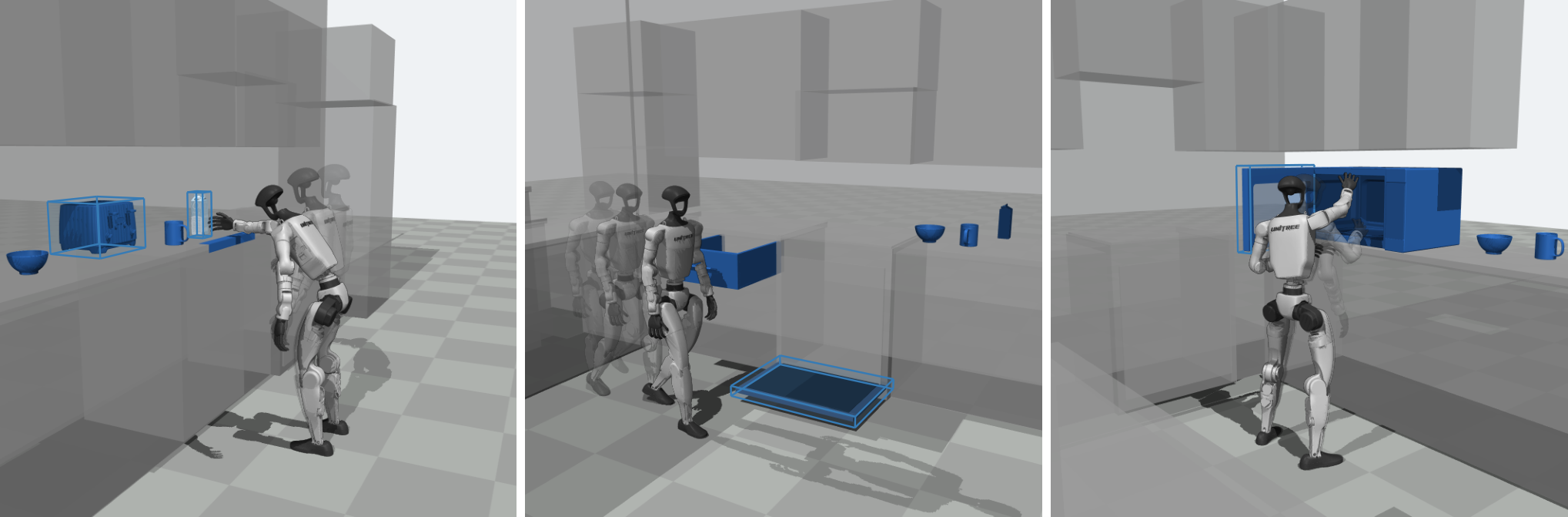
We evaluate CoFiT through four outcomes: realized safety, cooperation with the filter, motion quality, and reference tracking. We first isolate design choices in a simplified setting, then validate on more realistic scenes, a second tracker, and hardware. We provide the tracker with fixed world-frame trajectories that cannot replan in response to tracking errors or safety interventions.
Our scenes are therefore designed as near-misses or mild interferences requiring local readjustment rather than rerouting.
Sources and Demonstrations
Figures are reproduced from Mohnot et al. See the full paper for experimental details and the project page, when the paper links one, for demonstrations and videos.
Related Papers
A Balanced Data Diet: Addressing the Exploration Bottleneck in Mega-Scale RL for Robot Control
Octi Zhang, Mateo Guaman Castro, Patrick Yin et al.
General-purpose robots must perform a wide range of tasks from agile locomotion to dexterous manipulation.
A Browser-Native Digital Test Range for Benchmarking 4D Ocean-Glider Planning Algorithms
Edward Holmberg, Elias Ioup, Mahdi Abdelguerfi
Repeated in-situ evaluation of ocean-glider planners requires scarce vehicles, operators, deployment and recovery resources, and ocean conditions that cannot be reset for competing algorithms.
A Low-Cost, Open Platform for End-to-End Autonomous Driving on a Miniature Ackermann Vehicle
Gustavo Claudio Karl Couto, Eric Aislan Antonelo, Gabriel George Zipperer
This paper presents a low-cost, open experimental platform for research in end-to-end autonomous driving with miniature Ackermann vehicles.
A Mode-Unified, Continuous, and Biomimetic Control Strategy of a Robotic Lower Limb Prosthesis
Hanjun Kim, Sixu Zhou, John Shim et al.
Existing biomimetic lower-limb prosthesis controllers are commonly designed for discrete locomotion modes, requiring separate parameterizations for level walking, ramps, and stairs.