
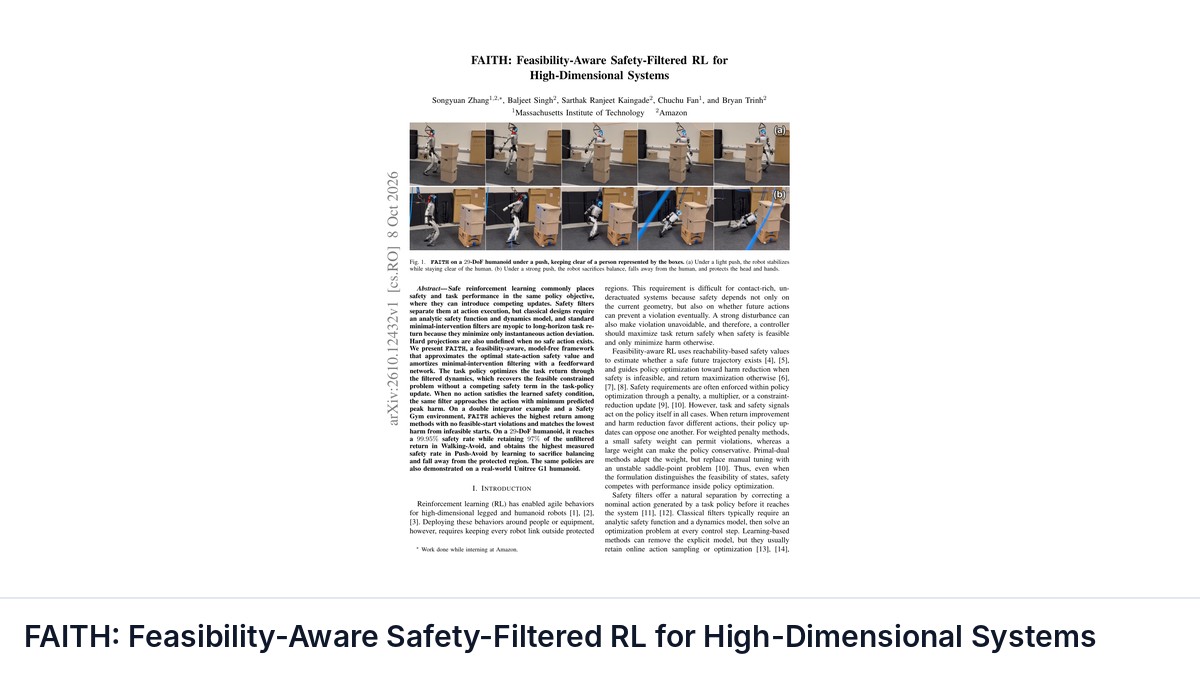
FAITH: Feasibility-Aware Safety-Filtered RL for High-Dimensional Systems
Songyuan Zhang, Baljeet Singh, Sarthak Ranjeet Kaingade, Chuchu Fan, Bryan Trinh · N/A · 2026
Framework
N/A
License
N/A
Stars
N/A
Summary
Safe reinforcement learning commonly places safety and task performance in the same policy objective, where they can introduce competing updates.
Abstract Summary
Key Points
- Safe reinforcement learning commonly places safety and task performance in the same policy objective, where they can introduce competing updates.
- Safety filters separate them at action execution, but classical designs require an analytic safety function and dynamics model, and standard minimal-intervention filters are myopic to long-horizon task return because they minimize only instantaneous action deviation.
- Hard projections are also undefined when no safe action exists
- We present FAITH, a feasibility-aware, model-free framework that approximates the optimal state-action safety value and amortizes minimal-intervention filtering with a feedforward network.
- The task policy optimizes the task return through the filtered dynamics, which recovers the feasible constrained problem without a competing safety term in the task-policy update.
Problem Setting and Preliminaries
We consider a discrete-time system $s^{k+1}=f(s^{k},a^{k})$ with state $s\in\mathcal{S}$, action $a\in\mathcal{A}$, and unknown deterministic dynamics $f$. A reward $r:\mathcal{S}\times\mathcal{A}\to\mathbb{R}$ specifies the task. For a policy $\pi:\mathcal{S}\to\mathcal{A}$, define its discounted return as 1 1 1 Trajectories under $\pi$ satisfy $s^{k+1}=f(s^{k},\pi(s^{k}))$.
We omit these dynamics when they are clear from context. where $\gamma\in[0,1)$ and the return is assumed finite.
Method
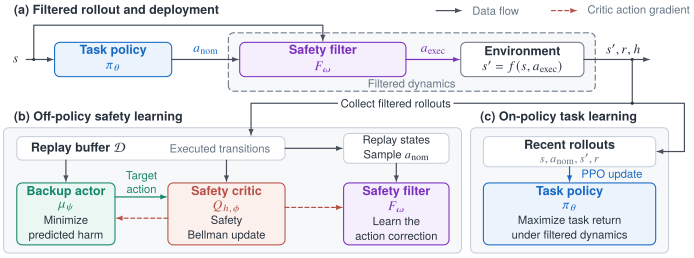
To address these limitations, we propose FAITH . FAITH approximates the optimal safety critic with a backup actor supplying low-harm actions for the Bellman target. A learned filter uses this critic to approximate the solution to ( 5 ) when the learned safety condition is feasible and to prioritize lower harm otherwise.
The task policy is trained from filtered rollouts using only reward, so safety does not appear as a competing objective in policy updates.
Simulation Experiments
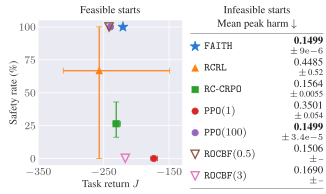
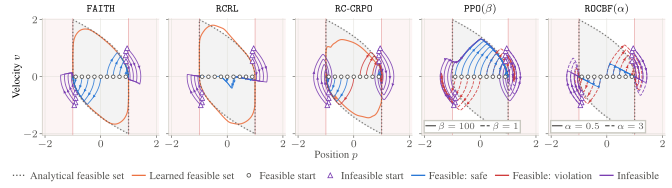
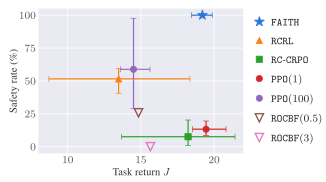
We conduct experiments to answer three research questions. (Q1): Starting from feasible states, how much task return can FAITH retain while respecting the safety constraint? (Q2): When harm is unavoidable, can FAITH minimize the harm? (Q3): Does FAITH scale to a high-dimensional system with whole-body constraints?
We compare against four representative ways of enforcing safety in the literature: RCRL [ 6 ] , a primal-dual feasibility-aware method that enforces a policy-conditioned safety value in the objective.
Hardware Experiments
We conduct qualitative hardware demonstrations on a $29$-DoF Unitree G1, with boxes representing the protected region ( ). In the pipeline ( Fig. 6 ), $10$ Hz LiDAR scans undergo SLAM-based ground removal [ 42 ] . We retain the nearest point in each of $64$ equal-width azimuth bins covering $360^{\circ}$, matching the simulation observation format.
At $50$ Hz, FAITH combines this observation (held between scans) with the current robot state to generate joint-position targets. A $1000$ Hz PD controller then tracks these targets.
Sources and Demonstrations
Figures are reproduced from Zhang et al. See the full paper for experimental details and the project page, when the paper links one, for demonstrations and videos.
Related Papers
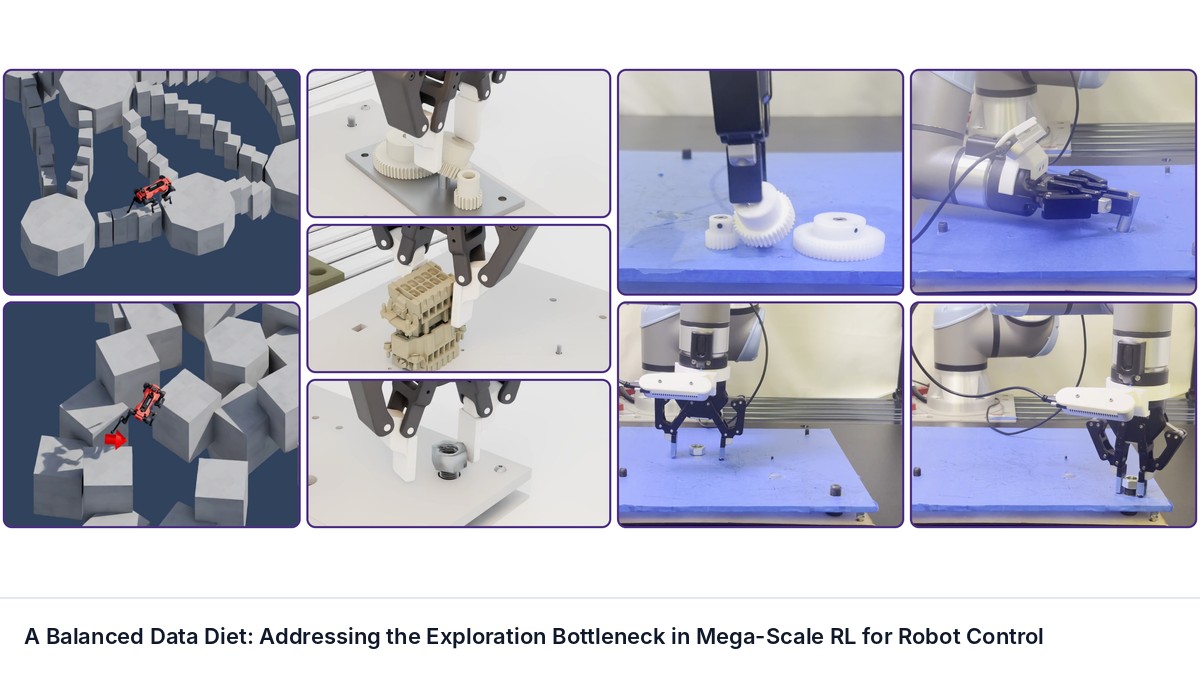
A Balanced Data Diet: Addressing the Exploration Bottleneck in Mega-Scale RL for Robot Control
Octi Zhang, Mateo Guaman Castro, Patrick Yin et al.
General-purpose robots must perform a wide range of tasks from agile locomotion to dexterous manipulation.
A Heterogeneous Architecture for Robot RL Beyond GPU-Dominant Paradigms
Yufei Jia, Zhanxiang Cao, Mingrui Yu et al.
Simulation-based RL for contemporary robot control is increasingly organized around GPU-resident simulation: physics, rollout collection, and learning are placed on a single GPU-centric execution path
A Mode-Unified, Continuous, and Biomimetic Control Strategy of a Robotic Lower Limb Prosthesis
Hanjun Kim, Sixu Zhou, John Shim et al.
Existing biomimetic lower-limb prosthesis controllers are commonly designed for discrete locomotion modes, requiring separate parameterizations for level walking, ramps, and stairs.
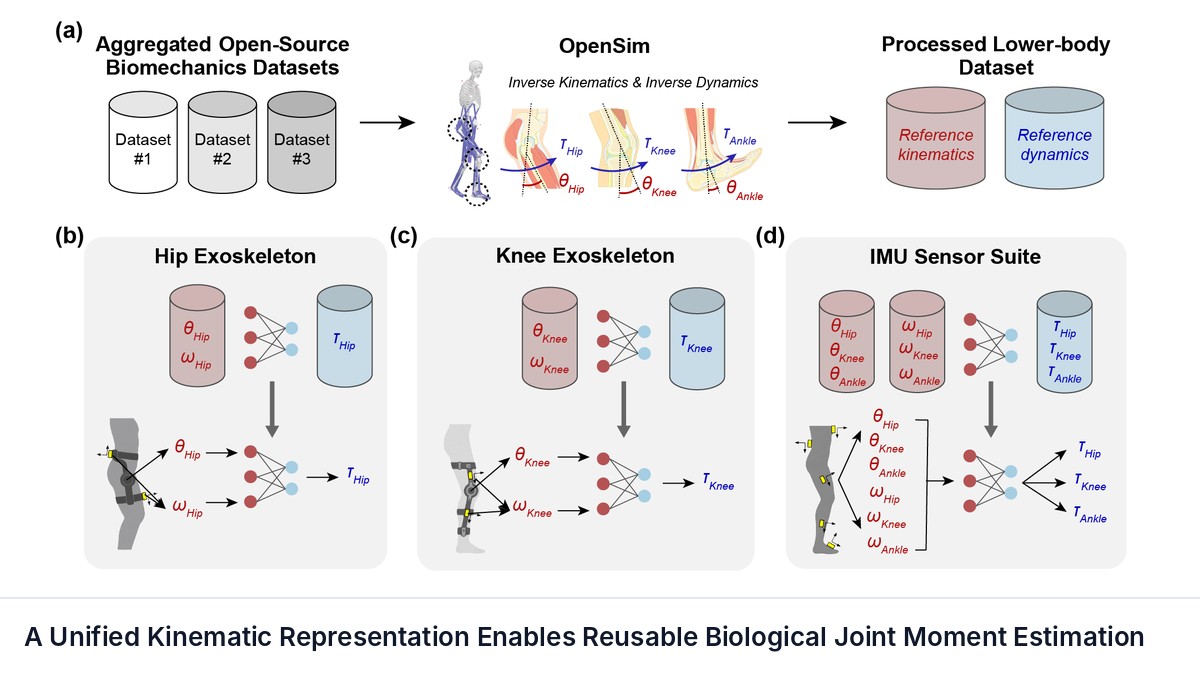
A Unified Kinematic Representation Enables Reusable Biological Joint Moment Estimation
Jinwoo Hwang, Ilseung Park, Changseob Song et al.
Objective: Data-driven models that estimate physiological states, particularly biological joint moments, are widely used in exoskeleton control.