
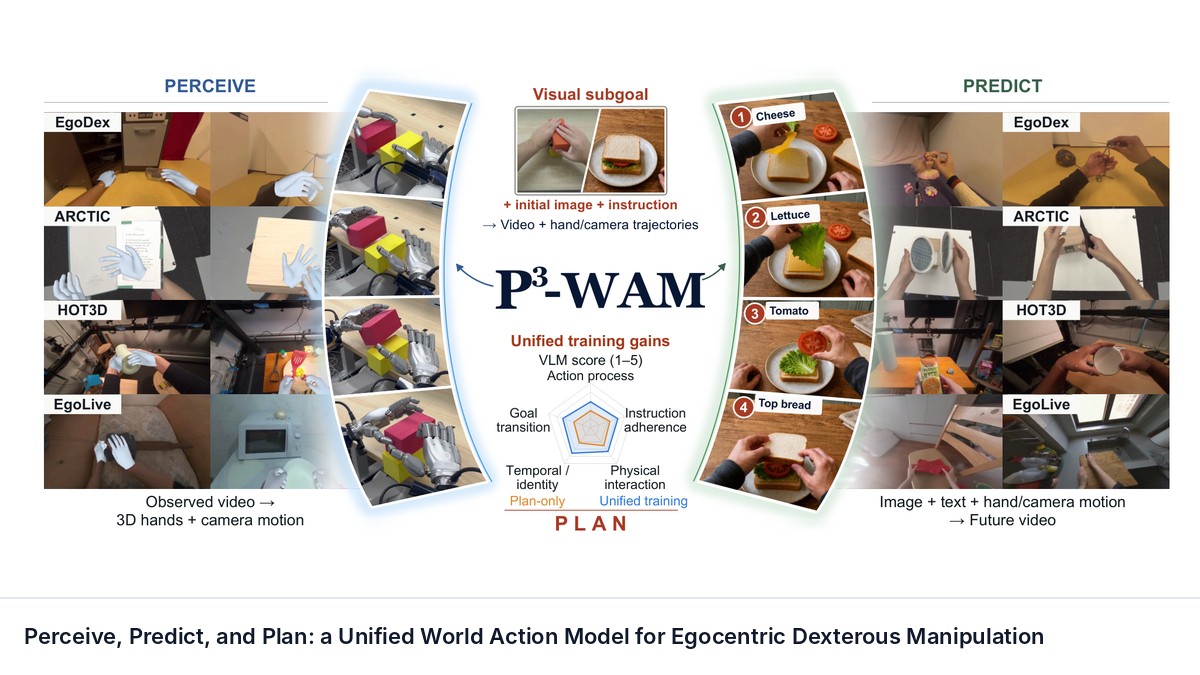
Perceive, Predict, and Plan: a Unified World Action Model for Egocentric Dexterous Manipulation
Zirui Wu, Chen Guo, Tianjian Jiang, Zeren Jiang, Zeming Li, Lingchen Yang, Longteng Duan, Ying Xue, Handi Yin, Shenyuan Gao, Martin R. Oswald, Jun Zhang, Ping Tan, Jie Song · N/A · 2026
Framework
N/A
License
N/A
Stars
N/A
Summary
We introduce P$^{3}$-WAM, a unified world action model for egocentric dexterous manipulation that learns 3D perception, action-conditioned prediction, and goal-directed planning through three complementary modes: Perceive, which reconstructs articulated hand motion and camera trajectories from video; Predict, which generates visual futures under prescribed actions; and Plan, which jointly generates action trajectories and their anticipated visual consequences conditioned on an initial image, a language instruction, and an optional visual goal.
Abstract Summary
Key Points
- We introduce P$^{3}$-WAM, a unified world action model for egocentric dexterous manipulation that learns 3D perception, action-conditioned prediction, and goal-directed planning through three complementary modes: Perceive, which reconstructs articulated hand motion and camera trajectories from video; Predict, which generates visual futures under prescribed actions; and Plan, which jointly generates action trajectories and their anticipated visual consequences conditioned on an initial image, a language instruction, and an optional visual goal.
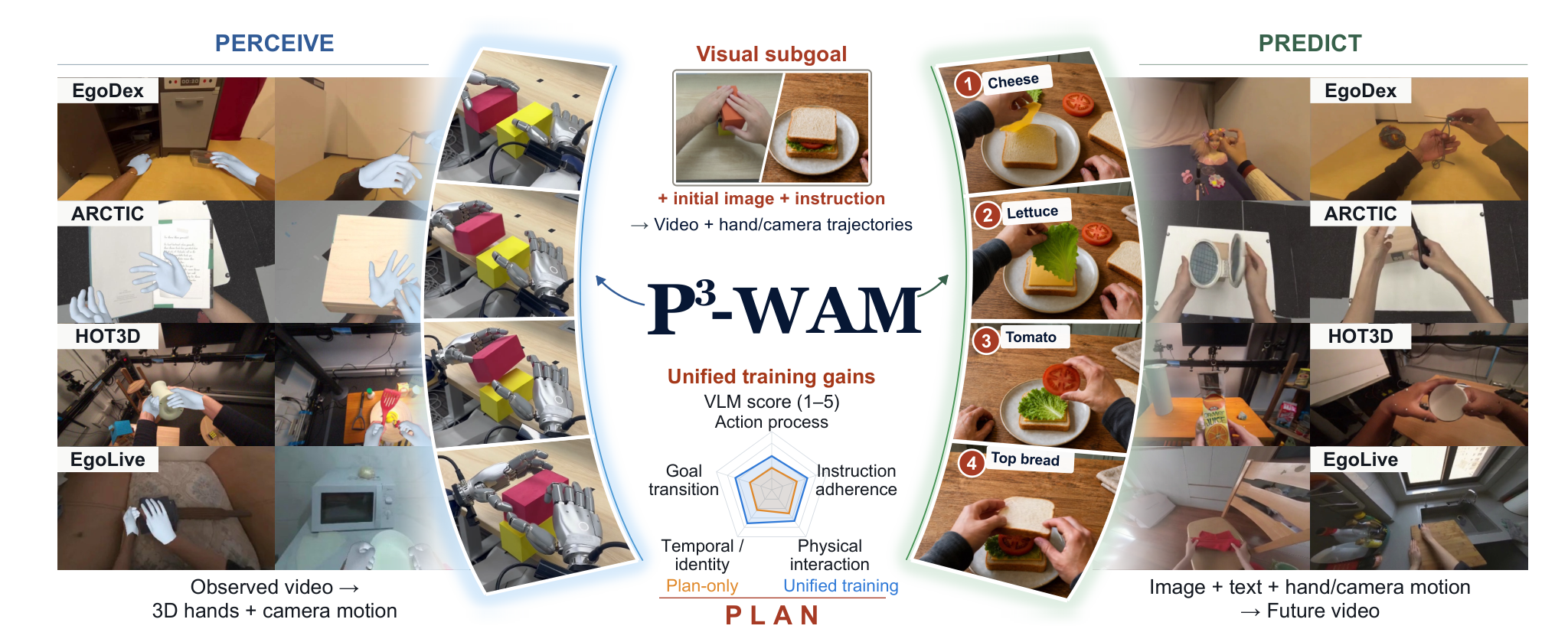
- Our model integrates a compact, structured 3D action representation into a pretrained video diffusion transformer through a mixture-of-transformers architecture with shared base weights, modality-specific adaptation, and bidirectional visual-action attention.
- Randomized modality visibility lets video and 3D actions serve as either conditioning context or prediction targets across the three modes.
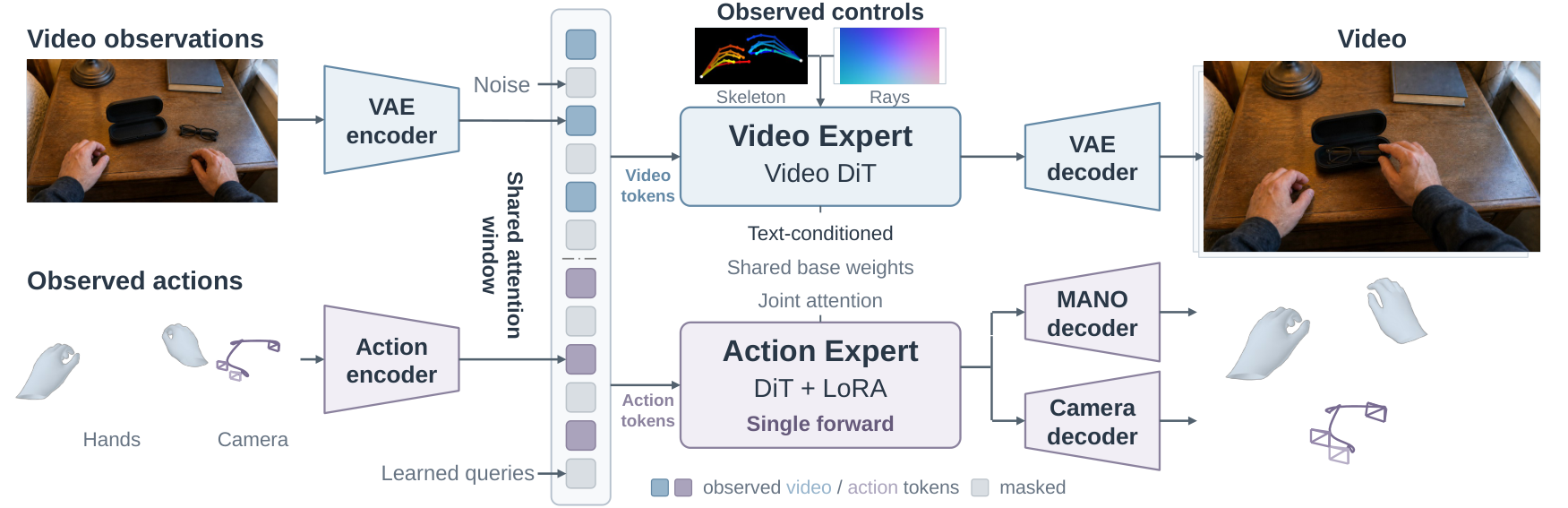
- Experiments show that unified training improves all three capabilities over single-mode training, including gains in planning quality under a vision-language model evaluation.
- Through unified training, our model outperforms specialized baselines on 3D hand reconstruction and action-conditioned video prediction across four datasets, while producing goal-directed manipulation videos with stronger instruction adherence and action progression than video-generation baselines.
Method
We consider an egocentric video $\mathbf{V}=\{\mathbf{I}_{t}\}_{t=1}^{T}$ with aligned hand states $\mathbf{H}=\{\mathbf{h}_{t}\}_{t=1}^{T}$ and camera states $\mathbf{P}=\{\mathbf{P}_{t}\}_{t=1}^{T}$, which encode rotation and translation relative to the first frame. We define the 3D action sequence as $\mathbf{A}=\{\mathbf{a}_{t}\}_{t=1}^{T}=\{\langle\mathbf{h}_{t},\mathbf{P}_{t}\rangle\}_{t=1}^{T}$.
Action tokens $\mathbf{z}_{a}$ encode the aligned hand and camera observations.
Experiments
We first examine whether unified training benefits each mode (Sec. 4.1 ), then compare Perceive , Predict , and Plan with specialized baselines on their respective tasks. We also evaluate whether the planned human actions can be transferred to a real-world dexterous robot (Sec. 4.4 ).
We initialize the single-mode and unified models from Wan2.2-Fun A14B-Control and evaluate them at $5{,}000$ total training steps, with all other training variables held fixed.

AI Use Disclosure
Generative AI assisted with manuscript drafting and editing, figure development, and research-code development and debugging. AI-generated images also serve as planning inputs in the examples identified as generated in the paper. A VLM provides evaluation scores under the protocol in Appendix E ; human ratings are collected separately.
The authors are responsible for reviewing the assisted material and for the accuracy, originality, and attribution of the final submission.
Reproducibility Statement
Section 3 and Appendices A – C describe the architecture, objectives, codec, and training. Appendix D specifies preprocessing, baseline interfaces, and metrics; Appendix E gives the human/VLM rubric and bootstrap procedure. Additional measurements appear in Appendix F . Within each diffusion expert, RGB and action use the same base self-attention Q/K/V and output projections and the same two FFN projections.
The action branch adds low-rank updates to these six projections and to the text cross-attention Q and output projections.
Sources and Demonstrations
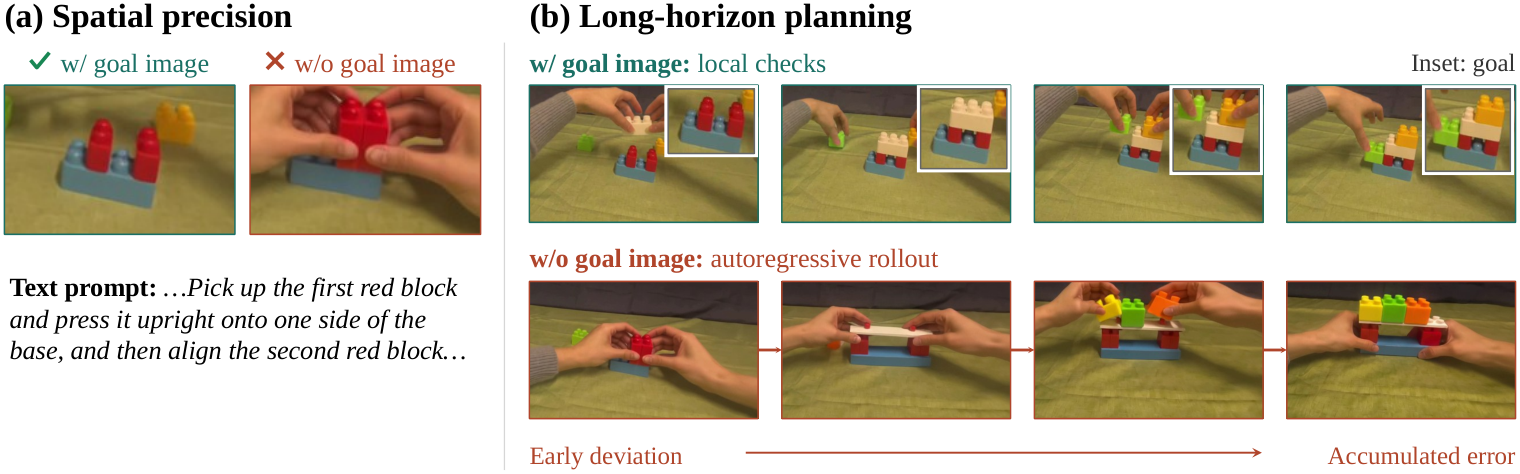
Figures are reproduced from Wu et al. See the full paper for experimental details and the project page, when the paper links one, for demonstrations and videos.
Related Papers
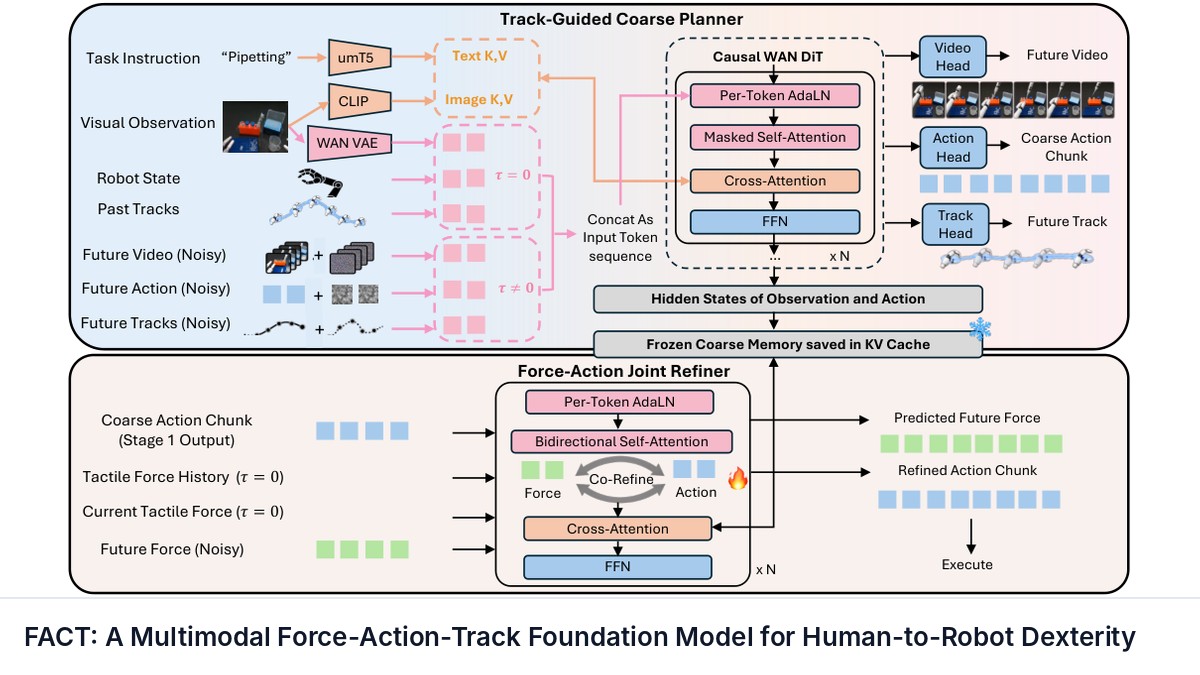
FACT: A Multimodal Force-Action-Track Foundation Model for Human-to-Robot Dexterity
Zhi Cao, Yining Hong, Jiaolong Yang et al.
Human demonstrations offer a scalable alternative to costly robot data collection for dexterous manipulation, but most human datasets lack force measurements.
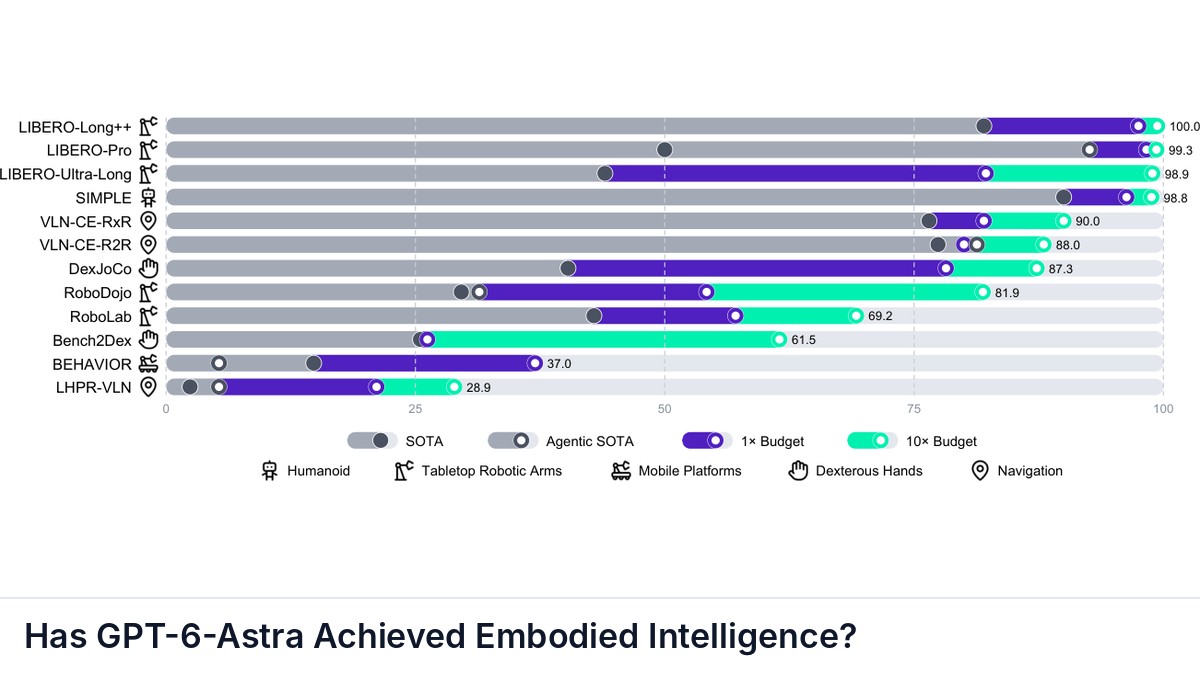
Has GPT-6-Astra Achieved Embodied Intelligence?
SenseNova, Joint Research Team, : et al.
GPT-6-Astra demonstrates a level of competence in robotic manipulation and navigation that challenges the conventional paradigm of building specialized models for individual tasks and embodiments.
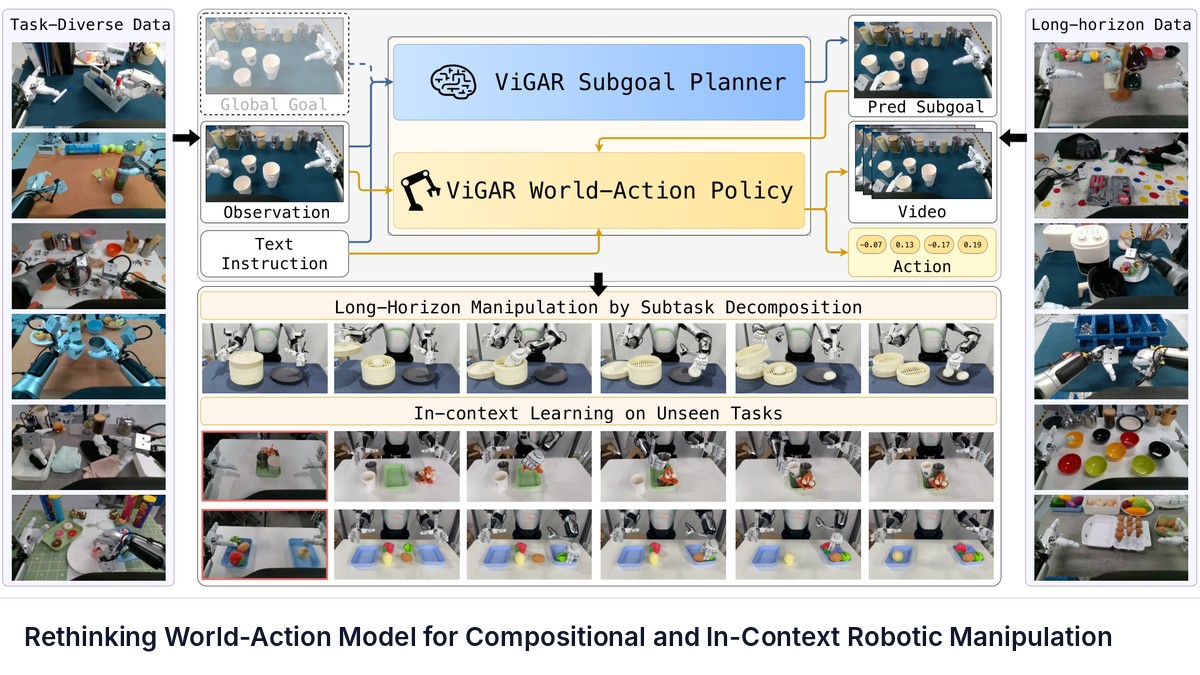
Rethinking World-Action Model for Compositional and In-Context Robotic Manipulation
Shukai Gong, Xuanran Zhai, Yintianrun Zhang et al.
Long-horizon compositional manipulation has become increasingly important for real-world robot deployment, where a single task involves multiple coordinated subtasks.
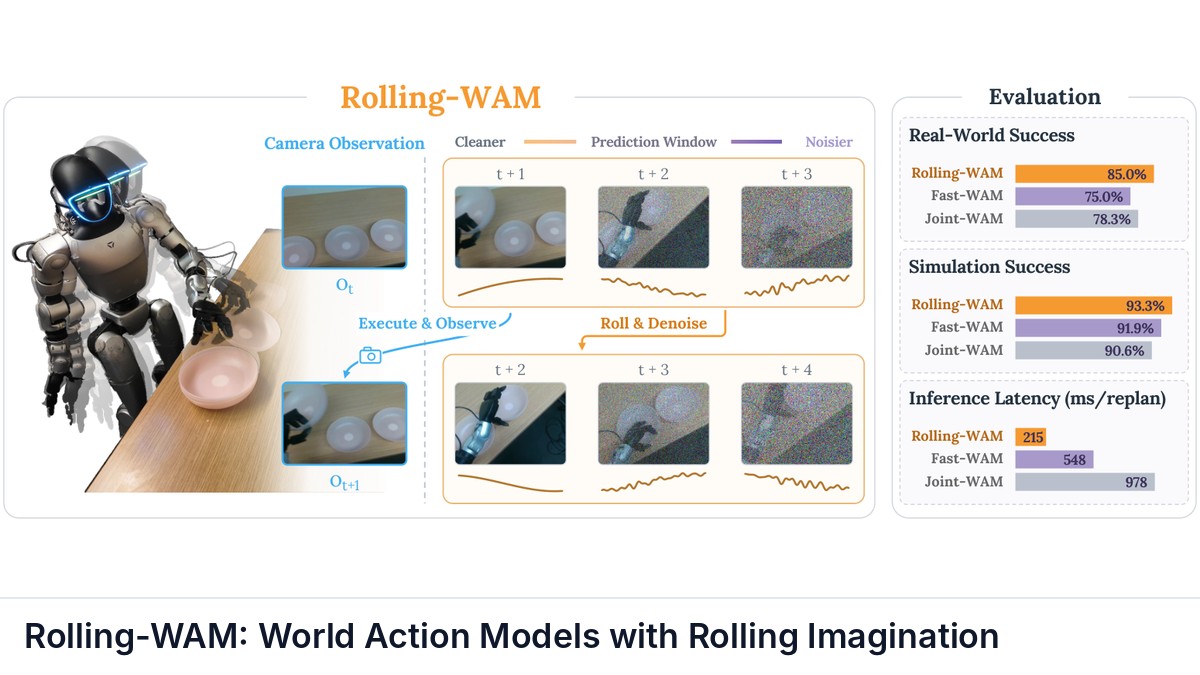
Rolling-WAM: World Action Models with Rolling Imagination
Yinghua Zhou, Junjie Ye, Yiqi Zhao et al.
World Action Models (WAMs) couple action generation with future visual prediction for robotic manipulation. However, completing the joint video-action denoising process at each replanning cycle incurs substantial latency, delaying action updates and limiting closed-loop responsiveness.