
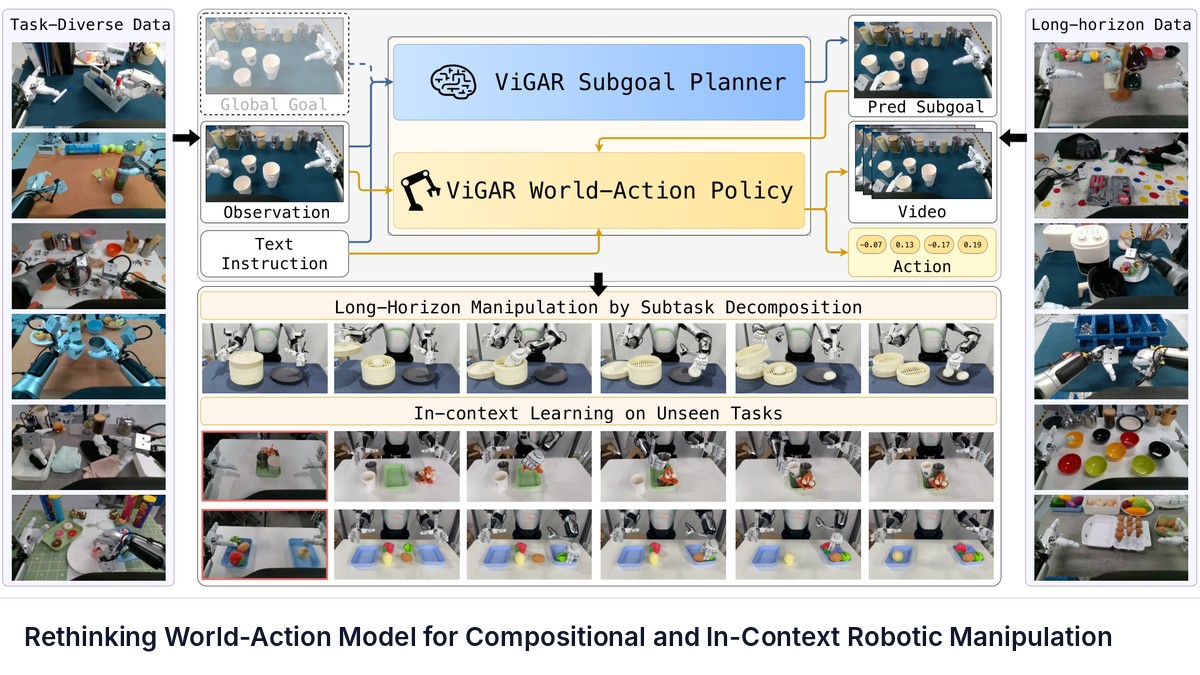
Rethinking World-Action Model for Compositional and In-Context Robotic Manipulation
Shukai Gong, Xuanran Zhai, Yintianrun Zhang, Ruopeng Cui, Ye Huang, Yiyang Fu, Dexuan Lyu, Chaojie Li, Xinyi Song, Peiwen Lin, Chuang Wang, Mingyuan Jia, Yufan Deng, Jiaxin Fang, Bo Liang, Jiaxin Li, Yuxiang Gao, Hao Liu, Daquan Zhou · N/A · 2026
Framework
N/A
License
N/A
Stars
N/A
Summary
Long-horizon compositional manipulation has become increasingly important for real-world robot deployment, where a single task involves multiple coordinated subtasks.
Abstract Summary
Key Points
- Long-horizon compositional manipulation has become increasingly important for real-world robot deployment, where a single task involves multiple coordinated subtasks.
- Existing world-action models (WAMs) jointly predict short-horizon visual futures and actions, but typically lack explicit subtask-level reasoning.
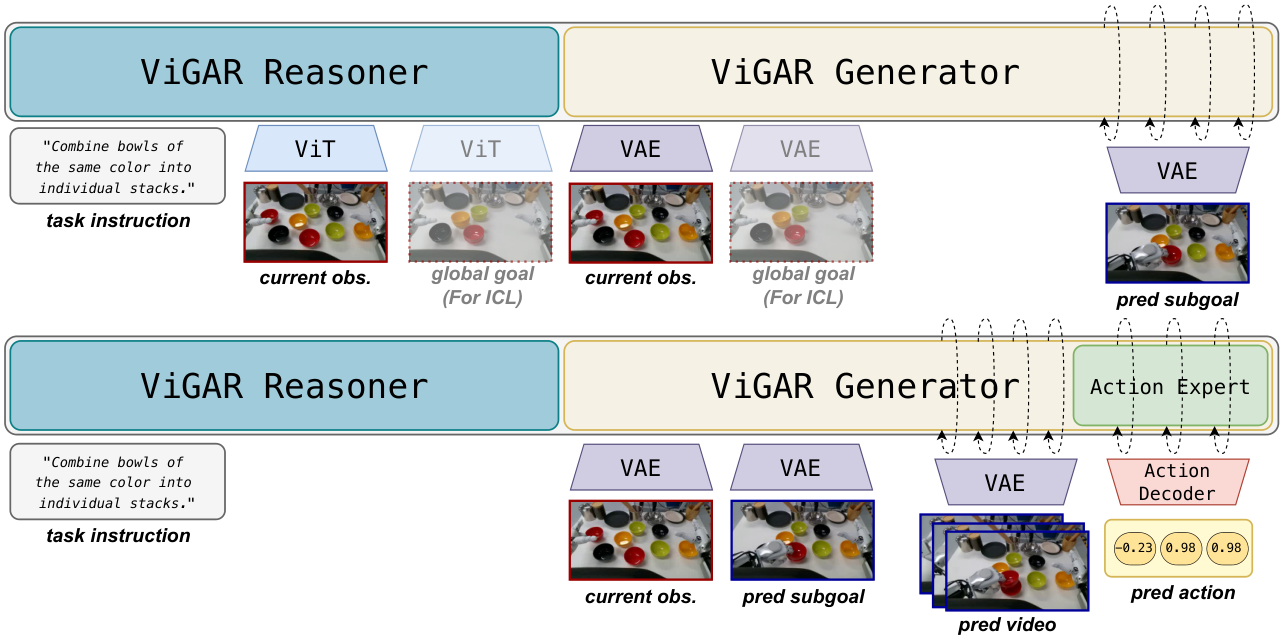
- We propose Visual Goal-conditioned Action Reasoning (ViGAR), a hierarchical framework that factorizes manipulation into a visual subgoal planner and a subgoal executor.
- Given the current observation and global instruction, the subgoal planner predicts a visual subgoal for the next subtask.
- The subgoal executor then jointly generates future visual trajectories and actions conditioned on the predicted subgoal.
Preliminaries
Consider a robot task specified by a language instruction $\ell$.
At inference step $t$, a VLA policy $\pi^{\text{VLA}}_{\theta}$ with parameters $\theta$ predicts an $H_{a}$-step action chunk $\mathbf{A}_{t+1}:=\mathbf{a}_{t+1:t+H_{a}}\in\mathbb{R}^{H_{a}\times d_{a}}$ conditioned on the current multi-view observation $\mathbf{o}_{t}=\{\mathbf{o}_{t}^{v}\}_{v=1}^{V}$, proprioceptive state $\mathbf{s}_{t}\in\mathbb{R}^{d_{s}}$, and textual metadata $\mu$ specifying the embodiment, camera resolution, and control mode: where $H_{a}$ denotes the a...
Method
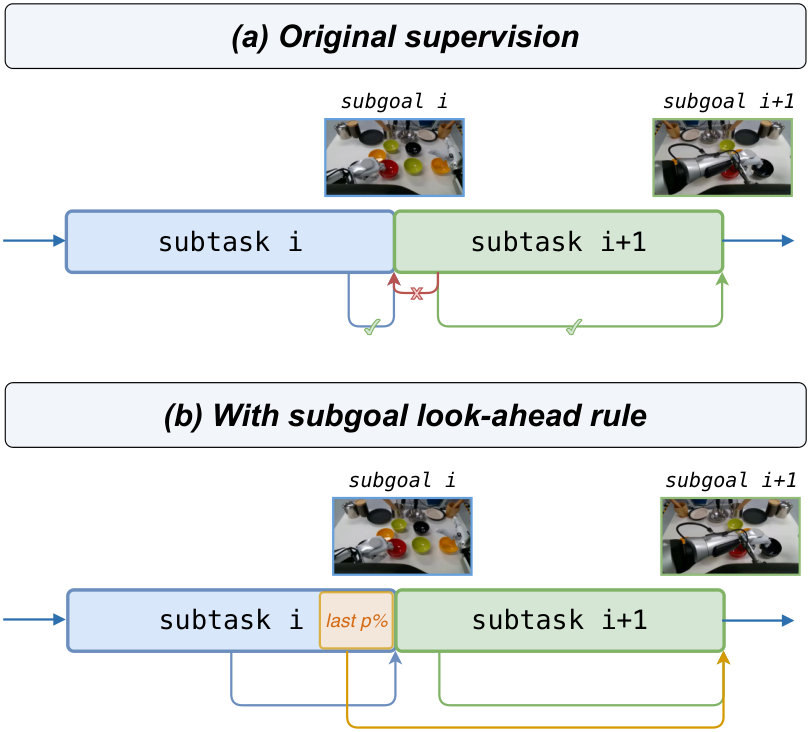
In this section, we describe the two essential parts of ViGAR: a subgoal planner and a subgoal-guided world-action model. We divide each compositional manipulation task into multiple subtasks, where each subtask contains an atom action and a subgoal $(\ell_{i},\mathbf{g}_{i})$. Our subgoal planner generates a subgoal for each subtask, as illustrated in Section 4.1 .
Then, our world-action policy predicts the action chunk from the current observation, proprioceptive state and generated subgoal, as detailed in Section 4.2 .
Experiments
Implementation. The subgoal planner $\mathcal{G}_{\theta}$ and subgoal-guided world-action model $\pi^{\text{WAM}}_{\phi}$ of ViGAR are initialized from the pretrained Cosmos3-Nano checkpoint [ 1 ] , a 16B-A8B-parameter omnimodal world model that adopts a dual-branch mixture-of-transformers architecture.
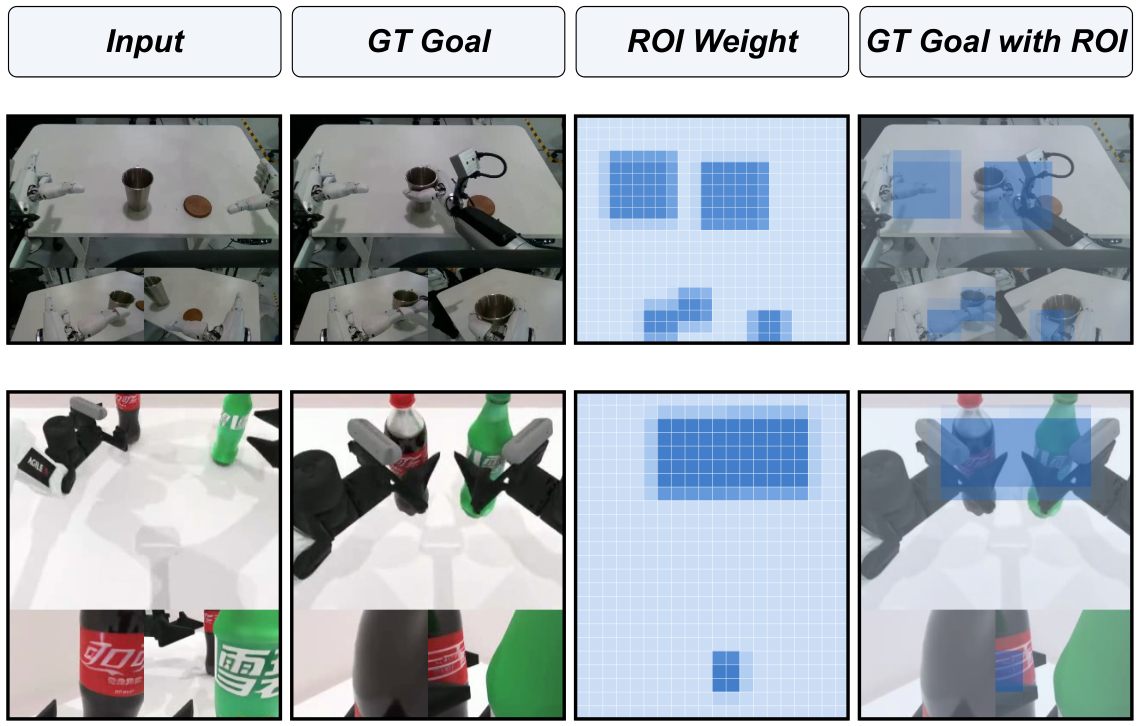
The subgoal planner $\mathcal{G}_{\theta}$ is adapted from the pretrained backbone by transforming its image-to-video generation capability into image editing.
Sources and Demonstrations
Figures are reproduced from Gong et al. See the full paper for experimental details and the project page, when the paper links one, for demonstrations and videos.
Related Papers
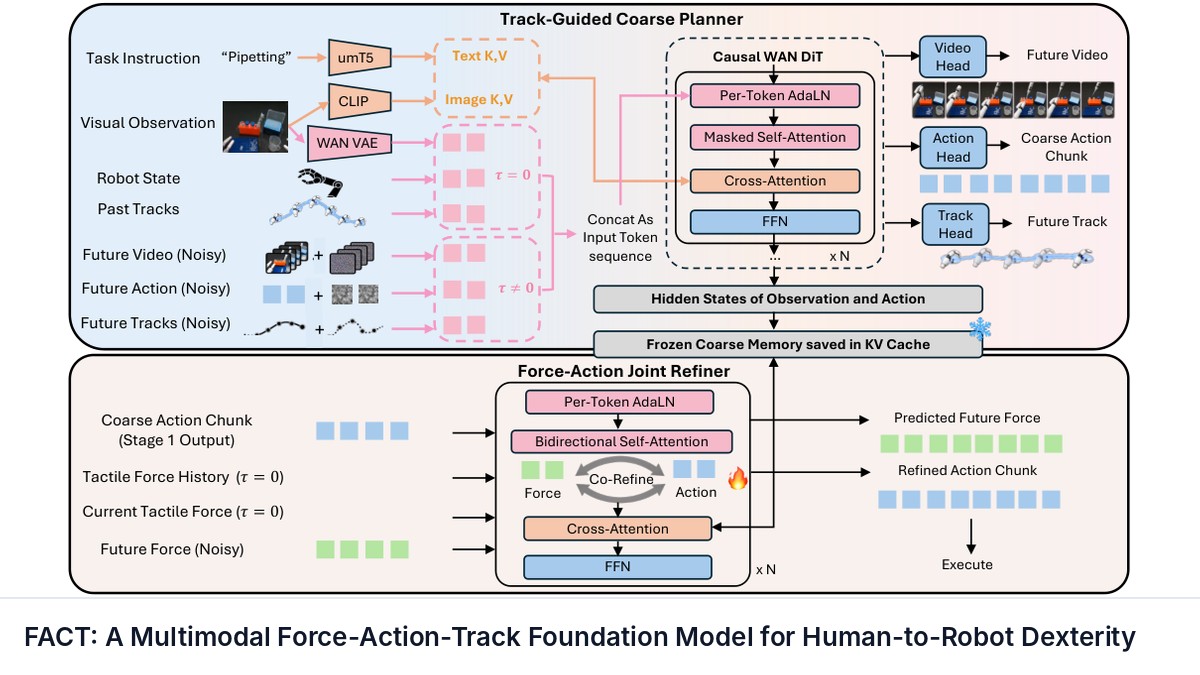
FACT: A Multimodal Force-Action-Track Foundation Model for Human-to-Robot Dexterity
Zhi Cao, Yining Hong, Jiaolong Yang et al.
Human demonstrations offer a scalable alternative to costly robot data collection for dexterous manipulation, but most human datasets lack force measurements.
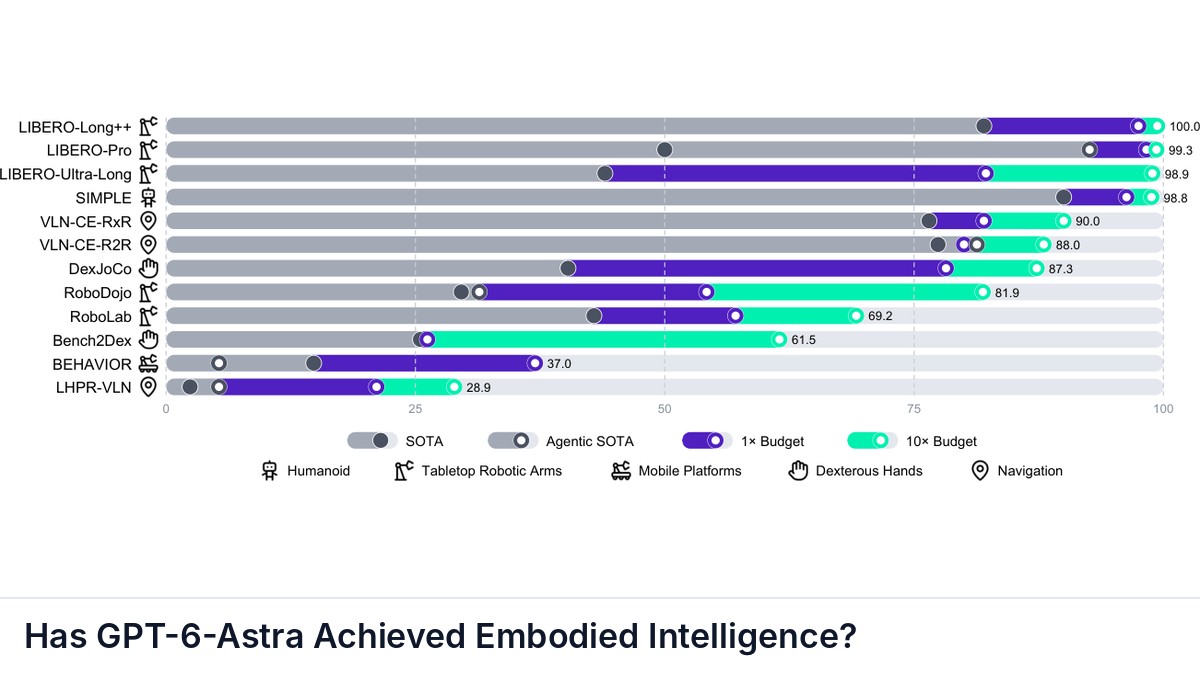
Has GPT-6-Astra Achieved Embodied Intelligence?
SenseNova, Joint Research Team, : et al.
GPT-6-Astra demonstrates a level of competence in robotic manipulation and navigation that challenges the conventional paradigm of building specialized models for individual tasks and embodiments.
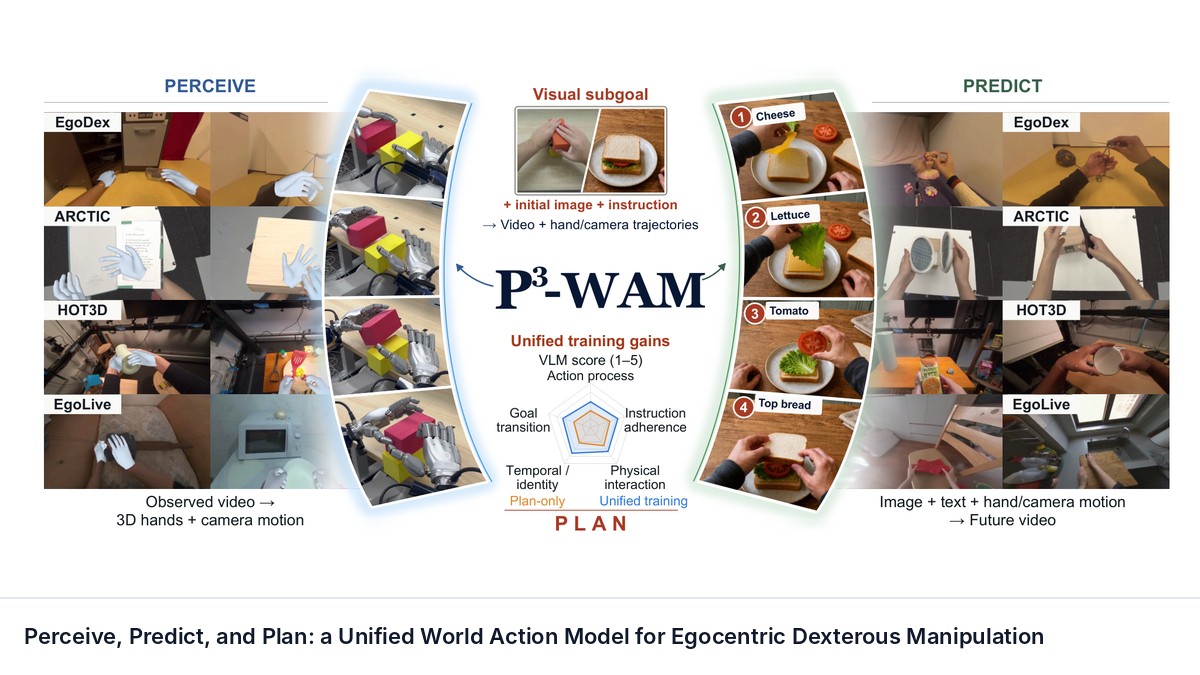
Perceive, Predict, and Plan: a Unified World Action Model for Egocentric Dexterous Manipulation
Zirui Wu, Chen Guo, Tianjian Jiang et al.
We introduce P$^{3}$-WAM, a unified world action model for egocentric dexterous manipulation that learns 3D perception, action-conditioned prediction, and goal-directed planning through three complementary modes: Perceive, which reconstructs articulated hand motion and camera trajectories from video; Predict, which generates visual futures under prescribed actions; and Plan, which jointly generates action trajectories and their anticipated visual consequences conditioned on an initial image, a language instruction, and an optional visual goal.
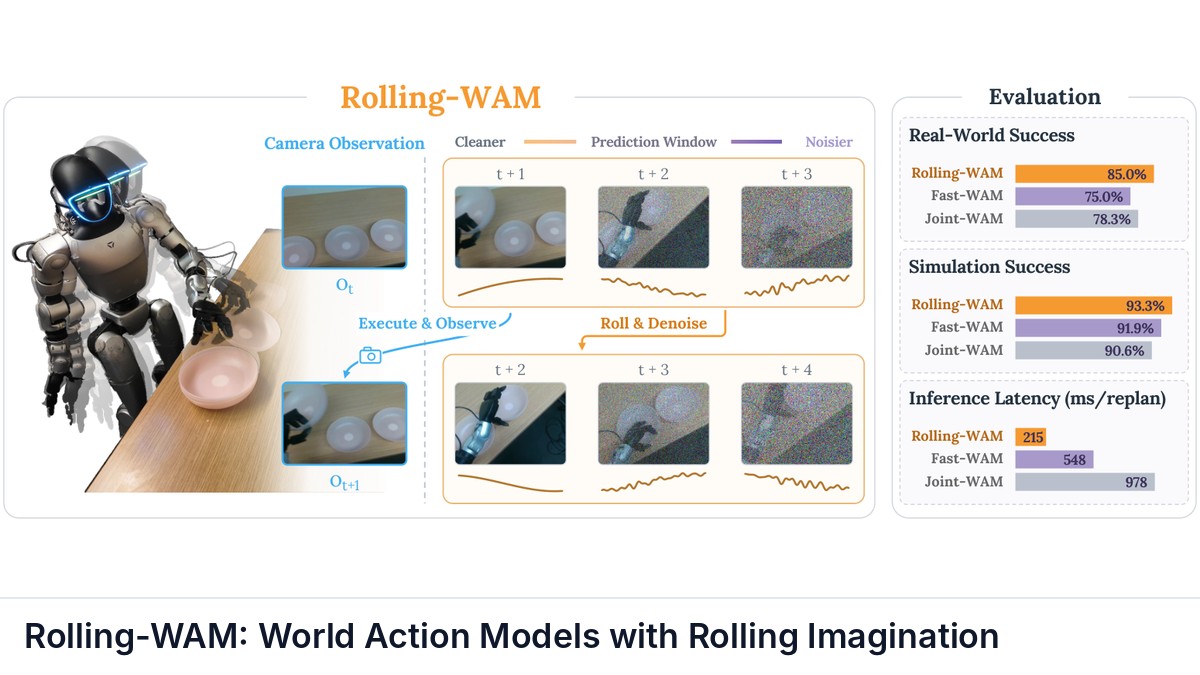
Rolling-WAM: World Action Models with Rolling Imagination
Yinghua Zhou, Junjie Ye, Yiqi Zhao et al.
World Action Models (WAMs) couple action generation with future visual prediction for robotic manipulation. However, completing the joint video-action denoising process at each replanning cycle incurs substantial latency, delaying action updates and limiting closed-loop responsiveness.