
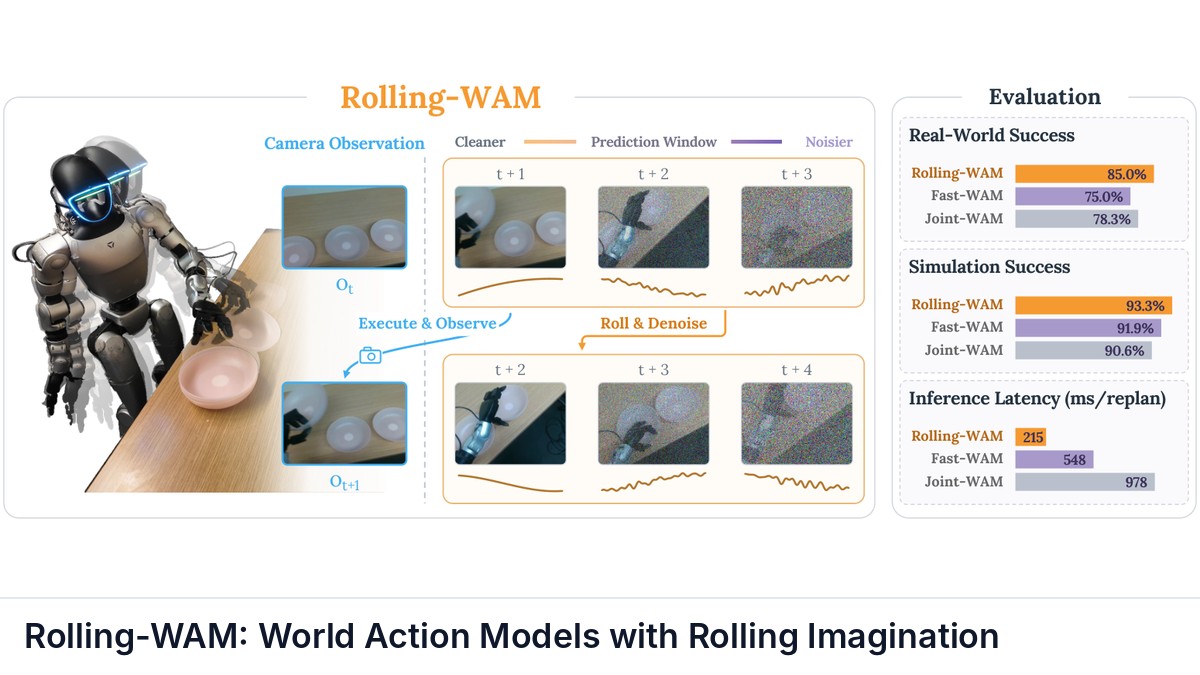
Rolling-WAM: World Action Models with Rolling Imagination
Yinghua Zhou, Junjie Ye, Yiqi Zhao, Hao Dong, Celina Shiyu Wang, Ruohai Ge, Tingyi Yang, Basile Van Hoorick, Gaurav Sukhatme, Vitor Guizilini, Yue Wang · N/A · 2026
Framework
N/A
License
N/A
Stars
N/A
Summary
World Action Models (WAMs) couple action generation with future visual prediction for robotic manipulation. However, completing the joint video-action denoising process at each replanning cycle incurs substantial latency, delaying action updates and limiting closed-loop responsiveness.
Abstract Summary
Key Points
- World Action Models (WAMs) couple action generation with future visual prediction for robotic manipulation.
- However, completing the joint video-action denoising process at each replanning cycle incurs substantial latency, delaying action updates and limiting closed-loop responsiveness.
- We present Rolling-WAM, a formulation that distributes joint denoising across successive replanning cycles.
- Our method maintains a sliding window of video-action chunks at staggered noise levels
- At each step, a rolling noise schedule fully denoises the imminent action chunk for execution, while partially refining farther-future chunks.
Method
This section presents Rolling-WAM, a joint video-action model for low-latency closed-loop robotic control. We first formulate the visual-action modeling problem and identify the computational bottleneck of standard joint denoising (Sec. III-A ). We then introduce a rolling denoising mechanism that maintains a sliding window of predictions at staggered noise levels (Sec. III-B ).
Next, we describe the sampling and execution process that distributes computation across control cycles (Sec. III-C ).
Experiments
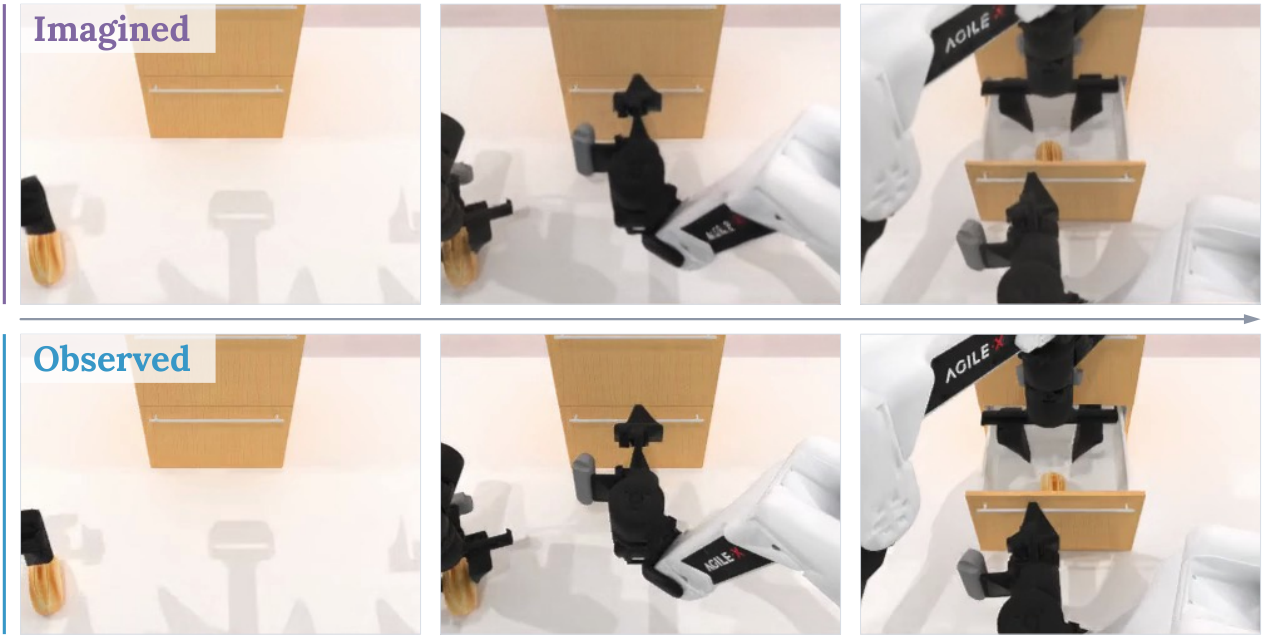
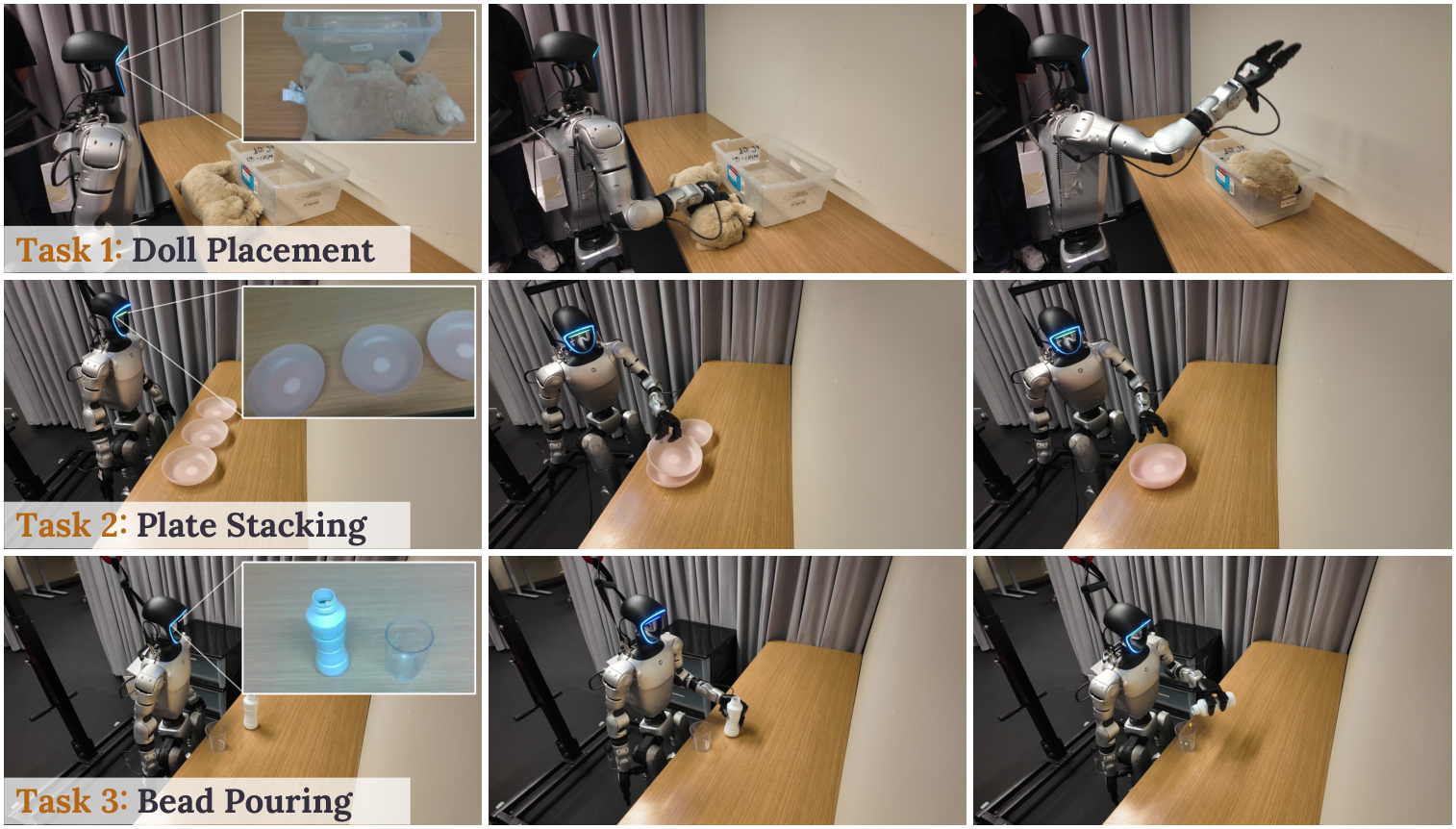
Our experiments verify whether rolling denoising can accelerate joint video-action prediction while preserving manipulation performance. We compare task success with a broad set of vision-language-action models and world action models on LIBERO, RoboTwin 2.0, and real-world Unitree G1 tasks. Controlled latency measurements quantify the computational savings of rolling denoising.
Ablations examine the roles of window size, training noise schedules, and cross-chunk action attention. We evaluate Rolling-WAM on the following settings.
Sources and Demonstrations
Figures are reproduced from Zhou et al. See the full paper for experimental details and the project page, when the paper links one, for demonstrations and videos.
Related Papers
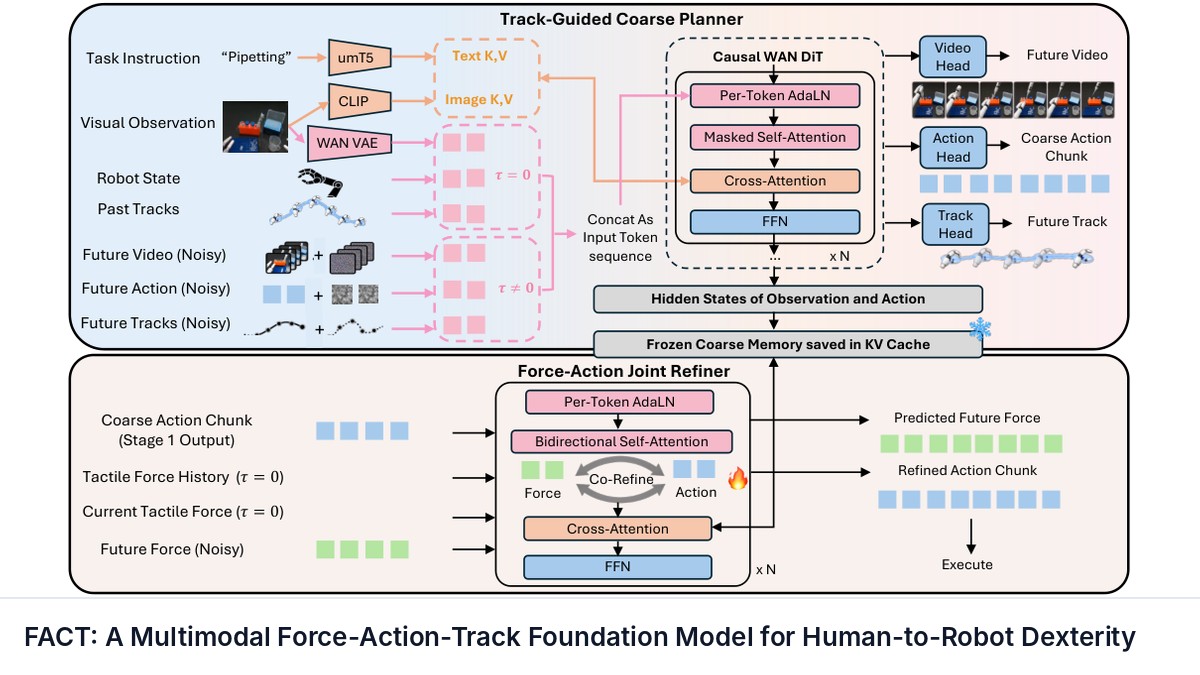
FACT: A Multimodal Force-Action-Track Foundation Model for Human-to-Robot Dexterity
Zhi Cao, Yining Hong, Jiaolong Yang et al.
Human demonstrations offer a scalable alternative to costly robot data collection for dexterous manipulation, but most human datasets lack force measurements.
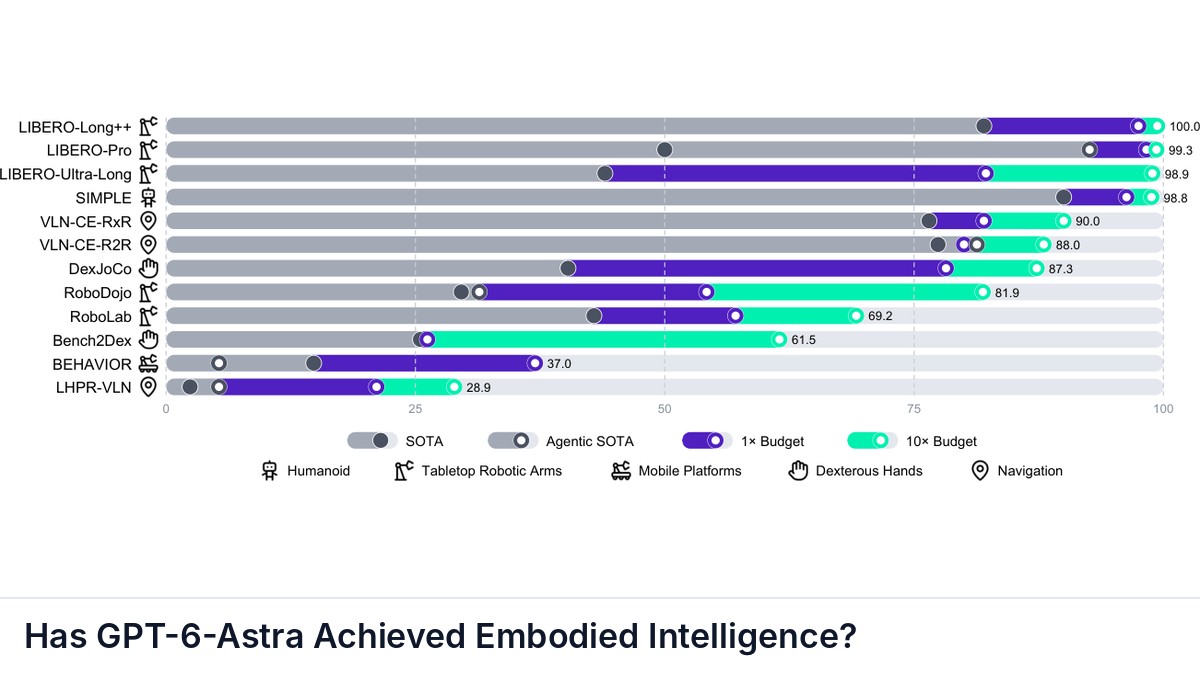
Has GPT-6-Astra Achieved Embodied Intelligence?
SenseNova, Joint Research Team, : et al.
GPT-6-Astra demonstrates a level of competence in robotic manipulation and navigation that challenges the conventional paradigm of building specialized models for individual tasks and embodiments.
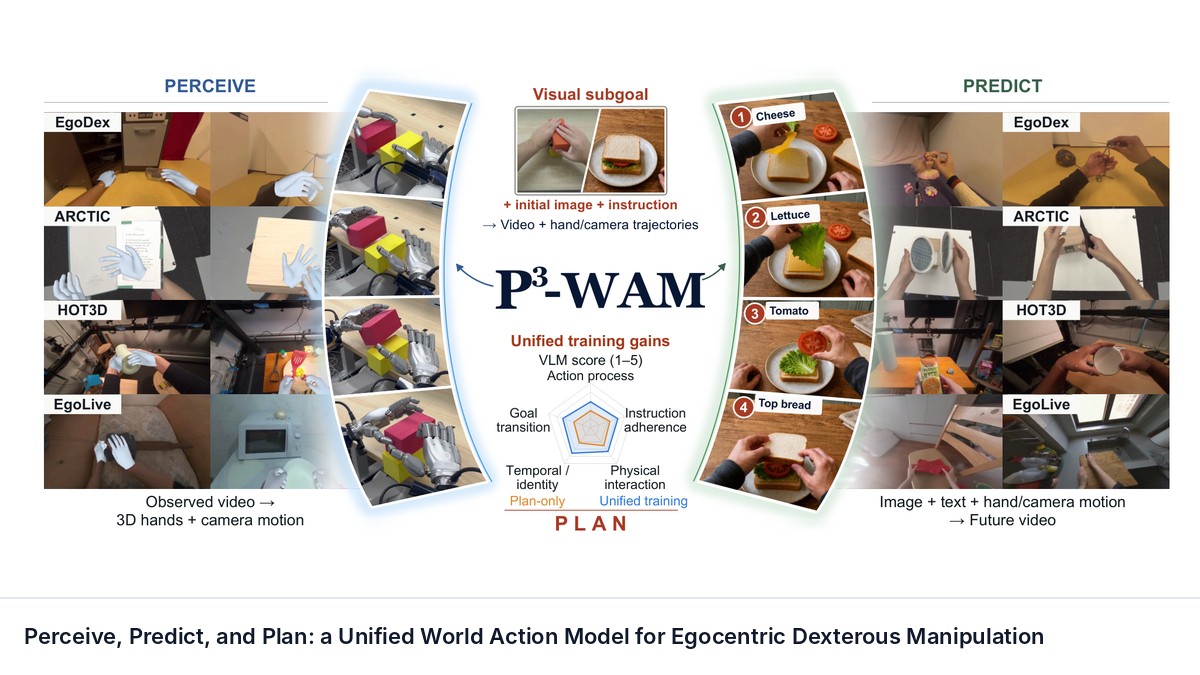
Perceive, Predict, and Plan: a Unified World Action Model for Egocentric Dexterous Manipulation
Zirui Wu, Chen Guo, Tianjian Jiang et al.
We introduce P$^{3}$-WAM, a unified world action model for egocentric dexterous manipulation that learns 3D perception, action-conditioned prediction, and goal-directed planning through three complementary modes: Perceive, which reconstructs articulated hand motion and camera trajectories from video; Predict, which generates visual futures under prescribed actions; and Plan, which jointly generates action trajectories and their anticipated visual consequences conditioned on an initial image, a language instruction, and an optional visual goal.
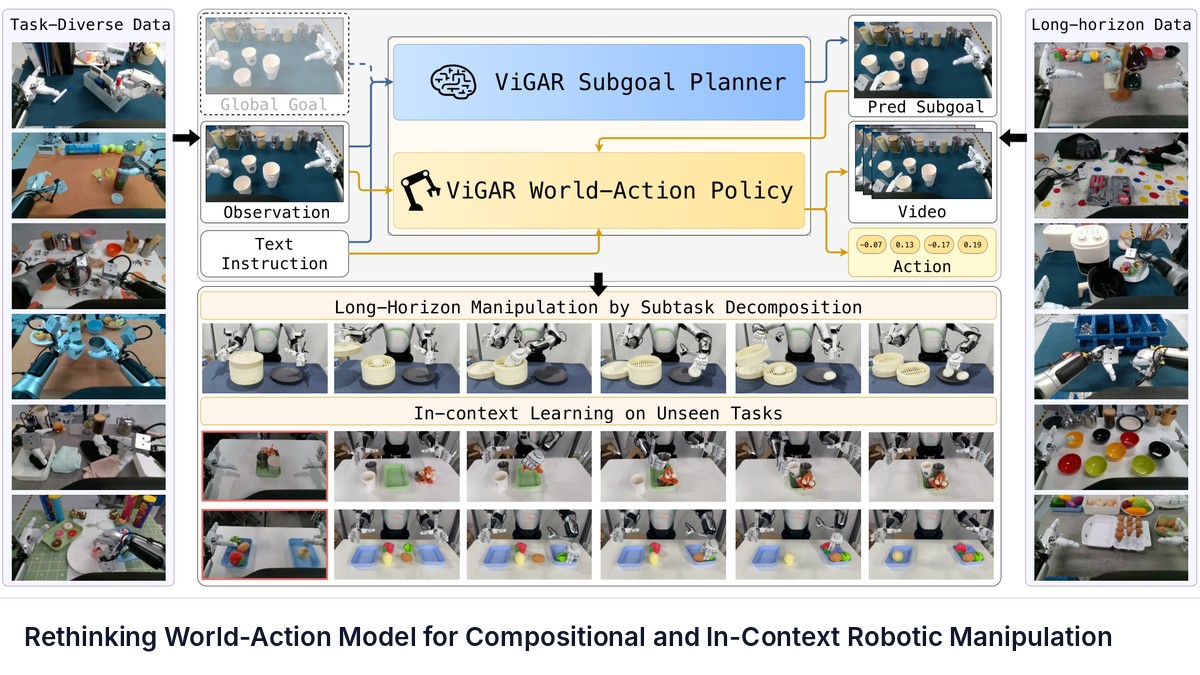
Rethinking World-Action Model for Compositional and In-Context Robotic Manipulation
Shukai Gong, Xuanran Zhai, Yintianrun Zhang et al.
Long-horizon compositional manipulation has become increasingly important for real-world robot deployment, where a single task involves multiple coordinated subtasks.