
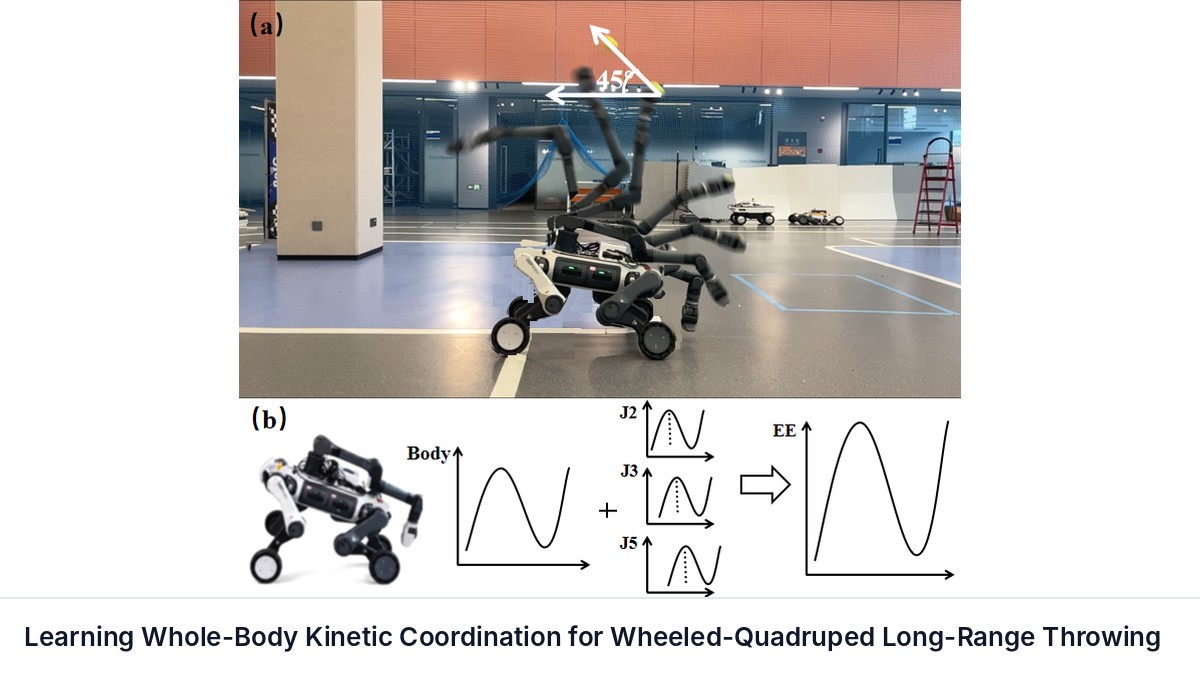
Learning Whole-Body Kinetic Coordination for Wheeled-Quadruped Long-Range Throwing
Qinglian Wu, Yidian Hu, Weiqi Fan, Yutian Zhang, Siyuan Ma, Jiaqi Zhai, Wei Dong, Li Xu · N/A · 2026
Framework
N/A
License
N/A
Stars
N/A
Summary
Long-range throwing on unstructured terrain is a key capability for mobile robots in delivery and retrieval tasks, but it requires high release velocity, coordinated whole-body motion, and robustness to terrain-induced disturbances.
Abstract Summary
Key Points
- Long-range throwing on unstructured terrain is a key capability for mobile robots in delivery and retrieval tasks, but it requires high release velocity, coordinated whole-body motion, and robustness to terrain-induced disturbances.
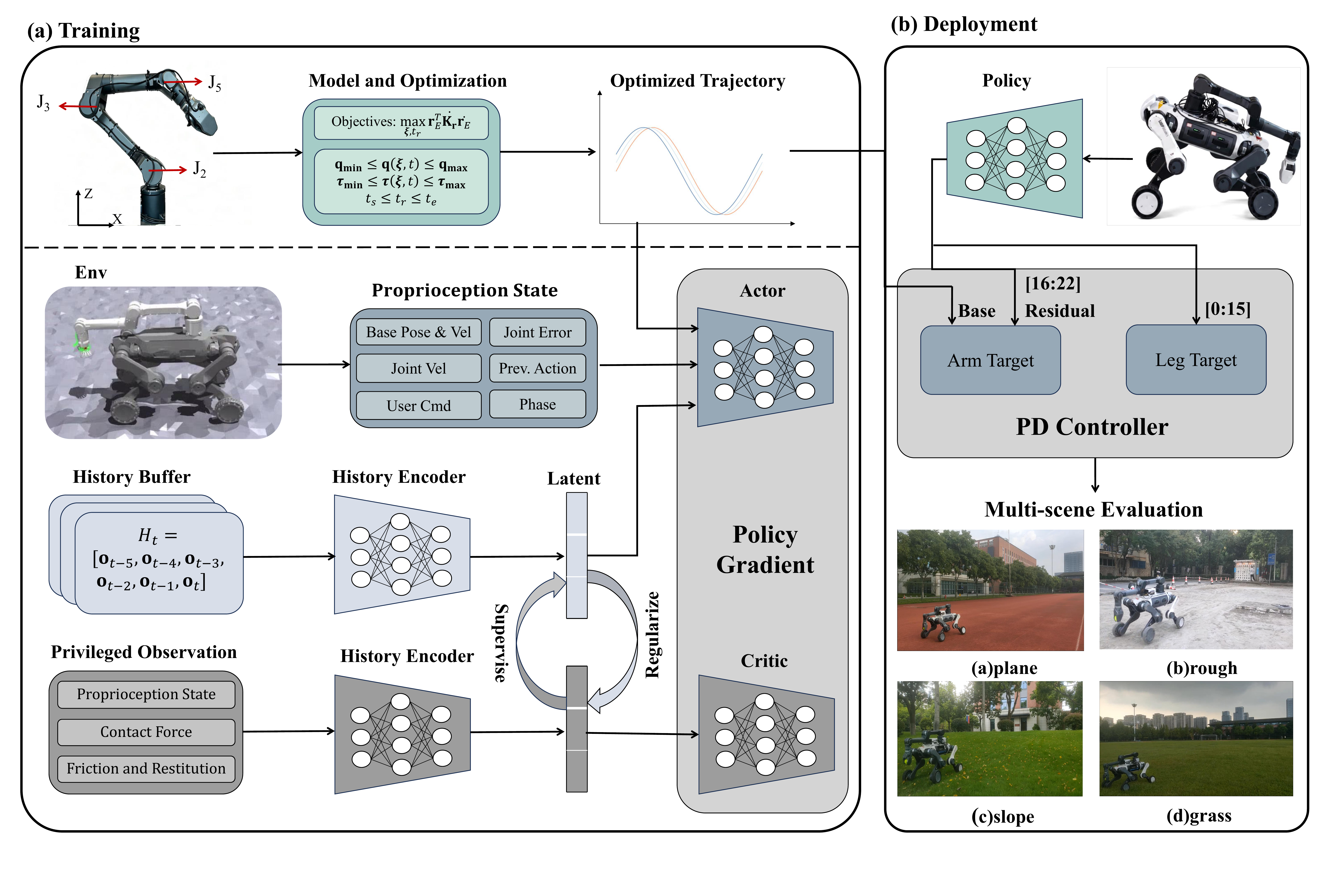
- We present a whole-body kinetic-coordination framework for a wheeled-quadruped manipulator that combines kinetic-chain arm modeling with SQP-based trajectory optimization and a reference-guided reinforcement learning policy for coordinated base motion.
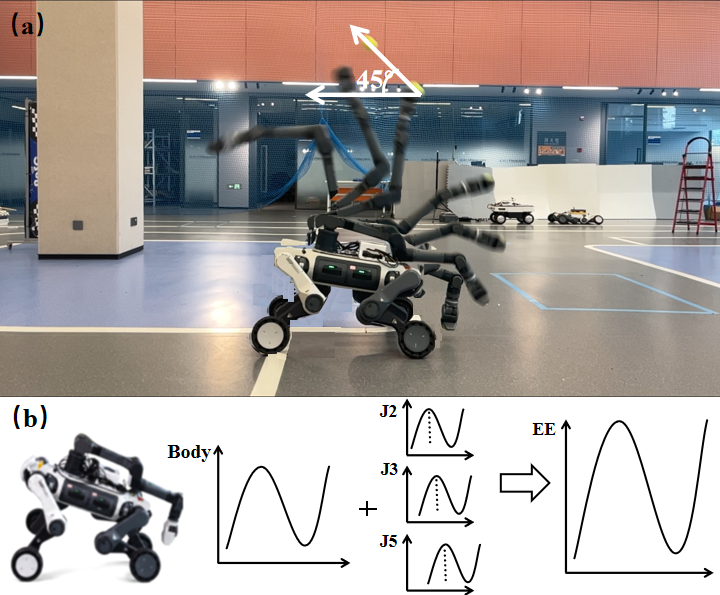
- The manipulator is first reduced to a kinetic-chain model and optimized under kinematic and dynamic constraints to produce a high-speed throwing reference.
- On a stationary base, the optimized arm trajectory reaches a release speed of 12.75 m/s and a throwing distance of 16.68 m.
- When whole-body coordination is enabled, the system further increases the release speed to 16.64 m/s and the throwing distance to 28.25 m.
Method
As shown in Fig. 2 , the proposed framework addresses terrain-robust dynamic throwing in two stages: kinetic-chain arm optimization and whole-body RL control. We first model the inertial coupling among the active throwing joints and parameterize the motion with sinusoidal basis functions.
The trajectory parameters and release time are then optimized by SQP to maximize the weighted end-effector release velocity under physical constraints.
Experiments and Results
We evaluate the proposed framework from three aspects. First, we analyze the SQP-optimized throwing reference and the resulting proximal-to-distal kinetic energy transfer. Second, we conduct simulation experiments and ablation studies to validate the effectiveness of the kinetic-chain reference and whole-body coordination.
Third, we perform hardware experiments on different terrains to evaluate the robustness of the learned policy. Fig.
Sources and Demonstrations
Figures are reproduced from Wu et al. See the full paper for experimental details and the project page, when the paper links one, for demonstrations and videos.
Related Papers
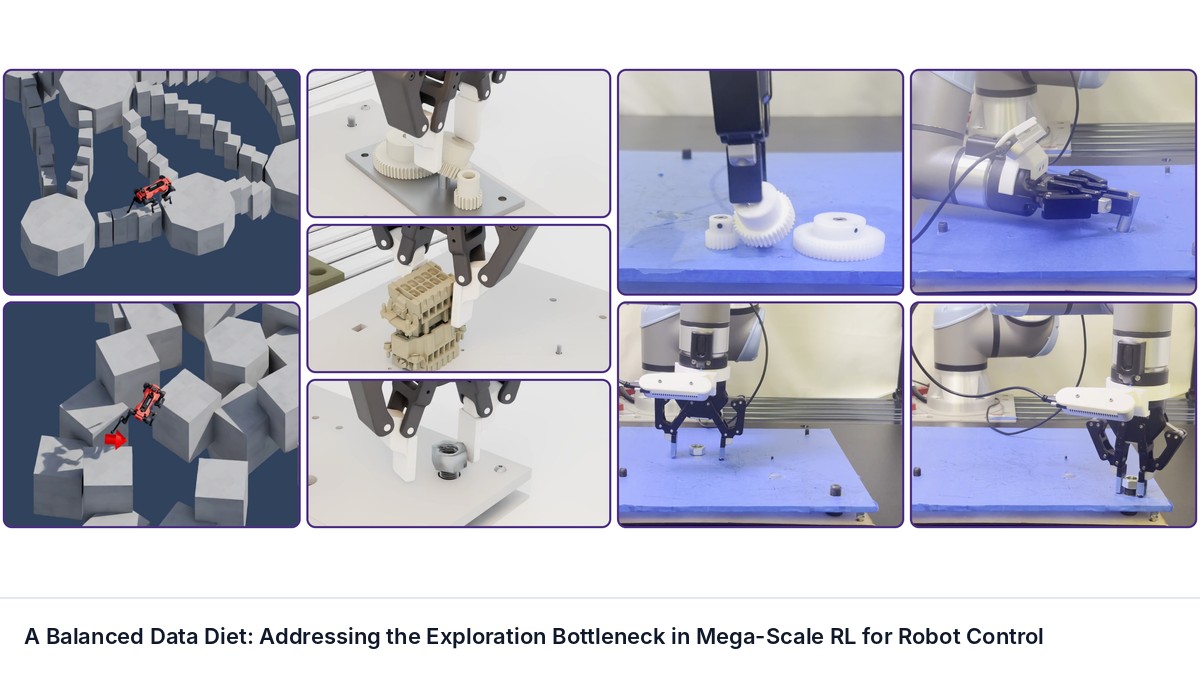
A Balanced Data Diet: Addressing the Exploration Bottleneck in Mega-Scale RL for Robot Control
Octi Zhang, Mateo Guaman Castro, Patrick Yin et al.
General-purpose robots must perform a wide range of tasks from agile locomotion to dexterous manipulation.
A Heterogeneous Architecture for Robot RL Beyond GPU-Dominant Paradigms
Yufei Jia, Zhanxiang Cao, Mingrui Yu et al.
Simulation-based RL for contemporary robot control is increasingly organized around GPU-resident simulation: physics, rollout collection, and learning are placed on a single GPU-centric execution path
A Mode-Unified, Continuous, and Biomimetic Control Strategy of a Robotic Lower Limb Prosthesis
Hanjun Kim, Sixu Zhou, John Shim et al.
Existing biomimetic lower-limb prosthesis controllers are commonly designed for discrete locomotion modes, requiring separate parameterizations for level walking, ramps, and stairs.
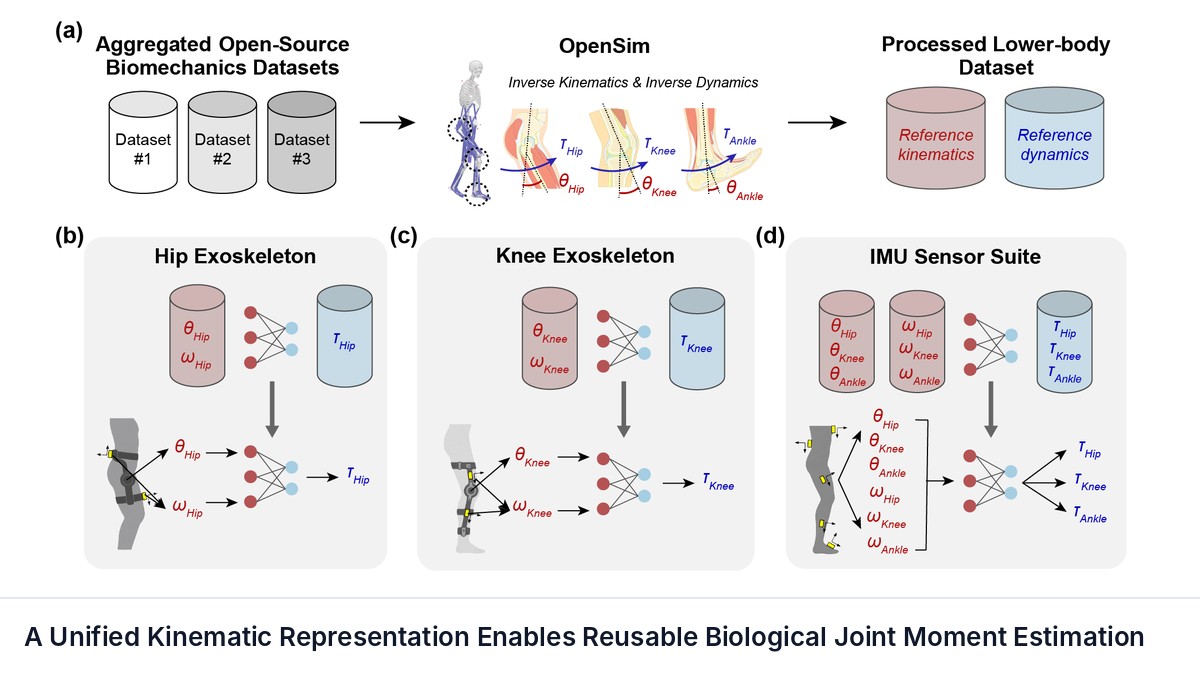
A Unified Kinematic Representation Enables Reusable Biological Joint Moment Estimation
Jinwoo Hwang, Ilseung Park, Changseob Song et al.
Objective: Data-driven models that estimate physiological states, particularly biological joint moments, are widely used in exoskeleton control.