
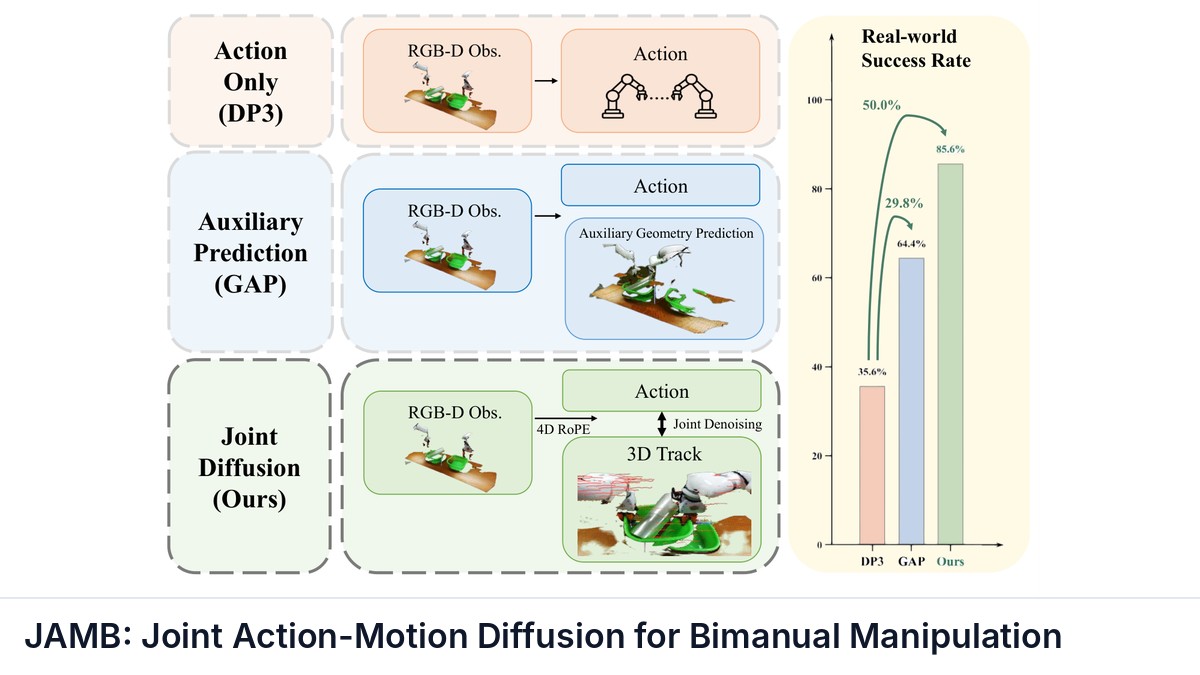
JAMB: Joint Action-Motion Diffusion for Bimanual Manipulation
Chuyang Xiao, Peilin Meng, David Held · N/A · 2026
Framework
N/A
License
N/A
Stars
N/A
Summary
Coordinated bimanual manipulation is challenging because the motion of either arm can alter the shared 3D scene and thereby affect the other arm.
Abstract Summary
Key Points
- Coordinated bimanual manipulation is challenging because the motion of either arm can alter the shared 3D scene and thereby affect the other arm.
- Yet most diffusion policies generate actions without explicitly modeling these future geometric consequences, while predictive variants typically use future state only as auxiliary supervision or fixed conditioning.
- We address this limitation by proposing JAMB, a diffusion policy that jointly denoises bimanual actions and future 3D point tracks.
- By allowing action and track hypotheses to evolve together within a shared Transformer, each can inform and refine the other throughout denoising.
- We further ground multimodal representations in a shared spatiotemporal coordinate system to facilitate geometry-aware interaction during joint denoising.
PROBLEM FORMULATION
We assume a dataset of expert trajectories where $o_{t}$ denotes the visual observation, $s_{t}$ denotes the robot proprioceptive state, and $a_{t}\in\mathbb{R}^{D_{a}}$ denotes the bimanual robot action. At time step $t$, the policy predicts an action chunk To represent future scene motion, we associate the visual observation with a grid of $N$ patch-aligned 3D query points.
Let $q_{i,0}\in\mathbb{R}^{3}$ denote the current position of query $i$, and let $q_{i,h}$ denote its position at future step $h$.
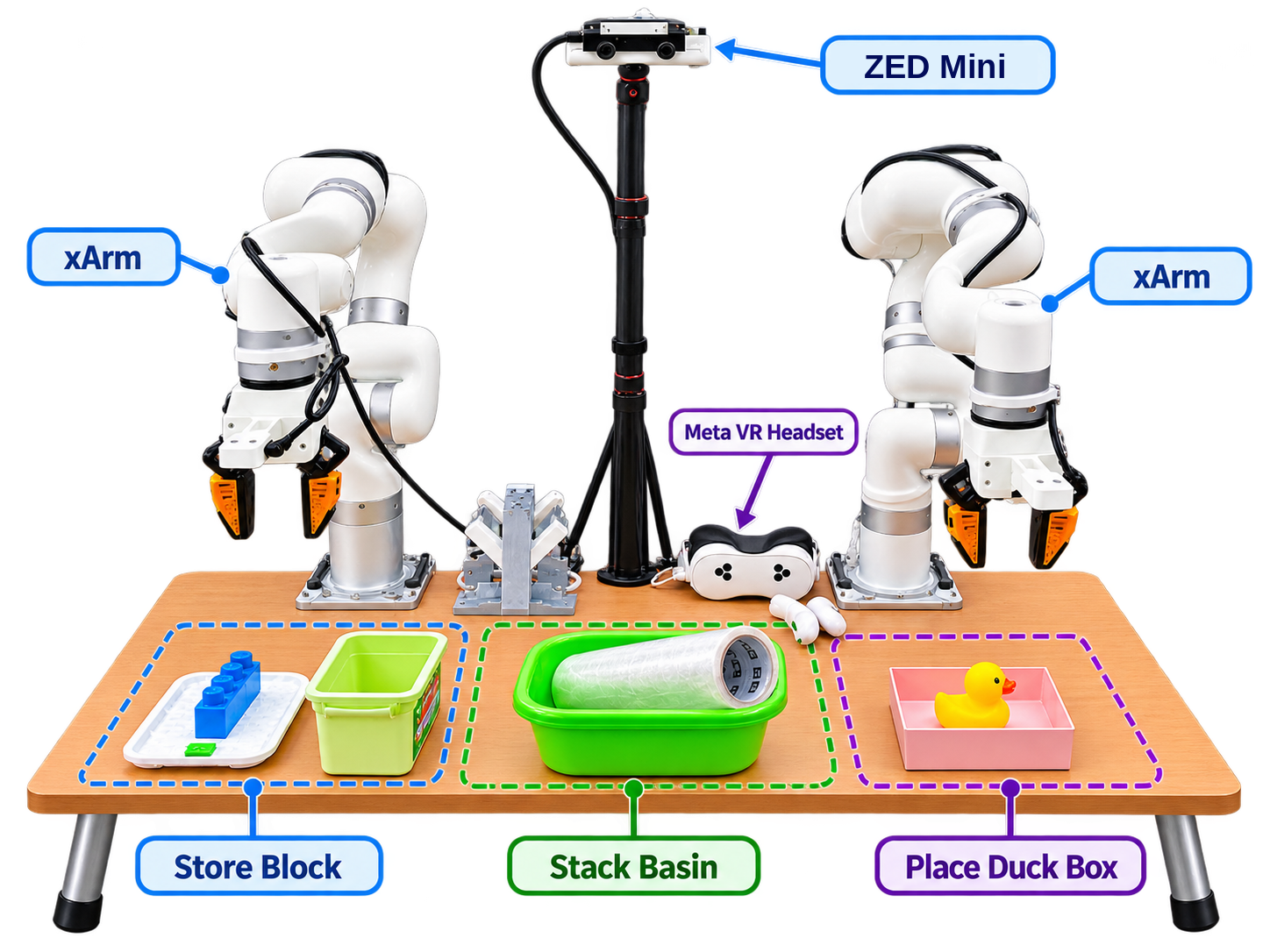
Method
We construct patch-aligned 3D point tracks as an explicit representation of future scene motion. For each visual patch, we initialize one image-space query at the patch center, yielding a fixed grid of $N$ points distributed over the input image. Each query is then lifted into 3D using the corresponding depth and camera geometry, producing a set of scene points whose motion is tracked over the future horizon.
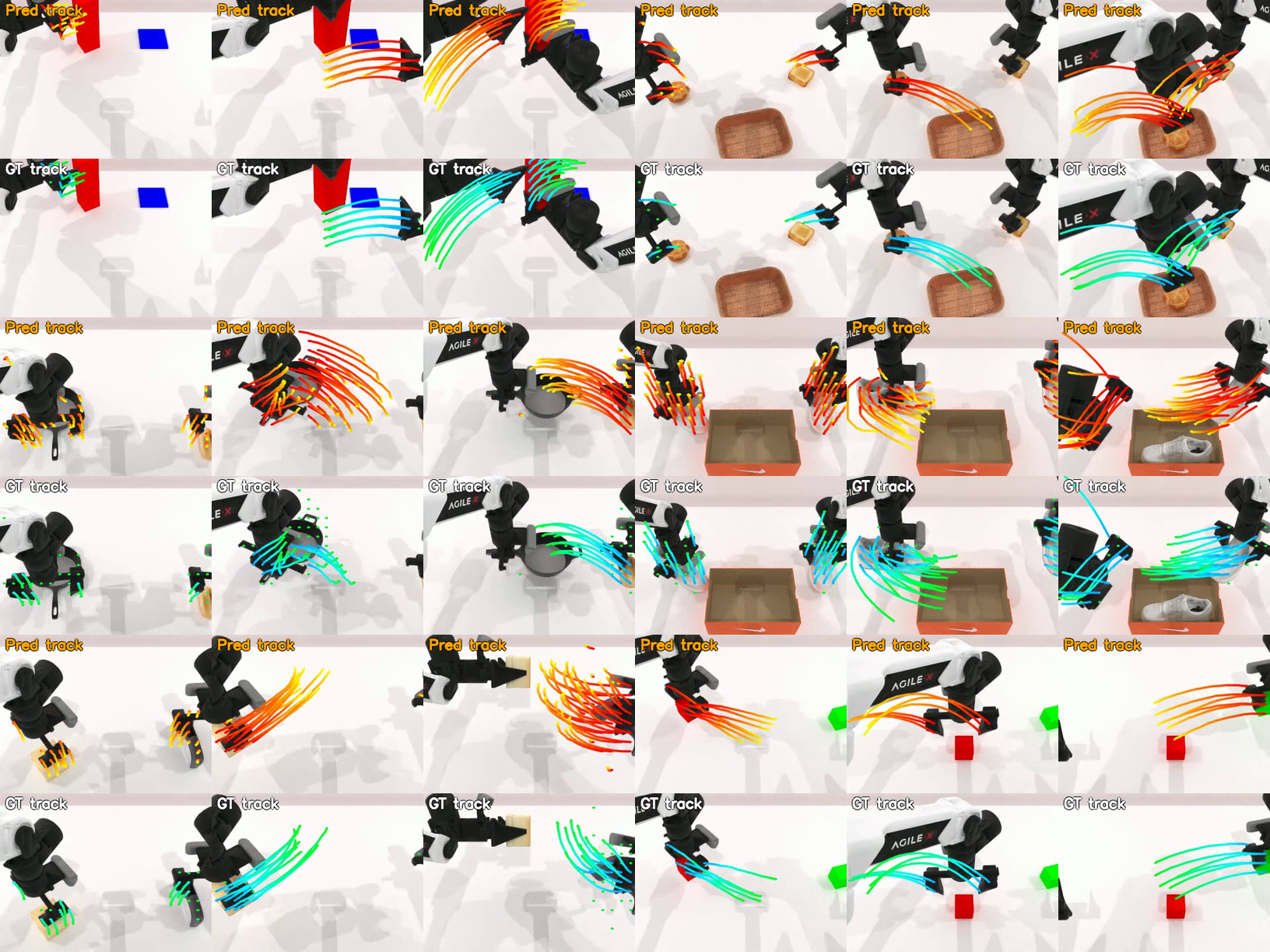
Experiments
Does predicting future 3D point tracks improve bimanual policy performance? Q2: How do joint action–motion diffusion and spatiotemporal grounding affect policy performance? Q3: Does our method generalize better to unseen backgrounds and object appearances? We evaluate on RoboTwin 2.0 [ 16 ] , following the two bimanual task categories used in prior work: 8 Sync-bimanual tasks, and 8 Seq-coordinate tasks.
Sync-bimanual tasks require simultaneous coordination, and Seq-coordinate tasks require sequential interaction between the two arms.
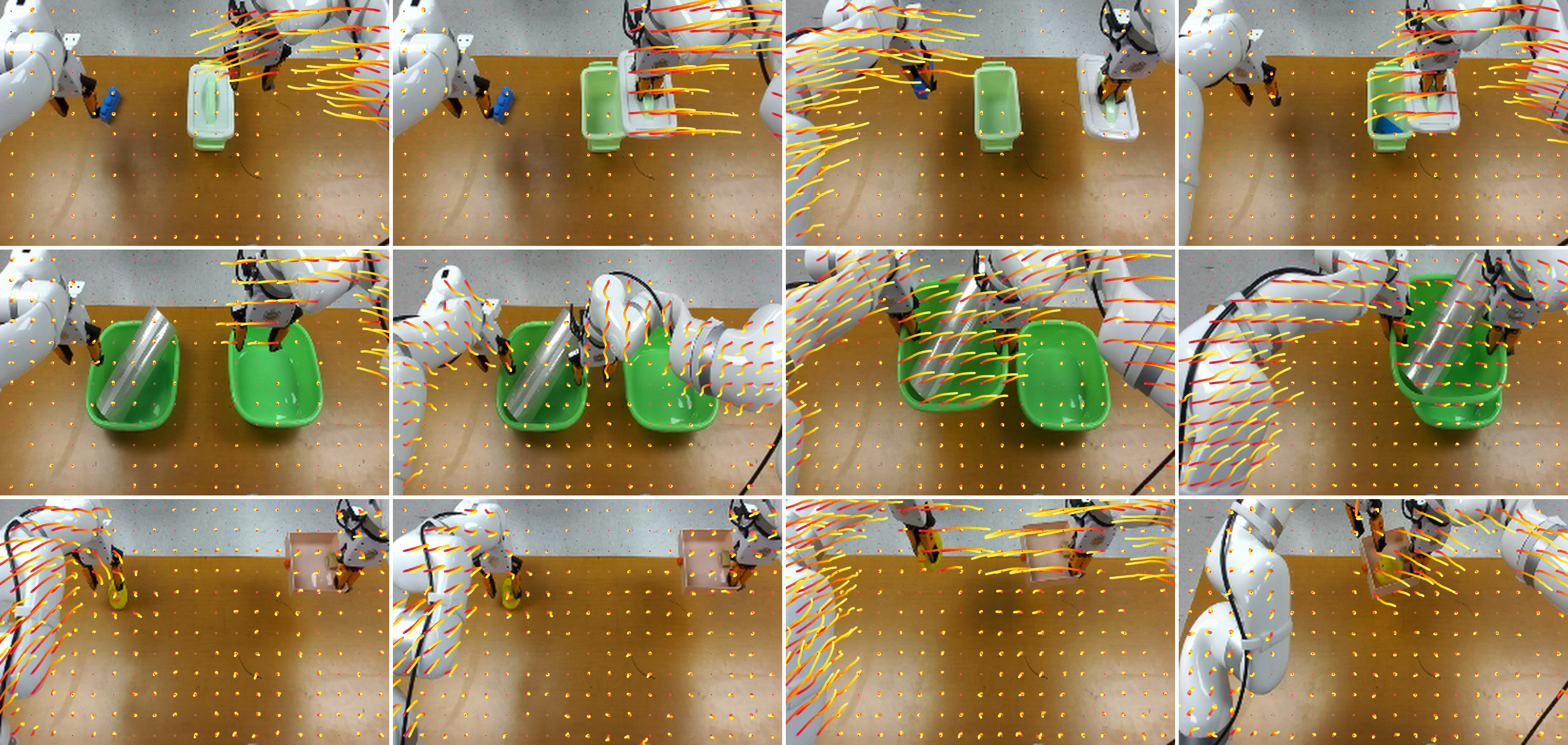
Sources and Demonstrations
Figures are reproduced from Xiao et al. See the full paper for experimental details and the project page, when the paper links one, for demonstrations and videos.
Related Papers
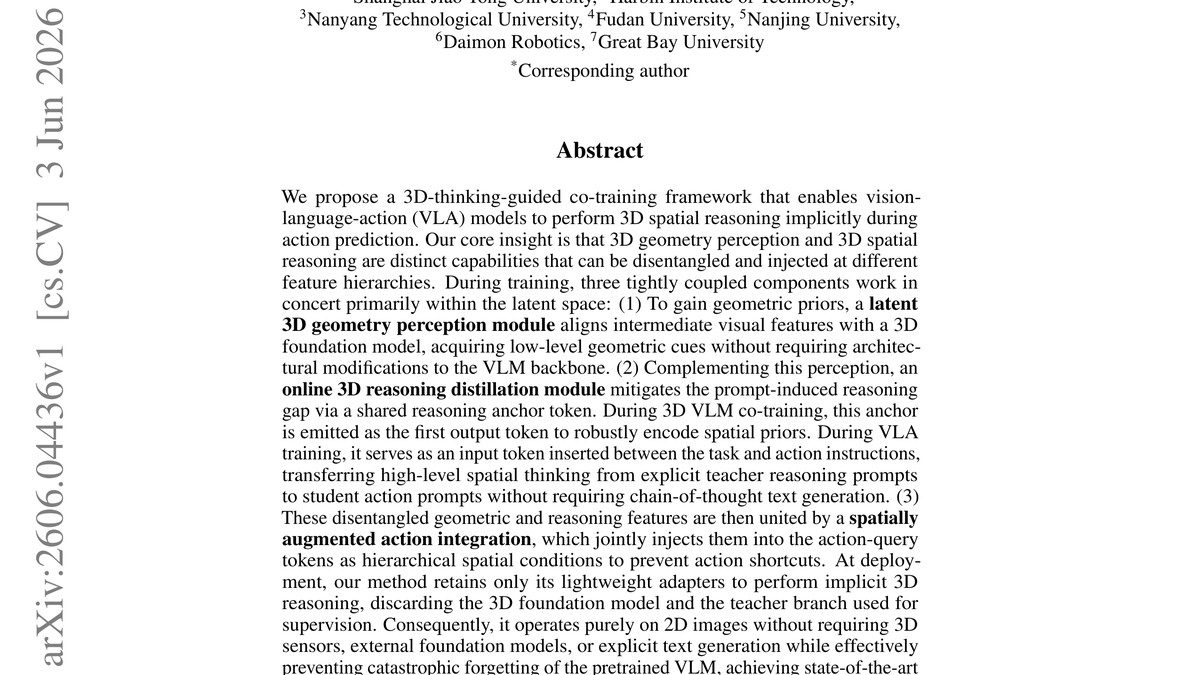
3DThinkVLA: Endowing Vision-Language-Action Models with Latent 3D Priors via 3D-Thinking-Guided Co-training
Jiaxin Shi, Xidong Zhang, Fucai Zhu et al.
We propose a 3D-thinking-guided co-training framework that enables vision-language-action (VLA) models to perform 3D spatial reasoning implicitly during action prediction.
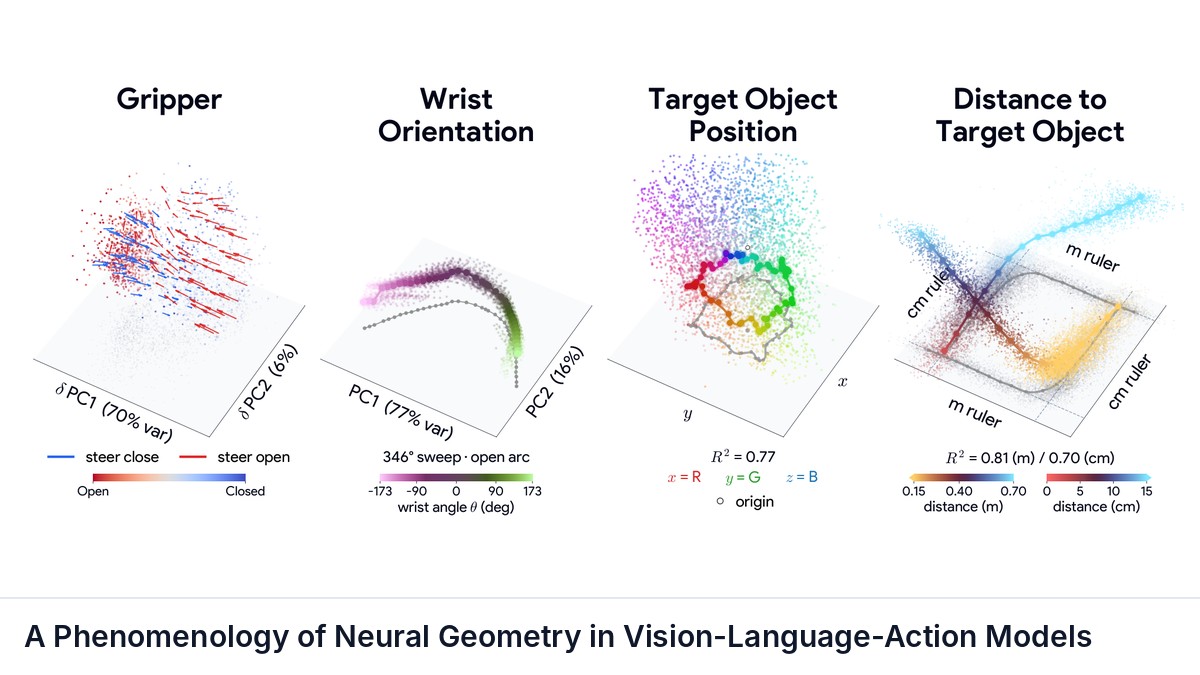
A Phenomenology of Neural Geometry in Vision-Language-Action Models
Mozes Jacobs, Aiden Swann, Mathilde Papillon et al.
Robotic manipulation is inherently geometric, but what shape does the world take inside the policy that performs it?

A Sim-to-Real Integration Pipeline for Training and Deployment of Chunk-Based VLA Manipulation Policies
Mathilde Kappel, Clémence Grislain, Mohamed Chetouani et al.
Vision-Language-Action (VLA) models have become a prominent paradigm for mapping multimodal inputs, including semantic instructions, visual observations of the scene, and proprioceptive observations, to robot actions.
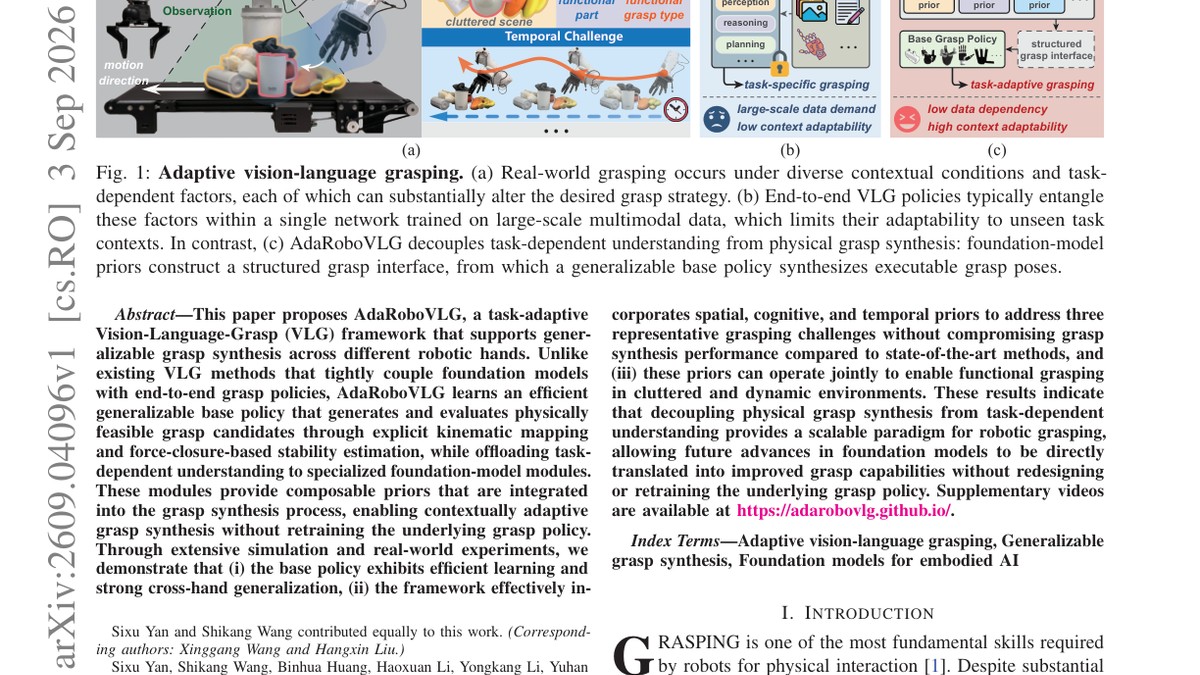
Adaptive Vision-Language Grasping via Composable Foundation Priors and Generalizable Grasp Synthesis
Sixu Yan, Shikang Wang, Binhua Huang et al.
This paper proposes AdaRoboVLG, a task-adaptive Vision-Language-Grasp (VLG) framework that supports generalizable grasp synthesis across different robotic hands.