
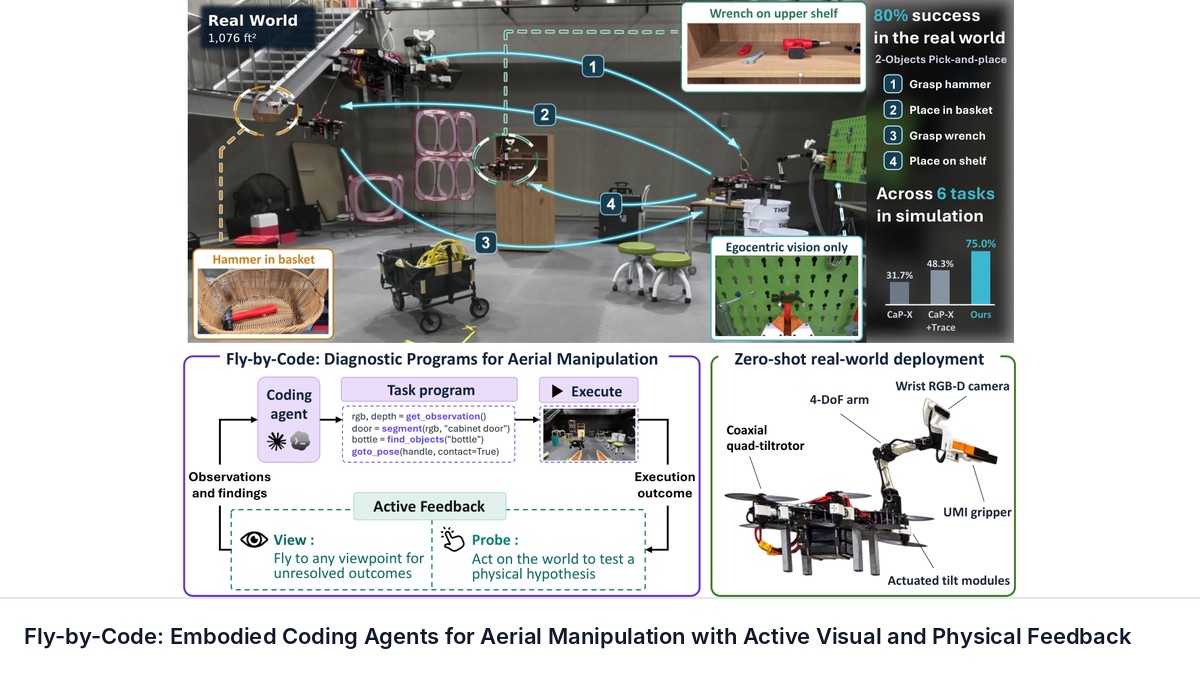
Fly-by-Code: Embodied Coding Agents for Aerial Manipulation with Active Visual and Physical Feedback
Jaewoo Lee, Jeongyeon Seo, Sihyun Cho, Gyeongrak Choe, Yutong Wang, Bavin Saravanan, Jia-Bin Huang, Furong Huang, Sebastian Scherer, Guanya Shi, H. Jin Kim, Seungjae Lee, Dongjae Lee · N/A · 2026
Framework
N/A
License
N/A
Stars
N/A
Summary
Embodied coding agents construct robot policies from natural-language instructions by generating executable programs and refining them from execution feedback.
Abstract Summary
Key Points
- Embodied coding agents construct robot policies from natural-language instructions by generating executable programs and refining them from execution feedback.
- This refinement assumes that execution feedback reveals whether the task succeeded and, after a failure, provides sufficient evidence to guide program revision.
- Aerial manipulation violates this assumption in two ways
- Payload constraints restrict onboard camera coverage and leave task-critical outcomes outside the robot's view (partial observability), while strong dynamic coupling and limited control margins make physical interactions fragile (limited interaction robustness) and leave failure causes unresolved.
- Re-examining the same feedback cannot recover observations that were never collected or separate failure causes that the available evidence does not distinguish.
Active Feedback for Program Synthesis in Aerial Manipulation
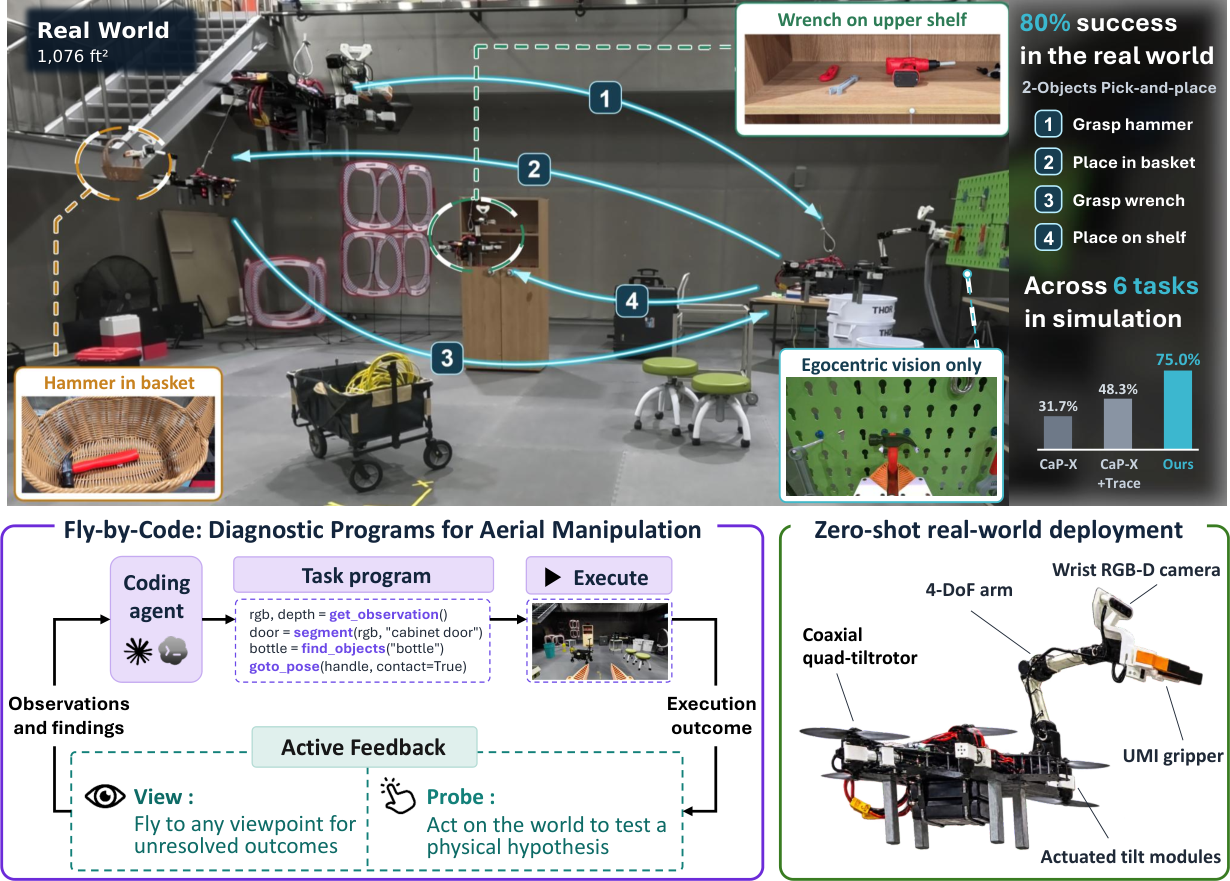
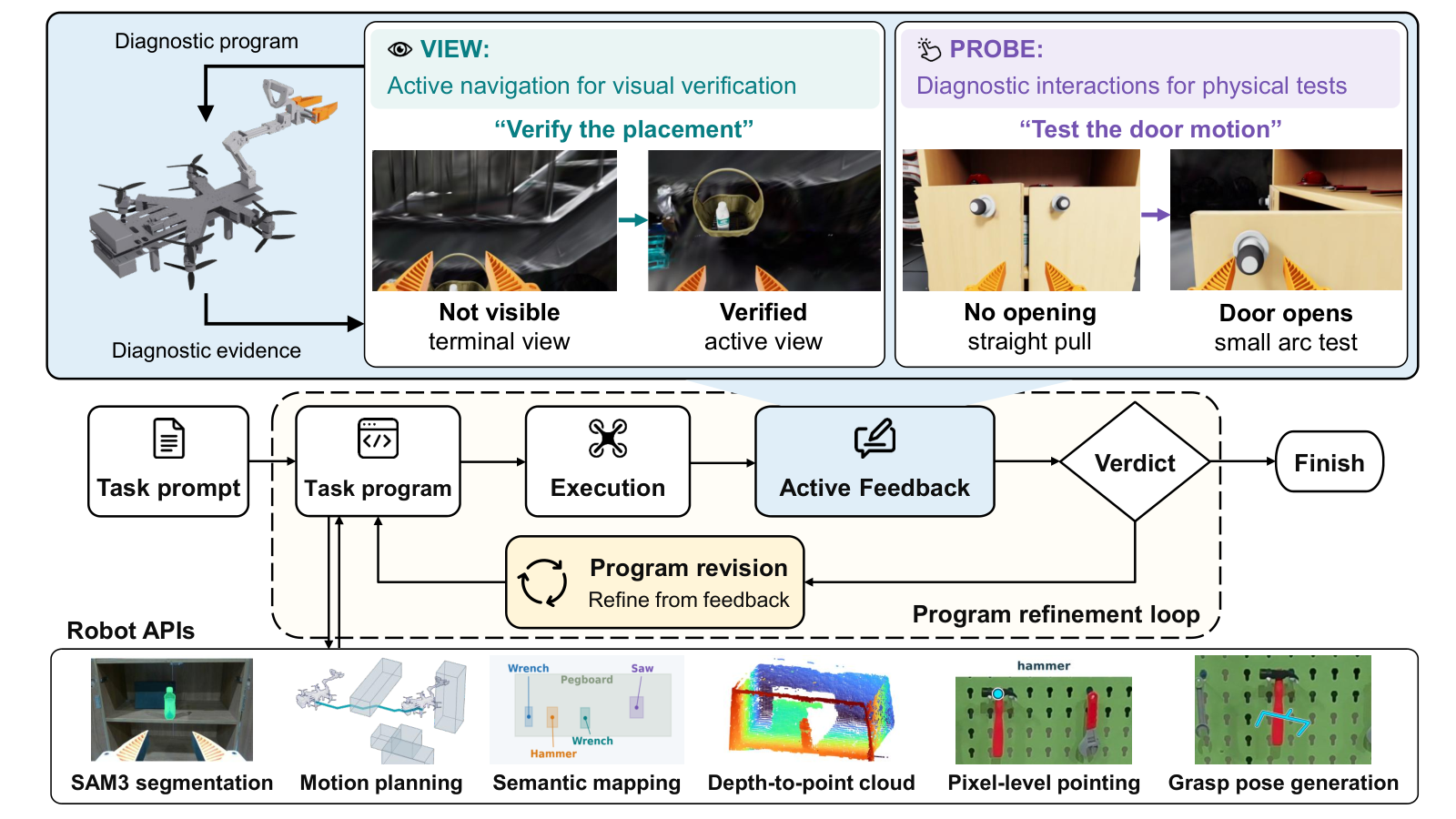
Active Feedback (AF) distinguishes Fly-by-Code from existing embodied coding agents that rely solely on passive execution feedback for completion assessment and program refinement. Such feedback is limited to evidence collected during task execution.
AF inserts an active diagnostic stage before the decision to finish or revise the task program: the agent writes a separate program that runs in simulation to acquire additional evidence for unresolved questions (Figure 2 ).
Experiments
We evaluate Active Feedback (AF) through three questions: (Q1) Does AF improve task success and completion assessment over passive execution feedback? (Q2) How does diagnostic evidence inform program refinement? (Q3) How does AF perform across models and agent interfaces? Section 4.5 then evaluates real-world deployment of the simulation-synthesized programs.
We evaluate Fly-by-Code in six tasks extending AM-Bench ( Wang et al., 2026 ) , implemented in Isaac Lab ( Mittal et al., 2025 ) .
Sources and Demonstrations
Figures are reproduced from Lee et al. See the full paper for experimental details and the project page, when the paper links one, for demonstrations and videos.
Related Papers
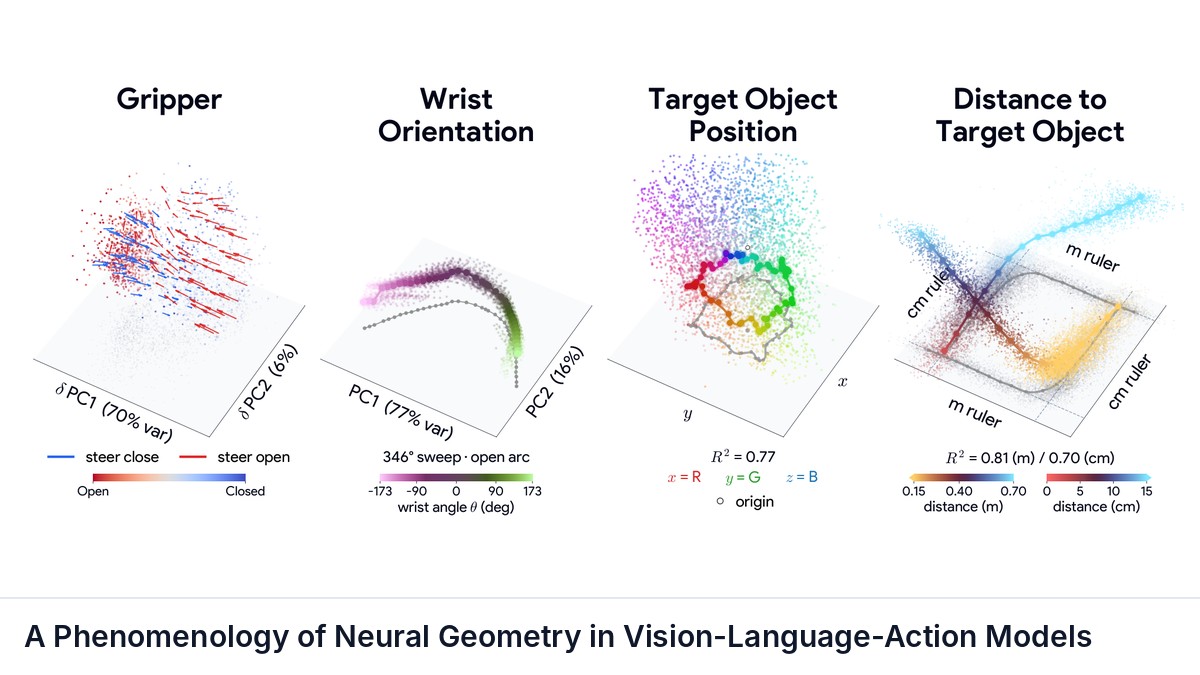
A Phenomenology of Neural Geometry in Vision-Language-Action Models
Mozes Jacobs, Aiden Swann, Mathilde Papillon et al.
Robotic manipulation is inherently geometric, but what shape does the world take inside the policy that performs it?

A Sim-to-Real Integration Pipeline for Training and Deployment of Chunk-Based VLA Manipulation Policies
Mathilde Kappel, Clémence Grislain, Mohamed Chetouani et al.
Vision-Language-Action (VLA) models have become a prominent paradigm for mapping multimodal inputs, including semantic instructions, visual observations of the scene, and proprioceptive observations, to robot actions.
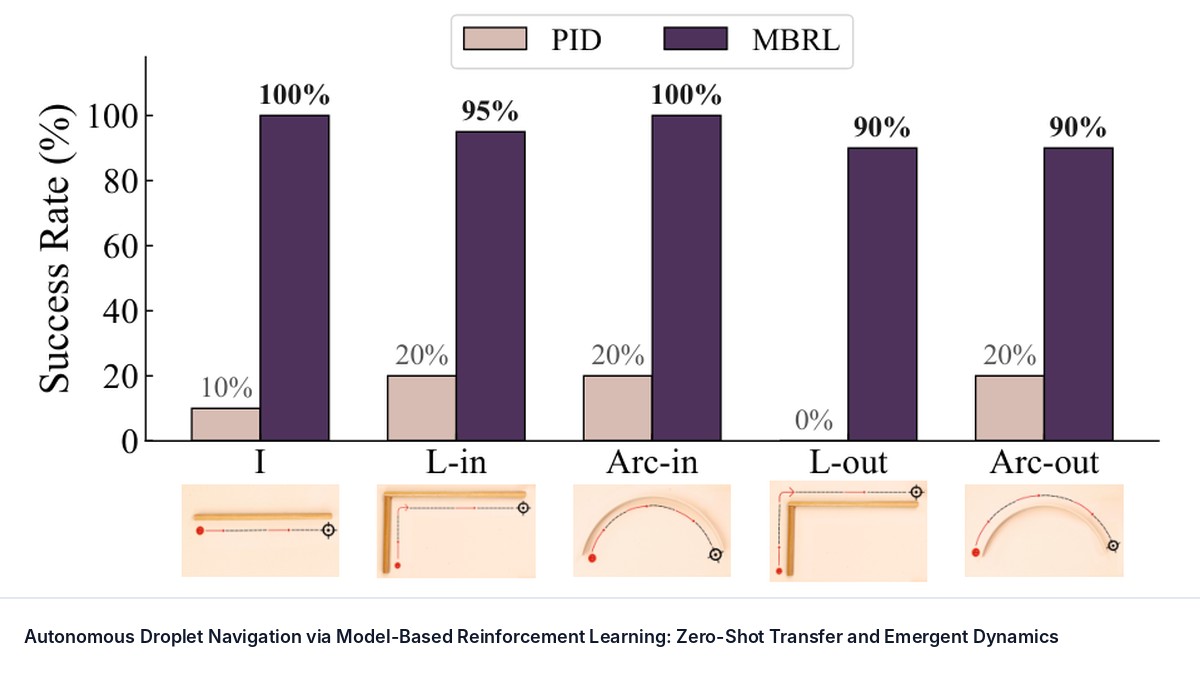
Autonomous Droplet Navigation via Model-Based Reinforcement Learning: Zero-Shot Transfer and Emergent Dynamics
Rajneesh Anand, Mayuresh V. Kothare
Self-driving laboratories (SDLs) are transforming chemical and materials discovery through closed-loop automation, yet automated infrastructure for physical manipulation of soft, deformable matter remains beyond current robotic platforms.
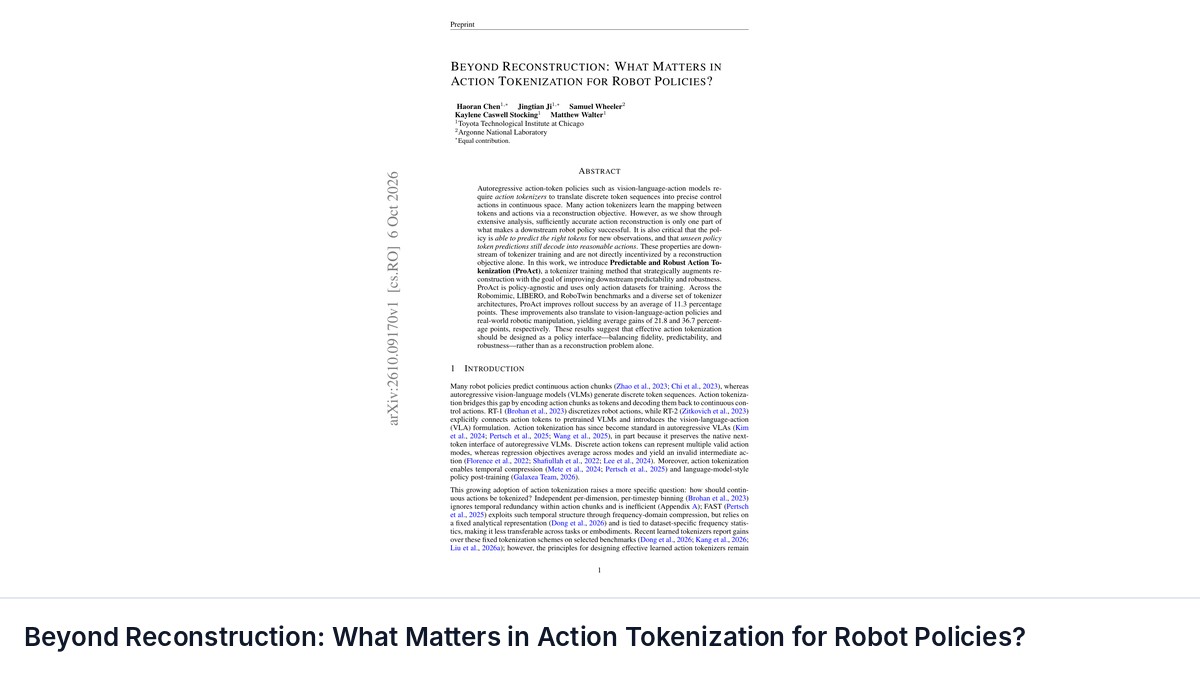
Beyond Reconstruction: What Matters in Action Tokenization for Robot Policies?
Haoran Chen, Jingtian Ji, Samuel Wheeler et al.
Autoregressive action-token policies such as vision-language-action models require action tokenizers to translate discrete token sequences into precise control actions in continuous space. Many action tokenizers learn the mapping between tokens and actions via a reconstruction objective.