
OJOx: Specification-Conditioned Demonstrations for Embodied AI in Construction
Mohamed Dawod · N/A · 2026
Framework
N/A
License
N/A
Stars
N/A
Summary
Large-scale egocentric and whole-body human demonstrations are becoming a primary source of data for embodied intelligence. They record what people perceive and do, but rarely the external specification that gave an action its purpose.
Abstract Summary
Key Points
- Large-scale egocentric and whole-body human demonstrations are becoming a primary source of data for embodied intelligence.
- They record what people perceive and do, but rarely the external specification that gave an action its purpose.
- In construction that omission is consequential: skilled work is directed at project-specific configurations defined in a design model - configurations not yet present in the environment being observed.
- A mason's transferable competence is not the geometry of one wall but the ability to realise a new geometry from a specification.
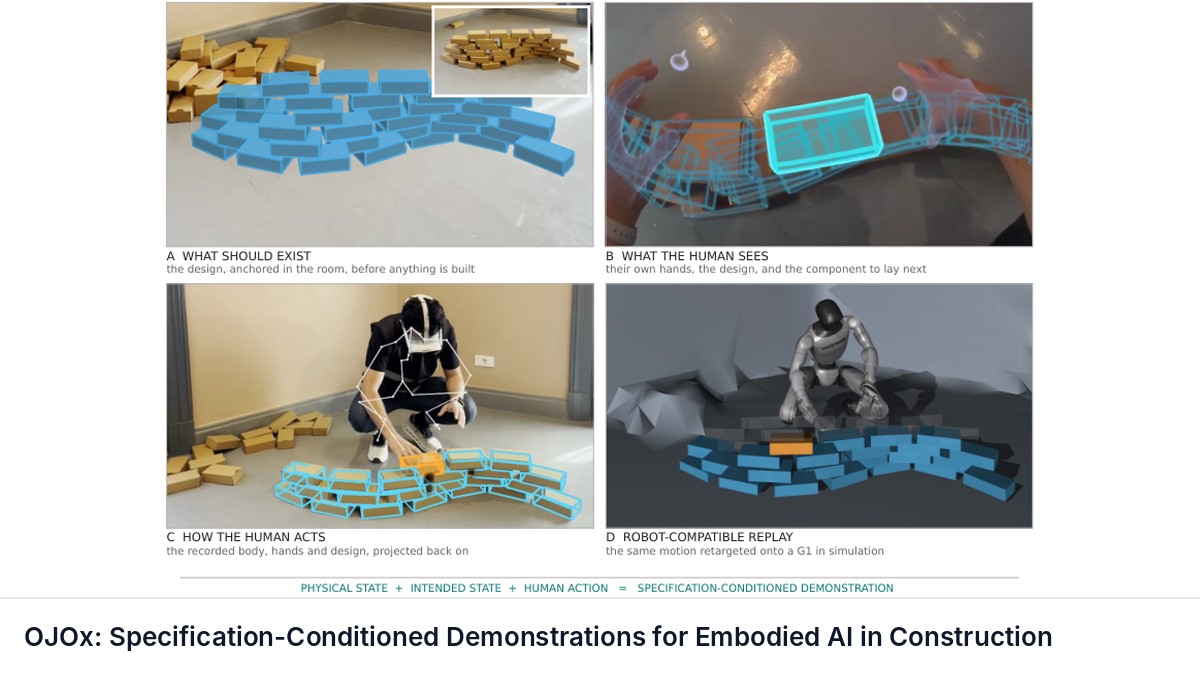
- We introduce the specification-conditioned demonstration: a synchronised record of the physical state a demonstrator perceives, the intended state supplied to them by an external design, and the behaviour connecting the two.
OJOx: Specification-Conditioned Capture
Augmented reality is the mechanism here, not the contribution. What the system produces is a data interface (Fig. 2 ): a way of getting an externally specified intended state into a demonstration at the moment the demonstration happens.
The specification is design geometry — in construction practice originating in BIM/CAD tooling — packaged with its task data and published to cloud storage, from which the headset retrieves it over HTTP and caches it on the device.
The Specification-Conditioned Demonstration
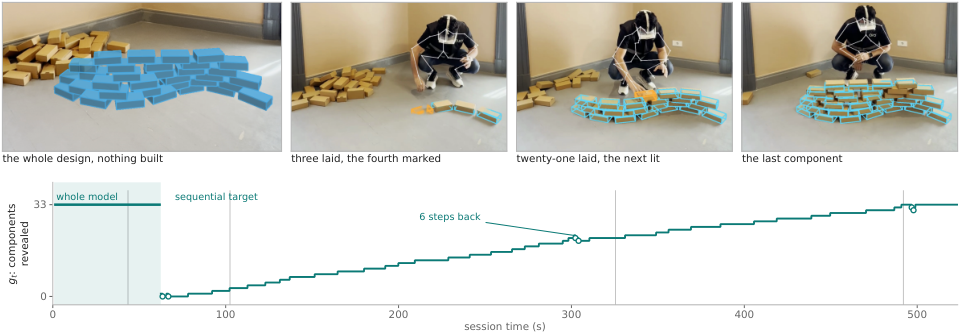
Write one session as with $o_{t}$ the observation of the physical state, $g_{t}$ the externally supplied intended state, and $h_{t}$ the demonstrator’s whole-body and hand configuration. In OJOx, $o_{t}$ and the visual form of $g_{t}$ arrive fused: the specification is composited into the same pixels the demonstrator perceives.
The symbolic record provides $g_{t}$ a second time, as component identity, 6-DoF pose, and current assembly-sequence state on the shared session clock.
System Validation
Whole-body Hands Egocentric video ● yes ◐ partial ○ no n/a not applicable. Rows group representative systems. Several columns lie outside a given system’s purpose rather than marking a deficiency, and where no goal representation is recorded at all the four goal columns are negative by entailment.
Toward Specification-Conditioned Embodied AI
A conventional imitation dataset supports one mapping, $o_{t}\rightarrow a_{t}$: act from what you see. A specification-conditioned demonstration makes a different one learnable in principle, which reads: given what exists and a statement of what should exist, how should I act? The shift it describes is from imitate this action to realise this specification .
None of what follows is demonstrated here; it is the programme the interface exists to enable.
Sources and Demonstrations
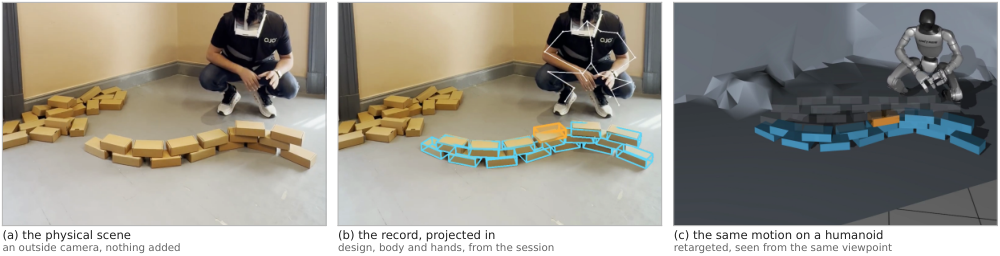
Figures are reproduced from Dawod See the full paper for experimental details and the project page, when the paper links one, for demonstrations and videos.
Related Papers
A Low-Cost, Open Platform for End-to-End Autonomous Driving on a Miniature Ackermann Vehicle
Gustavo Claudio Karl Couto, Eric Aislan Antonelo, Gabriel George Zipperer
This paper presents a low-cost, open experimental platform for research in end-to-end autonomous driving with miniature Ackermann vehicles.

A Sim-to-Real Integration Pipeline for Training and Deployment of Chunk-Based VLA Manipulation Policies
Mathilde Kappel, Clémence Grislain, Mohamed Chetouani et al.
Vision-Language-Action (VLA) models have become a prominent paradigm for mapping multimodal inputs, including semantic instructions, visual observations of the scene, and proprioceptive observations, to robot actions.
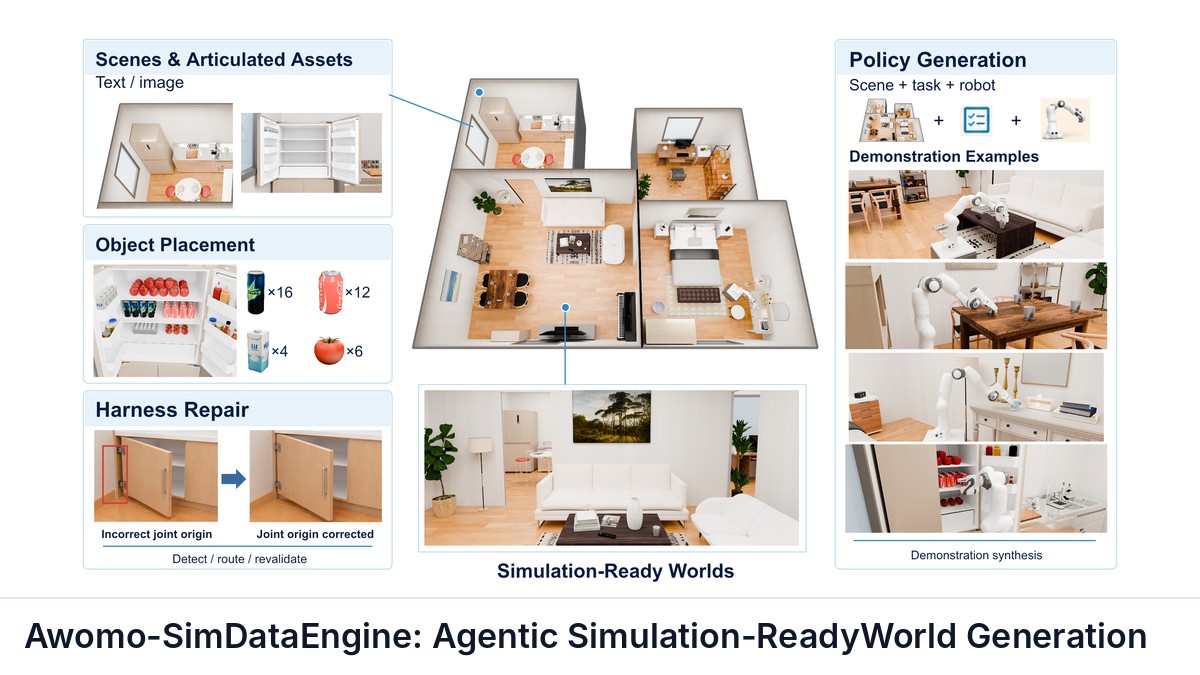
Awomo-SimDataEngine: Agentic Simulation-ReadyWorld Generation
PhysicalRSI Team, Danjiao Ma, Enhui Ma et al.
Generating useful robot-training data requires more than visually plausiblescenes: objects must support interaction, placements must remain physicallyvalid, and tasks must admit repeatable execution.

AXIS: A Growable Community-Driven Data Engine for Scalable Robot Manipulation
Mengfei Zhao, Dihong Huang, Yikai Tang et al.
Learning effective robot manipulation policies requires diverse, high-quality demonstrations, yet existing data pipelines are often difficult to scale because they rely on specialized hardware, centralized operators, or fixed task suites.