
At a glance
- Problem: errors compound across long assembly sequences. Source
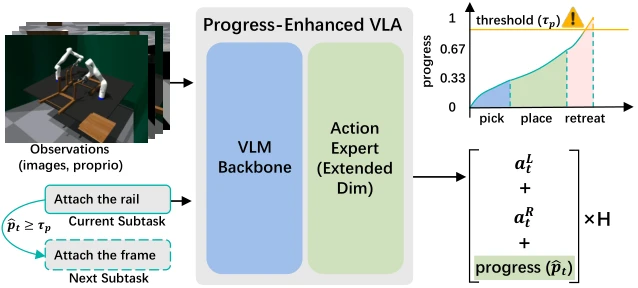
- Idea: predict continuous progress alongside actions and transition after retreat. Source
- Evidence: simulation on three furniture types and physical IVAR chair trials. Source
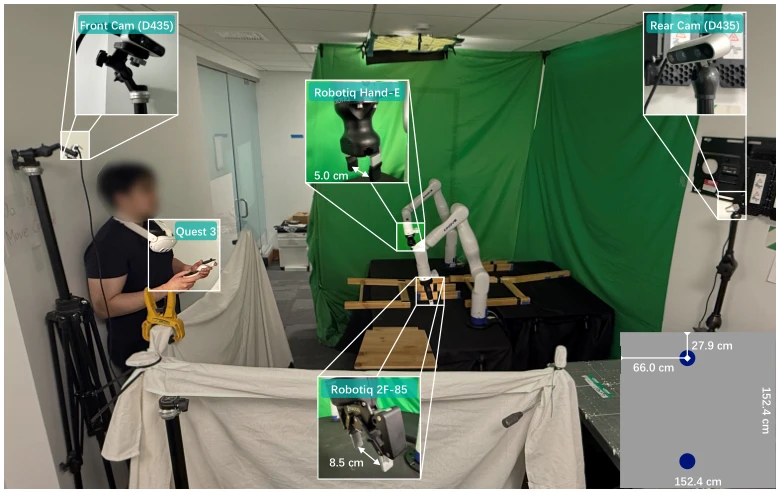
Evaluation scope The physical IVAR evaluation uses 100 demonstrations and 15 rollouts, with magnets installed in screw holes. Source
How it works
- Decompose assembly into semantic subtasks and assign continuous progress from action primitives. Source
- Filter predicted progress before switching subtasks; clear action buffers when a transition is confirmed. Source
Evidence & results
- Average full-assembly success in simulation is 80%, versus 48% for monolithic fine-tuning of the same backbone. Evidence
- Real IVAR full-assembly success is 40%. Independent per-part success is a different measure and must not substitute for complete assembly. Evidence

Limitations & boundaries
Takeaway
Explicit progress and carefully chosen transition boundaries help long-horizon control, but complete real-world assembly remains difficult. Source
Resources
Figures: the paper's authors. Editorial source and image review: 2026-10-21. Findings are author-reported, not independently reproduced by Robotics Research Hub.
Original abstract
Current work on robot furniture assembly mostly focuses on toy-scale settings or single-arm manipulation. We introduce FurnitureVLA, the first systematic study of real-scale bimanual furniture assembly using Vision-Language-Action models (VLAs). We formalize the task, develop a scalable simulation pipeline for expert data generation and evaluation, and build a VR teleoperation system for single-operator bimanual control to collect high-quality real-world demonstrations. To address extreme long-horizon assembly with up to 7 subtasks and 1550 control steps, we propose a progress-enhanced VLA, finetuned on semantically grounded subtasks, that jointly predicts actions and a continuous progress signal, enabling automatic subtask transitions and reducing compounding errors during inference. We further study perception and control design factors that critically affect precision in real-scale assembly. FurnitureVLA improves average simulation success from 48% to 80% compared to baselines across three furniture types, with an additional 21% gain from our design factor study. We validate on a real Kinova Gen3 platform with only 16% drop on the hardest task.