
SAKI: Skill Assembly and Kinematic Imitation from Human Videos for Long-Horizon Mobile Manipulation
Yijie Lu, James Zhao, Weiming Zhi · N/A · 2026
Framework
N/A
License
N/A
Stars
N/A
Summary
Learning from human videos offers a promising route to acquiring diverse manipulation skills. Extending this capability beyond tabletop settings to long-horizon mobile manipulation requires adapting and composing demonstrated interactions across changing scenes and robot configurations.
Abstract Summary
Key Points
- Learning from human videos offers a promising route to acquiring diverse manipulation skills
- Extending this capability beyond tabletop settings to long-horizon mobile manipulation requires adapting and composing demonstrated interactions across changing scenes and robot configurations.
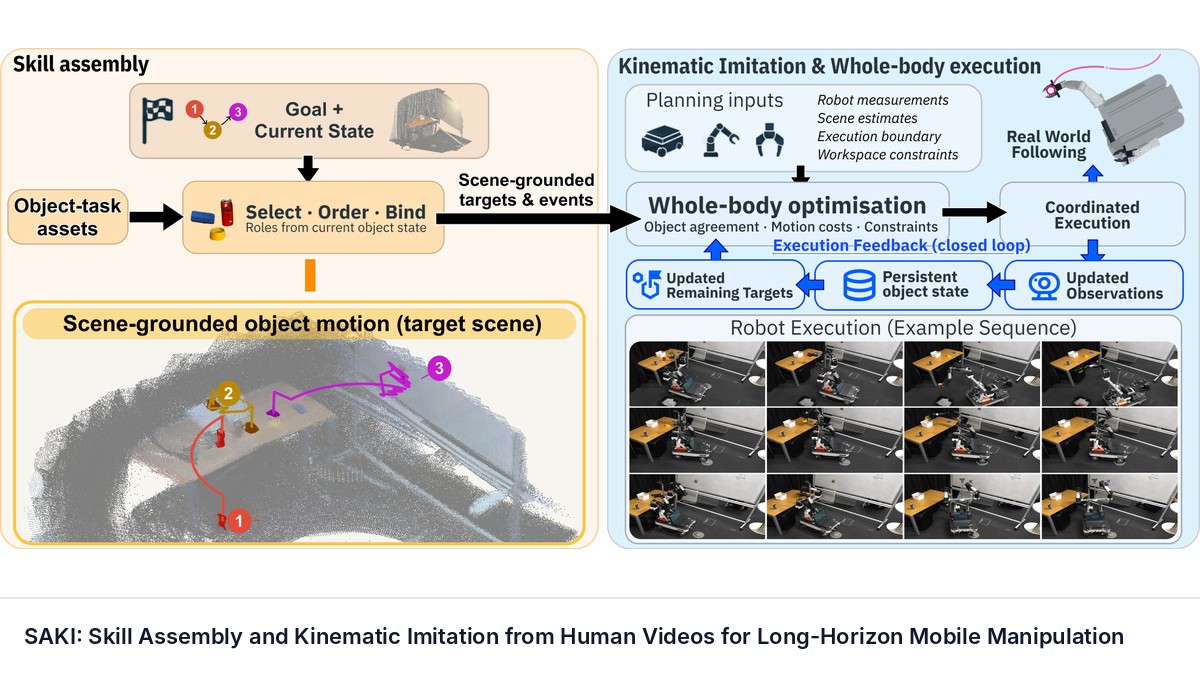
- We present Skill Assembly and Kinematic Imitation (SAKI), a framework connecting human-video skill acquisition, cross-demonstration assembly and closed-loop whole-body execution.
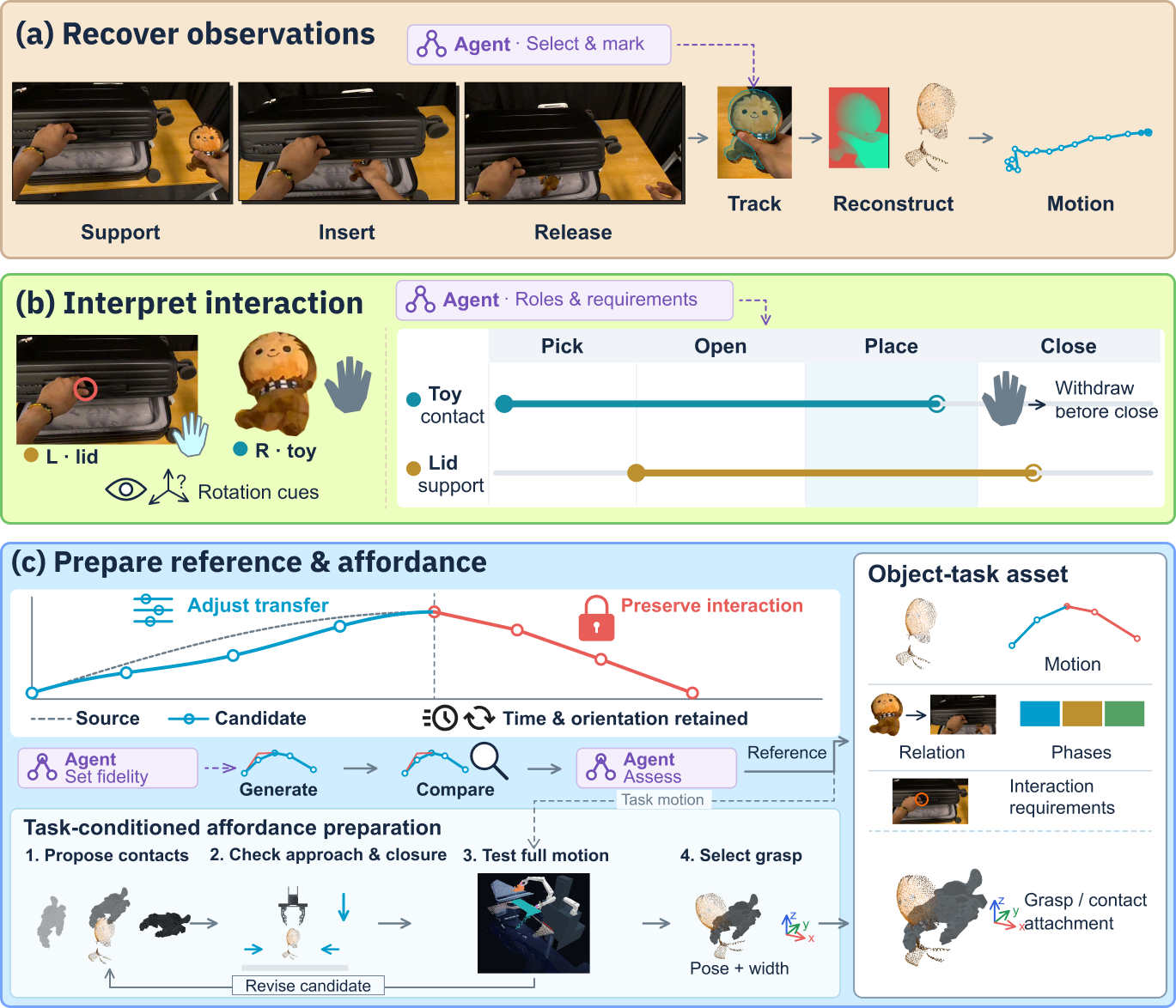
- SAKI prepares reusable object-centric skills that preserve task-critical interactions while allowing transfer paths to adapt.
- Given a goal and supplied task dependencies, it selects and orders skills, binds their object roles to the current scene, and carries scene estimates and robot configuration between successive skills.
Method
SAKI prepares reusable skills from human demonstrations, binds them to objects in the execution scene, and generates whole-body motion (Fig. 2 ). During execution, visual updates revise the remaining motion, and the preceding terminal configuration initialises each successor skill. State used for motion generation. SAKI maintains scene estimates, measured robot state and execution context.
Experiments
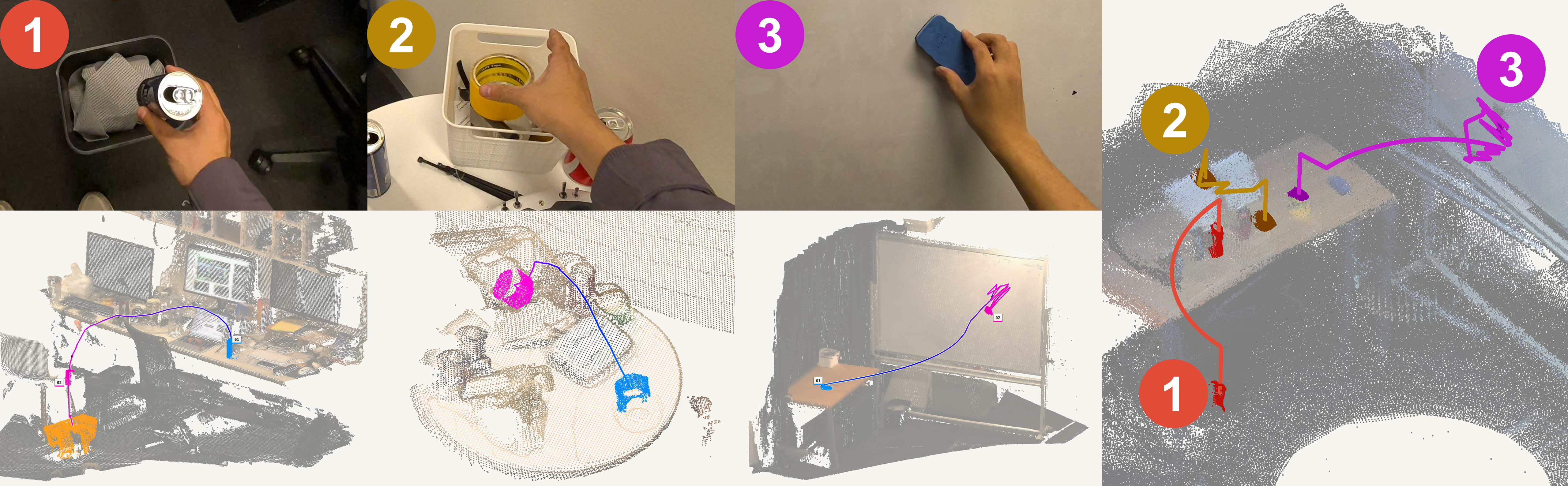
The evaluation examines how the SAKI framework reuses interaction specifications: continuous tasks test their composition, reference ablation tests the benefit of preparation, and changed-layout trials test reuse with frozen skills. A recorded visual update follows the runtime connection from object estimates to activated motion.
Local manipulation comparisons evaluate reference-generation pipelines under shared downstream conditions. Platform and tasks. We use a Ranger Mini V3 with two Nero arms.
Sources and Demonstrations
Figures are reproduced from Lu et al. See the full paper for experimental details and the project page, when the paper links one, for demonstrations and videos.
Related Papers

A Sim-to-Real Integration Pipeline for Training and Deployment of Chunk-Based VLA Manipulation Policies
Mathilde Kappel, Clémence Grislain, Mohamed Chetouani et al.
Vision-Language-Action (VLA) models have become a prominent paradigm for mapping multimodal inputs, including semantic instructions, visual observations of the scene, and proprioceptive observations, to robot actions.

AXIS: A Growable Community-Driven Data Engine for Scalable Robot Manipulation
Mengfei Zhao, Dihong Huang, Yikai Tang et al.
Learning effective robot manipulation policies requires diverse, high-quality demonstrations, yet existing data pipelines are often difficult to scale because they rely on specialized hardware, centralized operators, or fixed task suites.

Capability-Aware Arbitration for Semantic Intent-Based Shared Control
Zhaoda Du, Michael Bowman, Xiaoli Zhang
Shared control often allocates robot authority based on confidence in inferred human intent, assuming reliable autonomous execution. When this assumption fails, high intent confidence can cause over-helping.
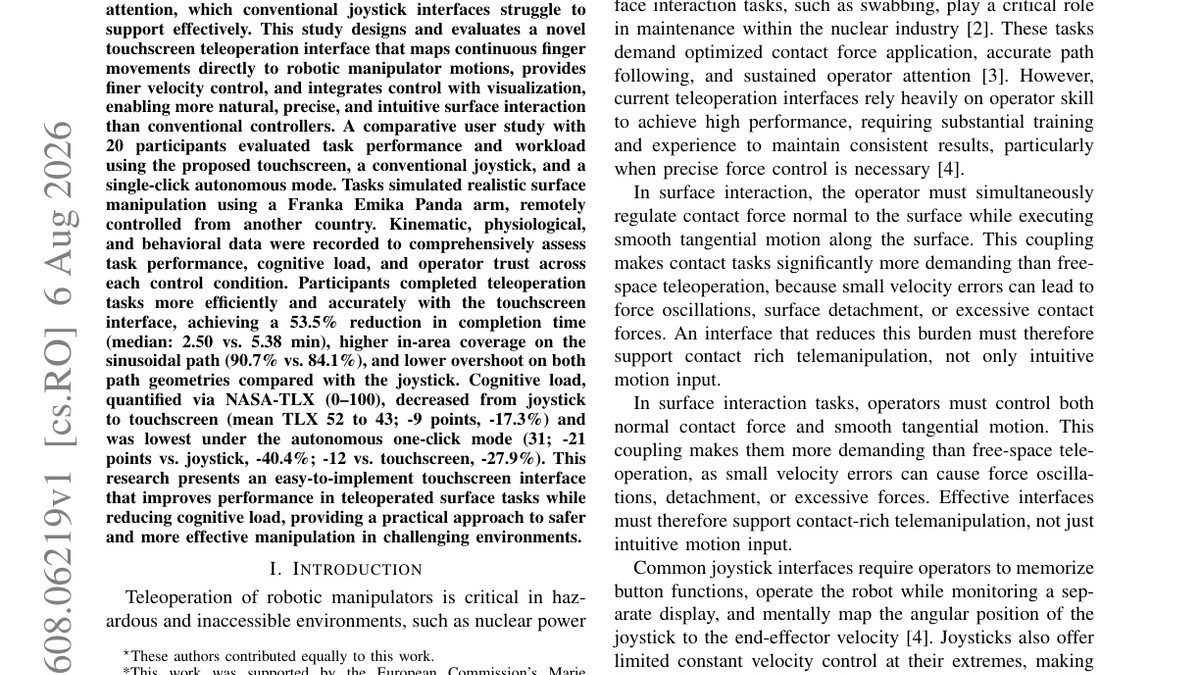
Design and Evaluation of a Touchscreen-Based Teleoperation Interface for Robotic Manipulators
Juan José García Cárdenas, Alperen Kenan, Hamidreza Raei et al.
Intuitive teleoperation interfaces are crucial for the safe and effective operation of robotic manipulators in challenging environments.