
Robust Multi-Agent Pursuit with Preemptive Communication via Reachability-Based Control Barrier Functions
Madison Book, Justin Bradley · N/A · 2026
Framework
N/A
License
N/A
Stars
N/A
Summary
Safe multi-agent coordination typically assumes what real-world, deployed, resource-constrained robots cannot provide: continuous, perfect state sharing. Robust control strategies must be complemented with robust communication strategies to deliver resilient deployments.
Abstract Summary
Key Points
- Safe multi-agent coordination typically assumes what real-world, deployed, resource-constrained robots cannot provide: continuous, perfect state sharing.
- Robust control strategies must be complemented with robust communication strategies to deliver resilient deployments.
- In this work, we propose a unified control/communication strategy that provides safe control to guarantee inter-agent safety under intermittent communication and demonstrate its effectiveness in a pursuit-evasion scenario.
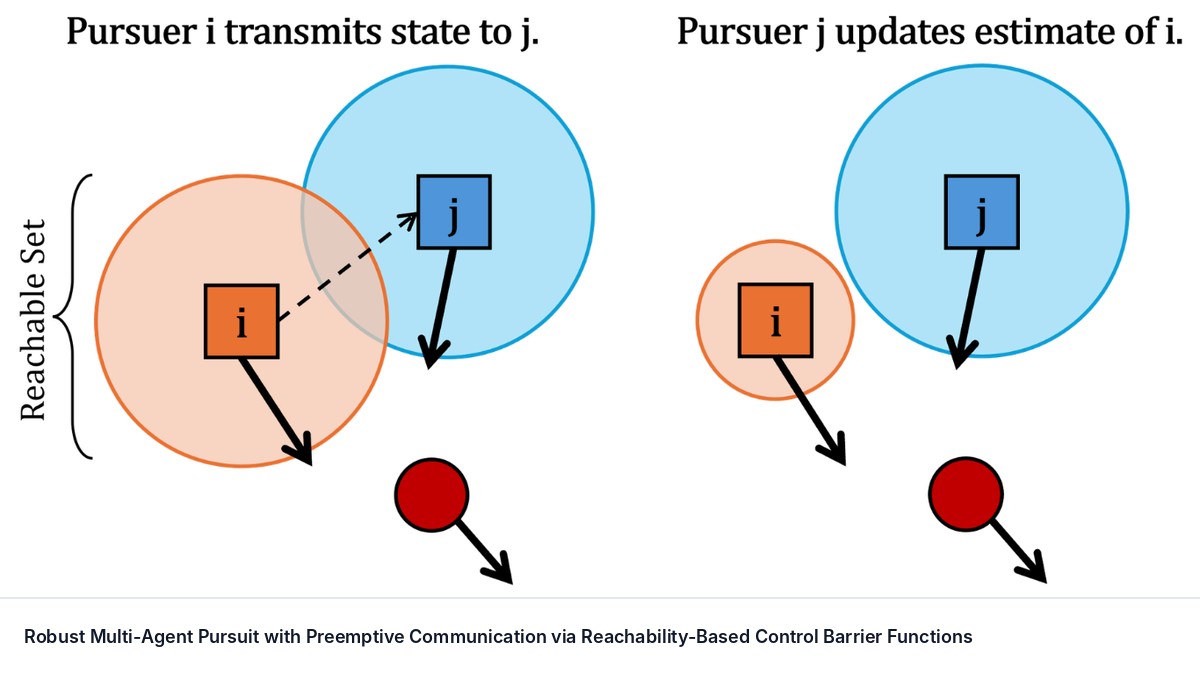
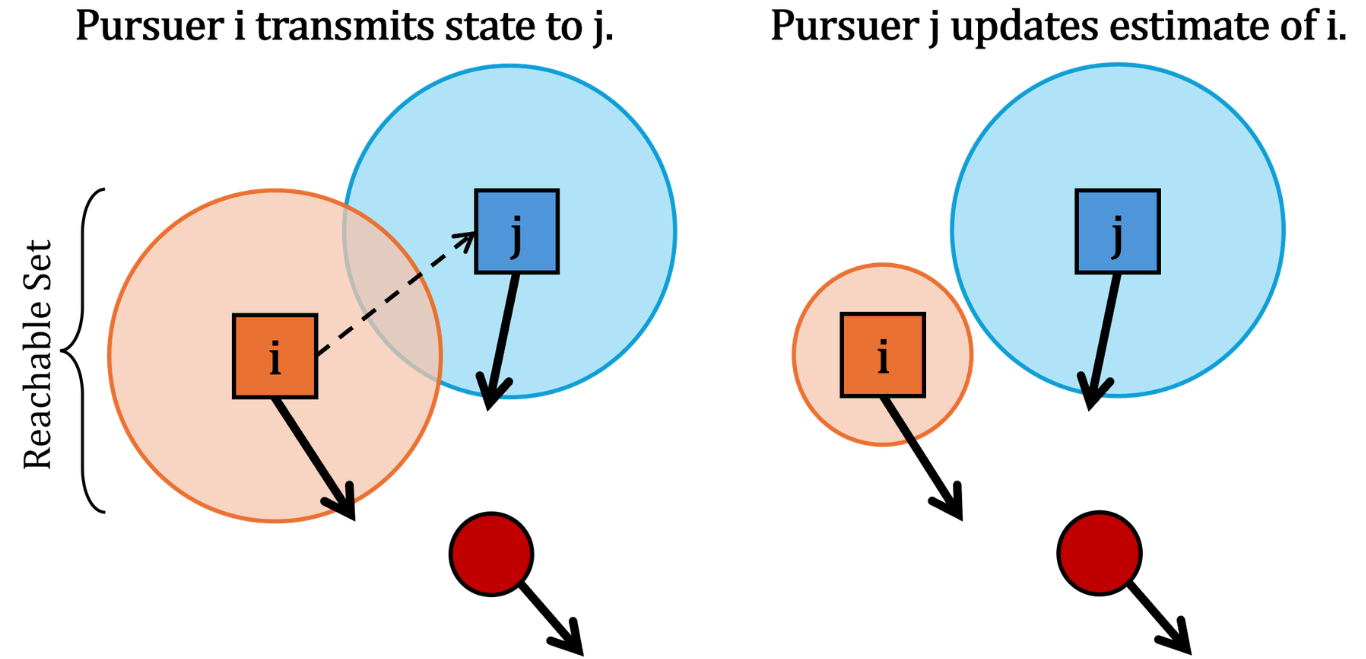
- Each agent computes the reachable set of neighboring agents based on the last state information received, then solves for a safe control input based on control barrier functions to ensure agents avoid collision.
- We prove that inter-agent collision avoidance is guaranteed provided communication staleness remains bounded.
PROBLEM FORMULATION
We consider a system of $n_{p}$ pursuers and $n_{e}$ evaders operating in $\mathbb{R}^{3}$. Pursuers and evaders are indexed by $\mathrm{P}=\{1,\ldots,n_{p}\}$ and $\mathrm{E}=\{1,\ldots,n_{e}\}$ respectively. Each agent’s state and dynamics are known and given by where $p,v,u\in\mathbb{R}^{3}$ denote position, velocity and control input, respectively.
We denote pursuer $i$’s state as $x_{i}$ and pursuer $i$’s assigned evader’s state as $x_{e_{i}}$.
REACHABILITY-BASED CONTROL BARRIER FUNCTIONS
Since pursuer $i$ does not have continuous access to neighbor $j$’s state information, pursuer $i$ over-approximates the set of states that $j$ may occupy based on the last transmitted state $\xi_{ji}$. As $\tau_{ji}$ increases, the true position of $j$ may deviate according to unknown and bounded control inputs.
PREEMPTIVE COMMUNICATION
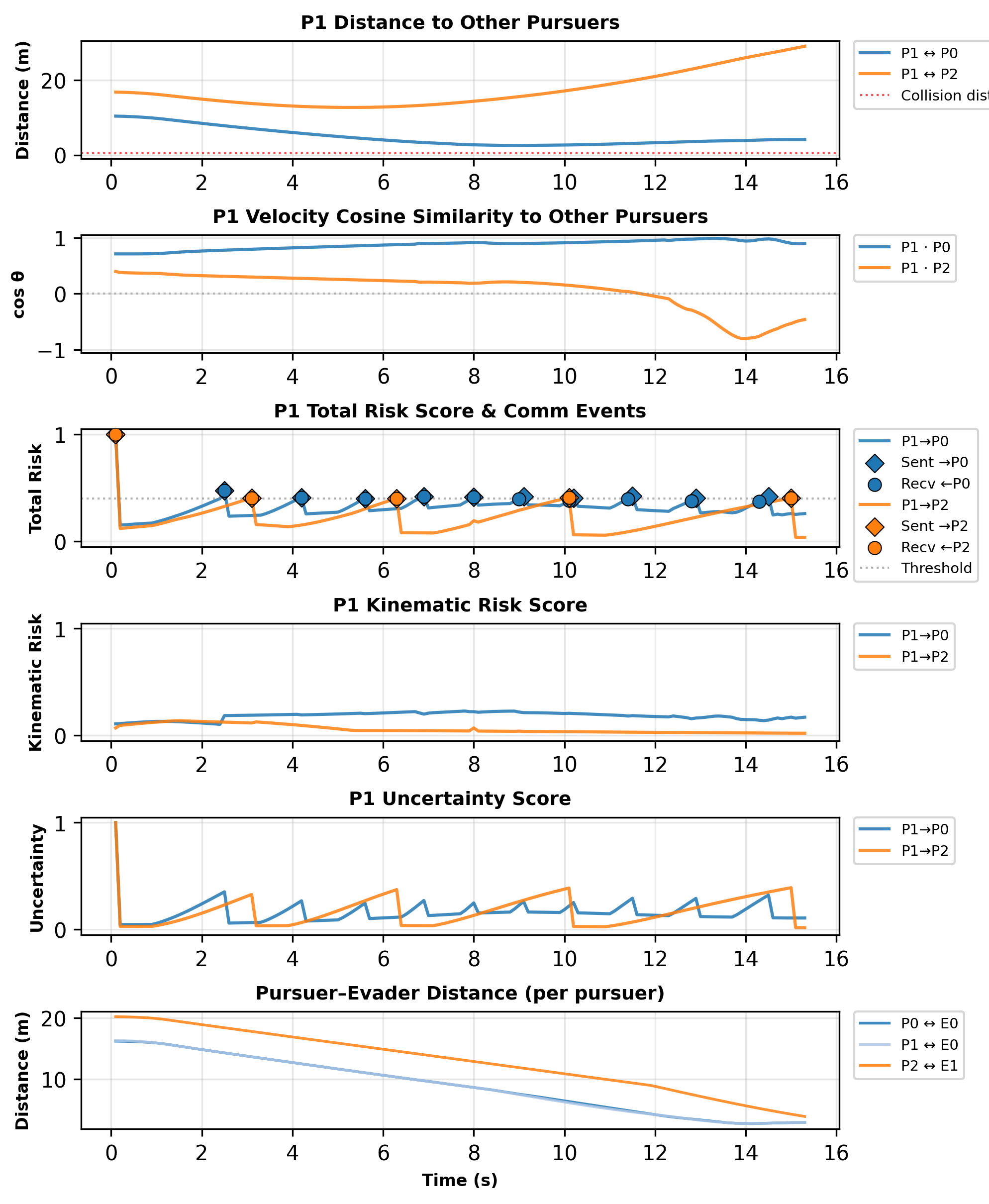
Theorem 1 guarantees safety provided $\omega_{ij}(x_{i},t_{k})\geq 0$ can be enforced at each time step, keeping the QP ( 17 ) feasible. QP feasibility is threatened as $\tau_{ij}$ grows (i.e., the reachable set inflates, reducing control authority). The objective of the proposed communication strategy is to preemptively transmit state information to preserve QP feasibility while minimizing unnecessary communication.
Results
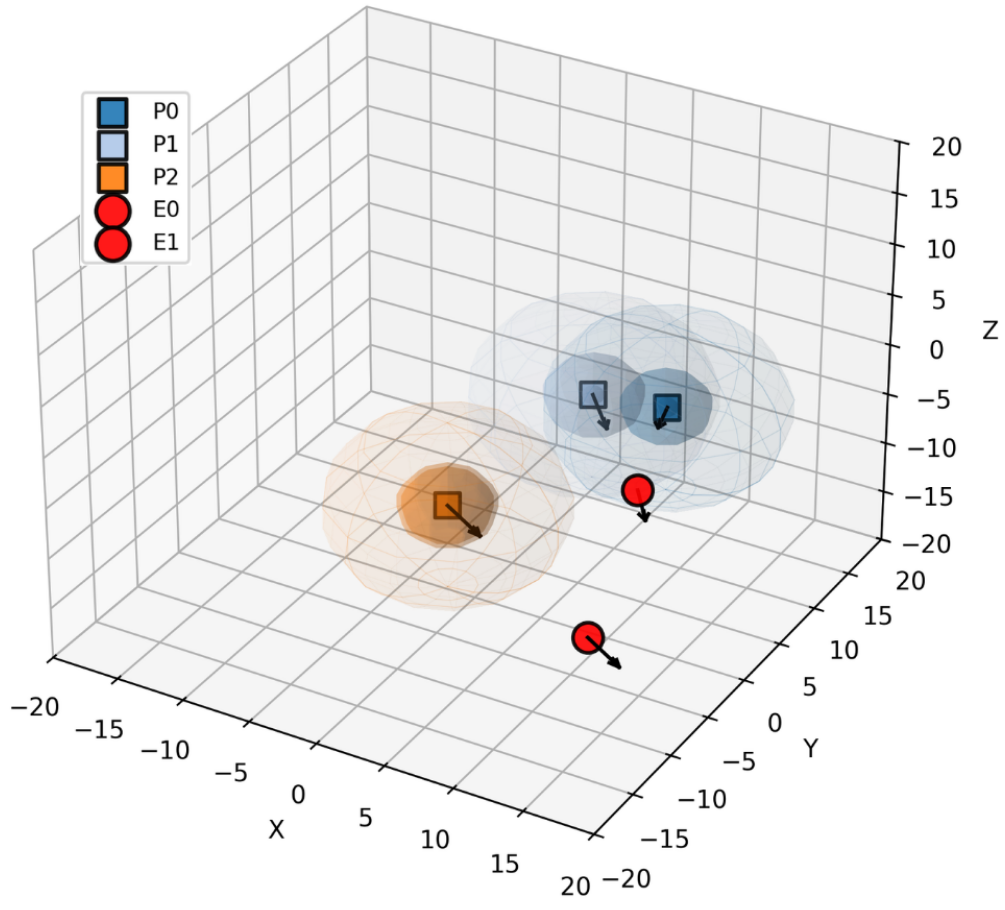
In this section, we evaluate our proposed framework in a decentralized pursuit-evasion setting with multiple pursuers and evaders. We present the effectiveness of the preemptive communication strategy against baseline communication models. The simulation consists of multiple cooperative pursuers attempting to capture multiple adversarial evaders.
Pursuers follow the dynamics outlined in ( 1 ) and use the safe controller outlined in Section III-B to enforce inter-agent collision avoidance.
Sources and Demonstrations
Figures are reproduced from Book et al. See the full paper for experimental details and the project page, when the paper links one, for demonstrations and videos.
Related Papers
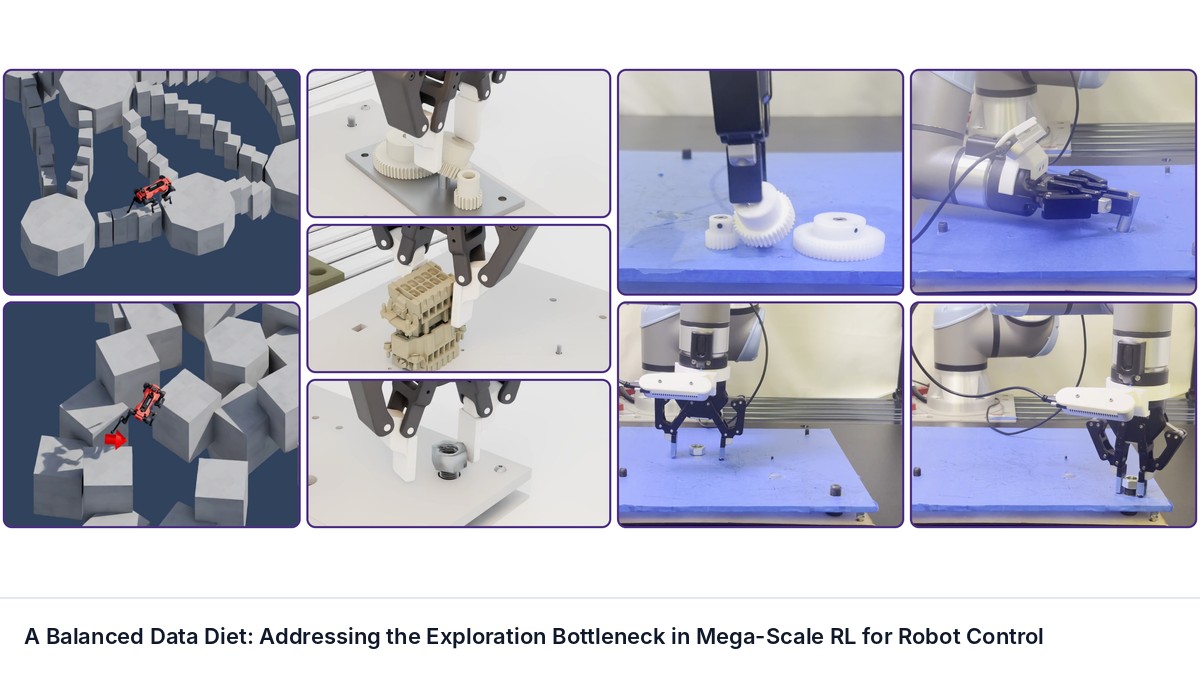
A Balanced Data Diet: Addressing the Exploration Bottleneck in Mega-Scale RL for Robot Control
Octi Zhang, Mateo Guaman Castro, Patrick Yin et al.
General-purpose robots must perform a wide range of tasks from agile locomotion to dexterous manipulation.
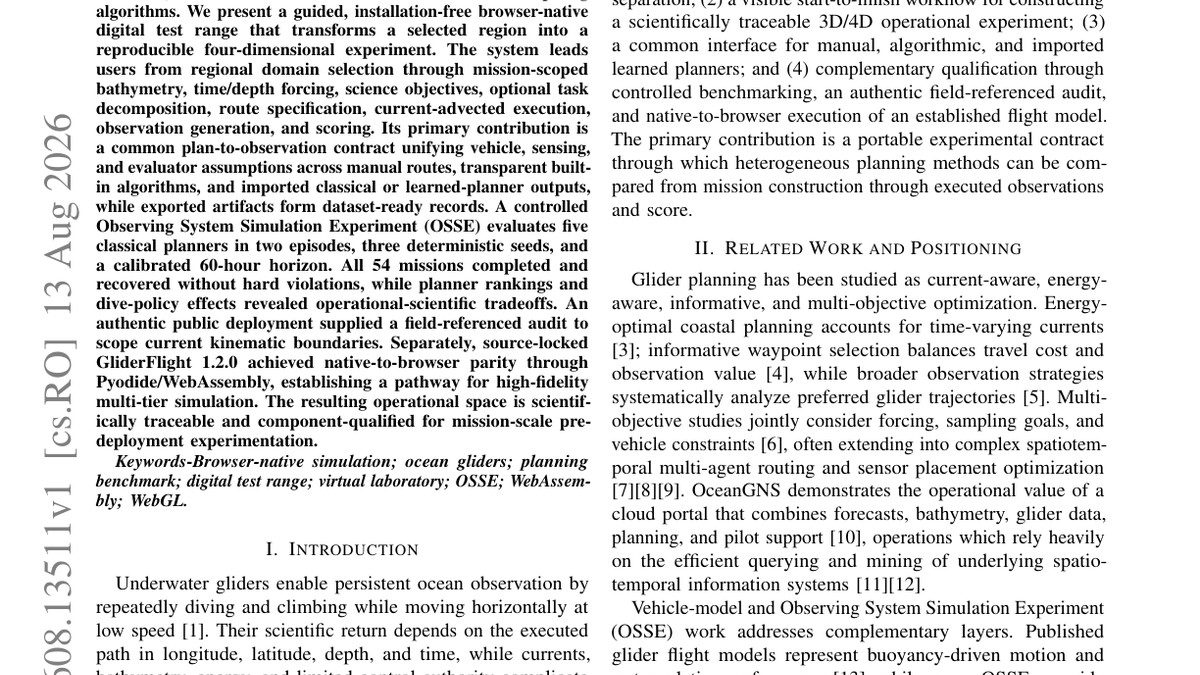
A Browser-Native Digital Test Range for Benchmarking 4D Ocean-Glider Planning Algorithms
Edward Holmberg, Elias Ioup, Mahdi Abdelguerfi
Repeated in-situ evaluation of ocean-glider planners requires scarce vehicles, operators, deployment and recovery resources, and ocean conditions that cannot be reset for competing algorithms.
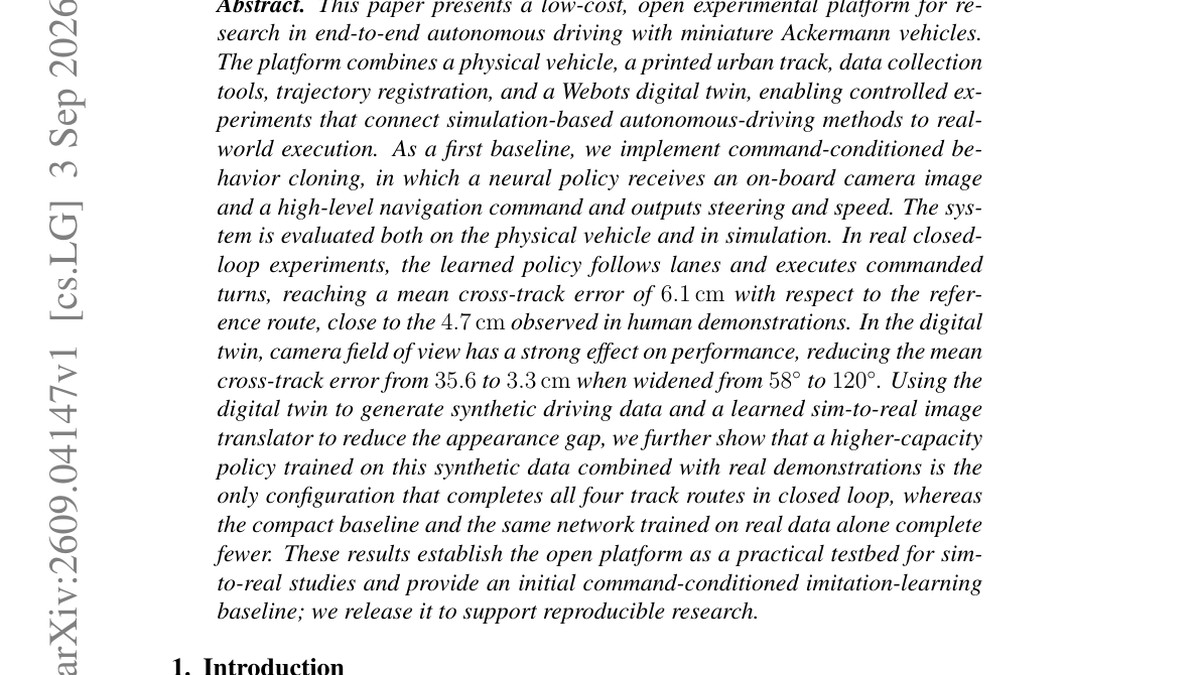
A Low-Cost, Open Platform for End-to-End Autonomous Driving on a Miniature Ackermann Vehicle
Gustavo Claudio Karl Couto, Eric Aislan Antonelo, Gabriel George Zipperer
This paper presents a low-cost, open experimental platform for research in end-to-end autonomous driving with miniature Ackermann vehicles.
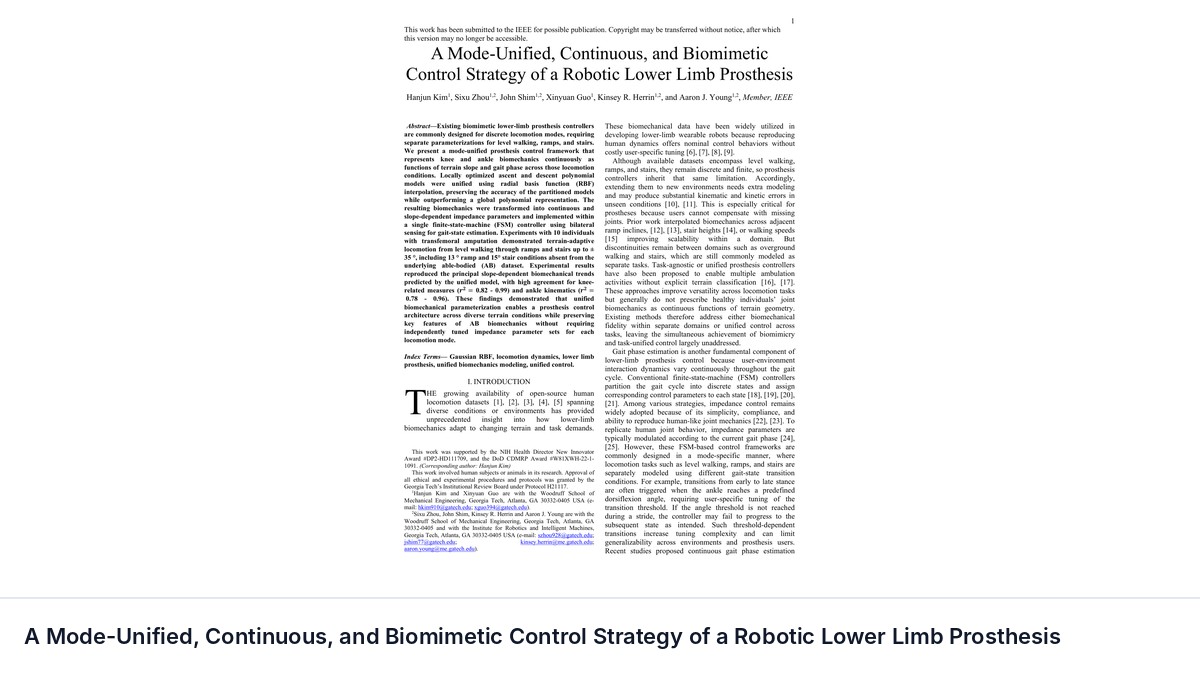
A Mode-Unified, Continuous, and Biomimetic Control Strategy of a Robotic Lower Limb Prosthesis
Hanjun Kim, Sixu Zhou, John Shim et al.
Existing biomimetic lower-limb prosthesis controllers are commonly designed for discrete locomotion modes, requiring separate parameterizations for level walking, ramps, and stairs.